2001 Dodge Ram 1500 Towing Capacity Chart: Expert Data-Driven Guide

If you have ever stared at your trailer hitch and wondered exactly how much weight your truck can safely handle, you aren’t alone. The 2001 Dodge Ram 1500 is a legendary workhorse, but its towing capabilities vary significantly based on engine size, transmission, cab configuration, and rear axle gear ratios. Relying on guesswork can lead to dangerous road conditions, transmission overheating, or permanent frame damage. This guide provides the essential 2001 Dodge Ram 1500 towing capacity chart details to ensure you remain within safe operating limits while hauling your equipment, camper, or utility trailer across the country.


Understanding Variables in the 2001 Dodge Ram 1500 Towing Capacity Chart
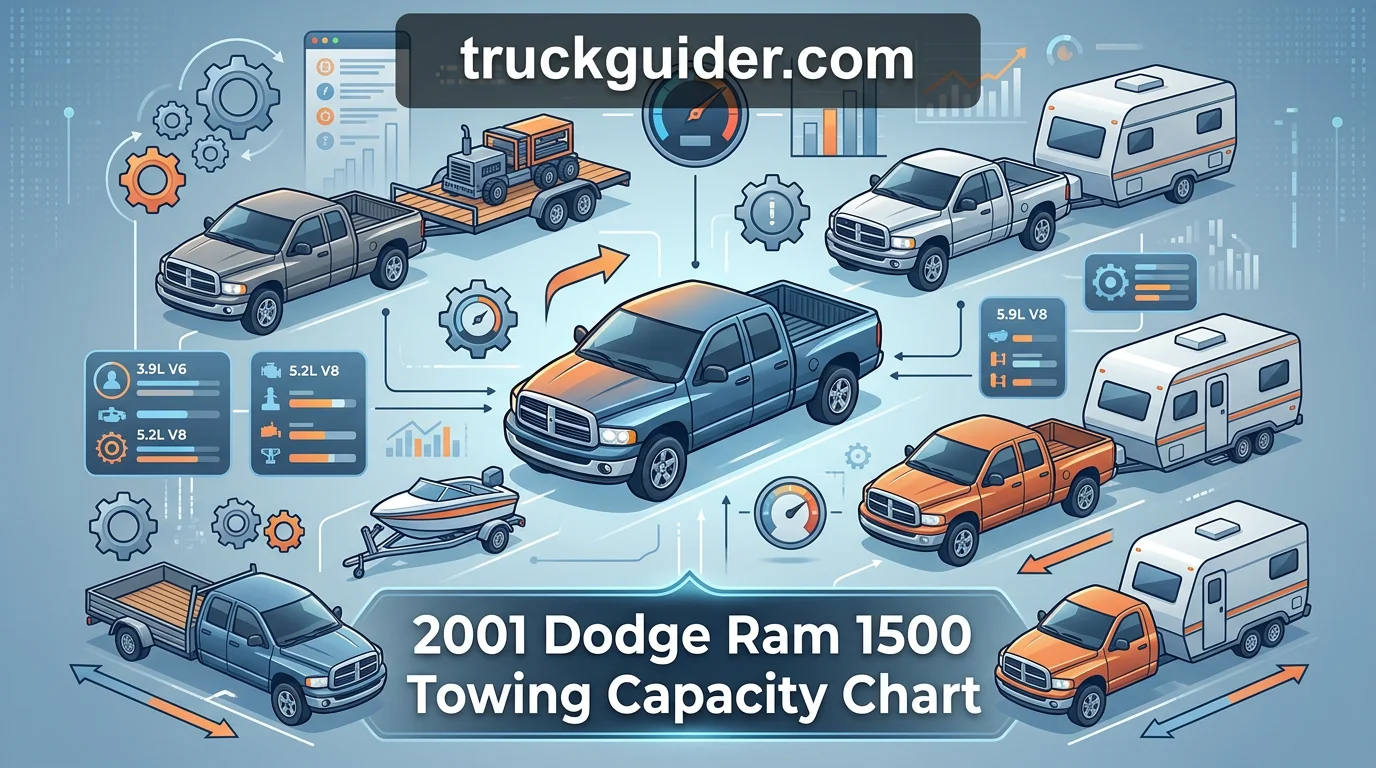
Before diving into the numbers, it is crucial to understand that a “one size fits all” approach to towing is a recipe for failure. The 2001 Ram 1500 was offered with multiple engine displacements, including the 3.9L V6, 5.2L V8, and the powerful 5.9L V8. Furthermore, the final drive gear ratio—typically 3.55 or 3.92—dramatically shifts how much torque reaches the ground. This overview of facts ensures you don’t confuse a light-duty payload configuration with a heavy-duty towing setup.
Comprehensive 2001 Dodge Ram 1500 Towing Capacity Chart
The following data table represents the maximum trailer weight (MTW) ratings for standard configurations. Always cross-reference these specs with your specific vehicle’s door jamb sticker, as aftermarket modifications or accessory packages can alter these figures.
🔎 How to Find Your Specific Towing Capacity Details
It is not enough to just look at a generic chart. To find the exact limits for your specific vehicle, you need to decode the factory information attached to your truck.
1. Locate the Safety Compliance Label: Open your driver’s side door and look for the rectangular sticker on the B-pillar. This label contains your Gross Vehicle Weight Rating (GVWR) and Gross Combined Weight Rating (GCWR).
2. Identify Your Axle Code: Check the build sticker, typically located in the glove box or inside the tailgate. The axle code will tell you if you have the 3.55 or 3.92 gears.
3. Check the VIN Decoder: If your stickers are faded, use an online VIN decoder specific to 2001 Dodge trucks to pull the “As-Built” configuration, which will confirm your engine and transmission type.
4. Calculate Real-World Load: Remember to subtract the weight of passengers and cargo inside the cab from your total towing capacity to find your true “available” towing limit.
The GCWR (Gross Combined Weight Rating) is the absolute limit for the truck and trailer combined. Exceeding this rating is often the primary cause of engine overheating on steep mountain grades.



✨ Key Benefits of Proper Load Management
Extended Transmission Life
Staying within your rated capacity prevents excessive heat buildup in your transmission fluid, which is the #1 cause of failure in 2001-era automatic transmissions.
Increased Braking Safety
By not overloading your rig, your truck’s factory braking system can effectively stop the momentum of the trailer, preventing jackknifing or brake fade.
Pro Tips for Safely Using Your 2001 Dodge Ram 1500
Never exceed the GAWR (Gross Axle Weight Rating). Even if your engine has enough power to pull the load, the structural components of the rear axle and suspension are limited by physical weight ratings.
What If You Still Have Questions Regarding Your Capacity?
If the information provided here does not align with your specific truck’s behavior or if you are planning to tow a load that is dangerously close to your maximum capacity, it is time to seek professional insights.
1. Visit a Certified Scale: Use a public weigh station to get your current “curb weight.” Knowing exactly what your truck weighs loaded is better than relying on estimated factory charts.
2. Consult a Local Driveline Specialist: If your vehicle feels sluggish or struggles to maintain speeds, a shop can evaluate your current gear ratio and suggest cost-effective upgrades like a gear swap or a performance transmission cooler.
3. Contact a Dealership Service Department: Use your VIN to request the “Build Sheet” from a Chrysler/Dodge service center. This is the ultimate source of truth for your specific truck.
4. Professional Inspection: If you notice excessive swaying or “sagging” in the rear suspension, consult a suspension specialist. Overloaded leaf springs can be replaced or upgraded for approximately $600–$1,200 depending on the parts selected.
Frequently Asked Questions
Does the 2001 Ram 1500 have the same towing capacity as the 2500 model?
No. The 2500 features a heavy-duty chassis, larger brakes, and beefier suspension components designed for much higher payloads. Never use the 2500 towing figures for a 1500 model.


Can I install a bigger hitch to increase my towing capacity?
No. The capacity is determined by the engine, transmission, frame strength, and cooling systems. Installing a higher-rated hitch does not change the actual tow rating of the truck and can lead to dangerous structural failure.
How does 4WD affect my towing capacity?
Generally, 4WD versions have a slightly lower towing capacity compared to 2WD versions due to the added curb weight of the transfer case and front differential components.
In summary, safely towing with your 2001 Dodge Ram 1500 is entirely dependent on understanding the factory limits tailored to your specific engine and axle configuration. By referencing this guide and verifying your vehicle’s unique specifications through the door jamb labels, you can ensure that your towing experience remains safe and efficient. Always prioritize proper load distribution and routine maintenance of your cooling and braking systems. For further peace of mind, consider visiting a local commercial scale to confirm your actual loaded weight before heading out on long trips.
❓ Frequently Asked Questions
1
What is the 2001 Dodge Ram 1500 towing capacity?
The towing capacity varies by configuration, ranging from approximately 2,000 lbs for base models up to 8,800 lbs for properly equipped V8 versions. You must check the engine size, transmission type, and axle gear ratio specific to your VIN to determine the accurate rating for your individual truck.
2
How does axle ratio impact towing?
A higher numerical axle ratio, such as 3.92, provides more torque at the wheels, which improves towing performance and hill climbing. A lower ratio, like 3.55, offers better fuel economy during highway cruising but provides less pulling power when starting from a stop with a heavy trailer attached.
3
Why is the GCWR important for towing?
The Gross Combined Weight Rating is the absolute maximum weight of the loaded truck and the loaded trailer combined. It is a critical safety figure provided by the manufacturer to ensure the engine, chassis, and braking system remain within their designed operational limits to prevent premature mechanical failure or accidents.



4
What are the benefits of checking these towing facts?
Knowing your exact towing capacity prevents vehicle strain, ensures legal compliance, and promotes safety on the road. Accessing research-based towing details helps you avoid over-taxing your transmission and suspension, ultimately extending the life of your 2001 Ram 1500 while providing peace of mind during transport.
5
How can I get started with finding my truck’s specs?
Start by locating the sticker on the driver’s side door jamb, which lists the GVWR and other capacity facts. Next, identify your engine size and rear axle ratio using your owner’s manual or by running your VIN through a Dodge service portal to access the original build sheet and technical details.

![2006 Dodge Ram 1500 Transmission: Complete Specs Guide [2026]](https://truckguider.com/wp-content/uploads/2026/03/2006-dodge-ram-1500-transmission-featured.webp)

![Dodge 3.7 Firing Order: Cylinder Layout & Diagram Guide [2026]](https://truckguider.com/wp-content/uploads/2026/03/dodge-3-7-firing-order-featured-768x403.webp)