Dodge Ram Generations by Year: 1st–5th Gen Chart (1981–2026)

The Dodge Ram and modern Ram pickup lineup is generally divided into five generations, beginning with the first-generation Dodge Ram in 1981 and continuing through today’s fifth-generation trucks.
For the Ram 1500, the commonly accepted generation years are 1st Gen: 1981–1993, 2nd Gen: 1994–2001, 3rd Gen: 2002–2008, 4th Gen: 2009–2018, and 5th Gen: 2019–present.
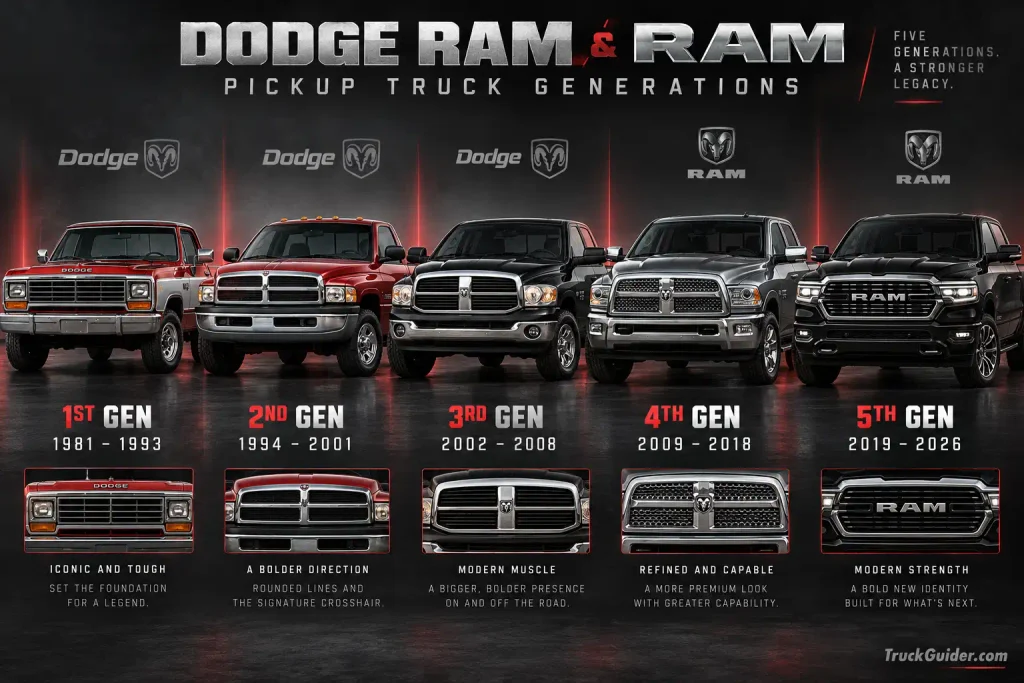
However, Ram 2500 and Ram 3500 Heavy Duty trucks did not always change generations in the same model year as the 1500. That distinction is important when identifying a truck, ordering parts, or comparing engines and body styles.
Dodge Ram Generations 1981–2026
Recommended Best Deal Products


A visual guide to the 1st through 5th generation Dodge Ram and Ram trucks, including key model years, engines, platforms, and major changes.
Dodge Ram Generations Timeline
Follow the evolution from the original work-focused Dodge Ram to today’s technology-packed fifth-generation Ram trucks.
1st Gen Ram
1981–1993 Original Ram EraThe first Dodge Ram retained traditional pickup styling and straightforward mechanical design. The arrival of the Cummins Turbo Diesel in 1989 became one of the most important moments in Ram history.
2nd Gen Ram
1994–2001 Big-Rig RevolutionThe revolutionary second generation introduced the famous big-rig-inspired grille, raised hood, and muscular body that made the Dodge Ram one of the most recognizable pickups of the 1990s.
3rd Gen Ram
2002–2008 HEMI EraThird-generation trucks gained a new chassis, more modern suspension, upgraded interiors, and the return of the legendary HEMI name with the 5.7L HEMI V8.
4th Gen Ram
2009–2018 Comfort & RefinementThe fourth generation introduced coil-spring rear suspension on the Ram 1500, RamBox storage, significantly improved interiors, and the transition from Dodge Ram to the standalone Ram brand.
5th Gen Ram
2019–Present Modern Ram EraThe current generation combines advanced technology, premium interiors, modern safety systems, available air suspension, and newer Hurricane powertrains while continuing Ram’s capability-focused heritage.
Ram 1500 and Heavy Duty trucks do not always change generations in the same model year. For example, the 3rd Gen Ram 1500 covers 2002–2008, while 3rd Gen Ram 2500/3500 trucks generally cover 2003–2009. Always confirm the model, year, VIN, and platform before ordering generation-specific parts.
| Generation | Ram 1500 Years | 2500 / 3500 Years | Major Identity | Notable Powertrain |
|---|---|---|---|---|
| 1st Gen | 1981–1993 | 1981–1993 | Original Ram | 5.9L Cummins |
| 2nd Gen | 1994–2001 | 1994–2002 | Big-Rig Styling | Magnum V8 / Cummins |
| 3rd Gen | 2002–2008 | 2003–2009 | HEMI Era | 5.7L HEMI / Cummins |
| 4th Gen | 2009–2018 | 2010–2018 | Comfort & Brand Split | HEMI / EcoDiesel |
| 5th Gen | 2019–Present | 2019–Present | Technology & Luxury | Hurricane / HEMI |
Why Some 2019–2024 Ram 1500 Trucks Are Still 4th Gen
Ram continued selling the fourth-generation DS truck as the Ram 1500 Classic alongside the fifth-generation DT. Therefore, a 2019–2024 Ram 1500 Classic is still a 4th Gen truck, while a DT Ram 1500 belongs to the 5th generation.
Dodge Ram Generations Chart
| Generation | Ram 1500 / Light-Duty Years | Ram 2500 & 3500 HD Years* | Common Name / Identity | Major Change |
|---|---|---|---|---|
| 1st Gen Ram | 1981–1993 | 1981–1993 | Original Dodge Ram | Ram name, Cummins diesel arrives |
| 2nd Gen Ram | 1994–2001 | 1994–2002 | Big-Rig Ram | Radical grille and body redesign |
| 3rd Gen Ram | 2002–2008 | 2003–2009 | HEMI Era | New frame, modern suspension and HEMI |
| 4th Gen Ram | 2009–2018 | 2010–2018 | DS/DJ Era | Coil-spring 1500, Ram brand separation |
| 5th Gen Ram | 2019–Present | 2019–Present | DT / Modern Ram Era | New design, technology, Hurricane engines |
*Heavy-duty model-year transitions can differ from the Ram 1500. Always verify the specific model, model year, VIN and platform when ordering generation-specific parts.
Important: The fourth-generation Ram 1500 did not completely disappear after 2018. The older DS-platform truck remained on sale as the Ram 1500 Classic alongside the new fifth-generation DT Ram 1500. Ram 1500 Classic production finally ended in 2024.
What Are the Dodge Ram Generations by Year?
Recommended Best Deal Products


Here is the simplest answer for the Ram 1500:
- 1st Gen Ram: 1981–1993
- 2nd Gen Ram: 1994–2001
- 3rd Gen Ram: 2002–2008
- 4th Gen Ram: 2009–2018
- 5th Gen Ram: 2019–Present
These year ranges are what most owners mean when they use terms such as “2nd Gen Ram,” “3rd Gen Dodge Ram,” or “4th Gen Ram.”
The Heavy Duty Ram 2500 and 3500 timeline is slightly different. For example, the third-generation Ram 1500 started with the 2002 model year, while the redesigned third-generation 2500 and 3500 arrived for 2003. Similarly, the fourth-generation Heavy Duty trucks followed the redesigned Ram 1500 one model year later.
1st Gen Ram Years: 1981–1993
Ram 1500/light-duty equivalent years: 1981–1993
Heavy-duty years: 1981–1993
Brand: Dodge
Known for: Simple construction, classic square-body styling and the introduction of the Cummins Turbo Diesel
The first-generation Dodge Ram arrived for the 1981 model year, replacing the older D-Series identity with the Ram name.
These trucks retained much of the rugged, straightforward engineering associated with earlier Dodge pickups. Early models were primarily work trucks, with relatively basic interiors, traditional leaf-spring suspension and simple gasoline powertrains.
Key 1st Gen Ram Features
Early trucks used familiar Chrysler engines, including the 3.7L Slant-Six and V8 options. One of the most important changes arrived in 1989, when Dodge introduced the 5.9L Cummins Turbo Diesel in its heavy-duty pickups.
The Cummins engine transformed the reputation of Dodge’s truck lineup. Its strong low-RPM torque and durable inline-six design helped establish the relationship between Ram and Cummins that continues in modern Heavy Duty trucks.
How to Identify a 1st Gen Ram
Look for:
- Boxy, squared-off body styling
- Traditional rectangular headlights
- Simple grille design
- D-series and W-series designations on earlier trucks
- Minimalist interiors compared with later generations
Today, first-generation Cummins-powered trucks are especially popular with diesel enthusiasts because of their mechanical simplicity.
2nd Gen Ram Years: 1994–2001
Recommended Best Deal Products


Ram 1500 years: 1994–2001
Ram 2500/3500 years: 1994–2002
Platform family: BR/BE
Brand: Dodge
Known for: The famous “big-rig” front-end design
The second-generation Dodge Ram debuted for the 1994 model year and completely changed the truck’s appearance.
Instead of following the conservative styling used by most pickups of the period, Dodge gave the new Ram a large upright grille, raised hood and dropped front fenders inspired by full-size highway trucks.
The result became one of the most recognizable pickup designs of the 1990s.
Key 2nd Gen Ram Changes
The second generation introduced or expanded several important features:
- Bold big-rig-inspired styling
- More spacious and comfortable interiors
- Extended-cab and Quad Cab configurations
- Magnum gasoline engines
- Available 8.0L Magnum V10
- Continued development of the 5.9L Cummins diesel
The truck’s dramatic styling helped move the Ram from a relatively small player in the pickup market into a serious competitor.
2nd Gen Ram Engines
Depending on model and year, engines included:
- 3.9L Magnum V6
- 5.2L Magnum V8
- 5.9L Magnum V8
- 8.0L Magnum V10
- 5.9L Cummins Turbo Diesel
Diesel versions are particularly important in the used-truck market, including both 12-valve and later 24-valve versions of the 5.9L Cummins.
How to Identify a 2nd Gen Ram
The easiest visual identifiers are:
- Tall crosshair-style grille
- Raised center hood
- Pronounced front fenders
- Rounded cab and body
- Classic 1990s Dodge Ram dashboard and interior
If you are looking at a 2002 Ram 2500 or 3500, remember that it may still belong to the second-generation Heavy Duty family even though the redesigned third-generation Ram 1500 had already arrived.
3rd Gen Ram Years: 2002–2008
Ram 1500 years: 2002–2008
Ram 2500/3500 years: 2003–2009
Platform family: DR/DH and related variants
Brand: Dodge
Known for: New chassis, HEMI V8, Mega Cab and Ram SRT-10
For shoppers asking “What years are 3rd Gen Ram?”, the answer depends on the model.
A 3rd Gen Ram 1500 is generally a 2002–2008 model, while third-generation Ram 2500 and 3500 pickups generally cover 2003–2009.
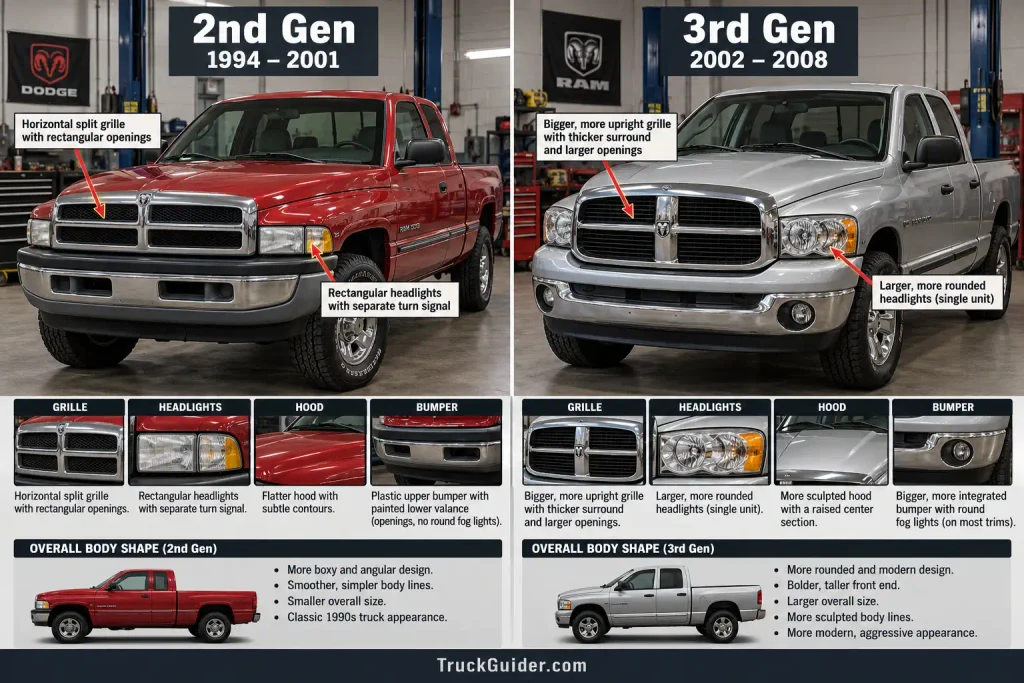
The third generation retained the aggressive personality of the previous truck but added a more modern chassis, suspension, powertrains and interior.
What Changed on the 3rd Gen Ram?
The redesign included:
- New frame
- Revised front suspension
- Rack-and-pinion steering on applicable 1500 models
- Larger four-door Quad Cab
- Improved interior design
- Introduction of Mega Cab
- Major gasoline and diesel engine changes
The exterior became smoother and more aerodynamic while retaining the prominent Dodge crosshair grille.
Return of the 5.7L HEMI
One of the defining events of the third generation was the return of the HEMI name.
The 5.7L HEMI V8 became available during this generation and developed into one of the most recognizable Ram gasoline engines.
Other engines included the 3.7L V6 and 4.7L V8, while Heavy Duty trucks continued to offer Cummins diesel power.
Later third-generation Heavy Duty models transitioned from the 5.9L Cummins to the 6.7L Cummins Turbo Diesel.
Ram SRT-10
The third generation also produced one of the most unusual performance pickups ever built: the Dodge Ram SRT-10.
Powered by an 8.3L V10 related to the engine used in the Dodge Viper, the SRT-10 transformed the full-size Ram into a high-performance street truck.
How to Identify a 3rd Gen Ram
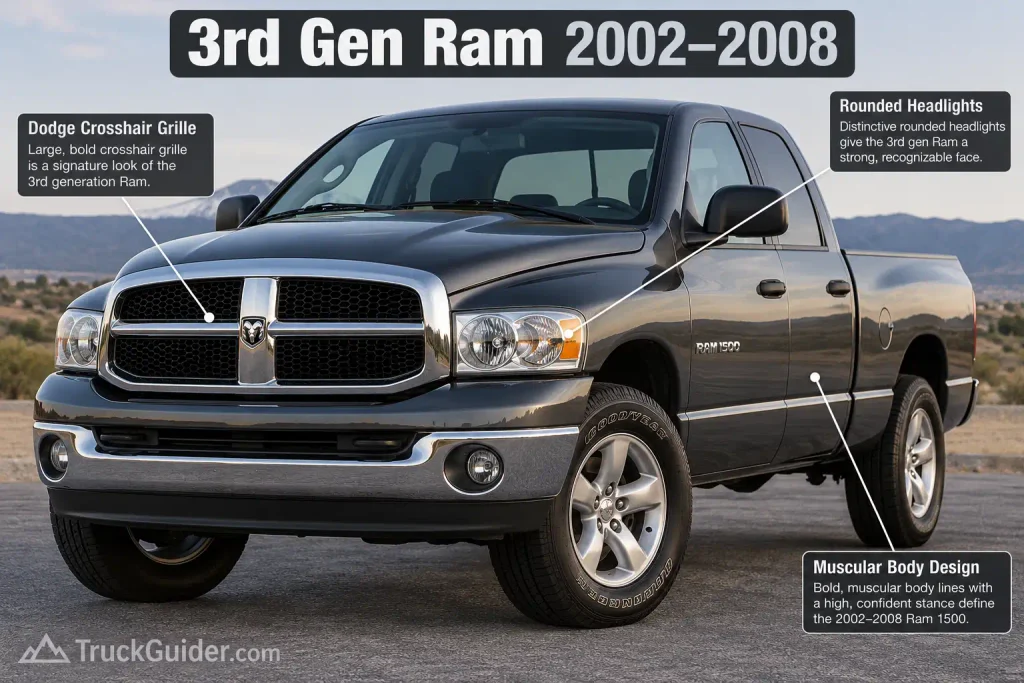
Look for:
- Large Dodge crosshair grille
- Rounded but muscular front end
- More integrated headlights than the 2nd Gen
- Four conventional doors on Quad Cab models
- Available Mega Cab on later models
For parts or repairs, do not automatically assume a 2009 Ram 2500 or 3500 is the same generation as a 2009 Ram 1500. The HD models remained on the third-generation architecture for the 2009 model year.
4th Gen Ram Years: 2009–2018
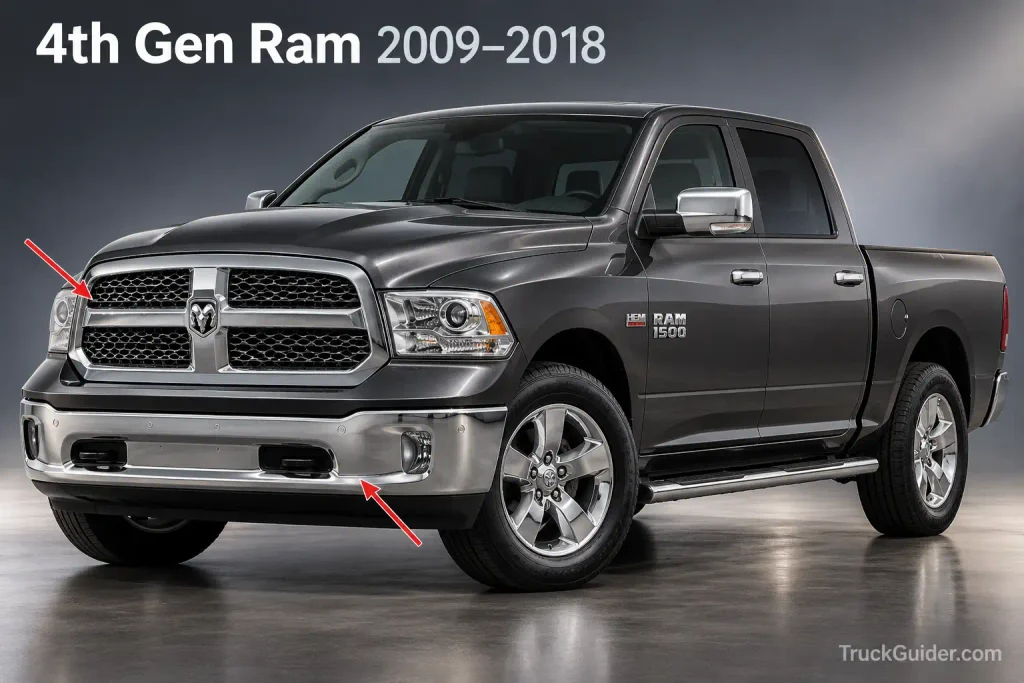
Ram 1500 years: 2009–2018
Ram 1500 Classic continuation: 2019–2024
Ram 2500/3500 years: 2010–2018
1500 platform: DS
Brand: Dodge Ram initially / Ram
Known for: Coil-spring rear suspension, RamBox, better interiors and the Dodge-to-Ram brand transition
A 4th Gen Ram 1500 normally refers to the 2009–2018 redesigned truck.
However, there is an important exception: the fourth-generation DS body remained in production after 2018 as the Ram 1500 Classic, which was sold alongside the fifth-generation truck through the 2024 model year.
That is why some 2019–2024 Ram 1500 trucks are technically fourth-generation trucks.
4th Gen Ram Suspension
One of the most significant engineering changes occurred underneath the Ram 1500.
Ram replaced the traditional leaf-spring rear suspension used by most full-size pickups with a multi-link coil-spring rear suspension.
This helped give the Ram 1500 a smoother, more controlled ride and became one of the truck’s biggest competitive advantages.
Heavy Duty models continued to use suspension systems appropriate for higher payload and towing requirements, so do not assume Ram 1500 suspension components interchange with 2500 or 3500 trucks.
RamBox and Interior Upgrades
Another major feature introduced during this era was the RamBox Cargo Management System, which integrated lockable storage compartments into the pickup bed.
Cabin quality also improved dramatically. Higher trims moved toward premium materials, larger infotainment displays and features traditionally associated with luxury vehicles.
4th Gen Ram Engines
Major gasoline and diesel options across the generation included:
- 3.7L V6 on early models
- 4.7L V8
- 3.6L Pentastar V6
- 5.7L HEMI V8
- 3.0L EcoDiesel V6 on Ram 1500
- 6.4L HEMI V8 on Heavy Duty models
- 6.7L Cummins Turbo Diesel on Heavy Duty models
When Did Dodge Ram Become Just Ram?
The Ram brand was separated from Dodge during Chrysler’s corporate restructuring around 2009.
This created a dedicated Ram truck brand while Dodge increasingly focused on passenger and performance vehicles.
As a result, early fourth-generation trucks are often casually called Dodge Ram, while later vehicles are officially branded simply as Ram.
Ram 1500 Classic vs 5th Gen Ram: Why 2019–2024 Can Be Confusing
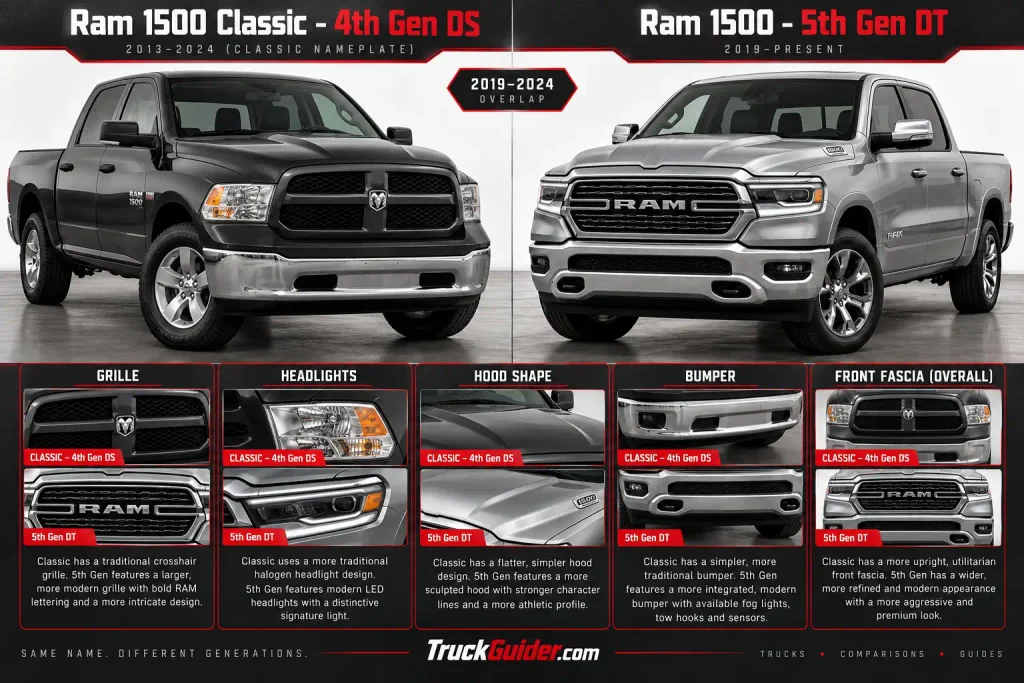
One of the biggest sources of confusion in Ram generation identification is the Ram 1500 Classic.
When the new fifth-generation Ram 1500 launched for 2019, Ram did not immediately stop building the previous-generation truck.
Instead, the fourth-generation DS model continued as the Ram 1500 Classic.
That means a 2019 Ram 1500 could be either:
- 5th Gen Ram 1500 DT, or
- 4th Gen Ram 1500 Classic DS
The Classic remained in production through 2024.
How to Tell Them Apart
The fifth-generation DT truck has a substantially newer exterior and interior design. One of the easiest visual clues is the front grille: fifth-generation trucks moved away from the traditional Dodge-style crosshair grille and adopted a wider, more modern Ram design.
The Classic retained the familiar fourth-generation body shape.
If you are buying body panels, headlights, suspension parts, interior components or other generation-specific parts for a 2019–2024 truck, verify whether it is a DT Ram 1500 or DS Ram 1500 Classic before ordering.
5th Gen Ram Years: 2019–Present
Ram 1500 years: 2019–Present
Ram 2500/3500 major redesign: 2019–Present
Ram 1500 platform: DT
Brand: Ram
Known for: Technology, luxury, Hurricane engines, advanced displays and modern safety systems
The fifth-generation Ram 1500 debuted for the 2019 model year.
It represented another major change in the evolution of the Ram pickup, with a new body, updated frame, improved aerodynamics, more technology and a strong focus on interior quality.
5th Gen Ram Interior and Technology
The fifth generation pushed Ram further into the premium-truck market.
Depending on year and trim, available equipment includes:
- Large Uconnect touchscreens
- Digital driver displays
- Premium audio systems
- Advanced driver-assistance technology
- Air suspension
- High-end leather, wood and metal interior materials
- Rear-seat comfort features on upper trims
Higher-end versions such as Limited and Tungsten demonstrate how far the Ram has evolved from the basic work-oriented trucks of the first generation.
5th Gen Ram Engines
Powertrain choices have changed significantly during the fifth generation.
Depending on model year, the Ram 1500 has offered engines such as:
- 3.6L Pentastar V6 with eTorque
- 5.7L HEMI V8
- 3.0L EcoDiesel V6
- 3.0L Hurricane twin-turbo inline-six
The 2025 model year represented a major shift toward the Hurricane inline-six, but the HEMI story did not end permanently.
2026 Ram 1500: HEMI Returns
For 2026, Ram brought the available 5.7L HEMI V8 back to the Ram 1500 lineup.
The 2026 Ram 1500 can therefore be configured with powertrains including the 3.6L Pentastar V6, available Hurricane inline-six engines and the newly available returning 5.7L HEMI V8.
This is important when comparing 2025 and 2026 fifth-generation trucks because the engine lineup changed significantly within a short period.
5th Gen Ram Heavy Duty
The Ram 2500 and 3500 also received a major redesign for 2019.
These Heavy Duty trucks continued to emphasize towing and payload capability while adding many of the luxury, safety and infotainment features found in the Ram 1500.
Important Heavy Duty powertrains include the 6.4L HEMI V8 and 6.7L Cummins Turbo Diesel.
Dodge Ram Generations Comparison
| Feature | 1st Gen | 2nd Gen | 3rd Gen | 4th Gen | 5th Gen |
|---|---|---|---|---|---|
| Ram 1500 Years | 1981–1993 | 1994–2001 | 2002–2008 | 2009–2018 | 2019–Present |
| Primary Brand | Dodge | Dodge | Dodge | Dodge/Ram | Ram |
| Design Theme | Traditional work truck | Big-rig styling | Modern muscular | Refined & premium | Tech-focused |
| Notable Gas Engine | 5.9L V8 | Magnum V8/V10 | 5.7L HEMI | 5.7L HEMI | Hurricane I6 / HEMI |
| Notable Diesel | 5.9L Cummins | 5.9L Cummins | 5.9L/6.7L Cummins HD | EcoDiesel / 6.7L Cummins HD | 6.7L Cummins HD |
| 1500 Rear Suspension | Leaf spring | Leaf spring | Leaf spring | Coil spring | Coil / available air suspension |
| Major Identity | Original Ram | Big-rig revolution | HEMI returns | Comfort & brand split | Technology & luxury |
How Do I Know What Generation My Ram Is?
The quickest method is to start with the model year and model series.
For a Ram 1500:
- 1981–1993: 1st Gen
- 1994–2001: 2nd Gen
- 2002–2008: 3rd Gen
- 2009–2018: 4th Gen
- 2019–Present: Usually 5th Gen
But there are two important exceptions.
First, Ram 2500 and 3500 Heavy Duty generation transitions can occur one model year later than the corresponding Ram 1500.
Second, a 2019–2024 Ram 1500 Classic is a continuation of the fourth-generation truck, not the fifth-generation DT truck.
For the most accurate identification, check:
- Model year
- 1500, 2500 or 3500 series
- VIN
- Body and grille design
- Platform or chassis code
- Engine and suspension configuration
Why Do Ram Generation Years Differ Between the 1500 and 2500/3500?
Ram does not always redesign its light-duty and Heavy Duty trucks in exactly the same model year.
For example:
- Third-generation Ram 1500: 2002–2008
- Third-generation Ram 2500/3500: 2003–2009
And:
- Fourth-generation Ram 1500: 2009–2018
- Fourth-generation Ram 2500/3500: 2010–2018
This staggered launch strategy is common in pickup lineups because Heavy Duty trucks use different frames, suspension systems, axles, engines and towing hardware.
Therefore, searching only by “Ram generation” without specifying 1500, 2500 or 3500 can sometimes produce conflicting year ranges.
For a deeper light-duty breakdown, see our Dodge Ram 1500 Generations Chart.
Heavy Duty owners can also see our Dodge Ram 2500 Generations Chart.
Dodge Ram Engine Evolution by Generation
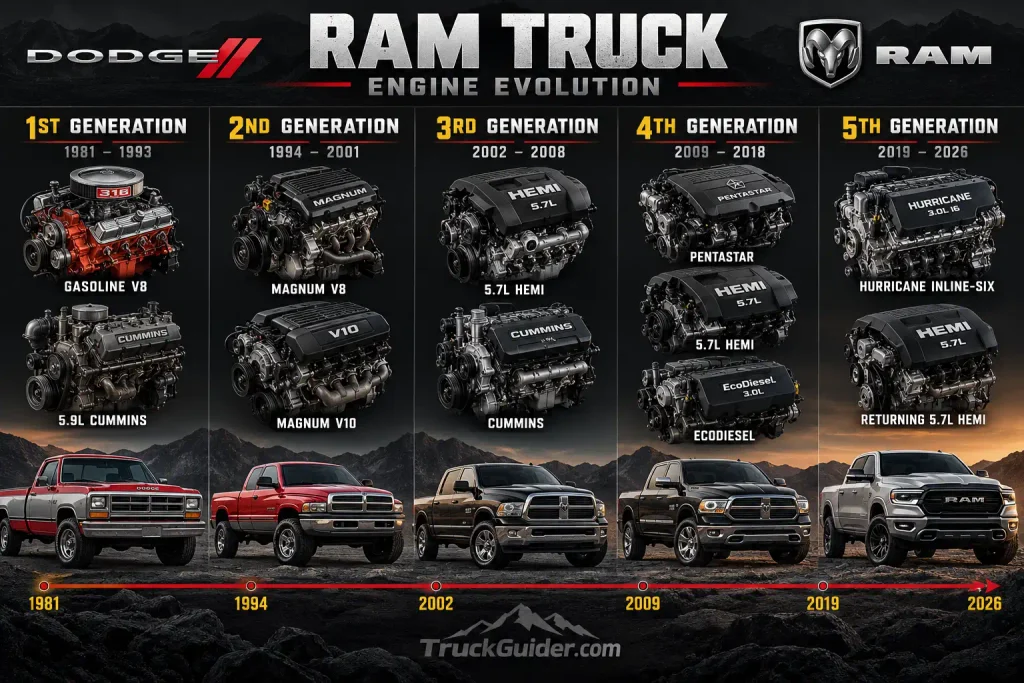
The Ram’s engine lineup has changed almost as dramatically as its body design.
1st Gen
Early gasoline engines were relatively simple, while the arrival of the 5.9L Cummins in 1989 created Ram’s long-running diesel identity.
2nd Gen
Magnum V6 and V8 engines dominated gasoline models, while the 8.0L V10 provided additional heavy-duty power. The 5.9L Cummins remained a major diesel option.
3rd Gen
The 5.7L HEMI became a defining gasoline engine. Heavy Duty trucks transitioned from the 5.9L Cummins to the newer 6.7L Cummins.
4th Gen
The 3.6L Pentastar V6 improved base-engine efficiency, the HEMI remained popular and the 3.0L EcoDiesel brought light-duty diesel power to the Ram 1500.
5th Gen
The generation began with familiar Pentastar, HEMI and EcoDiesel options before the twin-turbo 3.0L Hurricane inline-six became a major part of the lineup. The 5.7L HEMI returned as an available Ram 1500 engine for 2026.
For a more detailed engine-by-year breakdown, see our Dodge Ram Engine Codes by Year Chart.
Which Ram Generation Is Best?
There is no single best Ram generation for every owner because each generation has different strengths.
1st Gen: Best suited to enthusiasts who value mechanical simplicity and classic Cummins diesel trucks.
2nd Gen: Popular for iconic styling and older Cummins diesel configurations.
3rd Gen: A strong choice for buyers who like traditional Dodge styling, HEMI power and relatively simple electronics compared with newer trucks.
4th Gen: Offers a useful balance of modern comfort, engine choices, aftermarket support and used-truck availability.
5th Gen: Best suited to buyers prioritizing modern technology, interior comfort, safety systems and newer powertrains.
Condition, maintenance history, engine choice and previous usage can matter more than the generation itself when buying a used Ram.
Frequently Asked Questions
What years are the Dodge Ram generations?
For the Ram 1500, the commonly used generations are 1981–1993 for 1st Gen, 1994–2001 for 2nd Gen, 2002–2008 for 3rd Gen, 2009–2018 for 4th Gen and 2019–present for 5th Gen.
Heavy Duty Ram 2500 and 3500 transition years can differ.
What years are 2nd Gen Ram trucks?
The second-generation Ram 1500 covers 1994–2001. Ram 2500 and 3500 Heavy Duty versions continued through the 2002 model year.
What years are 3rd Gen Ram trucks?
The 3rd Gen Ram 1500 covers 2002–2008. Third-generation Ram 2500 and 3500 pickups generally cover 2003–2009.
What years are 4th Gen Ram trucks?
The redesigned 4th Gen Ram 1500 covers 2009–2018. The same body continued as the Ram 1500 Classic from 2019 through 2024.
The fourth-generation Ram 2500 and 3500 began with the 2010 model year.
What years are 5th Gen Ram trucks?
The 5th Gen Ram 1500 began in 2019 and continues today. Ram also introduced a substantially redesigned Heavy Duty lineup for 2019.
Is a 2019 Ram 1500 a 4th Gen or 5th Gen?
It can be either.
A 2019 Ram 1500 DT is a fifth-generation truck, while a 2019 Ram 1500 Classic DS is a fourth-generation truck.
This overlap continued for several years.
Is the Ram 1500 Classic a 4th Gen?
Yes. The Ram 1500 Classic is based on the fourth-generation DS truck. It was sold alongside the fifth-generation DT Ram 1500 and remained in production through 2024.
When did Dodge Ram become Ram?
Ram became a separate truck brand following Chrysler’s restructuring in 2009, with the branding transition becoming visible around the 2010 model-year era. That is why owners frequently use “Dodge Ram” for older trucks and simply “Ram” for newer models.
What generation is a 2018 Ram 1500?
A 2018 Ram 1500 is a fourth-generation Ram.
What generation is a 2020 Ram 1500?
Most 2020 Ram 1500 trucks using the newer DT platform are fifth generation. However, the 2020 Ram 1500 Classic remained a fourth-generation DS truck.
Is the 5.7L HEMI available in the 2026 Ram 1500?
Yes. After changes to the Ram 1500 engine lineup for 2025, the 5.7L HEMI V8 returned as an available engine for 2026, alongside Pentastar and Hurricane engine options.
Final Thoughts
The history of the Dodge Ram is easier to understand when the lineup is separated by model and generation rather than model year alone.
For the Ram 1500, the five main generations are straightforward: 1981–1993, 1994–2001, 2002–2008, 2009–2018 and 2019–present.
The main source of confusion is the Heavy Duty lineup, where redesigns sometimes arrived later, and the Ram 1500 Classic, which allowed a fourth-generation truck to remain on sale alongside the fifth generation through 2024.
Whether you are identifying a used truck, ordering parts, researching engines or comparing model years, always check the model year, series and platform together. That will give you a much more accurate answer than relying on the year alone.
![Ram 2500 Fuel Tank Size: Specs & Fitment Guide [2026]](https://truckguider.com/wp-content/uploads/2026/03/ram-2500-fuel-tank-size-featured.webp)