Ford F-250 TPMS Reset Steps Using the Hazard Flasher Method

To reset the TPMS on a Ford F-250, turn the ignition on with the engine off, switch the hazard flashers on and off three times within 10 seconds, then let air out of each tire in order, starting at the left front, until the horn sounds.


That training procedure appears in Ford’s F-250 owner manuals for 2010, 2015, 2017 and 2026. It teaches the system which sensor sits at which corner, which matters most after a tire rotation.
This Ford F250 TPMS reset guide covers the full steps, when Ford says you need them, what the horn signals mean, and why a light can stay on after a correct reset.
Ford F-250 TPMS Reset in 11 Steps


The steps below follow the single-rear-wheel procedure in the 2017 Super Duty owner’s manual. The 2010 and 2015 manuals use the same sequence, and the 2026 manual uses a shortened version of it.
- Warm up the sensors. Drive above 20 mph for at least two minutes, then park where you can reach all four tires and an air pump.
- Turn the ignition off. Keep the key in the ignition on keyed trucks.
- Turn the ignition on. Do not start the engine.
- Cycle the hazard flashers. Switch them on then off three times, all within 10 seconds.
- Confirm reset mode. The horn sounds once, the TPMS light flashes and a message appears. If not, start again at step 2.
- Train the left front tire. Remove the valve cap and let air out until the horn sounds.
- Train the right front tire. Let air out until the horn sounds.
- Train the right rear tire. Let air out until the horn sounds.
- Train the left rear tire. Let air out until the horn sounds. The light stops flashing and a message confirms training is complete.
- Turn the ignition off. Two short horn beeps mean the reset failed and must be repeated.
- Reinflate all four tires. Set them to the pressures on the Safety Compliance Certification Label or Tire Label.
What the F-250 Horn and Light Tell You
Source: Ford F-250 owner manuals for 2010, 2015, 2017 and 2026.
One horn chirp
Reset mode entered, or that tire’s sensor was learned
Double horn
That step failed, so repeat the procedure
Two short beeps at ignition off
The reset was unsuccessful and must be repeated
Flashing TPMS light
Training in progress, stops when the last tire is learned
All four manuals add a two-minute time limit between tires. Wait longer and the system times out, so you start over on all four wheels.
Knowing the steps is half the job. Knowing when Ford asks for them saves wasted effort.
When Ford Says an F-250 Needs a TPMS Reset in 4 Manuals
On trucks whose recommended front and rear pressures differ, the system warns at two different pressures, one for each axle. After a rotation it must learn which sensors moved to which axle.
2010 and 2015 Manuals
The 2010 F-250 owner guide says the reset is needed after each tire rotation on vehicles with different front and rear recommended pressures. The 2015 manual repeats that wording.
2017 Manual


The 2017 reset procedure note drops the condition, although its rotation warning keeps it. The note reads: “You need to perform the tire pressure monitoring system reset procedure after each tire rotation.”
2026 Manual
Ford’s 2026 Super Duty owner’s manual, edition 202506, returns to the conditional wording. You must reset the system after each rotation on vehicles that require different front and rear pressures.


Check your door label. If its front and rear pressures differ, plan on a reset after every rotation on any F-250 year covered here.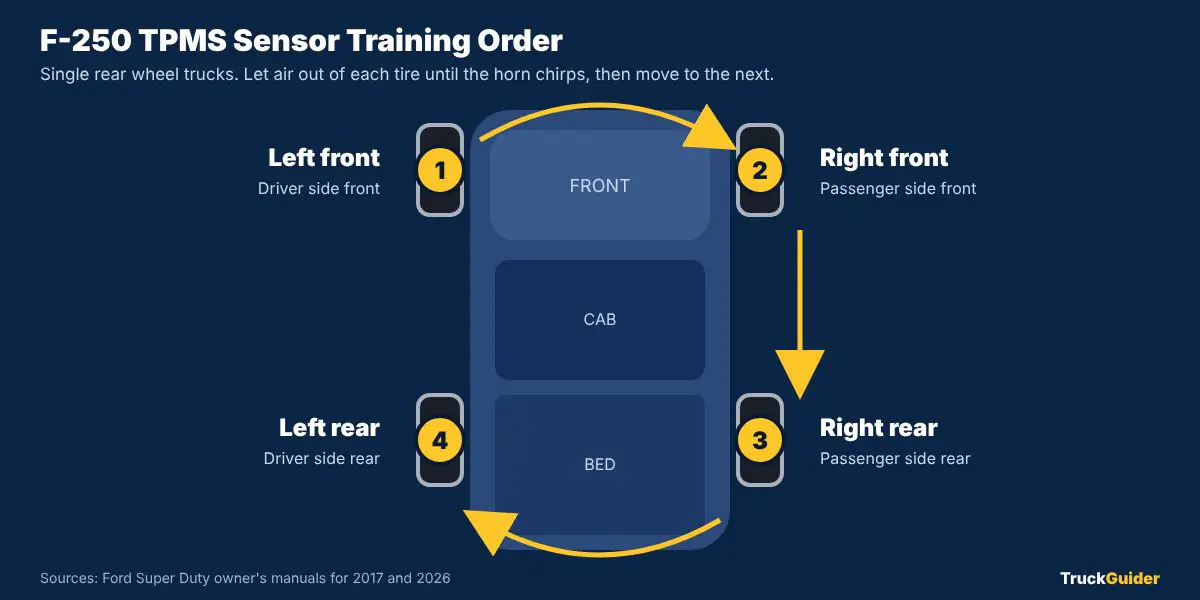
The diagram shows the clockwise order the manuals require. Training the tires out of order teaches the system the wrong positions, so follow the arrows exactly.
3 Rotation Rules From the 2017 F-250 Manual


The reset exists because of tire rotation, so the rotation itself has to be done right. Ford’s 2017 manual sets three rules that tie directly to the TPMS.
Rotate at the Scheduled Interval


The manual says rotating at the interval in the Scheduled Maintenance chapter helps the tires wear more evenly, for better performance and longer tire life. It also notes that rotation can sometimes correct irregular wear.


Fix Uneven Wear First
If the tires already show uneven wear, the manual asks owners to have a dealer check for wheel misalignment, tire imbalance or a mechanical problem before rotating. Rotating a misaligned truck only spreads the wear.
Reset Pressures After the Move
After the rotation, the manual says inflation pressure must be checked and adjusted to the vehicle requirements. Its warning adds that a truck with different front and rear label pressures needs the system reset, or it may not warn of low pressure when it should.
The manual also says a dissimilar spare tire or wheel is for temporary use only and should not go into the rotation. Keep it out, and the TPMS keeps tracking only the four road tires.
How the 2026 F-250 TPMS Reset Differs in 4 Ways
The 2026 manual keeps the hazard flasher entry and the left front starting point. We checked the 2026 manual only, so owners of 2023 to 2025 trucks should compare these details with their own manual.
Ignition Wording
The 2026 steps say to switch the ignition off, then switch it on without starting the engine. They no longer mention keeping the key in the ignition.
Rear Tires


After the right front, the 2026 manual says to repeat the deflate step on the right rear tire and then the left rear tire.
Finish
The 2026 single-rear-wheel steps end by switching the ignition off and setting all four tires to the pressure on the Safety Compliance Certification Label. If the horn sounds twice again after a repeat attempt, the manual says to contact a dealer.
Display Warning
The 2026 manual shows tire pressures in the truck info section of the cluster display, as the 2017 manual also did. It adds a clear warning: “Do not use the tire pressure displayed in the information display as a tire pressure gauge.” Set pressures with a real gauge.
Not every warning light means you need the reset, though.
4 Reasons the F-250 TPMS Light Stays On


Ford’s 2010 and 2015 manuals include a chart that matches each light behavior to a cause. These are the four situations they describe.
Low Tire Pressure
A solid light means at least one tire is low. Inflate to the label pressure, then drive above 20 mph. The light chart says to drive at least two minutes, and another section says the light can take up to two minutes to turn off.
Spare Tire in Use
The system keeps warning while the temporary spare is on. Repair the damaged road tire and remount it to restore full function.
Rotation Without Training
On trucks with different front and rear pressures, a rotation without the reset can leave the system watching the wrong limits. Run the reset after the rotation.
System Malfunction
A light that stays on, or keeps flashing, with correct pressures and no spare in use points to a fault. The manuals say to have the system inspected by an authorized dealer.
Cold weather can also trigger the light without any fault. Our guide on whether tire pressure drops in cold weather explains that effect in detail.
Where to Find the F-250 Tire Pressures for the Reset
Every version of the reset ends with reinflating the tires, so you need the right numbers. Ford’s 2017 and 2026 manuals point to the Safety Compliance Certification Label on the door hinge pillar, the door-latch post or the door edge next to the driver seat.
The manuals also name the Tire Label on the B-pillar or the edge of the driver door. Use the cold pressures on the label, not the maximum pressure molded into the tire sidewall.
The 2010 guide adds a warning that applies to every year. The TPMS is not a substitute for checking pressure with a gauge at least monthly.
How Temperature Sets Off the F-250 TPMS Light
Ford’s 2010, 2015 and 2017 manuals give the same numbers for a typical passenger tire. Pressure can rise about 2 to 4 psi from a cold start during normal driving.
Parked overnight, pressure can fall about 3 psi for every 30 degrees Fahrenheit the air temperature drops. That drop alone can trip the low pressure warning on a cold morning.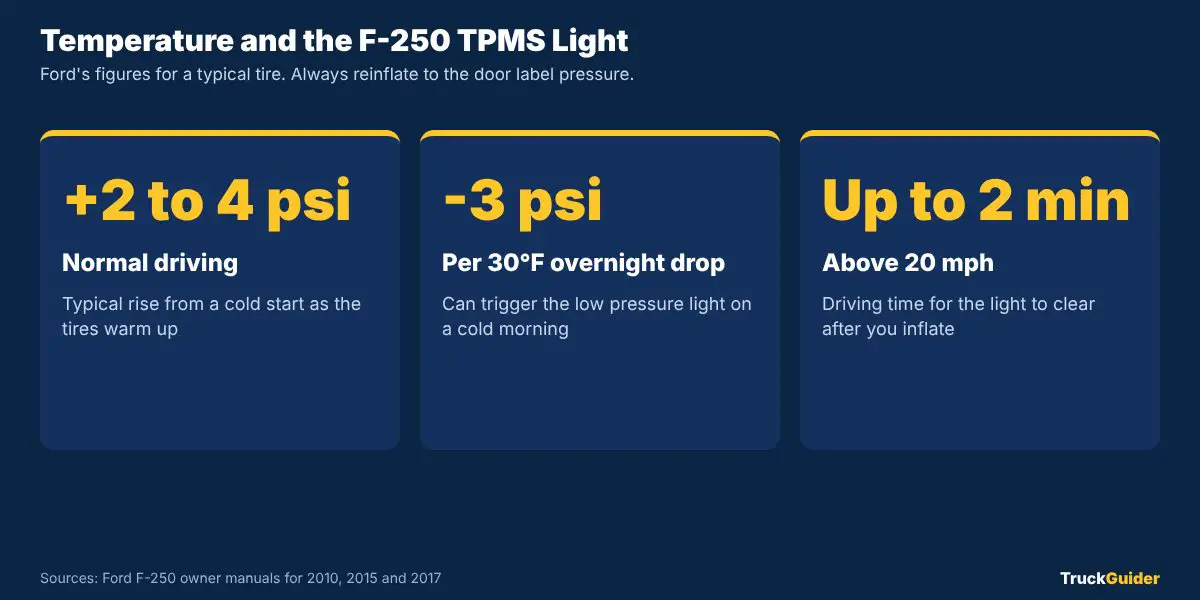
The card puts the two effects side by side, along with the drive time Ford gives for the light to clear. By Ford’s typical-tire figure, a tire parked through a 30-degree overnight drop can read about 3 psi low before it moves.
The manuals say to visually check each tire, confirm none is flat, and inflate all tires to the recommended pressure. Then give the system the two-minute drive above 20 mph to clear the light.
Checking pressure the right way matters here. Our guide on how to check tire pressure accurately covers gauges and timing.
F-250 TPMS Care When Changing Tires in 2 Areas
Sensor Location
The 2010 guide places each sensor inside the tire and wheel cavity, attached to the valve stem. It is hidden by the tire and can be damaged during a tire change, so Ford recommends a dealer for tire service.
Sealants and Flats
The 2015 Super Duty owner’s manual warns that tire sealant may damage the TPMS and should only be used in roadside emergencies. It also recommends a dealer repair a flat to protect the sensors. The 2017 manual is stricter and says not to use tire sealants because they may damage the system, while the 2026 manual limits sealant to roadside emergencies.
If a sensor is replaced during a tire change, the new one has to be learned too. Our guide to TPMS sensors after a tire change covers what to expect.
For the factory tire sizes the sensors sit in, see our F-250 tire size chart by year.
F-250 TPMS on 2002 to 2007 Trucks
We searched Ford’s 2002, 2005, 2006 and 2007 F-250 owner guides and found no tire pressure monitoring system section, though the 2006 and 2007 symbol glossaries show a low tire pressure icon. We could not check the 1999 to 2001, 2008 or 2009 guides. The 2010 guide lists the system as “if equipped,” so check for the TPMS light in the cluster on any truck before trying a reset.
If your truck has no TPMS warning light, there is nothing to reset. A tire gauge and the door label do the job.
Trucks with the system but an inactive light still need the same monthly gauge check. Ford’s 2010 guide says the TPMS is not a substitute for checking pressure by hand.
Finishing a Ford F250 TPMS Reset Correctly
Drive two minutes above 20 mph, park, turn the ignition on, and cycle the hazards three times in 10 seconds. Then deflate each tire in order from the left front until the horn chirps.
Turn the ignition off, listen for any double beep, and reinflate all four tires to the label pressures. A Ford F250 TPMS reset that ends with a single chirp per tire and no double beep is complete.
F-250 TPMS Reset FAQ in 6 Answers
Do I Need a Tool to Reset F-250 TPMS?
No. Ford’s owner manuals describe a reset that uses only the ignition, the hazard flasher switch and a way to let air out of each tire. You also need an air pump to refill the tires to the label pressure afterward.
Why Does My F-250 Horn Beep Twice During TPMS Reset?
A double horn means that step failed, and Ford says to repeat the procedure. Two short beeps when you switch the ignition off also mean the reset did not work. The manuals also warn that waiting more than two minutes between tires times out the system.
How Long Does the F-250 TPMS Light Take to Turn Off?
Up to two minutes of driving above 20 mph after you inflate the tires, according to Ford’s manuals. If the light stays on longer with correct pressures and no spare in use, have the system checked by a dealer. Cold mornings can also bring the light back, as the temperature section above explains.
Can I Reset F-250 TPMS Without Letting Air Out?
Not with the procedure in Ford’s owner manuals. Each sensor is learned when its tire loses air and the horn sounds. Lower the pressure slowly, stop when the horn sounds, then refill every tire to the label pressure once training is complete.
Is the F-250 TPMS Reset the Same as the F-150?
Not necessarily, because the F-150 is covered by separate Ford owner’s manuals. Our F-150 TPMS reset guide covers that truck separately, so follow the F-250 steps for a Super Duty. The Super Duty manuals we checked all start with the hazard flasher entry described above.
Does the F-250 Use the Dual Rear Wheel TPMS Procedure?
No. Ford’s dual-rear-wheel procedure trains six tires and applies to dually trucks. Ford’s 2026 spec sheet lists the F-250 only in single-rear-wheel form, so it follows the four-tire procedure starting at the left front. The six-tire version adds the inner rear tires to the training order.