P0299 Duramax Code Causes and Fixes: 2026 Engine Generation

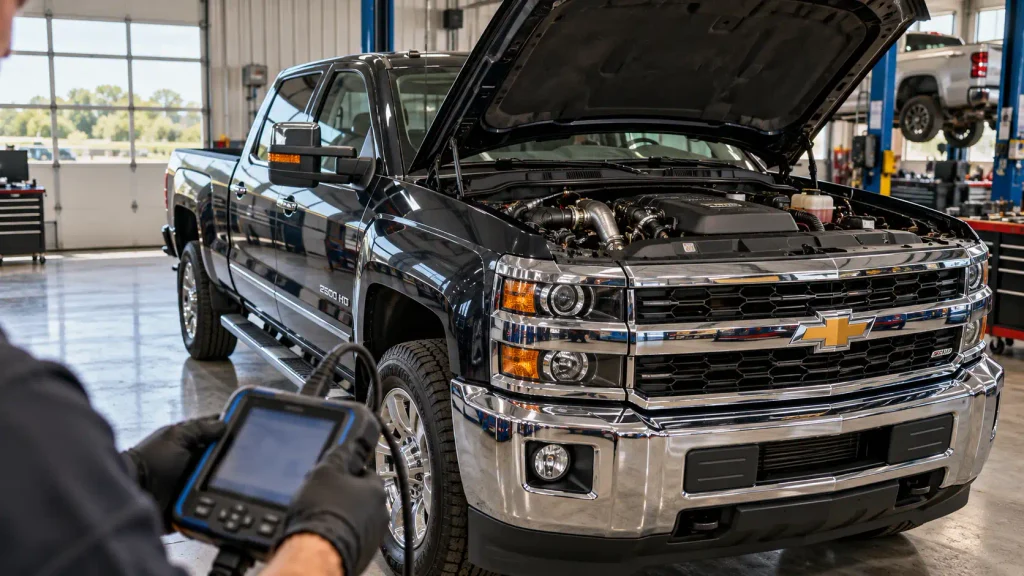
The P0299 Duramax code means the engine control module (ECM) has detected a turbocharger underboost condition. Actual intake boost is lower than the ECM expects under the conditions being monitored. That does not automatically mean the turbocharger has failed.
A leaking intercooler connection, inaccurate manifold pressure signal, exhaust leak, or turbo-control problem can produce the same code. The right test depends on your Duramax generation, any additional trouble codes, and what happens when the truck loses power. Start by identifying those details before buying parts.
P0299 means measured boost is lower than expected. Follow the evidence before replacing the turbocharger. Different Duramax generations have different service procedures.
Record model year, engine RPO, 6.6L or 3.0L, modifications, stored and pending codes, and freeze-frame data.
Note hissing, power loss, exhaust odor and companion DTCs. Review MAP, BARO, and desired versus actual boost using compatible units and OEM test conditions.
More than one clue may apply. A matching symptom or bulletin is a reason to test, not proof of a failed component.
Next check: Inspect charge-air boots, clamps and intercooler connections. Pressure-test to OEM specifications.
Next check: Rule out intake leaks first; then follow GM PI0759 MAP-connector guidance if applicable.
Next check: Inspect the EGR cooler bypass pipe where GM 17-NA-161 applies.
Next check: Verify pressure-sensor readings and turbo-control response; assess VGT data only on equipped engines.
Next check: Follow GM 22-NA-013 duct inspection and prescribed leak-testing procedure.
Next check: Have a technician check actuator-bolt seating under GM 22-NA-021 if applicable.
Severe power loss, scraping turbo noise, heavy smoke, significant oil loss or exhaust fumes inside the cab require prompt professional assessment.
What Determines the Correct P0299 Duramax Diagnosis



Four details should determine your next diagnostic step: engine generation, companion codes, symptoms, and live pressure data. Without them, replacing a turbocharger or sensor is an expensive guess.
Engine Generation and Model Year
The 6.6L Duramax V8 Turbo Diesel includes the LB7 (2001 to early 2004), LLY (introduced mid-2004), LBZ (2006 to 2007 Classic), LMM (2007.5 to 2010), LML (2011 to 2016), and L5P (2017 onward). Some transition years contain more than one engine variant. Confirm the engine RPO or VIN information rather than relying on the model year alone.
The 3.0L Duramax inline-six uses different hardware. Its LM2 and later LZ0 versions must not be diagnosed from a 6.6L service procedure. For other generation-specific faults, see our 6.6 Duramax problems guide.
Symptoms and Companion Fault Codes
Record whether P0299 is accompanied by P0106, P0107, P0108, P2263, P003A, P0046, or P0234. Their relevance depends on the engine. Also note hissing, exhaust odor, sudden power loss, smoke, or unusual turbocharger noise.
Boost Data and Operating Conditions
Save freeze-frame data before clearing codes. If your scanner supports it, record engine speed, load, desired boost, actual manifold absolute pressure (MAP), and barometric pressure (BARO) during the conditions that triggered the fault.
Check the units: MAP may be displayed as absolute pressure, while a dashboard boost gauge shows pressure above atmospheric pressure. At sea level, approximately 14.7 psi absolute corresponds to zero gauge boost. Do not compare those numbers directly.
If Your Duramax Hisses Check for Boost Leaks


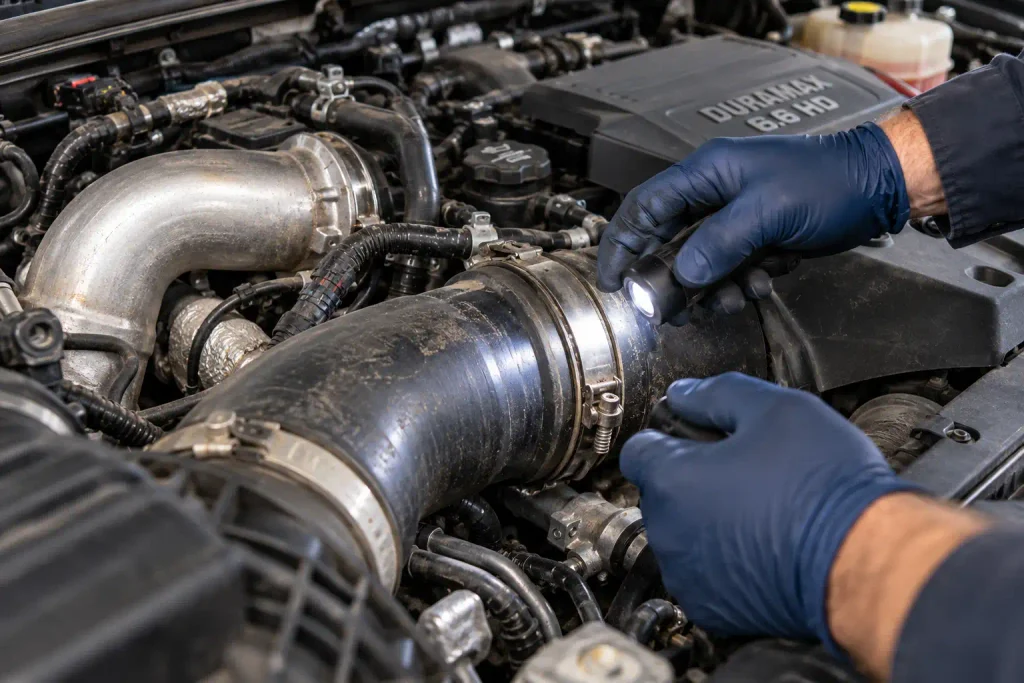
If your truck hisses under acceleration and feels weak, inspect the charge-air system before condemning the turbocharger. Pressurized air travels from the turbocharger through charge-air pipes and the intercooler before entering the engine.
Look for loose clamps, displaced couplers, split rubber boots, rubbed-through pipes, and connections that have moved out of alignment. An oily stain around a joint may help locate a leak, but residue alone is not proof that the joint is leaking.
On 2017–2019 Silverado 2500HD/3500HD and GMC Sierra 2500HD/3500HD trucks with the 6.6L L5P, GM Bulletin 22-NA-013 identifies loose charge-air-cooler duct connections as a possible cause of P0299 and other codes. GM directs technicians to inspect the turbo outlet, intercooler inlet and outlet, and intake airflow valve connections.
A stationary visual inspection can miss an insecure connection that moves under engine load. GM recommends the specified charge-air-cooler diagnostic test. Have a qualified technician perform any pressurized test using the correct equipment and service limits. Never pressurize the system to a guessed PSI value.
If a leak is confirmed: repair the affected connection or component, then repeat the specified leak test. If no leak is found: evaluate pressure-sensor data and other diagnostic branches.
If P0299 Appears With MAP Codes Inspect Wiring


The manifold absolute pressure (MAP) sensor helps the ECM determine intake pressure. A poor electrical connection or an inaccurate pressure signal can make genuine boost performance difficult to assess.
On 2011–2012 LML and LGH Duramax applications, GM Preliminary Information PI0759 addresses intermittent MAP sensor connector terminal-crimp problems. The bulletin references P0106, P0107, P0108, P0299, and P2263, but its troubleshooting path is conditional.
Specifically, when P0299 occurs with P0106 or P2263, GM directs technicians to inspect the intake and charge-air system for leaks first. If no leaks are found, the bulletin calls for a replacement MAP connector pigtail. The 2012 document lists part number 13580231. Confirm any current supersession and VIN fitment before ordering.
If P0299 is the only code, PI0759 directs technicians back to the normal diagnostic trouble code procedure. It does not authorize replacing a connector simply because underboost was detected.
Compare the relevant pressure readings and inspect the connector and wiring before replacing a MAP sensor. Our Duramax boost pressure sensor location guide explains how locations differ among engine generations.
If those checks pass, investigate exhaust leaks and turbo control.
If LML Duramax Smells of Exhaust Inspect EGR Piping


If a 2011–2016 6.6L Duramax HD has P0299 or P2263 alongside an exhaust smell in the cabin, reduced power, or a whistle under acceleration, inspect the Exhaust Gas Recirculation (EGR) bypass pipe.
GM Bulletin 17-NA-161 identifies a cracked EGR cooler bypass pipe as one possible cause on applicable Silverado and Sierra 2500/3500 trucks. GM’s correction is to replace the EGR valve pipe, not to replace the turbocharger without testing. The original bulletin lists pipe part number 12632253, which should be checked for current availability and supersession.
An exhaust leak before the turbocharger can affect the exhaust energy available to drive it. However, an exhaust smell by itself does not prove that this specific pipe has cracked.
If exhaust fumes enter the cabin: stop using the truck until the leak is assessed. Do not substitute an emissions delete for the documented repair. Otherwise, continue the appropriate diagnostic procedure.
If Boost Stays Low Check Duramax Turbo Controls
When charge-air leaks, relevant exhaust leaks, and sensor problems have been ruled out, assess turbocharger control. A low-boost reading alone is not evidence that the turbocharger assembly needs replacement.
Commanded and Actual Vane Position
The LB7 uses different turbocharger hardware from the variable-geometry systems introduced with the LLY. On Duramax engines equipped with a variable geometry turbocharger (VGT), the ECM changes vane position to control exhaust flow through the turbine.
With an appropriate bidirectional scan tool, a technician can compare requested and reported vane position under the manufacturer’s test conditions. A persistent mismatch may point toward the position-sensing circuit, actuator or control mechanism. It does not identify one failed part by itself.
Turbocharger Actuator Control Faults
Record associated actuator or turbo-control codes before clearing them. Check wiring, connectors, control response, and any engine-specific learn or calibration requirements. Do not apply one generation’s vane-position percentages or actuator replacement procedure to another generation.
A generic scanner may not expose this data. Use a diesel specialist if the required tests are unavailable.
Mechanical Turbocharger Damage
Grinding, scraping, abnormal shaft noise, oil consumption, or visible compressor damage warrants professional inspection. The technician should assess lubrication, compressor condition, and any restrictions or leaks before choosing a repair.
Replacing an unproven turbo can leave the original fault unresolved.
When 3.0L Duramax P0299 Requires Special Checks
The 3.0L Duramax inline-six needs its own RPO-specific service information.
LM2 Turbo Actuator Bolt Concerns
For applicable 2020–2022 Chevrolet Silverado 1500 and GMC Sierra 1500 models with the 3.0L LM2, GM Bulletin 22-NA-021 addresses reduced performance with P003A, P0046, P0299, or P0234.
GM directs technicians to inspect the three turbocharger actuator mounting bolts. If any bolt is not fully seated, the bulletin specifies turbocharger replacement. If all three bolts are seated, the bulletin does not apply and normal diagnosis continues. Do not simply tighten suspect bolts and assume the repair is complete.
LZ0 Underboost Diagnosis
On 2023 and newer 3.0L LZ0 applications, do not assume an LM2-specific bulletin applies. Confirm the exact engine and scan all available codes, then follow the LZ0 diagnostic instructions for charge-air, sensor, and turbo-control faults.
A technical bulletin describes a possible condition on certain trucks, not an automatic diagnosis for every vehicle with the same code.
How to Diagnose P0299 Duramax in Five Steps
The most efficient process is evidence-led, not a fixed order of replacing parts. Use the symptoms to choose the next test.
- Identify the truck. Record model year, engine RPO, mileage, modifications, and whether it is a 6.6L or 3.0L Duramax. Save stored, pending, and history codes with freeze-frame data.
- Inspect for obvious leaks. With the engine off and cool, check intake boots, charge-air pipes, clamps, and accessible exhaust joints. Do not touch hot exhaust or moving turbocharger components.
- Check pressure data. Compare MAP, BARO, desired boost, and actual boost only when the scanner and service procedure specify compatible values and operating conditions.
- Follow the matching branch. Test the charge-air system for hissing, MAP circuits for relevant sensor codes, EGR piping for applicable LML symptoms, or turbo controls when the other systems pass.
- Verify the repair. Recheck for leaks and codes, then follow the OEM drive cycle or service test to confirm the original underboost condition no longer occurs.
If your scanner displays 07E8, that is an ECM identifier, not P0299. Our 07E8 engine code explanation explains how to reach the actual stored DTCs.
The following matrix summarizes which test should come next.
| Observed Condition | Next Diagnostic Check | Escalate When |
|---|---|---|
| Hissing or oil-stained charge-air joint | Inspect boots, clamps, and pressure-test charge-air system | Leak location or safe test pressure is uncertain |
| P0299 with P0106 or P2263 on applicable LML/LGH | Follow GM PI0759 after intake leak checks | Connector/wiring repair is required |
| Exhaust smell and whistle on 2011–2016 HD | Inspect EGR cooler bypass pipe | Fumes enter cabin or pipe is cracked |
| Low boost with no detected leaks | Review MAP data and VGT control results | Manufacturer-level scan tests are required |
| P003A, P0046, P0299, or P0234 on applicable LM2 | Have actuator bolts inspected per GM guidance | Any mounting bolt is not fully seated |
| Scraping noise, heavy smoke, or oil loss | Stop driving and inspect turbo/lubrication system | Mechanical damage is suspected |
For engine-specific MAP and other sensor positions, consult the 6.6 Duramax sensor location diagram rather than following a diagram for the wrong model year.
What Does a P0299 Duramax Repair Cost
There is no single P0299 repair price. The code describes underboost, not a specific failed component. A loose connection, damaged pipe, wiring repair, and failed turbocharger have very different parts and labor requirements.
Here are documented cost and labor reference points, not a flat quote for every Duramax:
| Repair or Service | Verified Reference | What It Means |
|---|---|---|
| Charge-air duct connection repair, applicable 2017–2019 L5P | GM 22-NA-013 lists 0.8 labor hour for its bulletin-specific operation | Labor time is not a universal retail repair price |
| MAP connector pigtail, applicable 2011–2012 LML/LGH | GM PI0759 identifies original connector 13580231 | Check updated part number and local labor quote |
| EGR bypass pipe, applicable 2011–2016 HD | GM 17-NA-161 lists original pipe 12632253 | Parts and access costs vary with VIN and shop |
| Turbocharger assembly replacement, Chevrolet Silverado 3500 HD | RepairPal’s January 28, 2026 estimate is $3,955–$5,150, including $1,369–$2,009 labor and $2,585–$3,140 parts | Model-level estimate, not a confirmed quote for your engine or location |
The RepairPal estimate excludes taxes, fees, and related repairs. Get a written, VIN-specific diagnosis and quote before approving a turbocharger replacement. If the concern is limited to a boot or clamp, a complete turbo replacement is not a reasonable starting assumption.
When to Stop Driving With P0299 Duramax
A truck with mild underboost symptoms may still move, but you cannot assume that continued driving is safe. Avoid towing, steep grades, hard acceleration, and other heavy engine loads until the cause is known.
Stop driving and arrange inspection or towing if power loss makes traffic maneuvers unsafe, the turbo makes scraping noises, heavy smoke develops, engine oil level drops, or exhaust fumes enter the cab. Continued operation could worsen a mechanical fault or expose occupants to exhaust gases.
Even if the truck runs normally, record the codes and arrange diagnosis. Clearing P0299 does not repair underboost.
How to Confirm Your Duramax Underboost Repair Worked
A successful repair eliminates the underboost condition, not just the dashboard warning.
After the confirmed fault is repaired, recheck the affected piping, wiring, or turbo-control system. Clear codes only after saving the original diagnostic information. Then repeat the applicable GM verification procedure and review the same live-data values under safe, specified conditions.
On trucks requiring a turbocharger learn or calibration, use the matching service procedure. If P0299 returns, retain the new freeze-frame data and resume diagnosis rather than replacing another part on speculation.
What to Do Next With P0299 Duramax
The P0299 Duramax code tells you boost is lower than expected. It does not tell you whether the cause is a leaking intercooler connection, a faulty pressure signal, an exhaust leak, or a turbo-control problem. Those possibilities require different tests and repairs.
Identify the engine generation first. Check accompanying codes and freeze-frame data, then follow the diagnostic branch that matches the symptoms. The 2011–2012 LML/LGH, 2011–2016 HD, 2017–2019 L5P, and 2020–2022 LM2 bulletins offer useful clues only on vehicles to which they apply.
Start with documented inspections, confirm the failed component, and use a qualified diesel technician when specialized testing or major repair is required. That is the safest way to solve P0299 without paying for unnecessary parts.
Five Common P0299 Duramax Questions Answered
What Does P0299 Mean on a Duramax Diesel
P0299 indicates turbocharger engine underboost. Actual pressure is lower than expected. It does not necessarily mean the turbo failed. Check the additional codes and data.
Can I Drive My Duramax With a P0299 Code
Do not assume it is safe to continue driving with P0299. Mild symptoms still need diagnosis, and heavy towing should be avoided. Stop driving if you experience severe power loss, unusual turbo noise, heavy smoke, oil loss, or exhaust fumes inside the cab.
Can a Boost Leak Cause P0299 on a Duramax
Yes. A loose clamp, split charge-air boot, disconnected duct, or damaged intercooler can prevent the intake from reaching expected boost. GM specifically documents charge-air connection concerns on certain 2017–2019 L5P trucks. A proper leak test should confirm the fault before replacing parts.
Does P0299 Mean My Duramax Turbo Is Bad
No. P0299 alone cannot distinguish a failed turbocharger from a pressure-sensor issue, charge-air leak, exhaust leak, or control fault. Assess the related systems first. Turbo replacement is appropriate only when the diagnosis or an applicable GM service procedure supports it.
Can a Dirty MAP Sensor Cause P0299 on a Duramax
An inaccurate MAP reading can contribute to an underboost diagnosis, but dirt on the sensor is not proof of the problem. Check related MAP codes, measured pressure, wiring, and intake leaks. On certain 2011–2012 LML/LGH trucks, GM documents a connector-crimp issue under specific diagnostic conditions.