
R1 Concepts vs. PowerStop: The Ultimate Brake Kit Comparison (2025-2026)

The modern automotive aftermarket for braking components has evolved from a simple replacement parts industry into a sophisticated sector driven by application-specific engineering. Nowhere is this evolution more critical than in the light truck, SUV, and heavy-duty towing segments. As vehicle manufacturers push the Gross Vehicle Weight Ratings (GVWR) of half-ton and three-quarter-ton trucks ever higher,
the stock braking systems—often designed with a compromise between cost, noise, and performance—frequently become the limiting factor in vehicle safety and capability.


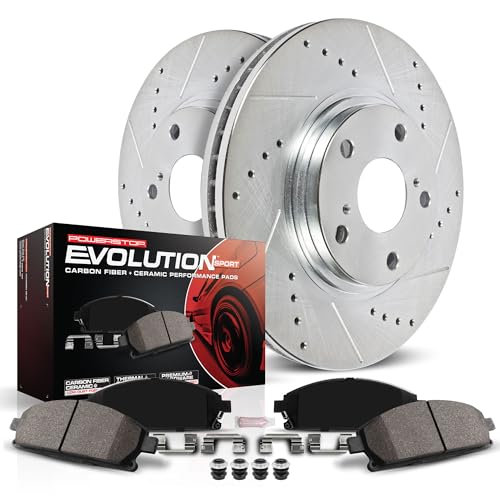
This report presents a comprehensive, data-driven analysis of two market leaders in this space: PowerStop and R1 Concepts. While both companies target the “prosumer” demographic—offering upgrades over Original Equipment Manufacturer (OEM) specifications—their engineering philosophies, metallurgical choices, and friction material formulations diverge significantly.
By synthesizing technical specifications, metallurgical data, independent corrosion testing (ASTM B117), and aggregated field performance data, this report aims to provide a definitive guide for consumers seeking to optimize their vehicle’s stopping power under high-load conditions.
The Physics of Inertia and Thermal Management
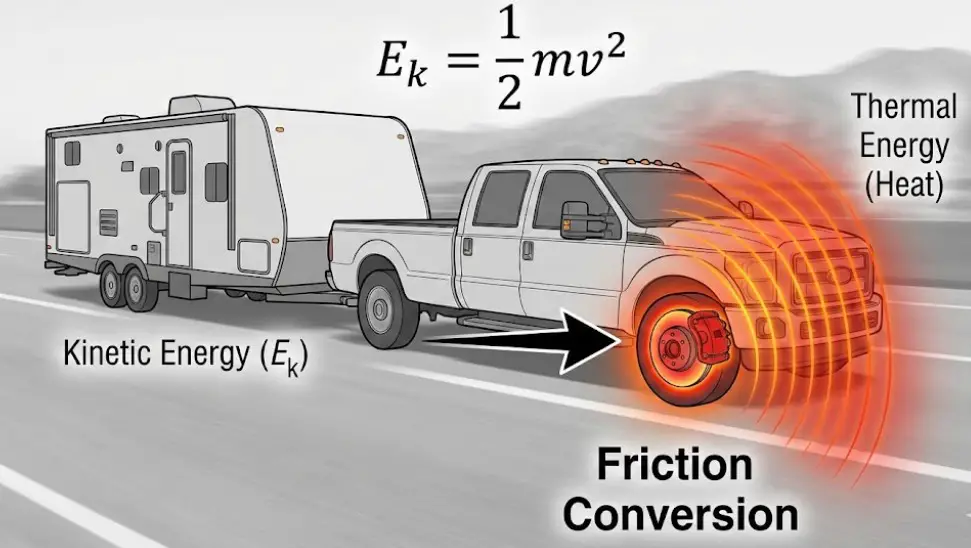
To understand the comparative advantages of R1 Concepts and PowerStop, one must first ground the discussion in the physics of braking. A braking system is fundamentally an energy conversion device, transforming the kinetic energy ($E_k$) of a moving vehicle into thermal energy through friction. The magnitude of this energy is governed by the equation:
$$E_k = \frac{1}{2}mv^2$$
In towing scenarios, the mass ($m$) variable nearly doubles. For a standard Ford F-150 weighing approximately 5,000 lbs towing a 7,000 lb travel trailer, the braking system must dissipate more than twice the thermal load of the unladen vehicle. This exponential relationship between speed and energy, combined with the linear increase in mass, places extreme stress on the rotor’s ability to act as a heat sink and the pad’s ability to maintain a consistent coefficient of friction ($\mu$).
The primary failure mode in these applications is brake fade, which manifests in two distinct forms:
- Friction Fade: Occurs when the brake pad interface exceeds its maximum operating temperature, causing the binding resins to outgas and create a lubricating boundary layer.
- Fluid Fade: Occurs when radiant heat transfers to the hydraulic fluid, causing it to boil and become compressible.
Both PowerStop and R1 Concepts market distinct technologies—drilled and slotted rotors, carbon-fiber reinforcement, and semi-metallic formulations—specifically engineered to mitigate these thermodynamic failures.
R1 CONCEPTS VS POWERSTOP
The Battle for Your Wheel Well: Customization vs. The “1-Click” Solution.
The Contenders
Before diving into the technical data, it is crucial to understand the philosophy behind each brand. R1 Concepts focuses on extensive customization and aesthetic options for the enthusiast, while PowerStop built its empire on the “1-Click Kit” concept—simplifying the buying process for DIYers.
R1 Concepts
🛠️- ➤ Strength: Massive rotor catalog & drill patterns.
- ➤ Tech: “Geo-Met” anti-rust coating.
- ➤ Best For: Aesthetics & specific fitments.
PowerStop
🛑- ➤ Strength: All-in-one “1-Click” Kits.
- ➤ Tech: Carbon-Fiber Ceramic pads (Z23/Z26).
- ➤ Best For: Towing, hauling, & easy upgrades.
Performance Matrix
We analyzed five critical performance vectors: Initial Bite, Dust Control, Noise Reduction, Rotor Longevity, and Price Value.
Key Takeaway
PowerStop (Red) leads slightly in Initial Bite due to their Carbon-Fiber infusion, making them ideal for heavy trucks. R1 Concepts (Blue) excels in Longevity thanks to their superior Geo-Met coating technology.
Cost Analysis: The “Wallet Feel”
Comparing the average street price for a full kit (Rotors + Pads, Front & Rear) across three popular vehicle categories. While prices fluctuate, PowerStop generally commands a premium for their Z36 Truck lines.
*Prices are estimates based on 2024/2025 market averages for complete 4-wheel kits.
Target Audience Breakdown
Understanding who buys these brakes reveals their strengths. R1 has a massive following in the “Show Car” and daily commuter segment, whereas PowerStop dominates the truck and towing niche.
R1 Concepts Focus
Heavily skewed towards visual customization and daily reliability.
PowerStop Focus
Dominated by the “Z36 Truck & Tow” and “Z23 Evolution” performance lines.
Final Verdict: Which Kit Do You Need?
Follow the path to find your ideal braking partner.
© 2026 TruckGuider Analysis. Data compiled from manufacturer specifications and aggregate user sentiment.


Manufacturer Profiles and Market Philosophy
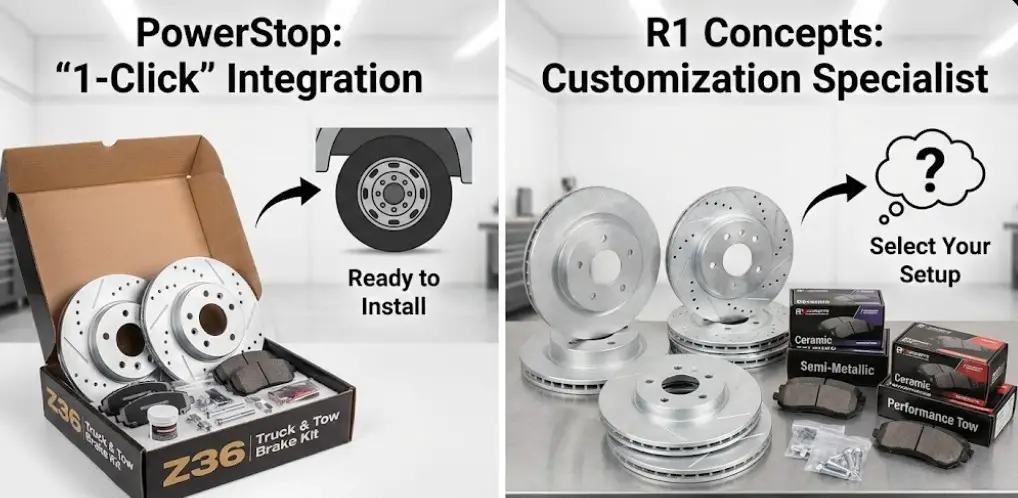
The divergence between R1 Concepts and PowerStop is not merely a matter of part numbers but of fundamental business philosophy and target consumer experience.
PowerStop: The "1-Click" Integration Specialist
PowerStop has effectively defined the "brake kit" market segment. Their business model is predicated on removing the technical guesswork for the consumer. By bundling application-specific rotors, pads, and often calipers into a single Stock Keeping Unit (SKU), they offer a "1-Click Brake Kit" solution.
Core Philosophy: Integration and Convenience. PowerStop’s engineering focus is on the holistic system. Their flagship Z36 Truck & Tow line ensures that the rotor metallurgy and pad deposition layer are compatible out of the box. This approach appeals strongly to the DIY mechanic looking for a "set it and forget it" upgrade.
Certification and Validation: PowerStop places a heavy emphasis on third-party validation, citing tests conducted in Los Angeles that verify their low-dust claims and noise reduction capabilities. They are an AMECA (Automotive Manufacturers Equipment Compliance Agency) certified manufacturer, ensuring compliance with friction material environmental regulations.
R1 Concepts: The Customization and Metallurgy Specialist
R1 Concepts, while also offering kits, operates with a philosophy closer to a tuner shop. They offer a higher degree of granularity, allowing users to mix and match rotor patterns (blank, drilled, slotted, or both) with specific friction compounds.
Core Philosophy: Material Science and Specificity. R1 Concepts differentiates itself through superior corrosion protection technologies (GEOMET®) and a broader portfolio of friction materials, including true semi-metallic pads for severe-duty applications.
Target Demographic: R1 appeals to the enthusiast who understands the specific trade-offs of braking dynamics—for instance, a user who might prefer the structural integrity of a blank rotor over the cooling benefits of a drilled one, or who prioritizes the cold bite of semi-metallics over the clean wheels of ceramics.
Metallurgical Analysis: Rotors and Thermal Dissipation
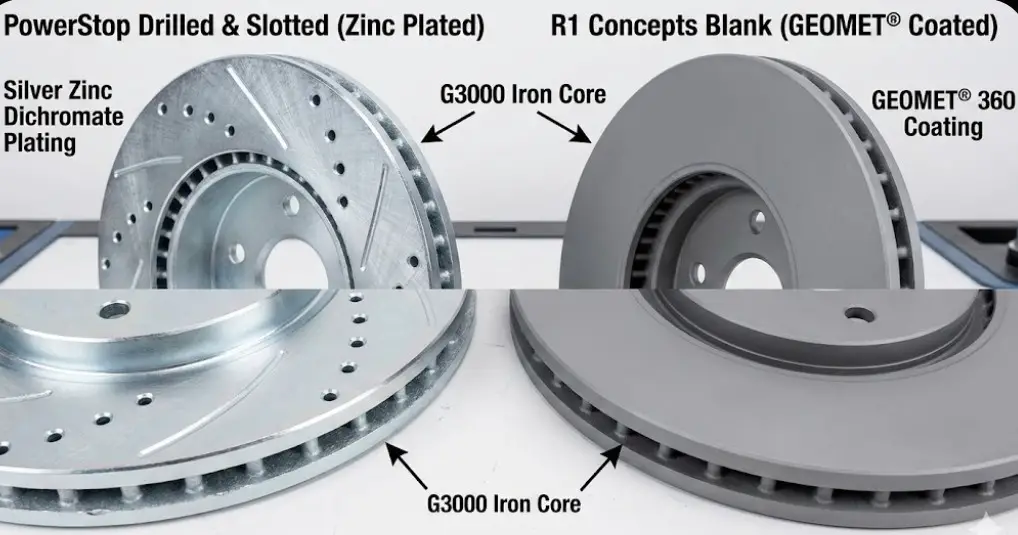
The brake rotor serves as the primary heat sink for the braking system. While both manufacturers utilize G3000-grade grey iron castings—the industry standard for thermal conductivity and vibration damping—their post-casting processing and finishing treatments reveal significant differences in performance and longevity.
Cast Iron G3000 Metallurgy
Both PowerStop and R1 Concepts utilize G3000 iron. This specification refers to a grey iron alloy with a laminar graphite microstructure, which offers excellent thermal conductivity and damping capacity (reducing squeal).
- R1 Concepts: Markets their rotors under the "Carbon GEOMET" banner. High-carbon iron is generally preferred in performance applications because the increased carbon content raises the thermal capacity and resistance to thermal shock (cracking).
- PowerStop: Focuses on precision machining and balancing, ensuring runout is minimized to prevent pedal pulsation (DTV - Disc Thickness Variation).
Machining Configurations: Drilled, Slotted, and Blanks
The geometric configuration of the rotor face is critical for gas management and bite.
Table 1: Rotor Configuration Comparison
| Feature | PowerStop (Evolution) | R1 Concepts (eLINE / Carbon GEOMET) | Technical Implication |
| Drilled Holes | Standard on Z36/Z23 | Optional | Holes increase surface area for cooling but can act as stress raisers, promoting cracking under extreme thermal cycling. |
| Slots | Standard on Z36/Z23 | Optional ("Diamond Slot" available) | Slots wipe the pad face clean of debris and vent superheated boundary layer gases, preventing friction fade. |
| Chamfering | Yes | Yes | Essential to reduce stress concentrations at the drill holes. |
| Blank Options | Limited (OE Replacement) | Extensive (Geomet Series) | Blank rotors provide maximum thermal mass and structural integrity, preferred for pure longevity or track use. |
Corrosion Science: Zinc Dichromate vs. GEOMET® 360
This is arguably the most significant technical differentiator between the two brands, particularly for users in the "Salt Belt" or coastal regions.
PowerStop: Silver Zinc Dichromate Plating PowerStop utilizes a silver zinc dichromate plating on their Evolution series rotors.
- Mechanism: Zinc plating acts as a sacrificial anode. In the presence of electrolytes (saltwater), the zinc oxidizes preferentially to the iron substrate.
- ASTM B117 Performance: Standard zinc electroplating typically survives 240 to 480 hours in salt spray testing before the appearance of red rust.
- Limitations: Electroplating can induce hydrogen embrittlement if not properly baked. The protection is generally thinner and less durable than flake coatings.
R1 Concepts: GEOMET® 360 Coating R1 Concepts heavily markets their Geomet Series. GEOMET® is a proprietary water-based zinc-aluminum flake coating.
- Mechanism: The coating consists of overlapping zinc and aluminum flakes in an inorganic binder. The flakes provide a tortuous path for electrolytes, while the zinc provides galvanic protection and the aluminum provides barrier protection.
- ASTM B117 Performance: GEOMET® 360 is rated for 720 to 1,000+ hours of salt spray resistance.
- Advantages: It is non-electrolytically applied, eliminating hydrogen embrittlement risks. It withstands higher temperatures (up to 300°C) without degrading, maintaining protection even after heavy braking events.
Tribology and Friction Material Science (Pads)
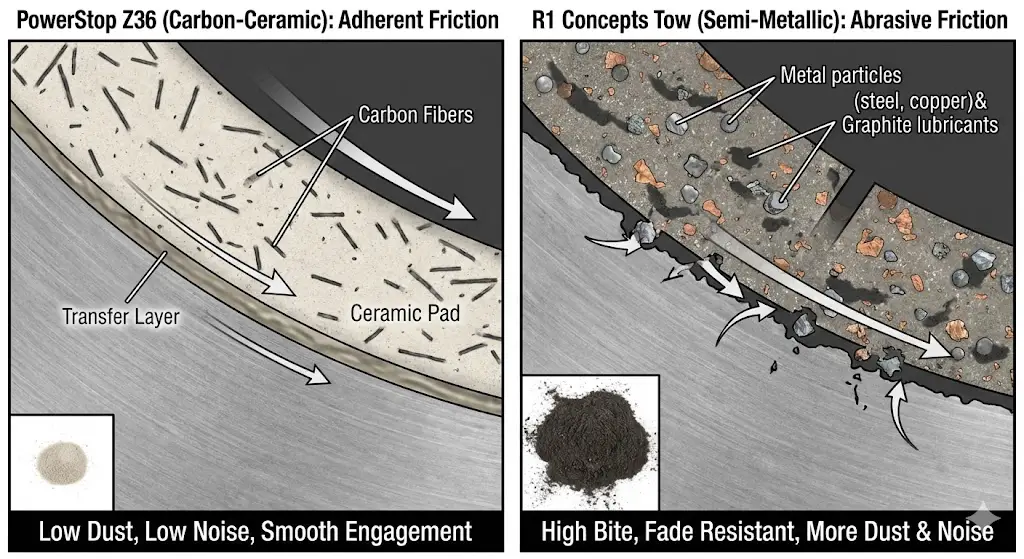
The friction material is the heart of the braking system. The choice between Ceramic and Semi-Metallic compounds represents a fundamental trade-off between comfort (NVH) and raw stopping power.
PowerStop Z36: The Carbon-Fiber Ceramic Paradigm
The Z36 pad is the cornerstone of PowerStop's towing lineup.
- Composition: A ceramic base reinforced with carbon fibers.
- Tribological Mechanism: Ceramic pads rely largely on "adherent friction," where a thin layer of pad material transfers to the rotor face. Breaking involves breaking the bonds within this transfer layer.
- Performance Profile:
- Dust: Extremely low. The dust produced is light-colored and non-ferrous, meaning it does not etch into alloy wheels.
- Noise: Excellent. Ceramics naturally dampen high-frequency vibrations.
- Thermal Stability: The carbon fiber reinforcement raises the thermal threshold significantly above standard OEM ceramics, allowing for towing without immediate fade.
- Limitations: Ceramics generally have lower "cold bite" (initial friction coefficient at low temps) and can glaze over if pushed beyond their thermal limit in severe-duty applications.
R1 Concepts Performance Off-Road/Tow: The Semi-Metallic Paradigm
R1 Concepts explicitly uses a Semi-Metallic formulation for their dedicated tow/off-road pads.
- Composition: A matrix of sintered metals (steel, iron, copper) combined with graphite lubricants and friction modifiers.
- Tribological Mechanism: Semi-metallics rely more on "abrasive friction," where the hard metal particles physically grip the rotor surface.
- Performance Profile:
- Bite: High static and dynamic friction coefficients. They provide an immediate, firm pedal feel even when cold.
- Thermal Capacity: Metal is an excellent thermal conductor. These pads help pull heat away from the interface and into the backing plate/caliper (though this requires good fluid maintenance). They resist fade at temperatures that would liquefy ceramic resins.
- Dust and Noise: High. The abrasion produces dark, ferrous dust that can be corrosive to wheels. Metal-on-metal contact is inherently louder.
Data-Driven Comparison: Fade Resistance and Towing
The implications of these material choices are profound for towing.


- Scenario A: The Weekend Camper. For a driver towing a moderate load (e.g., 4,000 lbs) periodically, the PowerStop Z36 is superior. It offers sufficient thermal capacity to prevent fade during normal descents while maintaining the daily drivability (clean wheels, no noise) of a passenger car.
- Scenario B: The Severe Duty Hauler. For a driver towing near GCWR (e.g., 10,000+ lbs) or traversing steep grades like the Rockies, the R1 Concepts Semi-Metallic is the safer choice. As temperatures climb past 800°F, the semi-metallic compound maintains its friction coefficient, whereas ceramic compounds may begin to experience a drop-off.
Table 2: Friction Material Comparative Matrix
| Metric | PowerStop Z36 (Carbon-Ceramic) | R1 Concepts Tow (Semi-Metallic) |
| Cold Bite | Moderate | High |
| High-Temp Fade Resistance | Good (Upgraded) | Excellent (Severe Duty) |
| Brake Dust | Low (30% less than OE) | Moderate/High |
| Rotor Wear | Low (Gentle) | High (Abrasive) |
| Noise Probability | Low | Moderate |
| Best Application | Daily Driving / Light-Med Towing | Heavy Towing / Off-Road / Big Tires |
System Integration and Engineering
Beyond the core components, the engineering of the complete system affects installation and long-term reliability.
Caliper Integration and Restoration Kits
One of PowerStop's most significant market advantages is the availability of kits that include powder-coated calipers.
- The Problem: On older trucks, the original calipers often have seized guide pins or corroded pistons. Installing new pads/rotors on bad calipers is futile.
- PowerStop Solution: The Z36 kit can be ordered with remanufactured calipers finished in high-heat red electrostatic powder coating. This simplifies the restoration process for older trucks.
- R1 Concepts Position: While R1 sells calipers, their primary marketing focus remains on the pad/rotor hardware. They do not have the same level of market penetration with "caliper-inclusive" kits as PowerStop.
Hardware and NVH Control
Both manufacturers include stainless steel hardware kits (abutment clips, pin boots) with their pads. This is critical because reusing old, fatigued clips is a primary cause of brake drag and noise.
- Shim Technology: PowerStop utilizes stainless steel shims that are often rubberized or multi-layered to dampen vibration. R1 Concepts also employs noise-reducing shims, though reports on their specific composition are less prominent in the technical literature.
The Consumer Experience: Installation and Burnishing
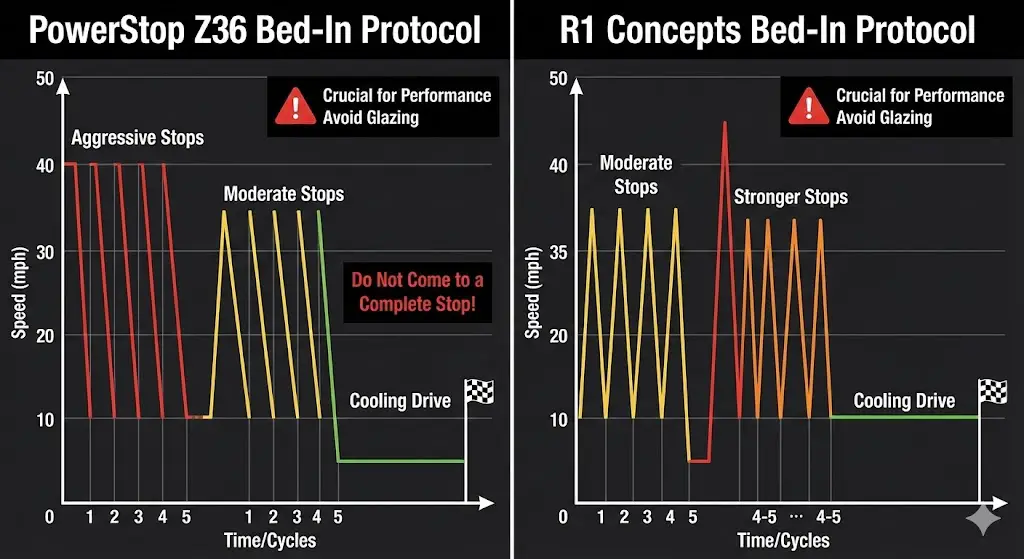
The performance of any high-friction brake setup is contingent upon proper installation and, crucially, the "bed-in" or burnishing process.
The Criticality of Bed-In Procedures
Both R1 and PowerStop emphasize that their pads must be bedded in to function correctly. This process heats the pads to cure the bonding resins and transfers a friction layer to the rotor.
- PowerStop Protocol: 5 aggressive stops from 40 mph to 10 mph (without full stop), followed by 5 moderate stops from 35 mph to 5 mph, then a cooling drive.
- R1 Concepts Protocol: 4-5 moderate stops from 35 mph to 5 mph, followed by 4-5 stronger stops from 45 mph to 10 mph, then cooling.
Analysis of Failure Modes: Forum analysis reveals that many negative reviews for PowerStop (e.g., "warped rotors after 5k miles") are actually cases of uneven pad deposition due to improper bed-in. The resin-heavy nature of the Z36 ceramic pad makes it intolerant of improper burnishing. If the driver comes to a complete stop while the brakes are scorching hot during bed-in, the pad leaves an imprint on the rotor, creating high spots that feel like warping (judder). R1's semi-metallic pads, being more abrasive, effectively "scrub" the rotor surface continuously, making them slightly more forgiving of imperfect transfer layers, though they still require bed-in for thermal stability.
Installation Pitfalls: The Electric Parking Brake (EPB)
A recurring theme in consumer feedback, particularly for late-model Ford F-150 owners, is confusion regarding Electric Parking Brakes (EPB).
- Issue: Ford trucks from 2015+ can have either mechanical or electric parking brakes. The rotor hat dimensions differ slightly.
- Consumer Feedback: There are reports of R1 Concepts' supply chain or cataloging occasionally causing confusion or shipping incorrect parts for specific EPB configurations. PowerStop's "1-Click" system attempts to mitigate this by having very specific VIN-based kit selectors, but user error remains a high risk for both brands.
Field Performance and Reliability: A Meta-Analysis of User Feedback
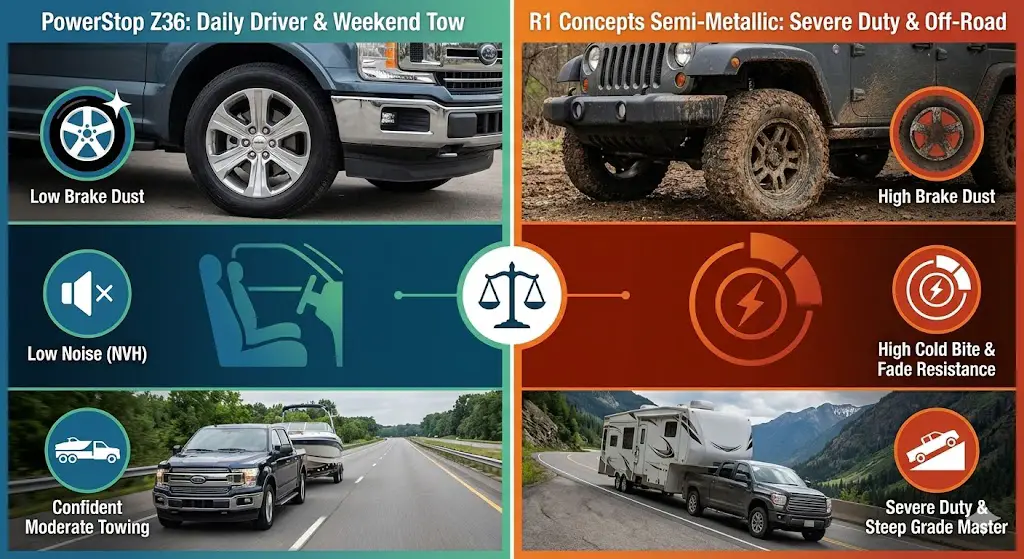
To validate the engineering claims, we analyzed user sentiment from automotive forums (Reddit r/F250, r/Toyota, r/4Runner) and field tests.
Towing Performance Reviews
- PowerStop Z36: Users consistently report a transformation in braking confidence. One F-250 owner noted, "The truck handled braking with the trailer down 6% grades in Cali better than the foothills of the Appalachians with my stock brakes". Another user towing a travel trailer reported zero fade over a 7,000 km review period. The consensus is that Z36 eliminates the "white knuckle" experience of towing with stock organic pads.
- R1 Concepts: Feedback from the "heavy duty" community highlights the consistency of the R1 semi-metallic pads. Users with lifted 4Runners and Jeeps—vehicles where large tires act as massive lever arms against the brakes—praise the "bite" of the R1 setup. The ability to lock up 35-inch tires on a steep incline is a specific performance metric where the R1 semi-metallic excels over ceramics.
Longevity and Wear Patterns
- PowerStop: Generally viewed as a high-mileage pad. The ceramic compound is gentle on rotors. However, in severe rust belts, the rotors often fail (corrode) before the pads wear out.
- R1 Concepts: Users of the Geomet rotors report excellent long-term visual appeal. "Typical rotors in the winter... have that squeal where you're breaking the rust off... the Geos never had that problem". This validates the ASTM B117 data regarding Geomet's superiority.
Noise and Dust
- PowerStop: Universally praised for low dust. "Added bonus is, no more brake dust all over the wheels".
- R1 Concepts: Mixed reviews on dust. Users of the Performance Off-Road (semi-metallic) pads accept dust as a trade-off for performance. However, users of R1's Ceramic line report similar low-dust properties to PowerStop.
Economic Analysis and Value Proposition
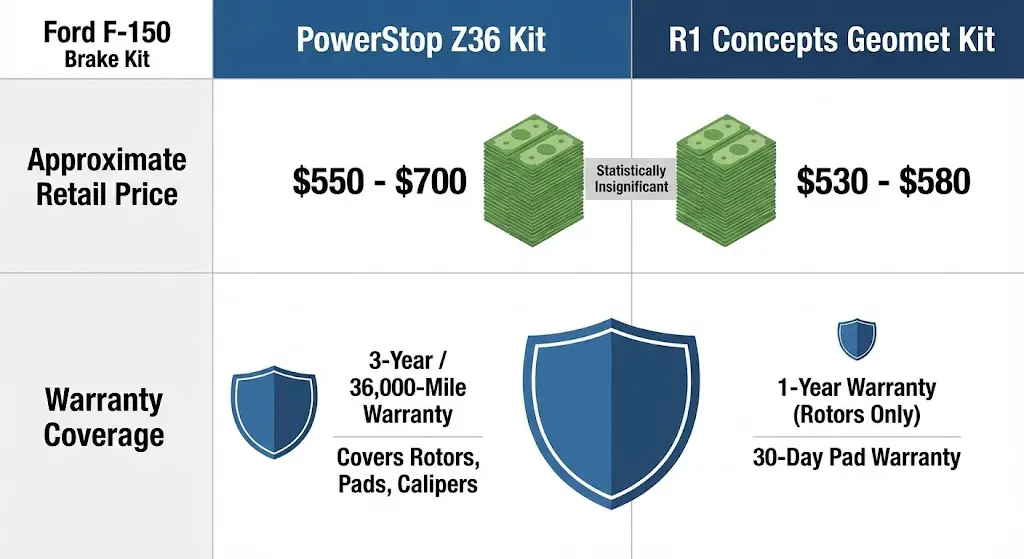
Price Comparison
Both brands offer high value compared to OEM dealership pricing.
- PowerStop Z36 Kit (F-150): Retail price hovers around $550 - $700 for a complete front and rear kit (rotors + pads).
- R1 Concepts Geomet Kit (F-150): Pricing is highly competitive, often found between $530 - $580 for a comparable setup. Specific forum users have noted price points as close as $5 difference between the brands ($177 vs $172).
Conclusion: The price delta is statistically insignificant. The purchasing decision should be driven by technical requirements rather than cost.
Warranty Architecture
- PowerStop: Offers a robust 3-Year / 36,000-Mile Warranty on their brake kits. This is comprehensive and covers rotor cracking and caliper function. They also offer a 60-day "hassle-free" exchange.
- R1 Concepts: Offers a 1-Year (365 Day) Warranty on rotors against warping and defects. Pads are typically covered for 30 days against defects.
- Analysis: PowerStop offers a significantly stronger warranty, suggesting higher confidence in the longevity of their components as a system. R1's warranty is standard for the industry but falls short of PowerStop's "prosumer" guarantee.
Conclusion and Strategic Recommendations
The data indicates that while both PowerStop and R1 Concepts offer significant upgrades over OEM braking performance, they serve distinct niches within the heavy-duty ecosystem. The choice is not binary but dependent on the user's specific environmental and operational variables.
The Verdict for Daily Drivers and Weekend Towing
Winner: PowerStop Z36 Extreme Truck & Tow
For the driver who uses their truck as a daily commuter and tows a boat or camper on weekends, the PowerStop Z36 is the superior holistic solution.
- Reasoning: The carbon-fiber ceramic formulation provides the necessary thermal capacity for towing without the penalties of brake dust and noise. The comprehensive warranty and "1-Click" simplicity make it the risk-averse choice.
- Ideal User: Ford F-150 owner, towing <8,000 lbs, living in non-rust-belt states.
The Verdict for Severe Duty and Lifted Rigs
Winner: R1 Concepts Performance Off-Road/Tow
For the dedicated work truck, the lifted off-roader, or the heavy hauler traversing mountain passes, R1 Concepts takes the technical lead.
- Reasoning: The semi-metallic friction material offers superior fade resistance and cold bite, critical for stopping heavy loads on steep grades or arresting large tires. The trade-off in dust is acceptable for the performance gain.
- Ideal User: Lifted Jeep Wrangler, Contractor Hauler, Mountain Resident.
The Verdict for the "Salt Belt"
Winner: R1 Concepts GEOMET® Series
Regardless of the friction material chosen, the R1 Geomet rotor is the mandatory choice for anyone living in areas with heavy road salt usage.


- Reasoning: The ASTM B117 data is conclusive: GEOMET® 360 provides nearly double the corrosion resistance of the zinc dichromate plating found on PowerStop rotors. A hybrid setup—using R1 Geomet rotors paired with a high-quality pad (even PowerStop's Z36 pads)—represents the theoretical "ultimate" braking system for northern climates.
Final Summary Table
| User Profile | Recommended System | Key Technical Reason |
| Daily Driver / Light Towing | PowerStop Z36 | Low Dust, Low Noise, Good Fade Resistance. |
| Heavy Towing / Mountains | R1 Concepts Tow Series | Semi-Metallic compound resists fade >800°F. |
| Off-Road / Lifted Tires | R1 Concepts Tow Series | Higher static friction offsets leverage of large tires. |
| Rust Belt Resident | R1 Concepts GEOMET | 720+ Hour Salt Spray Rating vs. 240 for Zinc. |
| Older Truck Restoration | PowerStop Kit w/ Calipers | Includes powder-coated calipers for easy refresh. |
Critical User Questions (FAQ)
Q: Can I use PowerStop pads with R1 Concepts rotors?
A: Yes. This "hybrid" approach is popular among enthusiasts. Pairing R1's Geomet rotors (for rust protection) with PowerStop's Z36 pads (for low dust) creates a system that resists corrosion while keeping wheels clean. Ensure you follow the bed-in procedure for the pads (PowerStop's protocol).
Q: Do these brake kits increase my vehicle's towing capacity?
A: No. Towing capacity is determined by the vehicle's chassis, suspension, transmission, and cooling systems. High-performance brakes increase safety margin and thermal endurance, but they do not legally or mechanically increase the Gross Combined Weight Rating (GCWR).
Q: Why do my new brakes smell hot?
A: This is normal during the bed-in period. The smell is the curing of the binding resins in the pads. It should dissipate after the break-in cycle is complete and the transfer layer is established.
Q: Which rotors are better for cracking resistance?
A: Blank (solid face) rotors are structurally the strongest. Drilled rotors, while offering cooling benefits, are more prone to micro-cracking around the holes under extreme thermal shock. For absolute reliability in severe conditions, R1 Concepts' Blank Geomet rotors are the strongest option.
Report Sources Utilized: through.
![How to Tow a Car with a Truck Long Distance: Step-by-Step Guide [2026]](https://truckguider.com/wp-content/uploads/2026/03/how-to-tow-a-car-with-a-truck-long-dista-featured-1.webp)

![AMP Research PowerStep Maintenance [2026]](https://truckguider.com/wp-content/uploads/2026/03/amp-research-power-step-maintenance-featured.webp)