Toyota Tacoma 2.4L Turbo Problems: 2026 Known Issues & Costs

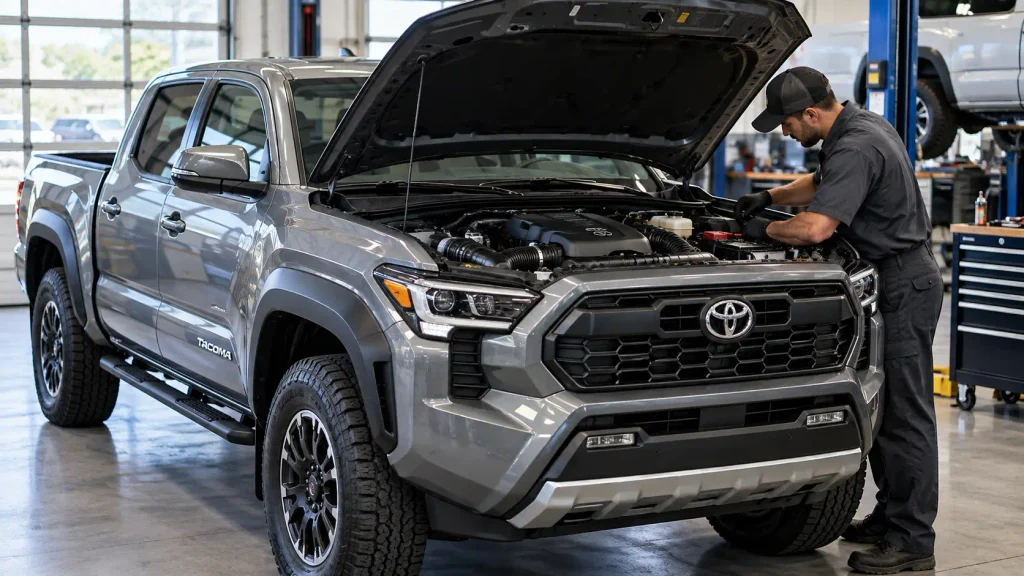
Tacoma 2.4 turbo problems can involve reduced engine power, a check engine light, abnormal noises, or suspected boost-control faults. Some owners have described turbocharger and wastegate failures, but a warning light or sluggish acceleration does not establish that the turbocharger itself has failed.
Toyota has also documented several transmission and accessory-system problems on fourth-generation Tacomas that require different repairs.


Diagnosis depends on your Tacoma’s powertrain, symptoms, and fault codes. This guide separates documented problems from reports and explains the next steps.
2.4L Turbo Symptom Decision Guide


Four common symptom patterns and the right first diagnostic action. Symptoms alone do not confirm turbocharger failure.
Severe power loss, heavy smoke or overheating
Then: Pull over safely. Do not continue towing or hard driving. Seek professional help; tow if driving is unsafe.
Weak acceleration or reduced-engine-power warning
Then: Save DTCs and freeze-frame data. Have the intake plumbing, boost readings and wastegate control tested before replacing parts.
Whining noise or brief engine-bay chirp
Then: Record when the noise occurs. An A/C-triggered chirp may involve the HVAC clutch; other noises need a separate inspection.
Harsh shifts, delayed response or gears not engaging
Then: Read transmission DTCs and review current Toyota guidance for your VIN. Shifting faults do not prove a bad turbo.
Diagnostic triage only. Applies to 2024–2026 Toyota Tacoma 2.4L turbo powertrains; exact procedures vary by configuration. This guide does not diagnose an individual truck.



What Changes Tacoma 2.4 Turbo Diagnosis


The 2024 redesign introduced the 2.4L T24A-FTS turbo four-cylinder in standard i-FORCE and i-FORCE MAX hybrid configurations. Toyota lists up to 278 horsepower and 317 lb-ft for the standard engine and up to 326 horsepower and 465 lb-ft for the hybrid in its 2026 Tacoma specifications.
Identify Your Tacoma Powertrain
Check the model year, trim, transmission, and standard or hybrid powertrain. Automatic and manual transmission problems need different tests.
Our Toyota Tacoma 2.4L turbo engine specifications guide breaks down the output differences, transmission combinations, and model-year configurations.


Check the Warning Light
Distinguish check engine, transmission, reduced-power, and maintenance warnings. Photograph the message and note when it appeared.
Record When Symptoms Occur


Record whether symptoms occur under load, at idle, during shifts, or after a restart. These details guide diagnostic tests.
Which Tacoma 2.4 Turbo Problems Are Documented


Individual turbo and wastegate reports exist, but manufacturer-documented problems also involve other systems.
| Concern | Evidence Available | Correct Interpretation |
|---|---|---|
| Turbo or wastegate failure | Individual owner reports and diagnostic possibilities | A confirmed failure requires vehicle-specific testing; population failure rate is not established |
| 2024 automatic transmission faults | Toyota service bulletin history | Documented transmission concern, not proof of turbo failure |
| 2024 manual shifting failures | Toyota bulletin T-SB-0058-24 | Applies to certain RC60F manual-transmission trucks |
| A/C clutch chirp | Toyota bulletin T-SB-0016-26 | Possible accessory-system noise on some 2024–2026 trucks |
| Active grille shutter warning | Toyota Special Service Campaign 24TC06 | A check engine light can originate outside the turbo system |
Reported Turbo and Wastegate Failures
Some owner discussions describe early wastegate-related faults, including a publicly reported case of a 2025 Tacoma with roughly 4,900 miles receiving a reduced-engine-power warning. The owner said the dealer diagnosed a faulty wastegate and planned a turbo replacement.
This is a self-reported case, not a verified defect rate or evidence that all 2025 Tacomas share the problem.
The wastegate controls turbo boost. Actuator, vacuum, wiring, or sensor faults can disrupt that control without proving internal turbo damage.


Documented Transmission Problems
Toyota documented certain 2024 automatic and manual transmission faults. Poor shifting does not establish a turbocharger defect.
Other Engine Bay Noise Complaints
Toyota bulletin T-SB-0016-26 addresses HVAC clutch chirping on certain 2024–2026 Tacomas. A chirp linked to A/C engagement warrants HVAC diagnosis.
What to Do If Your Tacoma Loses Power


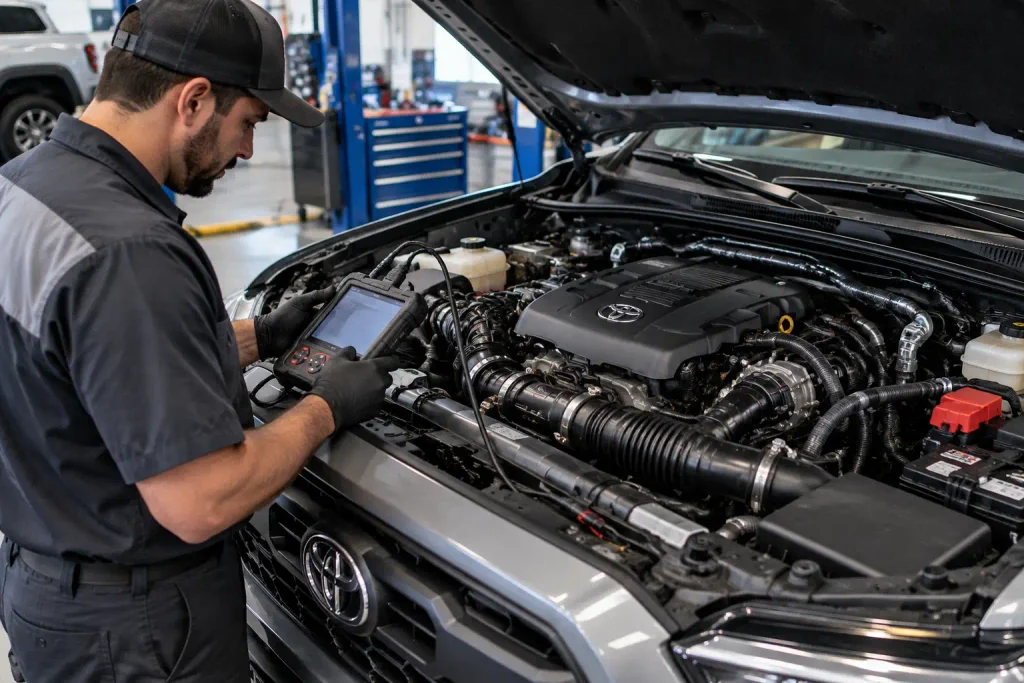
A reduced-power warning calls for prompt diagnosis, not an automatic turbo replacement.
If Reduced Engine Power Appears


If the Tacoma suddenly loses substantial power in traffic, move to a safe location when possible. Stop driving and arrange roadside assistance if it is overheating, producing heavy smoke, making severe mechanical noises, or cannot maintain a safe speed.
If stable, avoid heavy acceleration and towing. Record the warning and conditions even if the message disappears after restarting.
If Boost Related Codes Appear
Request diagnostic trouble codes (DTCs) and freeze-frame data. Tacoma diagnostic reference P25B3-72 indicates a stuck-open wastegate actuator condition, with possible causes including actuator, vacuum, sensor, wiring, or engine-control faults.
The technician should follow the Toyota repair procedure for your exact year and powertrain. Inspect intake plumbing, charge-air connections, relevant pressure readings, and actuator operation before authorizing replacement.
If No Relevant Codes Appear
An absent warning light does not rule out intermittent faults. A technician may need a controlled road test and live data to distinguish boost, fuel, or transmission problems.
How to Evaluate Tacoma Turbo Noises and Smoke


Noise timing and accompanying symptoms matter more than the label “turbo whine.”
If the Turbo Whines
A mild acceleration sound is not proof of failure. New, loud siren-like noise with power loss warrants prompt inspection.
A loose intake or charge-air connection can change airflow noise and reduce boost. Internal turbo damage is another possibility, but the cause must be confirmed rather than inferred from sound alone.
If Exhaust Smoke Appears


Persistent blue or gray smoke with oil consumption warrants inspection. Black smoke may involve air or fuel-control problems. Smoke color alone cannot diagnose the turbo.
Heavy smoke, overheating, or abnormal mechanical noises call for stopping safely and seeking professional assistance. Continuing to tow or drive hard can worsen an unresolved fault.
If the Engine Bay Chirps
First note whether the chirp occurs exactly when the air conditioner switches on. Toyota’s T-SB-0016-26 specifically addresses HVAC magnetic-clutch chirping on certain 2024–2026 trucks. If the noise is unrelated to A/C engagement, the bulletin does not establish the cause and normal diagnosis should continue.
When Tacoma Transmission Faults Mimic Engine Problems
Some 2024 Tacoma transmission problems can create jerking, delayed response, harsh shifts, or a warning light even when the turbocharger operates normally. Separating drivetrain behavior from engine power loss can prevent an unnecessary turbo repair.
Toyota’s former automatic-transmission bulletin T-SB-0094-24 applied to certain 2024 Tacoma and Tacoma Hybrid trucks showing specific transmission DTCs, including P07407F and P074571. It previously outlined assembly-level repairs for qualifying cases. However, Toyota’s April 15, 2026 obsolete notice states that the bulletin is no longer applicable. A dealer must consult current instructions rather than rely on the old repair procedure.
For manual trucks, bulletin T-SB-0058-24 identifies certain 2024 RC60F transmissions that may not engage second, fourth, or sixth gear because of cracking in a shift-lever retainer housing. Toyota described transmission replacement for vehicles that meet the bulletin’s conditions. This is a mechanical shifting issue, not turbo lag.
If your Tacoma shifts incorrectly but does not show verified boost faults, ask for a transmission-specific diagnosis and current VIN-applicable service information.
Which 2024 to 2026 Tacoma Recalls Apply
A safety recall, technical service bulletin, and special service campaign are different. Bulletin guidance does not automatically mean a free repair.
One useful example is Special Service Campaign 24TC06. Toyota identified approximately 3,200 certain 2024 Tacomas built from early January through late April 2024 with a possible active grille shutter connector-seal problem. Moisture intrusion could trigger an engine warning light. Toyota’s campaign remedy included inspection and, where needed, replacement of the affected harness or shutter assembly at no charge for eligible vehicles.
That warning-light condition is not a turbocharger failure. Likewise, a suspension or brake recall should not be described as an engine recall simply because it involves the same model year.
Enter your 17-digit VIN at Toyota’s official recall and service campaign lookup. Check both open campaigns and completed work, then ask the dealer to verify whether a relevant bulletin or campaign applies to your specific Tacoma. Do not assume every recall involving a Tacoma applies to the 2.4L turbocharger.
Reset routine reminders using the Tacoma maintenance light reset procedure after service. Never erase an unresolved fault warning.
How to Choose a Tacoma Turbo Repair Path
Confirm the fault before replacing an expensive turbocharger.
| What You Observe | First Action | When to Escalate |
|---|---|---|
| Severe power loss, overheating, or heavy smoke | Stop safely and arrange assistance | Immediate professional diagnosis; tow when unsafe |
| Reduced power with boost-related DTCs | Record codes and test boost-control components | Replace components only after confirming the fault |
| Whine with loose intake plumbing | Inspect accessible hoses and connections with engine off | Technician pressure or leak testing if unresolved |
| Chirp when A/C engages | Check the HVAC symptom pattern | Ask about T-SB-0016-26 applicability |
| Harsh shifts or missing manual gears | Read transmission DTCs and record shift behavior | Dealer transmission diagnosis and current bulletin review |
| Check engine light without drivability symptoms | Scan codes and check VIN campaigns | Diagnose the identified system rather than guessing |
What Does Tacoma Turbo Replacement Cost
A publicly listed Toyota dealer parts catalog shows a $2,209.70 turbocharger assembly listing for a 2024 Tacoma Limited 2.4L gasoline configuration at the time of this research. The dealer’s Toyota parts listing is a single retail example, not the average price or a guaranteed quote for another trim or year.
Labor, gaskets, fluids, taxes, diagnosis, and additional parts can raise the installed cost. No reliable installed-price range was verified across locations. Request a VIN-specific estimate and confirmation that the full assembly needs replacement.
Will Toyota Cover the Turbo Under Warranty
Toyota advertises 36 months or 36,000 miles of basic coverage and 60 months or 60,000 miles of powertrain coverage, whichever comes first, from the applicable in-service date. The turbocharger housing and internal parts are identified in Toyota powertrain warranty materials, subject to exclusions and the exact warranty terms.
For hybrid models, separate coverage applies to certain hybrid components and the hybrid battery. An owner should have the dealer verify the affected component, original in-service date, mileage, maintenance history, and any applicable warranty or service campaign before agreeing to a paid repair.
How Reliable Is the 2024 to 2026 Tacoma Turbo
The fourth-generation 2.4L turbo Tacoma debuted for the 2024 model year. As of October 2026, that leaves limited time to assess long-term outcomes compared with engines that have been in service for a decade or more.
A confirmed individual turbo failure is useful evidence that a problem can occur. It does not establish how frequently it occurs across all Tacoma production. Similarly, transmission bulletins and unrelated safety recalls cannot be added together to calculate a turbocharger failure rate.
Compare maintenance records, completed campaigns, cold-start behavior, road tests, and recurring fault codes.
The hybrid system introduces additional electrical and control components. It should not be assumed to have the exact same diagnostic path as the gasoline-only engine. Our Toyota i-FORCE MAX hybrid specifications guide explains the configuration differences without mixing the hybrid’s output with the standard 2.4L turbo ratings.
No defensible universal 150,000-mile or 200,000-mile lifespan figure can be established for 2024–2026 Tacomas from current real-world history alone.
Should You Buy a Used Tacoma Turbo
Judge used Tacomas by condition, repair records, and road-test behavior, not model year alone.
Proceed with a normal pre-purchase inspection when the truck has consistent service records, no unresolved drivability warnings, and no unexplained noise, smoke, or shifting problems. The inspection should still include a scan of the relevant modules.
Investigate before purchase if the seller reports intermittent power loss, an earlier turbo repair, a transmission replacement, or a warning that returns after being cleared. Obtain dealer repair orders and verify whether the underlying issue was resolved.
Decline or postpone the purchase when severe symptoms remain unexplained, a seller refuses independent inspection, or the repair history contradicts the truck’s current condition. A clean dashboard after a code reset is not proof that the powertrain is healthy.
What Tacoma 2.4 Turbo Owners Should Do Next
Tacoma 2.4 turbo problems require symptom-based diagnosis. Documented transmission, HVAC, and warning-light concerns do not automatically identify a bad turbocharger.
If your truck loses power, retrieve and preserve the diagnostic codes. If it makes a new noise, note exactly when the sound occurs. If the warning involves transmission behavior, request the correct transmission tests instead of approving turbo parts.
Check your VIN, record the symptoms, and confirm the failed component before authorizing repairs.
What Owners Ask About Tacoma 2.4 Turbo Problems
Is the 2024 Tacoma 2.4 Turbo Reliable
The 2024 Tacoma 2.4L turbo does not yet have a decade of operating history for a firm long-term durability verdict. Toyota has documented some 2024 powertrain and accessory concerns, but these should not be described as a proven widespread turbocharger defect. Judge an individual truck using diagnosis, service records, and resolved campaigns.
Does the 2025 Tacoma Have Turbo Problems
Individual 2025 Tacoma owners have reported turbo or wastegate-related faults, including reduced-power symptoms, but those reports cannot establish an overall failure rate. A warning message can have several causes. Retrieve DTCs and have the correct system checked before accepting a turbo replacement diagnosis.
What Are Tacoma Turbo Failure Symptoms
Possible warning signs include low boost, weak acceleration, abnormal turbo-area noise, and related diagnostic codes. Heavy smoke or serious power loss requires prompt attention. None of these symptoms alone proves that the complete turbocharger assembly is defective, because intake leaks and control-system faults can create similar behavior.
Is There a Recall for Tacoma Turbo Problems
A Tacoma recall is not necessarily a turbocharger recall, and we did not verify a blanket turbo-replacement recall for 2024–2026 Tacoma models in the records reviewed for this article. Eligibility changes and depends on the exact VIN. Check Toyota’s current recall and campaign lookup and ask the dealer about any model-specific service bulletins.
How Much Does a Tacoma Turbo Replacement Cost
One Toyota dealer parts listing showed a $2,209.70 turbocharger assembly for a 2024 Tacoma Limited 2.4L gas model. That is not an installed repair estimate. A complete quote needs VIN-confirmed parts, local labor, diagnostic findings, and any additional components or fluids required for the job.
Can You Drive With Reduced Engine Power
Do not continue normal driving or towing with an unresolved reduced-engine-power warning. Stop in a safe place, especially if the truck overheats, smokes heavily, makes severe noises, or cannot keep up with traffic. Arrange professional diagnosis and towing when driving would be unsafe.