Toyota Tundra Generations Chart by Year 2000-2026

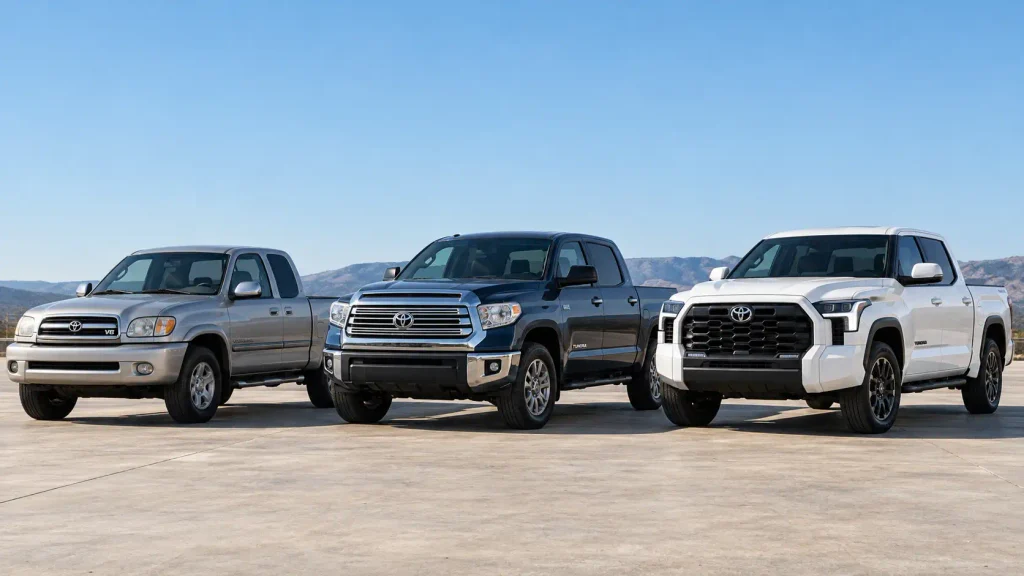
The Toyota Tundra generations chart covers three generations: 2000–2006, 2007–2021, and 2022–2027. The major redesigns arrived for the 2007 and 2022 model years. Toyota’s updated 2027 truck remains part of the third generation rather than starting a fourth.
That distinction matters when identifying a used Tundra, comparing engines, or ordering parts. The 2014 Tundra, for example, looks substantially different from a 2013 model but belongs to the same generation. Start with the chart, then use the visual clues and model-year changes below to identify your truck accurately.


Three generations. Two full redesigns. U.S. model years 2000–2027.
Original Tundra
Engines across these years3.4L or 4.0L V6; 4.7L V8
2004 Double Cab addedLarger Full-Size Tundra
Engines across these years4.0L V6; 4.7L, 4.6L or 5.7L V8
2014 styling refreshModern Twin-Turbo Tundra
PowertrainsTwin-turbo V6; available i-FORCE MAX hybrid
2027 update announcedKey model-year changes
Toyota Tundra Generations Chart From 2000 to 2027


Toyota’s U.S.-market Tundra has three main generations. The year ranges refer to model years, which may differ from the calendar year when a truck was built or first sold.
| Generation | Model Years | Common Chassis Code | Main Engines | Major Identifier |
|---|---|---|---|---|
| First generation | 2000–2006 | XK30 / XK40 | 3.4L V6, 4.0L V6, 4.7L V8 | Original, relatively compact Tundra body |
| Second generation | 2007–2021 | XK50 | 4.0L V6, 4.7L V8, 4.6L V8, 5.7L V8 | Larger full-size design; restyled for 2014 |
| Third generation | 2022–2027 | XK70 | 3.5L twin-turbo V6; i-FORCE MAX hybrid | New platform, coil-spring rear suspension, modern cabin |
Engine availability varies within each generation. The 2027 Tundra is an announced model-year update, and its complete equipment details must be checked against final Toyota specifications.
The useful breakpoints are 2007 for the second generation and 2022 for the third. A new grille, different headlights, or updated equipment alone does not establish a new generation. For that reason, the substantial 2014 refresh is grouped with the 2007–2021 trucks.
These major model-year milestones help explain the changes without confusing a refresh with a replacement:
| Model Year | What Changed | Generation |
|---|---|---|
| 2000 | First U.S.-market Tundra introduced | First |
| 2004 | Roomier Double Cab added | First |
| 2005 | New 4.0L V6 and updated 4.7L V8 | First |
| 2007 | Larger, fully redesigned Tundra | Second |
| 2010 | 4.6L V8 replaced 4.7L V8 | Second |
| 2014 | Major body styling and interior refresh | Second |
| 2020 | 5.7L V8 became the sole engine | Second |
| 2022 | New platform and twin-turbo V6 powertrains | Third |
| 2027 | Announced styling, technology and Trailhunter updates | Third |
First Generation Toyota Tundra From 2000 to 2006


The first-generation Tundra replaced Toyota’s T100 for the 2000 model year. Compared with the trucks that followed, its body is narrower and less imposing. Rounded exterior details, simpler lighting assemblies, and smaller-looking proportions are useful identification clues.


Original Body Design and Cab Styles


Early models offered Regular Cab and Access Cab arrangements, with the Access Cab providing limited rear seating behind the front row. Toyota introduced the larger Double Cab for 2004. That change gave buyers conventional rear doors and more useful passenger space without waiting for the all-new 2007 truck.
A first-generation Tundra may also have different beds, wheelbases, bumpers, and trim equipment depending on its year and cab. The 2003–2004 styling details will not necessarily match a 2005–2006 example, even though all belong to the same generation. Use the model-year label rather than body appearance alone when shopping for parts.
Early V6 and V8 Engines
For 2000–2004, the base engine was a 3.4L V6, while a 4.7L V8 was available. In 2005, Toyota replaced the 3.4L with a 4.0L V6 and updated the 4.7L V8 with variable valve timing. These engines continued through the first generation’s final 2006 model year.



The early V8 and later V6 differ in maintenance requirements, engine components, and transmission pairings. An advertised part for a “2000–2006 Tundra” is therefore not automatically correct for every truck in that range. The Cars.com Toyota Tundra model history provides an independent breakdown of the first generation’s engine and cab changes.
For identification, the simplest rule is that any U.S.-market 2000–2006 Tundra is first generation. The next model year introduced a substantially larger truck.
Second Generation Toyota Tundra From 2007 to 2021



Toyota redesigned the Tundra for 2007, moving to a larger, more conventional full-size pickup layout. A broader body, stronger-looking front end, new cab choices, and an expanded engine lineup separated it from the original truck.
This generation lasted 15 model years, but its appearance and available equipment changed considerably during that period.


Larger Body and Cab Configurations
The 2007 redesign introduced Regular Cab, Double Cab, and CrewMax configurations. CrewMax emphasized rear-seat room, while other cab and bed combinations offered different balances of passenger and cargo space. Specific cab availability changed in later years; the Regular Cab was eventually discontinued.
The large grille, broad headlights, and taller-looking hood distinguish the early second generation from 2000–2006 models. A 2007–2013 truck is generally easier to recognize from the front than a later 2014–2021 example, because Toyota significantly revised the exterior in 2014.
Truck equipment also changed by grade and model year. To compare SR, SR5, Limited, 1794 Edition, and later offerings without turning this generation guide into a trim catalog, use our Toyota Tundra trim levels chart.
V8 Engine Options by Year


The 2007 Tundra launched with a 4.0L V6, a 4.7L V8, and a new 5.7L i-FORCE V8. The 5.7L became a defining engine for this generation, producing 381 horsepower and 401 lb-ft of torque in its widely offered configuration.
Toyota replaced the 4.7L V8 with a 4.6L V8 for 2010. The 4.0L V6 remained available through 2014 and was dropped for 2015. The 4.6L continued through 2019; beginning in 2020, the 5.7L V8 was the only U.S. Tundra engine.
This timeline prevents a common mistake: assuming every second-generation truck has a 5.7L V8. When checking parts or technical specifications, a 2008 V8, a 2016 V8, and a 2021 V8 can represent different engine configurations, despite sharing the same generation.
Why the 2014 Toyota Tundra Is Still Second Generation



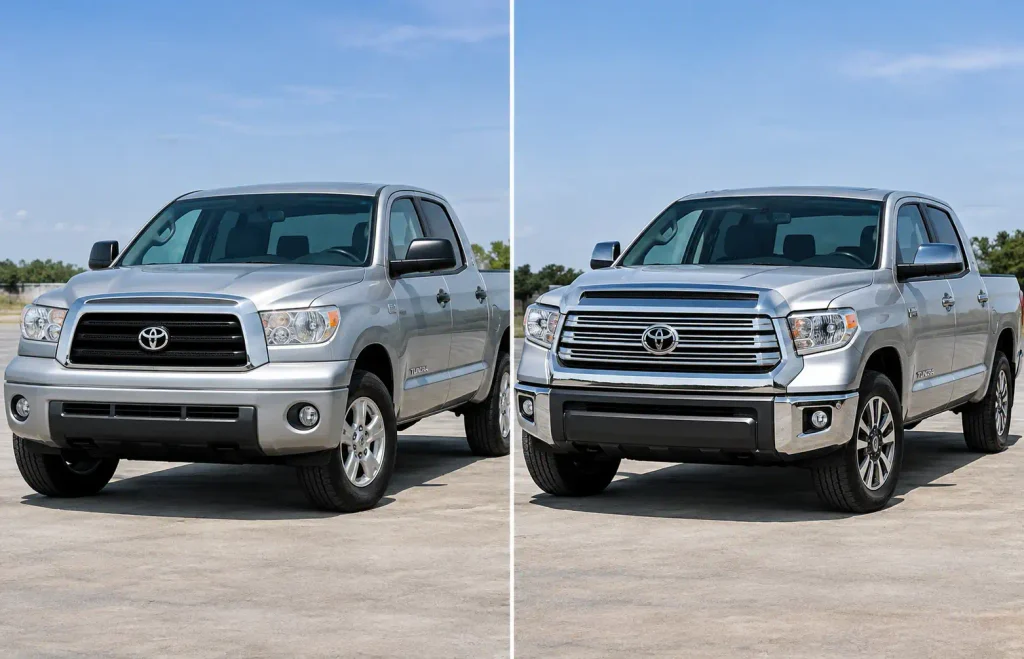
The 2014 Toyota Tundra is a second-generation truck, not the beginning of a third generation. Toyota revised its exterior and interior while continuing the model family introduced for 2007.
The refresh brought a taller grille, revised hood and fenders, more angular bodywork, redesigned bumpers, and a substantially updated dashboard. Toyota also introduced the Western-themed 1794 Edition for 2014. These changes can make a 2014 truck appear unrelated to a 2013 example when the two are parked side by side.
Toyota’s own 2014 Tundra redesign announcement describes the update as the first major change since the generation launched for 2007. That is the important distinction: 2014 was a significant refresh within generation two. The genuinely new third-generation Tundra arrived in 2022.
For a quick visual check, compare the front grille and dashboard of a 2013 Tundra with a 2014 model. For mechanical fitment, however, do not assume a 2014 part will fit every earlier second-generation truck merely because both share the same generation label.
Third Generation Toyota Tundra From 2022 to 2027
Toyota introduced the third-generation Tundra for 2022. Unlike the 2014 refresh, this was a ground-up redesign with a different frame, suspension layout, engines, transmissions, cabin technology, and exterior design.
New Twin Turbo V6 Powertrains
The third generation replaced the previous V8 lineup with a 3.5L twin-turbo i-FORCE V6. The standard engine produces up to 389 horsepower and 479 lb-ft of torque in the configurations highlighted at launch.
The available i-FORCE MAX hybrid combines the twin-turbo V6 with an electric motor-generator. Its combined launch rating is 437 horsepower and 583 lb-ft of torque. Both powertrains use a 10-speed automatic transmission, but availability depends on the trim and model year.
Toyota also introduced a high-strength boxed frame, a composite bed reinforced with aluminum, and a multilink rear suspension with coil springs instead of the second generation’s rear leaf springs. These are structural changes, not merely styling updates. The official Toyota 2022 Tundra launch details document the new architecture and powertrain ratings.
From the outside, the 2022–2026 Tundra has a more squared-off nose, prominent grille treatments, and modern lighting signatures. Inside, available large-format displays and the revised dashboard make the generation easier to distinguish from older trucks.
The Announced 2027 Tundra Refresh
For the 2027 model year, Toyota announced revised front-end styling, an updated multimedia system with a standard 14-inch display, and Toyota Safety Sense 4.0. An available Trailhunter package, based on the SR5, adds equipment aimed at overlanding. Toyota also announced TRD Pro updates, including revised FOX shocks.
These updates do not establish a fourth generation. Toyota presented the 2027 truck as an update to the Tundra introduced in 2022. Its July 2026 2027 Tundra announcement also stated that additional specifications and pricing would be detailed closer to production.
When comparing a 2027 truck with 2022–2026 models, verify the final Toyota build specifications rather than assuming every announced feature applies to every trim.
How Toyota Tundra Engines Changed Across Three Generations
The biggest engine break occurs between 2021 and 2022. The older Tundra’s naturally aspirated V8 lineup gave way to twin-turbo V6 gas and hybrid powertrains. Earlier changes within the first and second generations were smaller but still matter for maintenance.
| Generation | Key Engine Years | Typical Engine Choices | Transmission Context |
|---|---|---|---|
| First | 2000–2004 | 3.4L V6 or 4.7L V8 | Manual or automatic, by engine and year |
| First | 2005–2006 | 4.0L V6 or updated 4.7L V8 | Revised manual and automatic choices |
| Second | 2007–2009 | 4.0L V6, 4.7L V8, 5.7L V8 | Automatic transmissions |
| Second | 2010–2014 | 4.0L V6, 4.6L V8, 5.7L V8 | Automatic transmissions |
| Second | 2015–2019 | 4.6L V8 or 5.7L V8 | Six-speed automatic |
| Second | 2020–2021 | 5.7L V8 only | Six-speed automatic |
| Third | 2022–2027 | Twin-turbo V6 or available hybrid | Ten-speed automatic |
The engine name and model year should both appear in any fitment search. Even within one generation, a filter, accessory, sensor, or drivetrain component may differ by engine, production date, or fuel system.
For an example of how engine-specific part identification works on a transition-year truck, see the 2007 Toyota Tundra parts diagram and fitment guide. It separates the 4.0L V6, 4.7L V8, and 5.7L V8 rather than treating them as one configuration.
How to Identify Your Toyota Tundra Generation
The fastest method is to confirm the model year, then match it to the first chart. Grille shape can help, but it is not reliable enough when a truck has replacement body panels or aftermarket modifications.
- Check your registration or ownership records. Find the official model year. The date the truck was registered or manufactured may be different from that model year.
- Locate the 17-character vehicle identification number. On most U.S.-market Tundras, the VIN appears at the driver-side lower windshield and on the driver-door-area label. It may also appear in insurance or registration documents.
- Use Toyota’s Vehicle Specification lookup. Enter the VIN in Toyota’s official owners’ website to check the recorded vehicle details, including model year and installed equipment where available.
- Match the year to the generation range. Years 2000–2006 are first generation, 2007–2021 are second, and 2022–2027 are third. For parts, continue by confirming engine, cab, drivetrain, and exact production details.
A 2014 model is second generation even if it resembles newer trucks. Similarly, a 2027 model’s fresh styling does not make it fourth generation. Use the VIN and original vehicle labels to settle conflicting dealership listings or online fitment descriptions.
Which Toyota Tundra Parts Fit Across Generations
Parts are not automatically interchangeable between Toyota Tundra generations. The 2007 and 2022 redesigns changed important dimensions, mountings, suspensions, powertrains, and electrical systems. Parts listings that simply say “fits Tundra” do not provide enough detail.
Bed accessories are an especially common source of confusion. A 2019 tonneau cover should not be assumed to fit a 2023 Tundra just because both trucks use a similarly named bed length. The bed design, mounting arrangement, and cab pairing need to match. Our Toyota Tundra bed size chart covers the measurements and cab combinations separately.
The same caution applies within a generation. A second-generation 2013 front bumper may not fit a refreshed 2014 truck without differences, even though both are generation two. Likewise, 2WD versus 4WD, cab style, engine, trim, and optional equipment can affect parts selection.
For replacement parts, use the manufacturer’s year-and-configuration fitment tool and match the vehicle’s VIN where supported. For towing or payload questions, check the specific truck’s documentation and labels; a generation chart is not a substitute for configuration-specific ratings.
What Your Toyota Tundra Generation Means for Ownership
The Toyota Tundra generations chart divides the U.S.-market truck into three clear groups: first generation from 2000–2006, second generation from 2007–2021, and third generation beginning in 2022, including the announced 2027 refresh. The two full redesign years are 2007 and 2022. The prominent 2014 facelift belongs to the second generation.
Knowing the correct generation helps narrow an engine search, recognize a used truck, and avoid buying incompatible parts. But the generation label is only the starting point. Before ordering a bumper, engine component, bed accessory, or suspension part, confirm the truck’s model year, VIN, engine, cab, and drivetrain. That final check matters more than a visual resemblance between two Tundras.
What Owners Ask About Toyota Tundra Generations
What Years Are the First Generation Toyota Tundra?
The first-generation Toyota Tundra covers 2000–2006 model years in the United States. The engine lineup changed for 2005, and Toyota added the Double Cab for 2004, but neither update created a second generation. The full redesign came for 2007.
What Years Are the Second Generation Toyota Tundra?


The second-generation Toyota Tundra covers 2007–2021 model years. Toyota significantly updated its styling and interior for 2014, but that model remained second generation. Engine availability and cab configurations also changed within the 15-year run.
Is the 2014 Toyota Tundra Second or Third Generation?
The 2014 Tundra is second generation. Its redesigned grille, fenders, bumpers, tailgate, and interior made it look noticeably different from a 2013 model. The next full generation did not arrive until the 2022 model year.
What Year Did the Toyota Tundra Switch to a Twin Turbo V6?
Toyota switched to the 3.5L twin-turbo V6 for the 2022 Tundra. That model year also introduced the available i-FORCE MAX hybrid and a new 10-speed automatic transmission. The 2021 truck was the last Tundra model year with the 5.7L V8.
Is the 2027 Toyota Tundra a Fourth Generation?
No. Toyota announced the 2027 Tundra as an update to its third-generation pickup, not a fourth-generation redesign. The changes include new styling, technology, and off-road equipment. Check finalized Toyota specifications for exact 2027 trim and equipment availability.