2003 7.3 Powerstroke Specs – The Complete Guides 2025

The 2003 model year holds a unique and revered place in the history of Ford diesel trucks. It marks the end of an era—the final production run of the legendary 7.3L Powerstroke V8. This engine, first introduced in 1994, built its reputation on a foundation of robust, simple engineering and tractor-like reliability, earning it a spot as one of the top diesel engines ever produced.
For enthusiasts and truck owners, the “2003” designation is a critical one, as it was a split year that saw one of the most infamous transitions in diesel history. Ford and Navistar’s production of the 7.3L Powerstroke ceased in the first quarter of the 2003 model year. It was immediately replaced by the 6.0L Powerstroke, an engine often designated as the “2003.5” model.
This transition is precisely why the 2003 7.3L Powerstroke specs are so sought-after. This engine represents the most refined and final version of a “bulletproof” platform, existing just before the introduction of a new engine that, while more powerful, became notorious for its complex emissions systems and significant reliability challenges. This report provides the definitive, data-driven specifications for that final, legendary 2003 7.3L engine. For a complete history of the engine’s evolution, see the full production run in our guide to the 7.3 Powerstroke years.
2003 7.3L Powerstroke: The End of an Era
A visual breakdown of the specifications for the legendary 2003 Ford 7.3L Powerstroke diesel engine.
525 lb-ft
@ 1600 RPMEngine At-a-Glance
7.3L / 445ci
V8 Turbodiesel
~920 lbs
HEUI
Power & Performance
The 2003 model year offered two distinct power ratings, with the manual transmission models receiving a boost in both horsepower and torque.
The 7.3L vs. The 6.0L
The 7.3L was replaced mid-2003 by the 6.0L Powerstroke. While the 6.0L offered higher output, it suffered from significant reliability issues.
Key Fluid Capacities
Engine Oil (w/ filter)
15 Quarts
Engine Coolant
32.8 Quarts
Towing Capabilities
A true workhorse, the 7.3L was rated for significant loads, though exact figures vary by vehicle configuration and axle ratio.
Common Owner Watchlist
While famously reliable, these are a few common components that owners keep an eye on for maintenance or failure.
- ⚠️ Camshaft Position Sensor (CPS) Failure
- ⚠️ Exhaust Back Pressure Valve (EBPV) Issues
- ⚠️ Injector O-Ring Leaks
- ⚠️ Turbocharger Oil Leaks
A Legendary Workhorse
The 2003 model marked the end of the 7.3L’s iconic run. Prized for its durability and reliability—especially when compared to its 6.0L successor—it remains one of the most sought-after diesel engines on the market. Its straightforward design and robust performance cemented its legacy as a true legend in the truck world.
2003 7.3L Powerstroke Specifications: At a Glance
The 2003 7.3L Powerstroke is a V8 turbo-diesel built by Navistar International, known for its heavy-duty cast-iron block and cylinder heads.6 Its design philosophy prioritized durability and low-end torque over high-revving horsepower.
This focus on torque is physically embedded in the engine’s core architecture. With a bore of 4.11 inches and a longer stroke of 4.18 inches, the 7.3L is an “under-square” engine. This long-stroke design provides greater leverage on the crankshaft with each combustion event, which mechanically translates to superior pulling power at low RPMs—the very characteristic that defines its identity as a legendary towing engine.
Here are the core technical specifications for the 2003 7.3L Powerstroke engine.
| Specification | 2003 7.3L Powerstroke |
| Engine Type | 7.3L V8 Turbo Diesel |
| Displacement | 7.3 Liters / 444 Cubic Inches |
| Manufacturer | Navistar International |
| Block/Head Material | Cast Iron / Cast Iron |
| Valvetrain | OHV (Overhead Valve), 2 Valves Per Cylinder |
| Bore | 4.11 in (104.4 mm) |
| Stroke | 4.18 in (106.2 mm) |
| Compression Ratio | 17.5:1 |
| Fuel System | HEUI (Hydraulically Actuated Electronically Controlled Unit Injector) |
| Aspiration | Garrett GTP38 Wastegated Turbocharger w/ Intercooler |
| Firing Order | 1-2-7-3-4-5-6-8 |
| Dry Weight | Approx. 920 lbs |
2003 7.3 Powerstroke Horsepower and Torque: The Critical Split
One of the most critical and nuanced specifications for the 2003 7.3L Powerstroke is the difference in power output based on the vehicle’s transmission. Unlike a single-rating engine, the 7.3L’s final model year had two distinct factory-rated power levels.
This split was a direct result of the “Torque Wars” of the early 2000s. With competitors like Dodge (Cummins) and GM (Duramax) pushing torque figures over 500 lb-ft, Ford responded by giving the 7.3L one “last-time” power bump for its “High Output” (H.O.) version, which was exclusively paired with the 6-speed manual transmission.
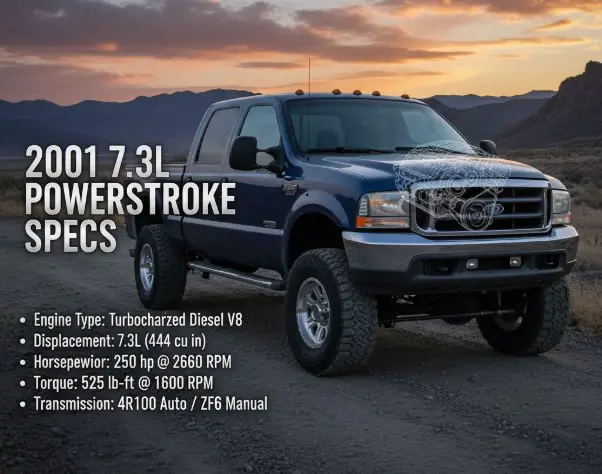
Why was this 275-horsepower tune manual-only? The limitation was the 4-speed 4R100 automatic transmission. The 4R100 was a reliable unit, but it was already near its operational limit and was a known weak point when power was added. Ford engineers withheld the higher-output calibration from 4R100-equipped trucks to preserve transmission life, creating two different power bands for the 2003 model year. Trucks equipped with the robust ZF S6-650 6-speed manual transmission received the full 275 HP and 525 lb-ft of torque.
It is worth noting that some sources show slight variations in torque figures; for example, the official 2003 Ford Towing Guide lists the automatic at 525 lb-ft and the manual at 520 lb-ft. However, the broader aftermarket and technical consensus, as seen in data from multiple sources, supports the 275 HP / 525 lb-ft manual rating and a 250 HP / 505-525 lb-ft automatic rating.
| Transmission | Transmission Model | Horsepower (at RPM) | Torque (at RPM) |
|---|---|---|---|
| 4-Speed Automatic | 4R100 | 250 HP @ 2,600 RPM | 505-525 lb-ft @ 1,600 RPM |
| 6-Speed Manual | ZF S6-650 | 275 HP @ 2,800 RPM | 525 lb-ft @ 1,600 RPM |
This power difference is a vital consideration for prospective buyers. While the automatic is more common, the 6-speed manual model is the true “High Output” version of the 7.3L’s final production run. Owners of the automatic transmission models should learn more about the 4R100 automatic transmission’s specifications and limitations before pursuing performance upgrades.
Detailed Technical Breakdown: The Components That Built a Legacy
The high-level specs of the 7.3L only tell part of the story. The engine’s character and reliability are defined by its unique fuel and air systems, which set it apart from its predecessors and successors.
Fuel System: The HEUI Injector
The 7.3L Powerstroke does not use a modern common-rail injection system, nor does it use a traditional injection pump. Instead, it employs a revolutionary (for its time) HEUI (Hydraulically Actuated Electronically Controlled Unit Injector) system.
This hybrid system, designed by Caterpillar, is what makes the 7.3L’s relationship with its engine oil so unique. Here is how it works:
- A gear-driven, fixed-displacement High-Pressure Oil Pump (HPOP) takes engine oil from the crankcase and pressurizes it to as much as 3,000+ PSI.
- This high-pressure oil is sent to the HEUI injectors.
- Inside each injector, that high-pressure oil acts as a hydraulic ram on an “intensifier” piston.
- This action pressurizes a small-volume, “unit” of fuel inside the injector body to approximately 21,000 PSI, forcing it out of the nozzle and into the cylinder.
This means the engine’s oil is not just a lubricant; it is the hydraulic fluid firing the injectors. This design is the primary reason why oil quality, oil level, and oil change intervals are supremely critical to the 7.3L’s health. It is also the root cause of the engine’s most common failure points, which are almost exclusively oil-system sensors and actuators, not the fuel system itself.
For the 2003 model year, Ford Super Duty and Excursion models were factory-equipped with “AD” code split-shot injectors. These injectors flow approximately 140 cc/min.
However, a well-known 7.3L expert-level detail involves the #8 cylinder. Due to the “deadhead” design of the fuel rails, the #8 cylinder (rear, driver’s side) was last in line for fuel and often experienced lower fuel pressure. This could lead to fuel starvation and a distinct “cackle” noise. Ford’s factory solution was to often fit a special “AE” code (or “Long Lead”) injector in the #8 slot.18 This injector had slightly different internal timing to compensate for the fuel pressure delay.
| Injector Code | Application | Flow Rate (approx.) | Injection Type |
|---|---|---|---|
| AD | 1999-2003 Super Duty / Excursion (Cyl 1-7) | 140 cc/min | Split-Shot |
| AE | 2001-2003 E-Series (Vans) / 1999.5-2003 Cylinder #8 | 120-140 cc/min | Split-Shot |
Turbocharger: The Garrett GTP38
All 2003 model year 7.3L engines (and all models from 1999.5 onward) were equipped with a Garrett GTP38 turbocharger.6 This was a significant upgrade from the “early 1999” models, as the GTP38 system included a factory air-to-air intercooler and a wastegate, which were not present on the earliest 7.3L engines.
The GTP38 is a fixed-geometry turbo, which is a key differentiator from the Variable Geometry Turbo (VGT) that would later be used on the 6.0L. While the fixed-geometry design is simpler and arguably more robust, it is also the reason the 7.3L can feel “laggy” compared to its VGT-equipped successor.
The specific specs of the stock turbocharger are often revealed by the specifications of common upgrades. For instance, popular upgrade kits for the “GTP38R” advertise an 88mm compressor wheel, which provides 33% more flow than the stock 80mm exducer (OEM) compressor wheel. Other sources specify the stock compressor wheel as having a 60mm inducer. This 60mm/80mm compressor wheel configuration, paired with a 1.0 A/R turbine housing, defines the engine’s air-handling characteristics. More details on this turbo and its upgrade paths can be found on Garrett Motion’s performance catalog.
Fluid Capacities & Service Data (2003 7.3L)
For owners, one of the most critical sets of specifications is the fluid capacity and type required for routine maintenance. The 7.3L’s large displacement and HEUI oil system require a significant amount of oil.
| Fluid / System | Capacity | Recommended Type / Spec |
|---|---|---|
| Engine Oil (with filter) | 15 Quarts (14.2 Liters) | 15W-40 Diesel-Rated (API CK-4) |
| Engine Coolant | 32.75 Quarts (31 Liters) | 50/50 Mix, Silicate-Based |
| Auto. Transmission (4R100) | 17.1 – 17.7 Quarts (Total Fill) | Mercon / Dexron III Compatible |
| Manual Transmission (ZF S6-650) | 5.8 Quarts | Synthetic ATF (Mercon-Rated) |
| Transfer Case (BW1536) | 2.0 Quarts | Mercon ATF |
| Fuel Tank (Long Box) | 38 Gallons | Diesel |
| Fuel Tank (Short Box) | 29 Gallons | Diesel |
The “Bulletproof” Myth: 7.3L Powerstroke Reliability & Common Problems
The 2003 7.3L Powerstroke is widely considered “nearly bulletproof,” but this reputation warrants a deeper, expert-level analysis. The “bulletproof” moniker refers to the engine’s hard parts. The cast-iron block, heads, and robust rotating assembly (which included forged-steel connecting rods in earlier 1999-2000 models) are exceptionally durable.
However, the engine is not without its flaws. The 7.3L’s common failures are not catastrophic internal meltdowns, but rather frustrating and well-documented failures of bolt-on sensors and actuators—most of which are tied to the HEUI high-pressure oil system.
The Achilles’ Heel: Cam Position Sensor (CPS) Failure
This is the most famous and “most frequently encountered issue on the 7.3L Powerstroke”.
- What it is: The CPS tells the powertrain control module (PCM) the engine’s speed and position.
- Symptoms: A faulty CPS will cause the engine to cut out and die instantly, as if the key were turned off. It can also cause a no-start condition or intermittent stalling, often when the engine is hot.
- The Expert Diagnostic Tip: The tachometer is the key. While cranking the engine, watch the tach. If the tachometer does not move or “bounce,” the PCM is not receiving a signal from the CPS, and the sensor is the prime suspect. This problem was so common that Ford issued a recall, and most veteran 7.3L owners keep a spare CPS in their glovebox. A detailed guide to this and other issues can be found at(https://puredieselpower.com/blog/7-3-powerstroke-diesel-engine).
Understanding the HEUI Oil System Failures
The other two major issues are also related to the high-pressure oil system that fires the injectors.
1. Injection Pressure Regulator (IPR) Valve:
- What it is: Located on the HPOP, this valve regulates the high-pressure oil output based on commands from the PCM.
- Symptoms: When the IPR valve sticks or its seals fail, it cannot build or maintain the correct oil pressure. This results in a rough idle, stumbling or misfiring, significant loss of power, or a hard-start/no-start condition.
2. Injector Control Pressure (ICP) Sensor:
- What it is: This sensor is the “eyes” of the PCM. It monitors the oil pressure in the high-pressure rail and reports it back to the computer, closing the feedback loop so the PCM can adjust the IPR as needed.
- Symptoms: A failing ICP sensor will send false data to the PCM, causing it to command incorrect pressure. Symptoms are nearly identical to a bad IPR: surging, rough idling, stalling, and no-start conditions.
- The Expert Diagnostic Tip: The ICP sensor has two common diagnostic tricks. First, unplug the electrical connector and check for oil. If the connector is full of engine oil, the sensor’s internal seal has failed, and it must be replaced. Second, if the engine refuses to start, try unplugging the ICP sensor’s connector entirely. This forces the PCM to ignore the (faulty) sensor and use a default, pre-programmed “limp mode” map. If the engine starts and runs (albeit poorly) with the sensor unplugged, the ICP sensor is almost certainly the culprit.
How the 2003 7.3L Powerstroke Compares to Other Engines
The 2003 7.3L’s specifications are best understood when-compared to the engines that came before, after, and alongside it.
7.3L vs. 6.0L Powerstroke: The Changing of the Guard
This is the most critical comparison for any potential buyer. The 7.3L was replaced in 2003 by the 6.0L, an engine that was superior in every way on paper. The 6.0L produced 325 HP and 560 lb-ft of torque and featured a more advanced 4-valve-per-cylinder design and a more responsive Variable Geometry Turbo (VGT).
However, this transition led to one of the greatest “trade-offs” in diesel truck history:
- The 7.3L Platform (2003): Has a “nearly bulletproof” engine mated to a weaker 4-speed 4R100 automatic transmission that is its primary weak link.
- The 6.0L Platform (2003.5): Has a notoriously unreliable engine (prone to head gasket, EGR, and oil cooler failures) 15 mated to a far superior and very tough 5-speed 5R110W “TorqShift” automatic transmission.
A 7.3L owner must often budget for an eventual transmission rebuild, especially if adding power. A 6.0L owner must budget for extensive “bulletproofing” of the engine to achieve the reliability the 7.3L had from the factory. The 7.3L is the simpler, more reliable workhorse; the 6.0L (once its issues are addressed) has a higher performance ceiling thanks to its VGT and better transmission. A full breakdown of this rivalry is available in our complete 7.3 Powerstroke vs 6.0 Powerstroke showdown.
| Feature | 2003 7.3L Powerstroke | 2003.5 6.0L Powerstroke |
| Displacement | 7.3L (444 ci) | 6.0L (365 ci) |
| HP / Torque | 250-275 HP / 505-525 lb-ft | 325 HP / 560 lb-ft |
| Valvetrain | OHV, 2-Valves per cylinder | OHV, 4-Valves per cylinder |
| Turbocharger | Fixed Geometry (Garrett GTP38) | Variable Geometry (VGT) |
| Auto. Trans. | 4-Speed (4R100) | 5-Speed (5R110W) |
| Reputation | Simple, reliable engine; weaker trans | Unreliable engine; stronger trans |
The “Other” 7.3L: Powerstroke Diesel vs. “Godzilla” Gas
In recent years, the search term “Ford 7.3L” has been confounded by Ford’s 2020 introduction of a new gasoline engine with the same displacement: the 7.3L “Godzilla”.
These two engines are completely unrelated and share nothing except their displacement and V8 configuration.
- 2003 7.3L Powerstroke: A Navistar-built, turbocharged, direct-injection diesel engine.
- 2020+ 7.3L “Godzilla”: A Ford-built, naturally-aspirated, port-injected gasoline engine.
The diesel makes its peak power at low RPM (275 HP) but produces more torque (525 lb-ft). The modern “Godzilla” gas engine has significantly more horsepower (430 HP) but less torque (485 lb-ft), and it produces that power at much higher RPMs.
The great irony is that for the “Godzilla,” Ford’s engineers returned to the 7.3L Powerstroke’s core design philosophy: a simple, durable, large-displacement, cast-iron block, OHV pushrod V8. After replacing the 7.3L diesel’s design philosophy with more complex engines, Ford ultimately resurrected its old-school architecture for its new heavy-duty gas workhorse.
The Navistar T444E vs. The 7.3L Powerstroke
The 7.3L Powerstroke engine is a Navistar T444E.10 “T444E” is simply Navistar’s internal designation for this engine platform, which stands for Turbocharged, 444 cubic inches, and Electronically controlled.
While the “Powerstroke” was Ford’s branding, Navistar used the T444E in its own applications, such as International school buses and medium-duty box trucks. The engines are “largely identical” in their fundamental components (block, heads, rotating assembly). The differences are in the application-specific “bolt-on” parts and, most importantly, the software:
- PCM Tuning: Ford (Powerstroke) versions were tuned for pickup truck use, prioritizing higher horsepower. Navistar (T444E) versions were often tuned for commercial use (like school buses), with lower horsepower but different torque curves to meet commercial demands.
- Components: The T444E used different turbochargers, sensors, and sometimes different fuel pumps (including mechanical pumps in some applications) to suit its various chassis and roles.45Further details on the T444E are available from sources like(https://en.wikipedia.org/wiki/Navistar_T444E_engine).
Final Verdict: Is the 2003 7.3L Powerstroke the Best Diesel Ever Made?
By today’s standards, the 2003 7.3L Powerstroke’s factory specifications of 250-275 HP seem modest. It is not the most powerful, the most responsive, or the most efficient diesel engine ever built.
Its legendary status is not derived from its peak performance numbers, but from its balance. The 7.3L Powerstroke offered excellent, usable torque from a simple, robust, and reliable platform. The 2003 model, as the final and most refined version, represents the absolute pinnacle of this platform—a workhorse built before the age of complex and often failure-prone emissions systems that would come to define its 6.0L successor. It is this unique position in history—the last of the simple, reliable giants—that solidifies its legend.
Frequently Asked Questions (FAQs)
How much HP and torque did the 2003 7.3 Powerstroke have?
It varied by transmission. Models with the 4R100 4-speed automatic had 250 HP and 505-525 lb-ft of torque. The “High Output” models with the ZF-6 6-speed manual transmission had 275 HP and 525 lb-ft of torque.
What is the 2003 7.3 Powerstroke oil capacity?
The engine oil capacity is 15 quarts (14.2 liters) with a filter change.
What was the last year for the 7.3 Powerstroke?
The 2003 model year was the final year. Production of the 7.3L ceased in the first quarter of 2003, and it was replaced by the 6.0L Powerstroke (often called the 2003.5) in the same model year.
Is the 2003 7.3L better than the 6.0L?
The 7.3L engine is widely considered far more reliable and simpler to maintain. However, the 6.0L is more powerful (325 HP) and was paired with a much stronger 5-speed automatic transmission (the 5R110W).
What are the most common problems with the 7.3 Powerstroke?
The engine itself is very reliable. The most common failures are bolt-on sensors related to the high-pressure oil system: the Cam Position Sensor (CPS), the Injection Pressure Regulator (IPR) valve, and the Injector Control Pressure (ICP) sensor.