2019 Ram 1500 Towing Capacity: A Guide to Engines, Payloads & Configurations

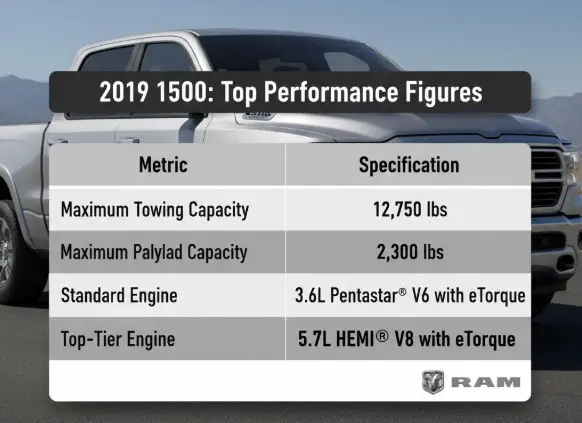
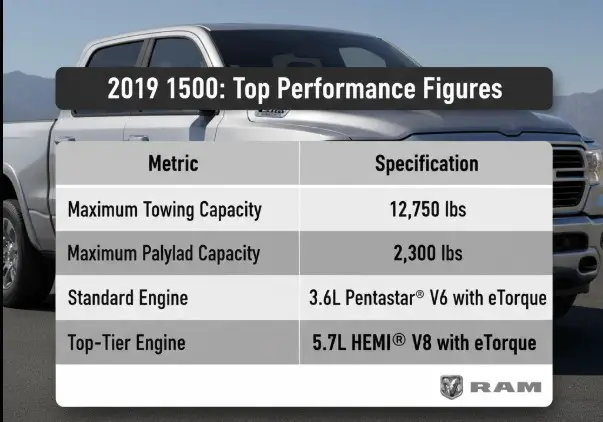
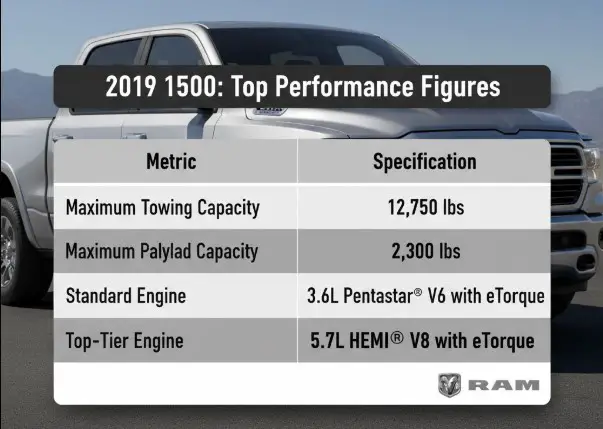
The redesigned 2019 Ram 1500 made a significant impact in the half-ton truck segment, establishing new benchmarks for capability and technology. When properly equipped, the 2019 Ram 1500 has a maximum towing capacity of 12,750 pounds and a maximum payload capacity of 2,300 pounds. These figures are not just incremental improvements; they represent a substantial leap forward, made possible by a complete re-engineering of the truck’s foundation.
For the 2019 model year, Ram introduced a new frame that is 100 pounds lighter than its predecessor, yet composed of 98% high-strength steel for improved rigidity and durability. This stronger, more efficient platform, combined with the innovative eTorque mild-hybrid system, is the core reason for the truck’s impressive capabilities.
However, it is crucial to understand the phrase “when properly equipped.” These headline numbers are achieved with a very specific combination of engine, drivetrain, cab style, and optional packages. The configuration that unlocks the 12,750-pound maximum is a Tradesman Quad Cab 4×2 equipped with the 5.7L HEMI® V8 with eTorque, a 3.92 axle ratio, and the Max Tow Package. This guide will break down exactly how these variables interact to define the true capability of any given 2019 Ram 1500.
Powertrain Deep Dive: How Engine Choice Impacts Capability
At the heart of the 2019 Ram 1500’s performance are three distinct powertrain options. Each is paired with a smooth and efficient TorqueFlite® eight-speed automatic transmission, but they are engineered to meet different needs—from daily driving efficiency to maximum towing muscle.
3.6L Pentastar V6 with eTorque
The standard engine across the 2019 lineup is the 3.6L Pentastar® V6, which comes standard with the eTorque mild-hybrid system.
- Horsepower: 305 hp
- Torque: 269 lb-ft
- Maximum Towing Capacity: 7,730 pounds
- Maximum Payload Capacity: 2,300 pounds
This powertrain serves as the high-value, high-efficiency option. It provides more than enough capability for lighter-duty tasks, such as pulling utility trailers, small boats, or pop-up campers, while delivering superior fuel economy.
5.7L HEMI V8
The legendary 5.7L HEMI® V8 is the traditional workhorse of the lineup, offering a substantial increase in power and capability for more demanding jobs.
- Horsepower: 395 hp
- Torque: 410 lb-ft
- Maximum Towing Capacity: 11,610 pounds
- Maximum Payload Capacity: 1,930 pounds
This engine is the choice for owners who regularly tow larger travel trailers, heavier equipment, or larger boats, where the significant jump in torque is essential.
5.7L HEMI V8 with eTorque
To achieve the Ram 1500’s maximum potential, buyers must opt for the 5.7L HEMI® V8 equipped with the eTorque mild-hybrid system. While it shares the same peak horsepower and torque ratings as the standard V8, the eTorque system provides a critical performance advantage.
It replaces the traditional alternator with a 48-volt, belt-driven motor-generator that can provide up to 130 lb-ft of supplemental launch torque from a standstill. This burst of electric power helps the truck overcome the inertia of a heavy load, enabling a smoother start and contributing directly to its higher certified tow rating.
- Horsepower: 395 hp
- Torque: 410 lb-ft (+130 lb-ft supplemental launch torque)
- Maximum Towing Capacity: 12,750 pounds
- Maximum Payload Capacity: 1,830 pounds
Interestingly, while the V8 with eTorque is the undisputed champion of towing, the title for maximum payload capacity belongs to the lighter 3.6L V6. This is because the V8 engine and the accompanying eTorque battery and motor components add significant curb weight to the truck.
Since payload capacity is calculated by subtracting the truck’s curb weight from its Gross Vehicle Weight Rating (GVWR), the heavier V8 models have less available capacity for in-bed cargo. This creates a crucial trade-off: to maximize towing, choose the V8 with eTorque; to maximize payload, the standard V6 is the superior choice.
The Complete Picture: 2019 Ram 1500 Towing Capacity Charts
A truck’s final, SAE J2807-compliant tow rating is not determined by the engine alone. It’s a complex calculation involving the drivetrain, cab size, bed length, and, most importantly, the axle ratio. Understanding these variables is key to knowing a specific truck’s true capability.
The Critical Role of Axle Ratio
The axle ratio refers to the gearing inside the rear differential. A higher numerical ratio (e.g., 3.92) acts as a torque multiplier, giving the truck more leverage to pull heavy loads, thus increasing its tow rating. A lower numerical ratio (e.g., 3.21) is better for highway fuel economy but reduces pulling power.
The impact is dramatic. For example, a 2019 Ram 1500 Quad Cab 4×2 with the standard 5.7L HEMI® V8 can tow 8,590 pounds with the 3.21 axle ratio. Equipping the exact same truck with the 3.92 axle ratio increases its towing capacity to a much more substantial 11,690 pounds.
Drivetrain and Cab Configuration
- 4×2 vs. 4×4: A two-wheel drive (4×2) system is lighter than a four-wheel drive (4×4) system. This lower curb weight means 4×2 models generally have slightly higher towing and payload ratings. However, 4×4 models offer superior traction, which is a significant advantage on slippery boat ramps or in poor weather conditions.
- Quad Cab vs. Crew Cab: The Crew Cab offers significantly more rear passenger space than the Quad Cab. This extra size and weight come at the cost of towing capacity. A similarly equipped Crew Cab will have a slightly lower tow rating than a Quad Cab due to its higher curb weight.
| Cab / Bed | Drivetrain | Engine | Axle Ratio | GCWR (lbs) | Max Trailer Weight (lbs) |
| Quad Cab / 6’4″ | 4×2 | 5.7L HEMI® w/ eTorque | 3.92 | 18,200 | 12,750 |
| Quad Cab / 6’4″ | 4×2 | 5.7L HEMI® | 3.21 | 13,900 | 8,590 |
| Quad Cab / 6’4″ | 4×2 | 5.7L HEMI® | 3.92 | 17,000 | 11,690 |
| Crew Cab / 5’7″ | 4×4 | 5.7L HEMI® w/ eTorque | 3.92 | 17,000 | 11,290 |
| Crew Cab / 5’7″ | 4×4 | 5.7L HEMI® | 3.92 | 17,000 | 11,340 |
| Quad Cab / 6’4″ | 4×2 | 3.6L Pentastar® V6 | 3.55 | 12,900 | 7,640 |
Engineering for the Haul: Key Towing Features & Technology
The 2019 Ram 1500’s impressive tow ratings are supported by a complete ecosystem of engineering and technology designed to enhance stability, safety, and driver confidence. It’s not just about pulling power; it’s about controlling the load.
Max Tow Package
To unlock the highest towing figures, the available Max Tow Package is required. This is more than just a hitch; it’s a comprehensive set of mechanical upgrades that prepares the truck for extreme duty. Key components include:
- 3.92 Axle Ratio: Provides the necessary gear reduction for maximum pulling power.
- Upgraded 9.75-inch Rear Axle: A heavier-duty axle designed to handle higher torque loads and a Gross Combined Weight Rating (GCWR) of up to 18,200 pounds.
- Trailer-Tow Mirrors: Larger, extendable mirrors for improved visibility around a wide trailer.
- Integrated Trailer Brake Controller: Allows for seamless synchronization of the truck and trailer brakes.
Suspension and Braking Superiority
Ram focused heavily on the chassis components that manage a heavy load. The 2019 model features the largest-in-class standard front brake rotors at 14.9 inches, ensuring superior stopping power.
Furthermore, the Ram 1500 offers a class-exclusive Active-Level™ Four-Corner Air Suspension. This available system automatically detects a trailer’s load and adjusts the air springs to maintain a level ride. This prevents the common “squat” seen in other trucks, improving stability, maintaining proper headlight aim, and enhancing aerodynamics while towing.
Advanced Towing Aids
The 2019 Ram 1500 integrates advanced technology to reduce the stress of towing:
- Blind Spot Monitoring with Trailer Detection: This intelligent safety feature automatically senses the length of your trailer and extends the blind-spot monitoring zone to cover it, alerting you to vehicles alongside the trailer.
- 360° Surround View Camera: Provides a bird’s-eye view of the truck and its surroundings, making it significantly easier to align the hitch ball with the trailer coupler and maneuver in tight spaces.
2019 Towing Showdown: Ram 1500 vs. The Competition
In the highly competitive half-ton truck market, numbers matter. Here’s how the 2019 Ram 1500’s maximum towing capacity stacked up against its primary rivals from Ford and Chevrolet.
- 2019 Ford F-150: The F-150 held the title for the highest overall towing capacity in 2019, with a maximum rating of 13,200 pounds. This was achieved with its 3.5L EcoBoost® twin-turbo V6 engine in a specific SuperCrew 4×2 configuration with the Max Trailer Tow Package.
- 2019 Chevrolet Silverado 1500: The redesigned Silverado 1500 offered a maximum towing capacity of 12,200 pounds. This required its largest 6.2L V8 engine, a Double Cab 4×4 configuration, and the Max Trailering Package.
While the Ford F-150 had the higher absolute number, Ram executed a clever marketing strategy by claiming the title of “Best-in-Class V8 Towing”. Since Ford’s top rating was achieved with a V6 engine, Ram could accurately claim that its 5.7L HEMI® V8 with eTorque out-towed any V8 offered by Ford or Chevrolet. This allowed Ram to appeal directly to traditional truck buyers with a strong preference for V8 power, securing a significant “win” in a key market sub-segment.
Beyond the Brochure: A Practical Guide to Safe Towing
The manufacturer’s tow rating is a critical number, but it’s only one piece of the puzzle. To tow safely, you must understand and respect all of your truck’s weight limits. For many real-world towing scenarios, especially with large travel trailers, your truck’s payload capacity is the true limiting factor.
Defining Key Towing Terms
Before you tow, you must know these terms, which can be found on the stickers inside your driver’s side door jamb:
- GVWR (Gross Vehicle Weight Rating): The absolute maximum weight your truck can be, including the vehicle itself, fuel, passengers, all cargo in the cab and bed, and the trailer’s tongue weight.
- GCWR (Gross Combined Weight Rating): The absolute maximum weight of your fully-loaded truck and fully-loaded trailer combined.20 You must never exceed this number.
- Payload Capacity: The maximum weight of all cargo and passengers you can carry in your truck. Crucially, the trailer’s tongue weight is considered part of your payload.
- Tongue Weight (TW): The downward force that the trailer coupler exerts on the truck’s hitch. For a conventional trailer, this should be 10-15% of the total loaded trailer weight.
The Payload Problem: Why It’s Often the Real Limit
Here’s a real-world example of why payload is so critical:
- Assume your 2019 Ram 1500 has a payload capacity of 1,800 pounds (a common figure for well-equipped Crew Cab models).
- You and your family get in the truck: -500 pounds.
- You load coolers, firewood, and gear into the bed: -200 pounds.
- You now have 1,100 pounds of remaining payload capacity for the trailer’s tongue weight.
- If you maintain a safe 13% tongue weight, your maximum trailer weight is limited to approximately 8,460 pounds.
Even though the truck might have a tow rating of over 11,000 pounds, its payload capacity limits you to a much lighter trailer in this scenario. Exceeding your payload can overload the truck’s suspension and tires, leading to an unstable and dangerous towing experience.
Safe Towing Checklist
- Know Your Numbers: Find the GVWR, GCWR, and payload capacity on your truck’s door jamb sticker.
- Weigh Your Trailer: Get the actual weight of your fully loaded trailer at a CAT scale. Don’t rely on the “dry weight” listed by the manufacturer.
- Calculate Tongue Weight: Ensure your tongue weight is between 10-15% of the total trailer weight.
- Do the Math: Confirm that you are not exceeding your truck’s payload, GVWR, or GCWR.
- Use the Right Equipment: For any trailer over 5,000 pounds, a weight-distributing hitch is strongly recommended to improve stability and safety.
Frequently Asked Questions (FAQs)
What is the exact configuration for the 12,750-pound towing capacity?
To achieve the maximum 12,750-pound rating, you need a 2019 Ram 1500 in a Tradesman or Big Horn/Lone Star trim with a Quad Cab, 6’4″ bed, 4×2 drivetrain, the 5.7L HEMI® V8 with eTorque, and the 3.92 axle ratio combined with the Max Tow Package.
How does the eTorque system actually help with towing?
The eTorque system uses a 48-volt motor-generator to provide up to 130 lb-ft of supplemental electric torque from a complete stop. This helps the truck get a heavy load moving more easily and smoothly, which is a key factor in the standardized(https://www.sae.org/standards/content/j2807_202010/) that determines the final rating.1
Can a 2019 Ram 1500 tow a large camper?
Yes, many configurations are well-suited for towing campers. However, you must be diligent about weight. A large travel trailer (e.g., 30 feet, 8,500 pounds) can have a tongue weight of over 1,100 pounds, which can easily exceed the payload capacity of many half-ton trucks once passengers and cargo are accounted for.24 For a deeper dive into these calculations, check out this towing capacity guide.
Is payload capacity or towing capacity more important?
For towing heavy trailers, payload capacity is often the more critical limit. The trailer’s tongue weight consumes a large portion of your payload, and exceeding this rating can overload your truck’s suspension and axles, creating an unsafe driving condition even if you are below the maximum tow rating.20
Where can I find my specific truck’s towing capacity?
The most accurate information for your vehicle is on the Tire and Loading Information sticker and the Safety Certification sticker, both located on the driver’s side door jamb. These will list your specific GVWR and payload. For detailed towing charts, you can consult the owner’s manual or use the official(https://www.ramtrucks.com/towing/towing-capacity-guide/lookup.html).6
Conclusion
The 2019 Ram 1500 stands as a remarkably capable and technologically advanced towing platform. Its maximum capacity of 12,750 pounds, enabled by the powerful 5.7L HEMI® V8 with eTorque and a robust high-strength steel frame, places it firmly in the top tier of its class.