2024 Ford F-250 Towing Capacity Chart & Hauling Complete Guide

More Than Just a Number—Decoding the 2024 F-250’s True Strength
The 2024 Ford F-250 Super Duty commands attention with a headline-grabbing maximum towing capacity of 23,000 pounds. This figure places it at the apex of the heavy-duty truck segment, promising immense power for the most demanding jobs. However, this single, impressive number represents a best-case scenario and is just the tip of the iceberg when it comes to understanding this truck’s true capabilities.
A truck’s real-world towing prowess is not defined by one figure, but by a complex interplay of engine choice, drivetrain configuration, cab style, and specialized equipment. This guide provides the exhaustive data and expert analysis needed to understand precisely what a specific F-250 can tow, moving beyond marketing claims to deliver actionable, real-world clarity.
This report begins with a high-level overview of the F-250’s capabilities, then dives deep into comprehensive towing charts. It will analyze the powerhouse engine lineup, explain how every configuration choice impacts towing limits, decode critical towing terminology, and explore the advanced technology Ford offers to make hauling safer and easier. Finally, this data is grounded in reality by examining what owners and reviewers experience on the road.
The Ultimate Guide to 2024 Ford F-250 Towing Capacity
This visual guide breaks down the F-250’s impressive towing and payload numbers with interactive charts, helping you configure the perfect truck for your needs.
F-250 Gooseneck Towing by Engine
The engine is the single biggest factor in towing capability. The High-Output Power Stroke® diesel unlocks the F-250’s maximum potential for the heaviest loads.
Engine Popularity
While gas engines are highly capable, the Power Stroke® diesels remain the most popular choice for buyers prioritizing maximum towing power and torque.
Conventional vs. Gooseneck Towing
The type of hitch used dramatically affects towing limits. Gooseneck and 5th-wheel hitches, which mount in the truck bed, allow for significantly higher capacity than a conventional bumper hitch.
How to Choose Your Ideal F-250
Your ideal configuration depends entirely on your workload. Follow this simple decision flow to match an engine to your primary towing requirements.
Occasional Heavy Loads (<17k lbs)
The 6.8L Gas V8 is a capable and cost-effective entry point for standard heavy-duty tasks like hauling landscape equipment or smaller travel trailers.
Frequent, Heavier Loads (>17k lbs)
The 7.3L “Godzilla” Gas V8 offers a significant power bump for larger trailers and equipment without moving to the complexity and cost of diesel.
Maximum Capability (>20k lbs)
The 6.7L Power Stroke® Diesels are the ultimate choice for serious, consistent towing of the heaviest gooseneck and 5th-wheel trailers, such as large RVs or horse trailers.
At a Glance: 2024 Ford F-250 Maximum Towing & Payload by Engine
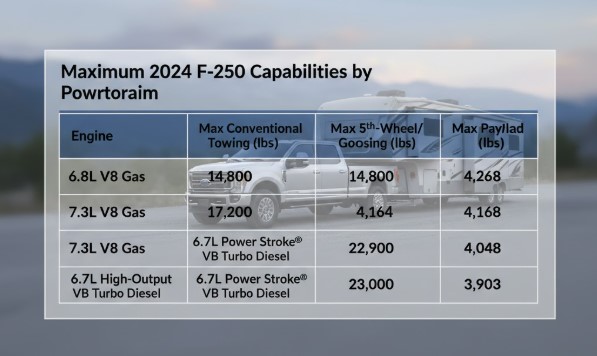
For those needing the top-line numbers immediately, this section provides a quick-reference summary of the 2024 Ford F-250’s peak potential. The following table outlines the absolute maximum towing and payload capacities achievable with each of the four available engine options. It is critical to note that achieving these figures requires very specific truck configurations, which will be detailed further in this guide.
| Engine | Max Conventional Towing (lbs) | Max 5th-Wheel/Gooseneck Towing (lbs) | Max Payload (lbs) |
| 6.8L V8 Gas | 14,800 | 14,800 | 4,268 |
| 7.3L V8 Gas | 17,200 | 17,200 | 4,164 |
| 6.7L Power Stroke® V8 Turbo Diesel | 22,000 | 22,900 | 4,048 |
| 6.7L High-Output Power Stroke® V8 Turbo Diesel | 22,000 | 23,000 | 3,903 |
A crucial observation from this data is the inverse relationship between maximum towing capacity and maximum payload capacity. The engines with the highest tow ratings—the two 6.7L Power Stroke® diesels—do not offer the highest payload ratings. Conversely, the 6.8L V8 gas engine provides the lineup’s best payload capacity at 4,268 pounds.
This apparent paradox stems from fundamental vehicle weight dynamics. A truck’s payload capacity is calculated by subtracting its curb weight (the weight of the empty truck) from its Gross Vehicle Weight Rating (GVWR), which is the maximum legal weight the truck can be. The 6.7L Power Stroke® diesel engines are substantially heavier than their gasoline counterparts due to their robust construction, turbocharging systems, and complex emissions equipment.
This added engine weight increases the truck’s overall curb weight. Therefore, even with a high GVWR, the heavier diesel models have less remaining capacity for in-bed cargo and passengers, resulting in a lower payload rating. This creates a critical decision point for buyers: those towing the absolute heaviest trailers will need a diesel, but those whose primary task is hauling heavy materials in the bed may be better served by a gas engine.
The Power Behind the Pull: A Deep Dive into the 2024 F-250 Engine Lineup
The 2024 Ford F-250 offers a formidable lineup of four distinct V8 engines, each engineered for a specific level of performance and duty cycle. All engines are paired with a sophisticated 10-speed automatic transmission to optimize power delivery and efficiency.
Standard Powerhouse: 6.8L Gas V8
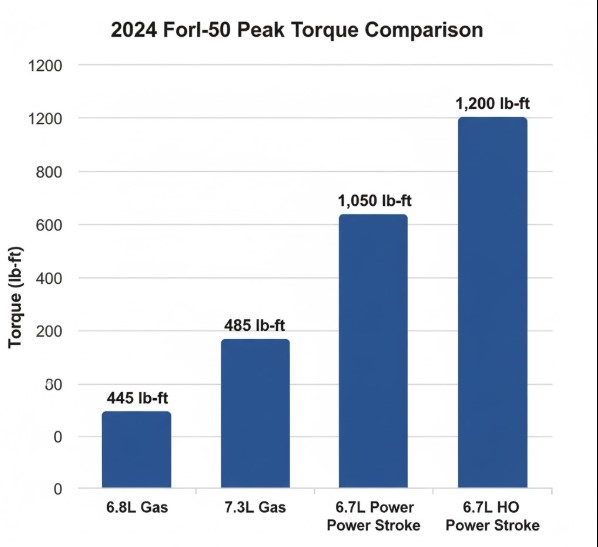
The standard engine across the lower trims is a highly capable 6.8L gasoline V8. It produces a solid 405 horsepower and 445 lb-ft of torque, making it a reliable workhorse for a wide range of tasks. This engine features a durable pushrod design and is paired with the TorqShift-G 10-speed automatic transmission. It is an excellent choice for fleet operators and buyers who prioritize the F-250’s highest available payload capacity over ultimate towing muscle.
The “Godzilla”: 7.3L Gas V8
For those needing a significant step up in capability without transitioning to a diesel, Ford offers the legendary 7.3L “Godzilla” gas V8. This engine delivers a best-in-class 430 horsepower and 485 lb-ft of torque for a gasoline engine in this segment. For 2024, it benefits from a revised air intake and refined tuning to optimize its performance. Paired with the heavy-duty TorqShift 10-speed automatic, the 7.3L V8 is perfectly suited for towing large travel trailers, mid-size 5th-wheels, and heavy equipment.
The Legendary Workhorse: 6.7L Power Stroke® V8 Turbo Diesel
The 6.7L Power Stroke® V8 Turbo Diesel is the engine that defines modern heavy-duty towing. It generates an immense 475 horsepower and 1,050 lb-ft of torque. This power is achieved through advanced technology, including a 36,000-psi fuel injection system for optimized combustion and a responsive, electronically actuated variable-vane turbocharger that excels in all conditions, especially at high altitudes.
A critical feature for heavy haulers is the integrated engine-exhaust brake, which provides superior downhill speed control, enhancing safety and reducing brake wear. This is the premier choice for frequent, serious towing of large 5th-wheel RVs and commercial trailers.
The Apex Predator: 6.7L High-Output Power Stroke® V8 Turbo Diesel
At the pinnacle of the F-250 powertrain lineup is the 6.7L High-Output Power Stroke® V8. This engine pushes the boundaries of performance with a class-leading 500 horsepower and a staggering 1,200 lb-ft of torque. It builds upon the standard Power Stroke® with specialized tuning to achieve its record-breaking output, enabling the F-250 to reach its maximum tow rating of 23,000 pounds. This engine is engineered for extreme-duty applications, providing the ultimate confidence to pull the heaviest legal loads with unparalleled ease.
The Complete 2024 Ford F-250 Towing Capacity Charts
The following tables provide the definitive, granular towing data for the 2024 Ford F-250. A truck’s official rating is determined by a combination of its engine, cab style (Regular, SuperCab, or Crew Cab), and drivetrain (4×2 or 4×4). These charts allow for the identification of the precise capacity for nearly every available configuration.
2024 F-250 Conventional Towing Capacity (lbs)
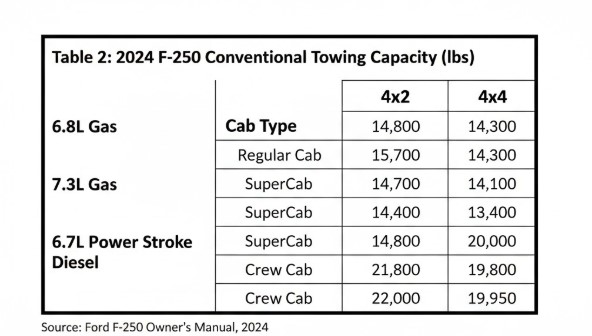
Conventional towing, also known as bumper-pull towing, is the most common method for hauling a wide variety of trailers. The ratings below represent the maximum trailer weight a properly equipped F-250 can pull using a hitch mounted to the truck’s frame.
| Engine | Cab Type | 4×2 Drivetrain | 4×4 Drivetrain |
| 6.8L Gas V8 | Regular Cab | 14,800 | 14,400 |
| SuperCab | 14,500 | 14,100 | |
| Crew Cab | 14,500 | 14,100 | |
| 7.3L Gas V8 | Regular Cab | 17,200 | 16,800 |
| SuperCab | 17,000 | 16,500 | |
| Crew Cab | 16,900 | 16,600 | |
| 6.7L Power Stroke® Diesel | Regular Cab | 18,200 | 20,000 |
| SuperCab | 19,500 | 22,000 | |
| Crew Cab | 19,500 | 22,000 | |
| 6.7L H.O. Power Stroke® Diesel | Regular Cab | 18,200 | 20,000 |
| SuperCab | 19,500 | 22,000 | |
| Crew Cab | 19,500 | 22,000 |
2024 F-250 5th-Wheel & Gooseneck Towing Capacity (lbs)
To unlock the F-250’s highest towing capabilities, a 5th-wheel or gooseneck hitch is required. These in-bed hitching systems transfer the trailer’s weight directly over the truck’s rear axle, providing greater stability and allowing for significantly heavier loads.
| Engine | Cab Type | 4×2 Drivetrain | 4×4 Drivetrain |
| 6.8L Gas V8 | Regular Cab | 14,800 | 14,300 |
| SuperCab | 14,500 | 14,000 | |
| Crew Cab | 14,400 | 14,100 | |
| 7.3L Gas V8 | Regular Cab | 17,200 | 16,700 |
| SuperCab | 16,900 | 16,500 | |
| Crew Cab | 16,800 | 16,500 | |
| 6.7L Power Stroke® Diesel | Regular Cab | 22,900 | 22,500 |
| SuperCab | 22,000 | 21,500 | |
| Crew Cab | 22,000 | 21,600 | |
| 6.7L H.O. Power Stroke® Diesel | Regular Cab | 23,000 | 22,700 |
| SuperCab | 22,000 | 21,400 | |
| Crew Cab | 22,000 | 21,600 |
Analysis of these charts reveals a consistent pattern: the most popular consumer configuration—the Crew Cab 4×4—often has a lower towing capacity than a base-model Regular Cab 4×2 with the same engine. For instance, the High-Output Diesel’s maximum gooseneck capacity drops from 23,000 pounds in a Regular Cab 4×2 to 21,600 pounds in a Crew Cab 4×4.
This is a result of the Gross Combined Weight Rating (GCWR), which is the fixed maximum weight of the truck and trailer combined. A larger Crew Cab and the heavy components of a 4×4 system increase the truck’s base curb weight. Since the GCWR is fixed for a given powertrain and axle, every pound added to the truck’s weight is a pound subtracted from its potential towing capacity. Buyers must recognize that adding comfort and all-weather capability comes with a direct trade-off in maximum towing potential.
Beyond the Engine: Critical Factors That Define Your Real Towing Limit
While the engine is the heart of a tow vehicle, several other mechanical components play a crucial role in determining its final, official capacity.
Axle Ratios Explained
The axle ratio (e.g., 3.73:1, 4.30:1) represents the number of times the driveshaft turns for every single rotation of the wheels. This ratio is a critical factor in torque multiplication. A higher numerical ratio, such as 4.30:1, provides more leverage, making it easier to get a heavy load moving from a standstill. This is why the highest tow ratings are often tied to optional, numerically higher axle ratios.
The trade-off is that a higher ratio results in higher engine RPMs at highway speeds, which can negatively impact fuel economy. Conversely, a lower numerical ratio, like 3.73:1, is better for fuel-efficient cruising but may not unlock the truck’s absolute maximum tow rating. A vehicle’s specific axle ratio can be identified by a code on the Safety Compliance Certification Label located on the driver’s side door jamb.
For those looking to maximize their truck’s potential, choosing the right axle ratio is a critical step. An article further detailing how to choose between different options can be found by understanding truck axle ratios.
The High-Capacity Axle Upgrade Package (Code 535)
One of the most important and often misunderstood options is the High-Capacity Axle Upgrade Package. On certain F-250 configurations, particularly those with diesel engines, this package is required to achieve the highest tow ratings listed in the official charts. This package includes a stronger, upgraded rear axle designed to handle greater stress. Its primary function is to increase the truck’s Gross Vehicle Weight Rating (GVWR), with some configurations reaching as high as 11,400 pounds. This boost to GVWR directly increases the truck’s payload capacity, which is often the true limiting factor when towing heavy 5th-wheel trailers.
Other Key Packages
Ford offers several other specialized packages that enhance the F-250’s utility for specific heavy-duty tasks. The Camper Package adds heavy-service front springs and a rear stabilizer bar to safely manage the high center of gravity of a slide-in camper. The Snowplow Prep Package includes heavy-duty alternators and other components necessary for mounting and operating a snowplow. These packages demonstrate the F-250’s design as a versatile and highly configurable work platform.
Decoding Towing Terminology: A Plain-English Guide to Safe Hauling
Understanding the key weight ratings is essential for safe and legal towing. Exceeding these limits can lead to vehicle damage, unsafe handling, and potential legal liability.
- GVWR (Gross Vehicle Weight Rating): This is the absolute maximum weight of the fully loaded truck, including the vehicle itself, all passengers, cargo in the bed, and the downward force exerted by the trailer hitch (tongue or pin weight). This non-negotiable rating is found on the door jamb sticker.
- GCWR (Gross Combined Weight Rating): This is the maximum allowable weight of the fully loaded truck and the fully loaded trailer combined. It is the total weight of the entire rig as it travels down the road.
- Payload Capacity: This is the total weight of all items that can be carried in or on the truck. It is calculated as $Payload = GVWR – Curb Weight$. Crucially, the trailer’s tongue weight (for conventional trailers) or pin weight (for 5th-wheels) must be subtracted from the payload capacity.
Towing Capacity vs. Payload Capacity: The Critical Difference
It is a common and dangerous misconception to focus solely on a truck’s maximum tow rating. For many towing scenarios, especially with large 5th-wheel RVs, the truck’s payload capacity is the first limit that will be reached. The pin weight of a 5th-wheel trailer is significantly higher than the tongue weight of a conventional trailer, typically ranging from 15% to 25% of the trailer’s total weight.
Consider a common scenario discussed by owners: an F-250 with a diesel engine might have a payload capacity around 3,900 pounds and a gooseneck tow rating over 21,000 pounds. A 16,000-pound 5th-wheel trailer—well within the truck’s tow rating—could easily have a pin weight of 3,200 pounds (20%). When adding the weight of passengers (e.g., 500 pounds) and the 5th-wheel hitch itself (e.g., 200 pounds), the total demand on the truck’s payload becomes 3,900 pounds ($3,200 + 500 + 200$).
This places the truck right at its GVWR limit, with no room for additional cargo in the bed or cab. This is why payload is often the real limiting factor, and why many experienced owners find that the higher payload ratings of an F-350 are necessary for heavy 5th-wheel applications, as it pushes buyers toward an F-350 for a safer margin.
To find the definitive ratings for a specific vehicle, consult the official (https://www.vdm.ford.com/content/dam/brand_ford/en_us/brand/towing/pdf/2024-Ford-RV-and-Trailer-Towing-Guide-V2.pdf) or use Ford’s online Towing Calculator with the vehicle’s VIN.9
Ford’s Smart Towing Technology Suite: Your Digital Co-Pilot
The 2024 F-250 is equipped with a suite of advanced technologies designed to simplify the complex and often stressful tasks associated with towing.
Hitching & Setup
- Pro Trailer Hitch Assist: This system uses cameras and artificial intelligence to automate the process of aligning the truck with a trailer. With the press of a button, it controls the steering, throttle, and braking to perfectly position the hitch ball under the trailer coupler, a feature reviewers have called a “cheat code” that makes hitching “absolutely effortless”.
- On-Board Scales & Smart Hitch: This feature estimates the weight of cargo in the bed and measures the trailer’s tongue weight to ensure proper load distribution. The system provides real-time feedback on the center touchscreen and through LEDs in the taillights, helping to prevent dangerous overloading or imbalance.
Maneuvering & Driving
- Pro Trailer Backup Assist: This technology removes the counter-intuitive nature of backing up a trailer. The driver uses a simple knob on the dashboard to direct the trailer, and the system handles the steering wheel inputs to execute the maneuver flawlessly.
- 360-Degree Camera System: Provides a composite, bird’s-eye view of the truck’s surroundings, which is invaluable for navigating tight job sites or crowded campgrounds.
- Trailer Navigation: When a trailer profile is active, the onboard navigation system can adapt the route to account for the trailer’s height and width, helping to avoid low bridges, sharp turns, and other potential hazards.
Safety & Control
- Integrated Trailer Brake Controller (TBC): A standard feature that seamlessly synchronizes the truck’s brakes with the trailer’s electric or electric-over-hydraulic brakes for smooth, controlled stops.
- Trailer Sway Control: This system works in conjunction with the truck’s AdvanceTrac® with Roll Stability Control™ to detect and mitigate unwanted trailer sway by selectively applying the truck’s brakes and reducing engine power.
- BLIS® (Blind Spot Information System) with Trailer Coverage: This available feature extends the truck’s blind-spot monitoring radar to cover the length of a conventional trailer, providing alerts for vehicles hidden alongside the trailer during lane changes.
Real-World Towing Performance: What Owners & Reviewers Say
While the spec sheets provide the numbers, real-world experience reveals how the 2024 F-250 truly performs under load.
The Overwhelming Power
Reviewers consistently praise the Power Stroke® diesel engines for their seemingly endless reserves of torque. One test, which involved hauling trailers over 2,400 miles, concluded that the truck “didn’t break a sweat even once”. The power is often described as “mind-boggling,” providing effortless acceleration and confidence even when pulling substantial loads up steep grades. The diesel’s efficiency is also a highlight, with one review noting fuel economy that was “well above expectations” while towing and another recording nearly 20 MPG on the highway when unloaded.
Stability and the Importance of Proper Setup
The F-250’s heavy-duty chassis provides a stable platform, but owner forums reveal that proper hitch setup is paramount to a safe and comfortable towing experience. Several users have reported issues with trailer sway or a “light” feeling in the front steering when using an improperly configured Weight Distribution Hitch (WDH). In some cases with lighter trailers, owners found the truck handled better without the WDH engaged at all, underscoring that correct setup is more important than simply having the equipment.
The Payload Predicament in Practice
The theoretical payload limit becomes a tangible problem for many owners of large 5th-wheel RVs. Forum discussions are filled with accounts of F-250 owners who, after loading their trailer, family, and gear, visit a CAT scale only to discover they have exceeded their truck’s GVWR, even while remaining well under the advertised maximum tow rating.
This often leads to the difficult decision to upgrade to an F-350 Single Rear Wheel (SRW) or even a dually for the necessary payload capacity and peace of mind. These real-world accounts serve as a critical lesson for potential buyers: always verify payload capacity for the specific truck and trailer combination.
Frequently Asked Questions (FAQs)
What is the maximum towing capacity of a 2024 Ford F-250?
The 2024 Ford F-250 can tow a maximum of 23,000 pounds. This rating requires the 6.7L High-Output Power Stroke® diesel engine, a Regular Cab 4×2 configuration, and a 5th-wheel or gooseneck hitch.
Which F-250 engine is best for towing?
For maximum capability and frequent heavy hauling, the 6.7L High-Output Power Stroke® V8 Turbo Diesel with 1,200 lb-ft of torque is the undisputed leader. For those who tow heavy loads less frequently, the 7.3L “Godzilla” V8 gas engine offers a powerful and more cost-effective alternative.
How much can a 2024 F-250 with the 7.3L Godzilla V8 tow?
Depending on its configuration, the F-250 with the 7.3L V8 can tow up to 17,200 pounds with either a conventional or a 5th-wheel/gooseneck hitch.
Do I need a special package for maximum towing?
Yes, in many cases, achieving the highest tow ratings requires specific optional equipment, most notably the High-Capacity Axle Upgrade Package (535). It is essential to verify the equipment on any specific truck to confirm its capacity.
Can an F-250 handle a large 5th-wheel RV?
While an F-250 has the tow rating to pull many large 5th-wheels, the trailer’s pin weight can easily exceed the truck’s payload capacity (GVWR). It is critical to calculate the total payload, including pin weight, passengers, and cargo, before purchasing. Many experienced RV owners recommend an F-350 for its higher payload capacity when towing heavy 5th-wheel trailers.
Conclusion: Matching the Right F-250 to Your Towing Needs
The 2024 Ford F-250 Super Duty is an immensely capable and technologically advanced truck, but harnessing its full potential requires an informed and data-driven approach. The headline 23,000-pound capacity, while impressive, applies to a specific configuration that may not align with the needs of the average consumer.
The most critical takeaways are that payload capacity is often a more significant limiting factor than the tow rating, especially for 5th-wheel trailers, and that popular, well-equipped models like the Crew Cab 4×4 come with inherent trade-offs in maximum capacity due to their higher curb weight.
For any potential buyer, the selection process should follow a logical progression:
- Define Your Load: Before shopping, know the Gross Vehicle Weight Rating (GVWR) of the trailer to be towed and, most importantly, its expected tongue or pin weight when fully loaded.
- Prioritize Your Limiting Factor: For heavy 5th-wheel towing, begin the search by comparing the trailer’s pin weight to the F-250’s specific payload capacity found on the door jamb sticker. If the primary use is hauling heavy materials in the bed, a gas engine model will likely offer a higher payload rating.
- Use the Detailed Charts: Locate the desired cab, drivetrain, and engine configuration in the comprehensive charts in this guide to find a realistic and accurate towing number.
- Verify with Ford: Before finalizing a purchase, use the official Ford Towing Guide or the online Ford Towing Calculator with the specific truck’s Vehicle Identification Number (VIN) to obtain the definitive, factory-certified capacity for that exact vehicle.