Ford F-150 Payload Capacity Guide (With Charts for 2023, 2024 & 2025)

You’re loading up your Ford F-150 for a weekend camping trip or a major run to the hardware store. As the gear piles up in the bed and passengers climb into the cab, a crucial question arises: “How much is too much?” While truck commercials love to boast about massive towing figures, the most critical number for your safety and your truck’s longevity is often the one that gets the least attention: payload capacity.
Many truck owners mistakenly interchange payload and towing. It’s a common and potentially dangerous point of confusion. Let’s set the record straight:
- Payload Capacity is the maximum weight your truck can safely carry in its cab and bed. This includes you, your passengers, your tools, your camping gear—everything loaded onto the truck itself
- Towing Capacity is the maximum weight your truck can safely pull behind it, such as a trailer or a boat.
Here is the critical connection that is often overlooked: the downward force a trailer puts on your hitch, known as tongue weight, counts against your payload capacity. A 7,000-pound travel trailer can easily have a 900-pound tongue weight. If your F-150 has a 1,600-pound payload limit, that trailer, you, and one passenger could push you over your legal limit before you’ve even packed a single cooler in the bed.
This guide is designed to demystify the Ford F-150’s payload ratings. We will cut through the marketing jargon and provide clear, data-driven charts and explanations to help you understand what your truck can really handle.
Ford F-150
An interactive breakdown of what defines America’s best-selling truck’s hauling power.
What is Payload, Really?
Payload is the total weight your truck can carry in its cab and bed. This includes passengers, cargo, tools, and even the tongue weight of a trailer. It’s the ultimate measure of a truck’s hauling capability.
The Most Important Number Is Here:
TIRE AND LOADING INFORMATION
“The combined weight of occupants and cargo should never exceed:”
XXX kg or XXXX lbs
Check your driver’s side door jamb!
Peak Payload Potential
3,325
Pounds
(Achieved by 5.0L V8 4×2 Regular Cab)
Payload Killers
Every option adds weight, reducing your real-world payload capacity.
- -300 lbs for 4×4 System
- -400 lbs for PowerBoost Hybrid
- -150 lbs for Luxury Trims
F-150 vs The Competition
(Max Payload Capacity)
Max Payload by Cab Configuration
Payload capacity changes dramatically based on the truck’s cab size and weight. Lighter, work-focused trucks can haul more.
Engine Impact on Payload
Different engines have different weights, directly affecting how much you can carry.
Payload Distribution
A typical loaded F-150 SuperCrew’s weight distribution.
Ford F-150 Payload Capacity Charts: A Year-by-Year Breakdown
The Ford F-150’s payload capabilities are impressive, but they vary significantly based on the model year and powertrain. The numbers below represent the maximum advertised payload for a given engine. These are best-case-scenario figures, typically achieved on a sparsely optioned base model. The following sections will break down why your specific truck’s payload will likely be different.
2025 Ford F-150 Maximum Payload Capacity by Engine
| Engine | Maximum Payload (lbs) |
| 3.5L EcoBoost® V6 | 2,440 |
| 5.0L Ti-VCT V8 | 2,225 |
| 2.7L EcoBoost® V6 | 1,775 |
| 3.5L PowerBoost® Full Hybrid V6 | 1,750 |
| High-Output 3.5L EcoBoost® V6 (Raptor) | 1,400 |
| 5.2L Supercharged V8 (Raptor R) | 1,400 |
2024 Ford F-150 Maximum Payload Capacity by Engine
| Engine | Maximum Payload (lbs) |
| 3.5L EcoBoost® V6 | 2,445 |
| 5.0L V8 | 2,230 |
| 2.7L EcoBoost® V6 | 1,785 |
| 3.5L PowerBoost® Full Hybrid V6 | 1,735 |
| High-Output 3.5L EcoBoost® V6 (Raptor) | 1,410 |
| High-Output 5.2L V8 (Raptor R) | 1,440 |
2023 Ford F-150 Maximum Payload Capacity by Engine
| Engine | Maximum Payload (lbs) |
| 5.0L Ti-VCT V8 | 3,315 |
| 3.5L EcoBoost® V6 | 3,235 |
| 2.7L EcoBoost® V6 | 2,465 |
| 3.5L PowerBoost® Full Hybrid V6 | 2,120 |
| 3.3L Ti-VCT V6 | 1,955 |
| High-Output 3.5L EcoBoost® V6 (Raptor) | 1,385 |
| High-Output 5.2L Supercharged V8 (Raptor R) | 1,440 |
You may have noticed the dramatic difference between the 2023 model year and the 2024/2025 models. The maximum payload dropped from a class-leading 3,315 pounds to around 2,445 pounds. This was not an engineering downgrade but rather a strategic shift in packaging by Ford. The highest 2023 ratings were achievable only with a specific and relatively rare Heavy-Duty Payload Package (HDPP), which became much less available on 2024 and newer models.
This change created a clearer capability gap between the F-150 and the F-250 Super Duty, guiding buyers who need to haul over 2,500 pounds toward the larger, more profitable truck line.
The Language of Hauling: A Practical Guide to Truck Weight Ratings
To truly understand payload, it’s essential to know the language of vehicle weights. These terms are set by the manufacturer for safety and legal compliance, and they form the basis of all payload calculations.
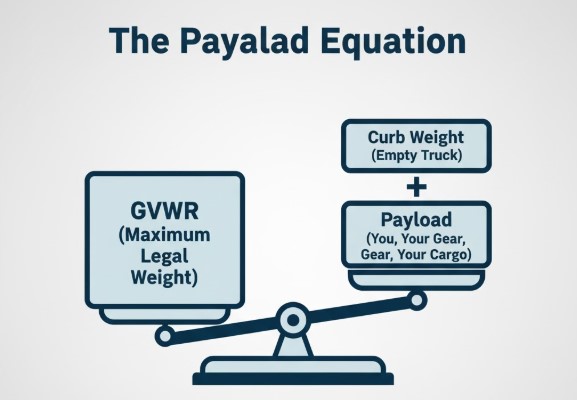
Gross Vehicle Weight Rating (GVWR)
The GVWR is the absolute maximum your truck can weigh when fully loaded. This includes the truck itself, a full tank of fuel, all passengers, and any cargo in the cab and bed. It is the single most important safety limit determined by the manufacturer, factoring in the capabilities of the frame, axles, suspension, and brakes.
For the Ford F-150, the GVWR typically ranges from 6,100 pounds on lighter models to 7,850 pounds on trucks equipped with the HDPP. Exceeding the GVWR is unsafe, illegal, and can cause significant damage to your vehicle.
Curb Weight
Curb weight is what your truck weighs when it’s empty but ready to drive, with a full tank of fuel and all necessary operating fluids. This number is not fixed; it changes with every single option you add. A base model F-150 might have a curb weight of around 4,021 pounds, while a fully-loaded, 4×4 SuperCrew with the PowerBoost hybrid system can exceed 5,540 pounds. Every feature—from a sunroof to a spray-in bedliner—adds to the curb weight.
The Payload Formula
With those two definitions, the formula for payload becomes clear. It’s a simple subtraction problem that determines how much weight is left over for you and your gear.
This is why a heavier truck doesn’t automatically mean a more capable truck. If two trucks have the same GVWR, the one with the lower curb weight will have the higher payload capacity.
Deconstructing the Numbers: Key Factors That Determine F-150 Payload
The maximum payload figures advertised by Ford are for a very specific, and often uncommon, configuration. In the real world, nearly every choice you make when building or buying an F-150 affects its final payload rating. Think of it as a zero-sum game: adding features almost always means subtracting payload.
Engine Choice
The engine is a primary factor. Heavier powertrains, like the 5.0L V8 or the 3.5L PowerBoost Full Hybrid (which includes a battery pack and electric motor), increase the truck’s curb weight. All else being equal, this reduces payload compared to the lighter 2.7L EcoBoost V6. The only way a heavier engine results in more payload is if it’s paired with a package that also increases the truck’s overall GVWR.
Cab & Bed Configuration
This is where the biggest differences emerge. The payload champion is consistently the Regular Cab with an 8-foot bed and a 4×2 drivetrain. Its lighter, two-door design minimizes curb weight.
- SuperCab models add smaller rear doors and seating, increasing weight.
- SuperCrew models, with four full doors and a spacious rear seat, are the heaviest, reducing payload capacity by 200 to 400 pounds compared to a similar Regular Cab.
Drivetrain (4×2 vs. 4×4)
Opting for a four-wheel-drive system adds significant hardware, including a transfer case, front differential, and front driveshafts. This extra equipment typically adds 150 to 250 pounds to the truck’s curb weight, directly reducing its payload capacity compared to an identical two-wheel-drive (4×2) model.
Trim Level (The Luxury Penalty)
As you climb the F-150 trim ladder from a work-ready XL to a luxurious Platinum or Limited, the payload capacity drops significantly. This is because high-end trims are loaded with heavy features:
- Panoramic sunroofs
- Power-deployable running boards
- Leather, heated, ventilated, and massaging seats
- Premium B&O sound systems with more speakers and amplifiers
- Additional sound-deadening material
These comfort and convenience items can easily add hundreds of pounds to the curb weight. It is not uncommon for a top-tier F-150 Platinum or Limited to have a payload sticker below 1,200 pounds, making it less capable of hauling heavy loads than a basic XL model that costs half as much. When choosing a trim, you are often trading payload capacity for features.
Optional Equipment & Accessories
Even after the truck leaves the factory, every item you add or subtract from your available payload. Be mindful of common additions:
- Spray-in Bedliner: Adds 40 to 70 pounds of permanent weight.
- Tonneau Cover: Hard, retractable, or tri-fold covers can weigh between 50 and 100+ pounds.
- Larger Fuel Tank: Upgrading from the standard 23-gallon tank to the 36-gallon tank means carrying an extra 13 gallons of fuel, which adds about 78 pounds when full.
The “Unicorn” Upgrade: Ford’s Heavy-Duty Payload Package (HDPP)
For those who need to maximize their F-150’s hauling potential, the key is the Heavy-Duty Payload Package (HDPP). This is not just a sticker upgrade; it’s a comprehensive set of mechanical enhancements that fundamentally increases the truck’s capability by raising its GVWR to a stout 7,850 pounds.
The HDPP is a rare find on dealer lots because it’s typically a special-order option limited to the work-oriented XL and XLT trims, and sometimes Lariat base trims, often requiring a specific cab and bed combination. It transforms the F-150 into a true “heavy half-ton” that bridges the gap to a Super Duty.
What’s Included in the F-150 Heavy-Duty Payload Package (HDPP)?
| Component | Upgrade / Benefit |
| Upgraded Springs | Higher-rate front coil springs and rear leaf springs to handle more weight without sagging. |
| 9.75-inch Gearset | A larger, more robust rear differential for enhanced durability under heavy loads. |
| 3.73 Electronic-Locking Rear Axle | Provides better leverage for moving heavy loads and improved traction. |
| Thicker Frame Rails | The frame itself is made from a thicker gauge of high-strength steel for increased rigidity. |
| Upgraded Wheels & LT Tires | Special 18-inch aluminum wheels and Load Range C or E “Light Truck” (LT) tires with stiffer sidewalls and higher load ratings. |
| Upgraded Shocks & Brakes | Tuned shock absorbers for better control and, on some models, larger rear brake rotors. |
The Only Number That Matters: How to Find Your F-150’s Real Payload
Brochures and websites list theoretical maximums. The only payload number that matters for your specific truck is the one printed on the federally mandated stickers inside the driver’s side door jamb. Here is how to find and use it.
Step 1: Locate the Door Jamb Stickers
Open the driver’s side door and look for two critical labels.
- The Safety Compliance Certification Label (usually white) lists the Gross Vehicle Weight Rating (GVWR) and Gross Axle Weight Ratings (GAWR).
- The Tire and Loading Information Label (usually yellow and white) is where you will find your truck’s specific payload capacity
Step 2: Read the Magic Phrase
On the Tire and Loading Information label, look for the following sentence: “THE COMBINED WEIGHT OF OCCUPANTS AND CARGO SHOULD NEVER EXCEED XXXX kg or XXXX lbs.”. That number is the official, as-built payload capacity for your truck, including all of its factory-installed options.
Step 3: Calculate Your Available Payload
The number on the sticker is your starting point. To find out how much you can actually put in the bed for a specific trip, you need to do some simple math.
- Start with Payload from Sticker: _______ lbs
- Subtract Driver & Passenger Weight: – _______ lbs
- Subtract Weight of Gear in Cab/Bed (coolers, tools, etc.): – _______ lbs
- Subtract Weight of Aftermarket Add-ons (bedliner, tonneau cover): – _______ lbs
- Subtract Trailer Tongue Weight (if towing): – _______ lbs
- Equals Your Remaining Available Payload: = _______ lbs
Before adding popular F-150 accessories that can affect your payload, always start with the number on your door sticker.
F-150 Payload vs. The Competition: A Head-to-Head Comparison
The Ford F-150 consistently competes at the top of its class for payload capacity, but its rivals from Ram, Chevrolet, and GMC offer compelling capabilities as well. It’s important to remember that, just like with the F-150, these maximum numbers are achieved on specific, often work-focused, configurations.
2025 Light-Duty Truck Payload Shootout (Maximum Advertised Capacity)
| Truck Model | Maximum Payload (lbs) | Key Engine/Configuration for Max Payload |
| Ford F-150 | 2,445 | 3.5L EcoBoost V6, Regular Cab, 4×2 |
| Ram 1500 | 2,370 | 3.6L Pentastar V6, Quad Cab, 4×2 |
| Chevrolet Silverado 1500 | 2,280 | 2.7L Turbo, Regular Cab, 4×2 |
| GMC Sierra 1500 | 2,240 | 2.7L Turbo, Regular Cab, 4×2 |
The F-150 maintains a slight edge in maximum advertised payload over its key rivals. The Ram 1500 is very competitive, often praised for its comfortable ride from its standard coil-spring rear suspension, though this can sometimes result in slightly lower payload ratings on comparable models.
The Chevrolet Silverado 1500 and GMC Sierra 1500 are mechanically similar and also post strong payload numbers, particularly in their work truck configurations. For a deeper look at these trucks, consult authoritative reviews from sources like Car and Driver
Frequently Asked Questions (FAQ)
What F-150 configuration has the highest payload capacity?
The configuration that consistently delivers the highest payload is a 4×2 Regular Cab with an 8-foot bed. For 2024/2025 models, this is paired with the 3.5L EcoBoost V6. For 2023 and prior model years, the absolute maximum was achieved with the 5.0L V8 and the Heavy-Duty Payload Package.
Does trailer tongue weight count against my F-150’s payload?
Yes, absolutely. The tongue weight of your trailer—the downward force it exerts on the hitch—is treated as cargo by your truck. It must be subtracted from the payload capacity listed on your door sticker. This is the single most common cause of overloading a pickup truck
How much payload does a spray-in bedliner or tonneau cover use?
A spray-in bedliner adds approximately 40 to 70 pounds of permanent weight, reducing your available payload by that amount. A tonneau cover can add another 50 to 100+ pounds, depending on the style and material.
Can I increase my F-150’s payload capacity with airbags or better springs?
No. While aftermarket suspension upgrades like airbags or add-a-leaf springs can help level the truck’s ride when loaded and improve handling, they do not legally or safely increase the manufacturer’s Gross Vehicle Weight Rating (GVWR). The payload capacity on your door sticker is the legal limit, determined by the entire system of frame, axles, brakes, and wheels.
What is the payload capacity of an F-150 Lightning?
The all-electric F-150 Lightning has a maximum payload capacity of up to 2,235 pounds. This figure is for the Pro trim with the lighter, standard-range battery. Trims with the heavier extended-range battery have lower payload capacities due to the increased curb weight. Learn more in our complete F-150 Lightning review.
Why is my truck’s payload on the door sticker so much lower than what Ford advertises?
Ford’s advertised numbers represent the maximum possible payload, which is only available on a very specific, lightweight base model configuration. Your truck’s unique combination of a heavier cab (SuperCrew), 4×4 drivetrain, higher trim level, and other factory options increases its curb weight. Since payload is GVWR minus curb weight, every pound of added features directly reduces the final payload number printed on your specific door sticker. Understanding how different F-150 trim levels add features and weight is key to managing expectations.