Ford F-150 Towing Capacity Chart 2013-2023: A Complete Guide

The Ford F-150’s reign as America’s best-selling truck is a legacy built on decades of proven reliability, innovation, and, above all, capability. At the heart of this capability lies its power to haul materials to a job site and tow trailers on a weekend adventure. Ford consistently advertises class-leading towing figures, but the truth is that the actual towing capacity of any specific F-150 is a complex calculation, not a single number.
This definitive guide will demystify that complexity. We provide a data-driven, year-by-year breakdown of the Ford F-150’s towing capabilities from the 2013 to 2023 model years. This analysis goes beyond the marketing headlines to show how engine choice, cab size, drivetrain, axle ratio, and essential equipment packages interact to determine your truck’s true potential.
We will begin by defining the critical language of towing, chart the evolution of the F-150’s power across three major generations, provide detailed data tables, and break down the factors that unlock maximum performance. For those just starting their search, understanding how to choose a pickup truck is the first step in this journey.
Before You Hitch Up: Understanding the Language of Towing
To safely and effectively use your F-150, it is essential to understand the terminology that governs its limits. These ratings are not suggestions; they are safety-critical limits determined by Ford’s engineers. Focusing solely on the maximum tow rating is a common mistake that can lead to unsafe conditions and premature wear on your vehicle.
Defining the Core Metrics
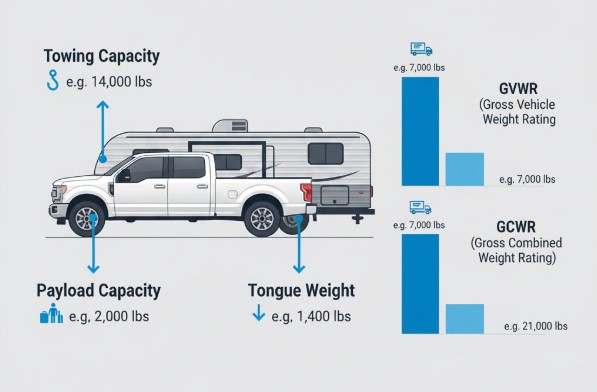
- Towing Capacity vs. Payload Capacity: These are the two most frequently cited figures, and they measure different things. Towing Capacity is the maximum weight your truck can pull behind it with a trailer. Payload Capacity is the maximum weight your truck can carry in its cab and bed, including passengers, cargo, and the trailer’s tongue weight. Ford has often engineered the F-150 to be “best-in-class” in both metrics simultaneously, but often with different configurations.
- Gross Vehicle Weight Rating (GVWR): This is the absolute maximum legal weight of your fully loaded truck. It includes the truck’s own curb weight plus fuel, all passengers, all cargo in the cab and bed, and the downward force of the trailer’s tongue. The GVWR is a critical safety number found on the Safety Compliance Certification Label on the driver’s side door jamb. For any truck owner, this sticker is the ultimate authority, superseding generic manual charts.
- Gross Combined Weight Rating (GCWR): This is the absolute maximum legal weight of the fully loaded truck and its attached trailer combined. This rating is determined by the strength of the truck’s engine, transmission, frame, axles, and braking system. You must never exceed the GCWR, regardless of the advertised towing capacity.
- Tongue Weight (TW): This is the downward force that the trailer coupler exerts on the truck’s hitch ball. For conventional trailers, a safe tongue weight is 10-15% of the total loaded trailer weight. Crucially, this weight is considered part of your truck’s payload and must be subtracted from your payload capacity.
The interplay between these ratings is where many towers run into trouble. A truck may be rated to tow a 10,000-pound trailer, but that trailer will exert 1,000 to 1,500 pounds of tongue weight on the hitch. If the truck’s payload capacity is only 1,600 pounds, adding two 200-pound adults and some gear into the cab could easily push the truck over its GVWR and payload limit, creating a dangerous situation.
The maximum tow rating is only achievable if you do not exceed any of the other weight ratings. For a deeper dive into how payload is calculated, refer to our guide on the Ford F-150 payload capacity.
Ford F-150 Towing Capacity Evolution: 2013-2023
Over the past decade, Ford has pushed the boundaries of light-duty truck capability. The F-150’s evolution is a story of innovation in materials, powertrain technology, and smart features, culminating in a peak conventional towing capacity of:
14,000
Pounds
The Big Picture: Max Towing Over Time
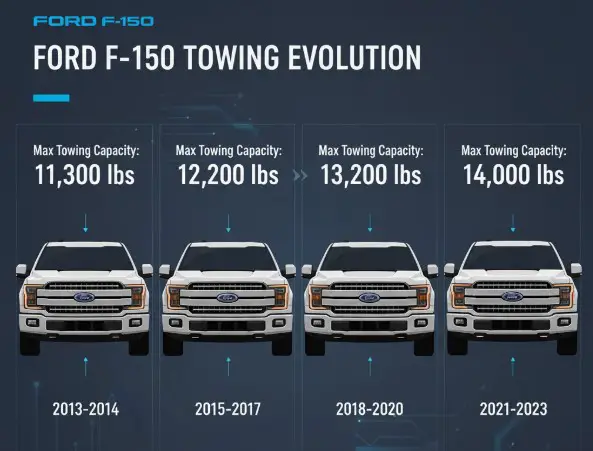
The maximum conventional towing capacity of the F-150 has seen a significant upward trend, with major leaps corresponding to the introduction of new generations and powertrain technologies in 2015 and 2021.
Heart of the Beast: 2023 Engine Comparison
Engine choice is the single most important factor for towing. The 3.5L EcoBoost V6 remains the champion for maximum conventional towing, while the 5.0L V8 and PowerBoost Hybrid offer compelling alternatives.
Key Technological Leaps
Several key innovations fueled the F-150’s towing growth. These milestones represent shifts in engineering philosophy and a relentless pursuit of capability.
2015: The Aluminum Revolution
The 13th generation debuts with a high-strength steel frame and aluminum alloy body, shedding up to 700 lbs. This weight reduction directly translates to increased payload and towing capacities.
2018: Power Stroke Diesel Arrives
Ford introduces a 3.0L Power Stroke V6 turbo-diesel engine, offering a blend of high torque for towing and improved fuel efficiency, broadening the F-150’s appeal.
2021: Hybrid Power & New Heights
The 14th generation launches with the innovative 3.5L PowerBoost Full Hybrid V6. Smart engineering allows properly equipped EcoBoost models to achieve the 14,000 lb towing milestone.
The Towing Capacity Formula
Achieving maximum towing isn’t just about the engine. A specific combination of cab, bed, drivetrain, and axle ratio is required. This flowchart shows how these critical choices stack up to determine your final capacity.
1. Engine Choice
(e.g., 3.5L EcoBoost)
2. Cab & Bed Size
(e.g., SuperCrew, 5.5′ Bed)
3. Drivetrain & Axle
(e.g., 4×2, Max Trailer Tow Pkg)
Final Towing Rating
(e.g., 14,000 lbs)
A Decade of Dominance: Charting the F-150’s Towing Evolution
The period from 2013 to 2023 was one of intense innovation for the F-150, marked by three distinct phases of capability. This evolution was driven by revolutionary changes in materials science, powertrain technology, and transmission engineering. The most significant milestone was the 2015 redesign, which introduced a high-strength steel frame paired with a military-grade, aluminum-alloy body.
This move shed hundreds of pounds of curb weight, which engineers could then “reinvest” into higher payload and towing capabilities. This era also saw the rise of EcoBoost technology, the introduction of a 10-speed automatic transmission, and the debut of hybrid powertrains, all contributing to a steady climb in the F-150’s dominance.
The table below provides a high-level overview of the F-150’s progress, highlighting the key generational shifts that pushed its towing limits higher.
| Model Year Range | F-150 Generation | Maximum Conventional Towing Capacity | Key Engine for Max Towing |
| 2013-2014 | 12th Gen | 11,300 lbs | 3.5L EcoBoost® V6 |
| 2015-2017 | 13th Gen | 12,200 lbs | 3.5L EcoBoost® V6 |
| 2018-2020 | 13th Gen (Refresh) | 13,200 lbs | 3.5L EcoBoost® V6 |
| 2021-2023 | 14th Gen | 14,000 lbs | 3.5L EcoBoost® V6 |
Detailed Towing Capacity Charts by F-150 Generation
While the maximum numbers are impressive, they only tell part of the story. The true capability of an F-150 depends on the specific engine under its hood. This section provides a detailed breakdown of the maximum towing potential for each available powertrain within its respective generation.
The Steel Standard: 12th Gen F-150 (2013-2014)
The 2013-2014 F-150 represents the pinnacle of Ford’s traditional steel-bodied truck engineering. This generation offered a robust lineup of four distinct engines, from a capable base V6 to a powerful 6.2L V8. However, it was the then-revolutionary 3.5L EcoBoost V6 that began to change the landscape of truck performance, proving that a smaller, turbocharged engine could outperform larger, naturally aspirated V8s. The maximum towing capacity for this generation topped out at an impressive 11,300 pounds when properly equipped.
This era marked a pivotal strategic shift for Ford. The fact that the 3.5L EcoBoost V6, with a displacement nearly half that of the 6.2L V8, could achieve the same maximum tow rating was a testament to the efficiency and power of forced induction. It delivered this capability while offering superior fuel economy, a combination that resonated with buyers.
This success validated Ford’s massive investment in EcoBoost technology and set the stage for turbocharged V6 engines to become the premier towing powerplants in the F-150 lineup for the next decade.
| Engine | Horsepower | Torque | Maximum Towing Capacity (lbs) |
| 3.7L Ti-VCT V6 | 302 hp | 278 lb-ft | Up to 6,700 |
| 5.0L Ti-VCT V8 | 360 hp | 380 lb-ft | Up to 10,000 |
| 6.2L SOHC V8 | 411 hp | 434 lb-ft | Up to 11,300 |
| 3.5L EcoBoost® V6 | 365 hp | 420 lb-ft | Up to 11,300 |
The Aluminum Revolution: 13th Gen F-150 (2015-2020)
The 2015 model year was a watershed moment for the entire pickup truck industry. Ford’s radical shift to a high-strength, military-grade, aluminum-alloy body and cargo box sent shockwaves through the market. This lightweighting strategy reduced the truck’s curb weight significantly, allowing for substantial increases in both payload and towing capacities.
This generation saw two distinct capability jumps: the initial redesign pushed the maximum to 12,200 pounds for 2015-2017, and a mid-cycle refresh in 2018, which included powertrain updates and the introduction of a 10-speed automatic transmission, elevated that figure to a new class-leading 13,200 pounds.
During this period, Ford also refined its powertrain strategy. While the 3.5L EcoBoost V6 consistently held the title of towing champion, the venerable 5.0L V8 was strategically positioned as the “payload king.” In many model years, an F-150 equipped with the 5.0L V8 and the Heavy-Duty Payload Package could boast a slightly higher maximum payload rating than its EcoBoost counterpart.
For example, in 2020, the V8 offered a max payload of 3,270 lbs compared to the 3.5L EcoBoost’s 3,230 lbs. This allowed Ford to claim “best-in-class” titles for two different, crucial metrics, appealing to both customers who prioritize pulling heavy trailers and those who prioritize hauling heavy loads in the bed.
| Engine | Model Years Available | Maximum Towing Capacity (lbs) |
| 3.5L Ti-VCT V6 | 2015-2017 | Up to 7,600 |
| 3.3L Ti-VCT V6 | 2018-2020 | Up to 7,700 |
| 2.7L EcoBoost® V6 | 2015-2020 | Up to 9,000 |
| 5.0L Ti-VCT V8 | 2015-2020 | Up to 11,600 |
| 3.0L Power Stroke® Diesel V6 | 2018-2020 | Up to 11,500 |
| 3.5L EcoBoost® V6 | 2015-2020 | Up to 13,200 |
| 3.5L High-Output EcoBoost® V6 | 2017-2020 | Up to 11,100 |
The Apex of Power & Technology: 14th Gen F-150 (2021-2023)
The 14th generation F-150, launched in 2021, represented a significant evolution of the aluminum-bodied platform, with a heavy emphasis on integrating advanced technology and offering the most diverse powertrain lineup in F-150 history. This generation saw the introduction of the innovative 3.5L PowerBoost™ Full Hybrid V6, which offered a compelling blend of V8-like power and impressive fuel efficiency.
On the conventional side, engineers pushed the limits even further, allowing a properly configured F-150 with the 3.5L EcoBoost V6 to break the 14,000-pound towing barrier, setting a new benchmark for the half-ton class.
However, potential buyers and owners must understand that the headline-grabbing 14,000-pound tow rating is a “unicorn” configuration. Achieving this number requires a very specific, and relatively uncommon, combination of features: a SuperCab with an 8-foot bed or a SuperCrew model, a 4×2 drivetrain, the 3.5L EcoBoost V6 engine, and the mandatory Max Trailer Tow Package.
The most popular configuration sold to consumers—the 4×4 SuperCrew—has a slightly lower maximum capacity of 13,800 pounds with the same engine and package. Trucks with other popular engines, like the 5.0L V8 or 2.7L EcoBoost, have significantly lower limits. This highlights the importance of checking the specific ratings for a particular vehicle rather than relying on the maximum advertised figure.
| Engine | Maximum Towing Capacity (lbs) |
| 3.3L Ti-VCT V6 | Up to 8,200 |
| 2.7L EcoBoost® V6 | Up to 10,100 |
| 5.0L Ti-VCT V8 | Up to 13,000 |
| 3.0L Power Stroke® Diesel V6 (2021 only) | Up to 12,100 |
| 3.5L EcoBoost® V6 | Up to 14,000 |
| 3.5L PowerBoost™ Full Hybrid V6 | Up to 12,700 |
| High-Output 3.5L EcoBoost® V6 (Raptor) | Up to 8,200 |
| High-Output 5.2L Supercharged V8 (Raptor R) | Up to 8,700 |
Beyond the Engine: The Anatomy of a Max Tow F-150
The engine is the heart of a tow vehicle, but it is only one part of a complex system. Two F-150s with the exact same engine can have vastly different tow ratings based on their configuration and optional equipment. Understanding these variables is the key to unlocking a truck’s full potential.
The Configuration Matrix
- Cab Style & Bed Length: A truck’s weight and wheelbase directly impact its towing stability and capacity. Lighter Regular Cab models, with their lower curb weight, sometimes have a slight towing advantage over heavier, feature-rich SuperCrew models because there is more “room” left under the Gross Combined Weight Rating (GCWR) for the trailer. Longer wheelbases, associated with longer beds, generally improve stability while towing.
- Drivetrain (4×2 vs. 4×4): The choice between two-wheel drive and four-wheel drive has a direct impact on towing capacity. The 4×4 system adds several hundred pounds of weight due to its transfer case, front differential, and front axles. This added weight must be subtracted from the GCWR, resulting in a lower maximum tow rating compared to an identical 4×2 model. This is a consistent factor across every F-150 towing guide.
The Axle Ratio Advantage
The axle ratio is one of the most critical yet least understood components in the towing equation. It represents the ratio of driveshaft rotations to one full rotation of the wheels. A higher numerical ratio (e.g., $3.73:1$) means the engine has more leverage to turn the wheels, providing greater torque multiplication for pulling heavy loads from a standstill.
A lower numerical ratio (e.g., $3.31:1$) allows the engine to operate at a lower RPM at highway speeds, which benefits fuel economy. For a detailed explanation of this trade-off, see our guide on how axle ratio affects towing capacity.
Historically, choosing a “towing axle” like a $3.73$ or $4.10$ meant accepting a significant penalty in fuel economy during daily, unloaded driving. However, the introduction of advanced multi-speed transmissions, like Ford’s 10-speed automatic, has fundamentally changed this dynamic. With a wider spread of gear ratios, the transmission can use its very low first gear to get a heavy load moving (simulating the effect of a high axle ratio) while also having multiple overdrive gears to keep engine RPMs low during highway cruising. This technological synergy means that opting for a max-tow configuration today comes with less of a daily-driving compromise than it did in the past.
Unlocking Full Potential: Ford’s Towing Packages
Achieving the maximum advertised tow ratings is impossible without specific, factory-installed equipment. The Max Trailer Tow Package (or its equivalent, the Tow/Haul Package in later years) is not just a hitch; it is a comprehensive engineering solution designed to handle the immense stress of heavy towing.
Key components of this package typically include :
- An upgraded rear bumper and Class IV trailer hitch receiver.
- A higher-ratio electronic-locking rear axle (e.g., $3.55$ or $3.73$).
- An integrated trailer brake controller to synchronize truck and trailer brakes.
- Pro Trailer Backup Assist™ for easier maneuvering in reverse.
- A larger 36-gallon fuel tank for extended range.
- Enhanced engine and transmission cooling systems.
- Upgraded front stabilizer bar.
Without one of these factory packages, an F-150’s towing capacity is often limited to a base level of 5,000 to 7,000 pounds, regardless of the engine.
Frequently Asked Questions (FAQ)
What is the maximum a 2023 Ford F-150 can tow?
A properly configured 2023 Ford F-150 can tow a maximum of 14,000 pounds. This rating requires the 3.5L EcoBoost V6 engine, a 4×2 drivetrain, and the Max Trailer Tow Package.
How much can an F-150 with the 2.7L EcoBoost V6 tow?
The maximum towing capacity for an F-150 with the 2.7L EcoBoost V6 varies by year, but for the 2021-2023 models, it is 10,100 pounds. Achieving this requires specific configurations and often the 2.7L EcoBoost Payload Package.
What is included in the F-150 Max Trailer Tow Package?
The Max Trailer Tow Package is a comprehensive suite of upgrades required for maximum towing. It typically includes an upgraded rear bumper, a 3.55 or 3.73 electronic-locking rear axle, a 36-gallon fuel tank, an integrated trailer brake controller, and advanced features like the Pro Trailer Backup Assist system.
How do I find the exact towing capacity for my specific F-150?
The most accurate source is the Safety Compliance Certification Label on your driver’s side door jamb. This label lists your specific vehicle’s Gross Vehicle Weight Rating (GVWR) and Gross Axle Weight Ratings (GAWR). You should cross-reference this information with the official Ford RV & Trailer Towing Guide for your model year to find the GCWR and tow rating for your exact engine, cab, and axle ratio combination. The door sticker’s ratings are the final authority.
Does a higher axle ratio increase towing capacity?
Yes. A higher numerical axle ratio (e.g., 3.73:1 compared to 3.31:1) acts as a torque multiplier, allowing the engine to turn the wheels with more force. This significantly increases the vehicle’s rated towing capacity, especially for pulling heavy loads from a stop or up grades.
Can I add a hitch to my F-150 and tow the maximum amount?
No. Simply adding an aftermarket hitch does not increase your truck’s towing capacity. The maximum ratings are dependent on the entire vehicle system, including the factory-installed engine, axle, cooling systems, suspension, and frame components that are part of the official towing packages. Towing with only a bumper-mounted hitch is typically limited to 5,000 pounds.
Conclusion: Hitching Up with Confidence and Knowledge
Over the last decade, the Ford F-150 has cemented its position as a leader in capability through relentless innovation. From the lightweighting of the aluminum body to the powerful efficiency of the EcoBoost engine family and the intelligence of modern transmissions, its evolution has been remarkable. The steady climb from an 11,300-pound maximum in 2013 to a 14,000-pound peak in 2023 is a clear testament to this engineering progress.
However, the most critical takeaway from this deep dive is that “maximum towing capacity” is not a universal number. It is the result of a precise, and sometimes uncommon, combination of powertrain, configuration, and optional equipment. The true capability of America’s favorite truck lies not in a single advertised figure, but in understanding the specific ratings of the vehicle you own or plan to buy.
Always verify your truck’s GVWR and GAWR on the door jamb sticker and consult the official towing guide for your model year before hitching up. By respecting these limits, you ensure that every towing experience is not just capable, but safe.