Ram 2500 Towing Capacity Chart [2024-2025] | Max Towing & Payload

The 2024 Ram 2500 stands as a titan in the heavy-duty truck segment, engineered to handle immense workloads with confidence. For those who depend on their truck to pull heavy trailers, large RVs, or essential work equipment, understanding its precise capabilities is paramount.
The 2024 Ram 2500 offers a maximum towing capacity of up to 19,990 pounds when properly configured with the legendary 6.7L Cummins® Turbo Diesel engine. For those who prefer gasoline power, the standard 6.4L HEMI® V8 provides a formidable maximum towing capacity of 17,740 pounds.
These impressive figures represent the peak capability of the Ram 2500 lineup. However, the actual tow rating of any specific truck is a nuanced figure, determined by a critical combination of engine choice, axle ratio, cab size, drivetrain, and bed length.
This comprehensive guide provides the official 2024 Ram 2500 towing capacity charts and, more importantly, explains how to interpret these numbers to find the perfect configuration for your real-world needs.
From a deep dive into its powerful engines to a head-to-head comparison with its rivals, this is the definitive resource for mastering the Ram 2500’s towing prowess. For those exploring the broader world of capable workhorses, see how this model fits within the landscape of modern heavy-duty trucks.
Ram 2500 Towing Capacity
A visual breakdown of the power, configurations, and capabilities of this heavy-duty workhorse.
Peak Performance Numbers
The Ram 2500 offers staggering capabilities when properly equipped. These maximum ratings form the benchmark for its class-leading power.
19,990
Max Diesel Towing (lbs)
With 6.7L Cummins & Gooseneck Hitch
4,000
Max Gas Payload (lbs)
With 6.4L HEMI V8 Engine
Engine Towing Power Compared
The choice between the standard 6.4L HEMI® V8 and the available 6.7L Cummins® Turbo Diesel is the most significant factor in determining towing capacity. The Cummins offers a substantial increase in torque and towing potential.
Payload Capacity: Gas vs. Diesel
While the diesel engine excels at towing, the lighter gasoline engine allows for a higher maximum payload capacity, making it ideal for carrying heavy loads directly in the truck bed.
Towing Capacity by Configuration
Towing capacity varies based on engine, cab type, and drivetrain. This table provides a snapshot of conventional towing capabilities for common configurations. Note that gooseneck/5th-wheel hitches will further increase diesel ratings.
| Configuration | 6.4L HEMI V8 (lbs) | 6.7L Cummins Diesel (lbs) |
|---|---|---|
| Crew Cab, 4×2, 6’4″ Box | 17,060 | 19,230 |
| Crew Cab, 4×4, 6’4″ Box | 16,650 | 18,820 |
| Mega Cab, 4×4, 6’4″ Box | 16,290 | 18,350 |
| Regular Cab, 4×2, 8′ Box | 17,730 | 19,990 |
Data is for representative purposes for a recent model year. Always confirm with the official VIN-specific tow rating of your vehicle.
Heavy-Duty Towing Competition
The Ram 2500 competes in a fierce market. Here’s how its maximum diesel towing capacity stacks up against its primary rivals, the Ford F-250 and Chevrolet Silverado 2500HD.
Hitch Type Matters
For the Cummins Diesel, upgrading from a conventional bumper pull hitch to a gooseneck or 5th-wheel setup significantly increases towing capacity by transferring the trailer’s tongue weight over the truck’s rear axle.
How Towing Capacity is Calculated
Your truck’s final, official tow rating is not a single number but the result of several key configuration choices working together.
(Power & Torque)
(Gearing)
(Weight & Size)
The Official 2024 Ram 2500 Towing Capacity Charts
Navigating the world of tow ratings can be complex, with numerous variables influencing the final number. The following charts, synthesized from Ram’s official 2024 Heavy Duty Towing Guide, offer a clear and comprehensive breakdown of the Ram 2500’s capabilities.
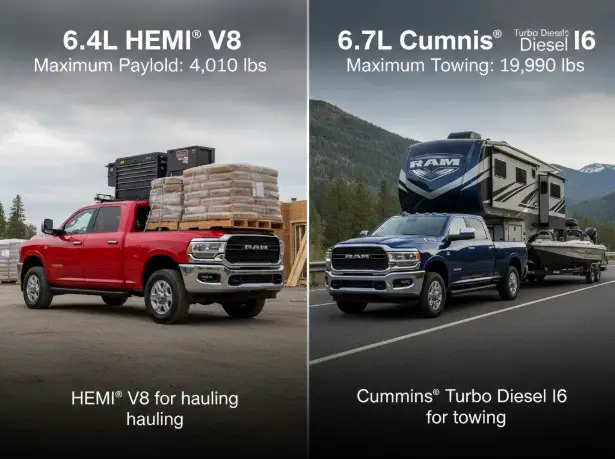
For a quick overview, the table below summarizes the maximum potential of each available powertrain. This provides an at-a-glance look at the top-line numbers for both towing and in-bed hauling.
2024 Ram 2500 Maximum Capability Overview
Detailed Towing Charts by Configuration
For those needing to match a specific truck configuration to their towing requirements, the following tables provide a granular look at how capacity changes with drivetrain, cab style, and axle ratio. The “Max Trailer Weight Rating” is the key figure to consult.
2024 Ram 2500 4×2 Towing Capacities (lbs)
| Cab / Box Configuration | Engine | Axle Ratio | Max Trailer Weight Rating |
| Regular Cab / 8′ Box | 6.4L HEMI V8 | 3.73 | 15,540 |
| 6.4L HEMI V8 | 4.10 | 17,740 | |
| 6.7L Cummins Diesel | 3.73 | 19,990 | |
| Crew Cab / 6’4″ Box | 6.4L HEMI V8 | 3.73 | 15,190 |
| 6.4L HEMI V8 | 4.10 | 17,390 | |
| 6.7L Cummins Diesel | 3.73 | 20,000 | |
| Crew Cab / 8′ Box | 6.4L HEMI V8 | 3.73 | 15,060 |
| 6.4L HEMI V8 | 4.10 | 17,260 | |
| 6.7L Cummins Diesel | 3.73 | 20,000 |
2024 Ram 2500 4×4 Towing Capacities (lbs)
| Cab / Box Configuration | Engine | Axle Ratio | Max Trailer Weight Rating |
| Regular Cab / 8′ Box | 6.4L HEMI V8 | 3.73 | 15,220 |
| 6.4L HEMI V8 | 4.10 | 17,420 | |
| 6.7L Cummins Diesel | 3.73 | 19,980 | |
| Crew Cab / 6’4″ Box | 6.4L HEMI V8 | 3.73 | 14,870 |
| 6.4L HEMI V8 | 4.10 | 17,070 | |
| 6.7L Cummins Diesel | 3.73 | 19,980 | |
| Crew Cab / 8′ Box | 6.4L HEMI V8 | 3.73 | 14,700 |
| 6.4L HEMI V8 | 4.10 | 16,900 | |
| 6.7L Cummins Diesel | 3.73 | 18,230 | |
| Mega Cab / 6’4″ Box | 6.4L HEMI V8 | 3.73 | 14,470 |
| 6.4L HEMI V8 | 4.10 | 16,600 | |
| 6.7L Cummins Diesel | 3.73 | 15,620 |
2024 Ram 2500 Specialized Trim Towing Capacities (lbs)
| Trim / Configuration | Engine | Axle Ratio | Max Trailer Weight Rating |
| Power Wagon Crew Cab / 6’4″ Box | 6.4L HEMI V8 | 4.10 | 10,590 |
| Rebel Crew Cab / 6’4″ Box | 6.4L HEMI V8 | 3.73 | 14,670 |
| 6.4L HEMI V8 | 4.10 | 16,870 | |
| 6.7L Cummins Diesel | 3.73 | 14,920 |
Engine Breakdown: The Power Behind the Pull
The heart of any heavy-duty truck is its engine, and the 2024 Ram 2500 offers two legendary powerplants, each designed for a specific type of user and workload.
6.4L HEMI V8
The standard 6.4L HEMI® V8 engine is a testament to the enduring power of American V8 engineering. Using Variable-Cam Timing (VCT), it delivers a best-in-class standard 410 horsepower, providing impressive capability for a wide array of towing and hauling tasks.
Paired with a sophisticated eight-speed automatic transmission, it offers refined performance, making it an excellent choice for those who need a powerful all-around truck that can serve as a daily driver and a weekend workhorse. This engine configuration is also where the Ram 2500 achieves its maximum payload capacity of 4,010 pounds.
6.7L Cummins Turbo Diesel I6
For those whose work demands the most extreme pulling power, the available 6.7L Cummins® Turbo Diesel I6 is the undisputed champion. This engine is renowned for its durability and, most importantly, its massive torque output. Churning out an immense 850 lb-ft of torque, the Cummins engine is engineered to tackle the most demanding jobs with ease, providing the low-end grunt necessary to get heavy loads moving from a standstill and up steep grades.
It is paired with a robust six-speed automatic transmission optimized for its power delivery. This is the engine that unlocks the Ram 2500’s maximum towing capacity, making it the premier choice for serious, frequent towing of heavy fifth-wheel trailers and commercial equipment.
2024 Ram 2500 Engine Specifications Compared
| Specification | 6.4L HEMI V8 | 6.7L Cummins Turbo Diesel I6 |
| Horsepower | 410 hp | 370 hp |
| Torque | 429 lb-ft | 850 lb-ft |
| Transmission | 8-Speed Automatic | 6-Speed Automatic |
| Maximum Towing Capacity | 17,740 lbs | 19,990 lbs |
| Maximum Payload Capacity | 4,010 lbs | 3,150 lbs |
Decoding the Details: Key Factors That Determine Your Truck’s True Capacity
The “maximum” tow rating advertised for any truck is only achievable with a very specific, and often uncommon, configuration. Understanding the key variables that influence these ratings is essential for selecting a truck that is not only capable but also safe for your specific needs.
The Payload Paradox: Why the Strongest Towing Engine Has Less Payload
One of the most critical and often misunderstood aspects of configuring a heavy-duty truck is the relationship between the engine and payload capacity. As shown in the table above, the 6.7L Cummins® engine provides the highest towing capacity but has a significantly lower maximum payload than the gas-powered HEMI® V8. This is not an error; it is a direct result of physics.
A truck’s payload capacity is calculated by subtracting its curb weight (the weight of the truck itself) from its Gross Vehicle Weight Rating (GVWR), which is the maximum weight the truck is engineered to safely handle. The powerful Cummins diesel engine, along with its robust transmission and cooling systems, is substantially heavier than the HEMI V8 powertrain.
This added weight increases the truck’s curb weight. Since the GVWR for most Ram 2500 models is a fixed limit of 10,000 pounds, the heavier diesel truck has less remaining capacity for passengers and cargo, resulting in a lower payload rating.
This is especially critical for those planning to tow a fifth-wheel or gooseneck trailer. The pin weight of these trailers—the portion of the trailer’s weight that rests directly in the truck bed—can be 15-25% of the total trailer weight. This pin weight counts directly against the truck’s payload.
It is entirely possible to have a trailer that is well under the truck’s maximum tow rating but whose pin weight exceeds the truck’s payload capacity, creating an unsafe and potentially illegal towing situation. Therefore, for heavy fifth-wheel towing, carefully balancing the trailer’s pin weight against the truck’s specific payload rating is just as important as checking the tow rating. For a deeper dive into this crucial metric, it is helpful to start by understanding your truck’s payload.
Axle Ratio: The Unsung Hero of Towing
The choice of axle ratio is one of the most significant decisions affecting a truck’s towing performance. The Ram 2500 with the HEMI V8 engine is commonly offered with either a 3.73 or a 4.10 axle ratio. This number represents how many times the driveshaft must turn to rotate the wheels one full revolution.11
A higher numerical ratio, like 4.10, acts as a torque multiplier. It gives the engine a greater mechanical advantage, making it easier to pull a heavy load from a stop and maintain speed on inclines. The difference is substantial: a 4×2 Regular Cab Ram 2500 with the HEMI V8 and a 3.73 axle ratio can tow 15,540 pounds. Equipping the exact same truck with a 4.10 axle ratio boosts its capacity by over 2,200 pounds to 17,740 pounds.
The trade-off for this increased power is typically fuel efficiency. At highway speeds, the 4.10 ratio requires the engine to run at a higher RPM, which can consume more fuel when the truck is not towing. The 3.73 ratio offers a balance between capable towing and better efficiency for daily driving. The choice depends on the user’s primary needs: for maximum towing power, the 4.10 is the clear winner; for a more balanced, all-purpose truck, the 3.73 is often the preferred choice.
The Off-Road Trade-Off: Power Wagon & Rebel
The Ram 2500 Power Wagon® and Rebel® are the lineup’s most visually aggressive and off-road-capable models. However, this capability comes at the cost of towing and payload capacity. The Power Wagon, in particular, is a highly specialized vehicle designed for extreme off-road articulation and rock-crawling prowess.
To achieve this, it features a softer, more flexible suspension, locking front and rear differentials, and an electronically disconnecting front sway bar. This suspension, ideal for keeping tires on uneven terrain, is the opposite of the stiff, heavy-duty suspension required to support a massive trailer and heavy pin weight.
Consequently, the Power Wagon has a much lower GVWR of 8,565 pounds and a maximum towing capacity of just 10,590 pounds. While the Rebel offers more towing capability than the Power Wagon, it still prioritizes off-road performance over maximum hauling. These trims are purpose-built for adventure, not for towing the heaviest loads.
Ram 2500 vs. The Competition: A Heavy-Duty Showdown
The 3/4-ton heavy-duty truck market is one of the most fiercely contested segments in the automotive world. The Ram 2500 goes head-to-head with the Ford F-250 Super Duty and the Chevrolet Silverado 2500HD. The following table provides a data-driven comparison of their 2024 models’ key performance metrics.
2024 Heavy-Duty Truck Towing & Power Comparison
| Specification | Ram 2500 | Ford F-250 | Chevrolet Silverado 2500HD |
| Max Gas Towing (Conventional) | 17,740 lbs | 17,200 lbs | 16,000 lbs |
| Max Diesel Towing (Conventional) | 20,000 lbs | 22,000 lbs | 20,000 lbs |
| Max Diesel Towing (5th-Wheel/Gooseneck) | 19,990 lbs | 23,000 lbs | 22,500 lbs |
| Max Gas Payload | 4,010 lbs | 4,268 lbs | 3,759 lbs |
| Top Diesel Engine | 6.7L Cummins I6 | 6.7L High-Output Power Stroke V8 | 6.6L Duramax V8 |
| Max Diesel Torque | 850 lb-ft | 1,200 lb-ft | 975 lb-ft |
In the 2024 model year comparison, both the Ford F-250 and Chevrolet Silverado 2500HD offer higher maximum fifth-wheel/gooseneck towing ratings. Ford, in particular, leads the class in peak torque with its High-Output Power Stroke V8 engine. The Chevrolet Silverado 2500HD also posts very strong numbers with its updated Duramax diesel.
However, the Ram 2500 remains a formidable competitor with its own distinct advantages. The Cummins inline-six engine is legendary for its reliability and smooth power delivery. Ram also offers class-exclusive features like the Auto-Level Rear Air Suspension, which improves stability and ride quality when towing heavy loads. Ultimately, while competitors may hold an edge in certain top-line specifications for 2024, the choice often comes down to powertrain preference, available features, and brand loyalty.
A Look Through Time & Into the Future: Ram 2500 Towing Evolution
The capability of heavy-duty trucks has seen a dramatic increase over the last decade. The Ram 2500 is a prime example of this engineering progress, with each new generation bringing more power and strength.
Ram 2500 Maximum Towing Capacity by Year (2018-2024)
| Model Year | Maximum Towing Capacity (lbs) |
| 2024 | 19,990 |
| 2023 | 19,980 |
| 2022 | 20,000 |
| 2021 | 19,780 |
| 2020 | 19,780 |
| 2019 | 19,780 |
| 2018 | 17,980 |
Sneak Peek: The 2025 Ram 2500
Looking ahead, the 2025 Ram 2500 is set to receive a significant powertrain update that directly addresses the competitive landscape. For the first time, the Ram 2500 will be available with the High-Output 6.7L Cummins® Turbo Diesel I6 engine, an option previously exclusive to the Ram 3500.
This update brings a substantial power increase, with the 2025 model’s maximum diesel towing capacity rising to 20,000 pounds. More importantly, the High-Output engine boosts torque to a staggering 1,075 lb-ft, placing it in direct competition with the most powerful engines from Ford and GM. This strategic move demonstrates Ram’s commitment to remaining at the forefront of heavy-duty capability.
Mastering the Lingo: A Practical Towing Glossary
To tow safely and legally, it is essential to understand the terminology and acronyms that define a truck’s limits.
- Curb Weight: The weight of the truck with all standard equipment and a full tank of fuel, but without any passengers or cargo.
- Payload: The maximum weight of all cargo and passengers that a truck can safely carry in its cab and bed. The formula is simple:
- GVWR (Gross Vehicle Weight Rating): The absolute maximum allowable weight of the fully-loaded truck. This includes the truck’s curb weight plus the weight of all passengers, cargo, and the trailer’s tongue/pin weight. This limit, found on the driver’s side door jamb sticker, should never be exceeded.
- GCWR (Gross Combined Weight Rating): The maximum allowable weight of the loaded truck and the loaded trailer combined. This is the rating that determines the maximum trailer weight a truck can pull.
- Tongue/Pin Weight: The downward force that the trailer’s coupler exerts on the truck’s hitch. This weight is carried by the truck and must be subtracted from the available payload capacity. For conventional trailers, it should be 10-15% of the total trailer weight; for fifth-wheel/gooseneck trailers, it should be 15-25%.
The Gold Standard: Why SAE J2807 Matters
In the past, truck manufacturers used their own internal testing procedures to determine tow ratings, making fair, apples-to-apples comparisons nearly impossible. To standardize the process, the Society of Automotive Engineers (SAE) International developed the SAE J2807 standard.
This standard outlines a set of rigorous, real-world performance tests that a vehicle must pass to earn its tow rating. These tests are designed to simulate challenging conditions and include:
- Highway Gradeability: Climbing the steep, 11.4-mile Davis Dam grade in Arizona during 100°F heat with the air conditioning on full blast, all while maintaining a minimum speed.
- Acceleration: Meeting minimum 0-30 mph and 0-60 mph times while pulling a trailer at the maximum rated weight.
- Braking and Handling: Passing tests for stopping distance, trailer sway response, and understeer to ensure the vehicle remains stable and controllable.
Frequently Asked Questions (FAQs)
What can a 2024 Ram 2500 realistically tow?
A properly equipped Ram 2500 with the 6.7L Cummins® engine can comfortably handle a wide range of heavy loads. This includes large fifth-wheel RVs (often weighing 14,000-16,000 pounds), toy haulers with multiple ATVs, large livestock trailers, and heavy construction equipment like skid steers or mini excavators. The 6.4L HEMI® V8 is well-suited for large travel trailers, ski boats, and heavy-duty utility trailers.
Is the Power Wagon a good choice for heavy towing?
No, the Power Wagon is not designed for heavy towing. It is a specialized off-road vehicle with a unique suspension system that prioritizes trail performance over hauling capability. Its maximum towing capacity is significantly lower than other Ram 2500 models, at around 10,590 pounds. Buyers who need to tow heavy loads should choose a different trim level.
What’s the difference between a 5th-wheel and a gooseneck hitch?
Both are heavy-duty hitches mounted in the truck bed, but they use different connection mechanisms. A fifth-wheel hitch uses a large, articulated plate and a jaw mechanism that clamps onto a “kingpin” on the trailer. It’s most common for RVs and provides a very stable, smooth towing experience, though the hitch itself is bulky.
A gooseneck hitch uses a simple ball in the truck bed that connects to a coupler on the trailer’s “gooseneck.” It is less invasive in the bed and common for agricultural and commercial trailers, but may not offer as quiet a ride as a fifth-wheel. For more details on hitch types, resources like(https://www.curtmfg.com/) are excellent.
How do I find the exact towing capacity for my specific truck?
The most accurate information for your specific vehicle is located on the certification labels on the driver’s side door jamb. One sticker will list the Gross Vehicle Weight Rating (GVWR) and the Gross Axle Weight Ratings (GAWRs). A separate “Tire and Loading Information” sticker will list the specific payload capacity (“the combined weight of occupants and cargo should never exceed XXXX lbs”) for your truck as it was built at the factory. You can then consult the owner’s manual or Ram’s official(https://www.ramtrucks.com/towing/towing-capacity-guide.html) to find the Gross Combined Weight Rating (GCWR) for your specific configuration.
Should I choose the gas or diesel engine for towing?
The choice depends entirely on your needs.
- Choose the 6.7L Cummins® Diesel if: You tow heavy loads (over 15,000 pounds) frequently, travel long distances with a trailer, or need the absolute maximum pulling power. The diesel’s superior torque and better fuel economy under load make it the ideal choice for serious work.
- Choose the 6.4L HEMI® V8 if: You tow moderate loads, need a higher payload capacity for in-bed campers or heavy cargo, want a lower upfront purchase price, and desire quicker acceleration when the truck is unloaded.