Ram 3.6L V6 Pentastar Specs: The Definitive Guide (2025 Update)

For more than a decade, the 3.6L Pentastar V6 has served as the reliable, efficient heart of the Ram 1500 lineup. Often overshadowed by the legendary HEMI V8, the Pentastar has carved out a crucial role as the standard-bearer, delivering a balanced blend of capability, refinement, and value that meets the needs of a vast majority of truck owners. It’s the engine that powers daily commutes, supports small businesses, and handles weekend projects with quiet competence.
First introduced to the Ram 1500 for the 2013 model year, the Pentastar V6 has been continuously refined, most notably with the integration of the eTorque mild-hybrid system, which enhances both performance and drivability. This guide provides an exhaustive, data-driven look into the Ram 3.6L V6 engine. We will cover its core specifications, demystify its eTorque technology,
explore its real-world reliability, and analyze how it stacks up against its fiercest competitors. Whether you are a prospective buyer or a current owner, this is your definitive resource for understanding the workhorse of the Ram family.
Ram 3.6L V6 Pentastar: Core Specifications for the 2025 Model Year
For the 2025 model year, the 3.6L Pentastar V6 with eTorque continues its role as the standard engine in key Ram 1500 trims like the Tradesman and Big Horn. It provides a robust foundation of performance and efficiency. Below are the official specifications for the engine as configured in the 2025 Ram 1500.
2025 Ram 1500 3.6L Pentastar V6 Specs
| Specification | Value |
| Engine Type | 3.6L Pentastar V6 with eTorque Mild-Hybrid System |
| Horsepower | 305 hp @ 6,500 rpm |
| Torque | 269 lb-ft @ 4,900 rpm |
| Transmission | TorqueFlite 850RE 8-Speed Automatic |
| Maximum Towing | 8,110 lbs |
| Maximum Payload | 2,370 lbs |
| MPG (2WD) | 20 City / 25 Highway / 22 Combined |
| MPG (4WD) | 19 City / 24 Highway / 21 Combined |
| Fuel Requirement | Regular 87-Octane Unleaded |
| Oil Capacity | 6 quarts |
One of the most significant and often overlooked advantages of the 3.6L V6 is its contribution to the Ram 1500’s payload capacity. While more powerful engines like the new Hurricane inline-six offer higher towing numbers, the Pentastar V6 configuration yields the truck’s highest possible payload rating at 2,370 pounds. This is a direct result of its lighter weight.
Payload is calculated by subtracting a truck’s curb weight from its Gross Vehicle Weight Rating (GVWR). Because the V6 engine is lighter than the turbocharged I-6 or the outgoing V8, it leaves more of the GVWR available for cargo in the bed. This makes the 3.6L V6 the ideal choice for users who prioritize hauling heavy materials—such as landscapers, painters, or contractors—over towing heavy trailers.
Decoding eTorque: Ram’s Mild-Hybrid Advantage Explained
Standard on every 3.6L Pentastar V6 in the modern Ram 1500, the eTorque system is a key differentiator in the light-duty truck market. It is a 48-volt mild-hybrid system that replaces the engine’s traditional alternator with a sophisticated belt-driven motor-generator unit (MGU). This MGU works in tandem with a suitcase-sized, air-cooled lithium-ion battery pack mounted on the rear wall of the truck’s cabin.
While it provides a modest 1-2 MPG improvement, the system’s primary benefits are centered on refining the driving experience. It accomplishes this through six key functions:
- Seamless Engine Start/Stop: eTorque delivers exceptionally smooth and fast engine restarts—often in less than 70 milliseconds. This makes the auto start/stop function nearly imperceptible in city traffic, a significant improvement over the often clunky systems in competitor vehicles.
- eRoll Assist (Torque Boost): From a complete stop, the MGU delivers up to 90 lb-ft of supplemental electric torque to the crankshaft for the first half-rotation of the wheels. This doesn’t increase the engine’s peak torque rating, but it fills the momentary torque gap at low RPMs, making the truck feel significantly more responsive and confident when accelerating from a standstill.
- Brake Regeneration: During deceleration and braking, the MGU reverses its function, capturing kinetic energy that would otherwise be lost as heat. This energy is used to recharge the 48-volt battery pack, improving overall system efficiency.
- Torque Smoothing & Rev-Matching: To enhance shift quality, the MGU can make minor, instantaneous adjustments to engine speed during gear changes. This smooths out both upshifts and downshifts, reducing driveline shock and contributing to a more luxurious ride feel.
- Powering Electrical Systems: The 48-volt battery helps power the truck’s electrical accessories, reducing the parasitic load on the gasoline engine and freeing up more of its power for propulsion.
- Cylinder Deactivation Support: On the now-discontinued 5.7L HEMI V8, eTorque also helped smooth the transition when the engine switched from eight to four cylinders, making the fuel-saving measure less noticeable to the driver.
eTorque System Diagram
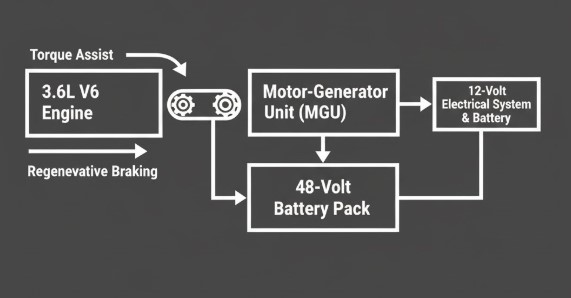
- Description: A simple flowchart illustrating the flow of energy within the eTorque system. A central box labeled “3.6L V6 Engine” is connected by a belt graphic to a box labeled “Motor-Generator Unit (MGU).” The MGU has two-way arrows connecting it to a “48-Volt Battery Pack.” An arrow points from the MGU to the “12-Volt Electrical System & Battery.” Text annotations explain the energy flow: “Torque Assist” (from MGU to Engine) and “Regenerative Braking” (from MGU to Battery).
Ultimately, the eTorque system is engineered less for headline-grabbing fuel economy numbers and more for elevating the refinement of the standard powertrain. It makes the base-model Ram 1500 drive with a smoothness and quiet sophistication that is typically reserved for premium vehicles, reinforcing Ram’s brand focus on comfort and ride quality.
A Legacy of Versatility: The History and Evolution of the Pentastar V6
The 3.6L Pentastar is not a new or unproven engine; it is a well-established platform with a long history of continuous improvement. Introduced at the 2009 New York Auto Show for the 2011 model year, the Pentastar was a landmark achievement for Chrysler. It was designed as a single, flexible V6 architecture to replace seven outdated V6 engines across the company’s portfolio, streamlining manufacturing and modernizing the powertrain lineup.
It brought contemporary technologies like a lightweight, high-pressure die-cast aluminum block, dual overhead camshafts (DOHC), and dual independent variable valve timing (VVT) to the forefront, delivering a much-needed balance of power and efficiency.
In the Ram 1500, the Pentastar’s journey began with the 2013 model year, when it replaced the anemic 3.7L V6. Over the years, it received significant upgrades, including a two-stage variable valve lift (VVL) system and cooled exhaust gas recirculation (EGR) to further refine its performance and economy. The most notable evolution came with the launch of the fifth-generation Ram 1500 (DT), which made the eTorque mild-hybrid system standard on the V6.
Evolution of the 3.6L V6 in the Ram 1500 Table
| Model Year | Key Feature / Spec Change | Max Towing Capacity | Max Payload Capacity |
| 2013-2018 | Introduction to Ram 1500, paired with 8-speed auto | Up to 7,600 lbs | Up to 1,900 lbs |
| 2019-2024 | eTorque system becomes standard | 7,730 lbs | 2,300-2,330 lbs |
| 2025 | Becomes standard engine alongside new Hurricane I-6 | 8,110 lbs | 2,370 lbs |
Long-Term Reliability, Common Issues, and Lifespan
Any discussion of a workhorse engine must include a frank assessment of its long-term reliability. The 3.6L Pentastar V6 has earned a dual reputation: it is widely regarded as a durable, high-mileage engine, yet it has several well-documented and predictable failure points.
With consistent, proper maintenance, the Pentastar V6 has a life expectancy that regularly exceeds 250,000 to 300,000 miles. There are numerous accounts from owners, particularly those with fleet vehicles like the ProMaster van, of engines reaching 500,000 miles.
However, prospective buyers and current owners should be aware of a few common issues that tend to appear as the engine ages:
- Oil Filter Housing & Cooler Leaks: This is the most prevalent issue with the Pentastar engine. The original housing is made of plastic, and after thousands of heat cycles, it can become brittle, crack, or warp, leading to significant oil and/or coolant leaks into the engine valley. The aftermarket has responded with durable aluminum replacement parts, which many owners and independent shops recommend as a preventative upgrade.
- Rocker Arm / Lifter “Tick”: A distinct ticking noise from the top of the engine, especially on earlier models, is often a sign of failing roller rocker arms or hydraulic lifters. If left unaddressed, this can cause excessive wear on the camshafts, leading to misfires and a costly repair.
- Cooling System Failures: Malfunctions of the water pump, radiator, or thermostat housing are known to occur and can lead to overheating. Overheating is a critical issue, as it can exacerbate other problems, including the potential for cylinder head damage that was more common on the earliest (pre-2014) versions of the engine.
While some owners of both experience these frustrating and sometimes expensive repairs, the issues are so well-documented that they have become predictable. This predictability is, in a way, a form of reliability. Unlike engines that suffer from random, catastrophic failures, the Pentastar’s weaknesses are known quantities. A knowledgeable owner or a mechanic performing a pre-purchase inspection knows exactly what to look for, allowing for proactive monitoring and repair.
Head-to-Head: The 3.6L V6 vs. The Competition
To fully understand the 3.6L Pentastar’s place in the market, it’s essential to compare it against its key rivals, both within the Ram family and from competing brands.
Internal Rivalry: Pentastar V6 vs. The Legendary 5.7L HEMI V8
For years, the primary decision for Ram 1500 buyers was “V6 or V8?” Although the 5.7L HEMI has been discontinued for the 2025 Ram 1500, it remains available in the Ram 1500 Classic and is a critical benchmark for used truck shoppers. The choice represents a classic trade-off: the V6’s superior fuel efficiency and payload versus the V8’s raw power, iconic sound, and immense towing strength. For a deeper dive into how these engines affect the(https://truckguider.com/ram-1500-towing-capacity/), further research is recommended.
Ram 3.6L V6 vs. 5.7L HEMI V8 (2024 Model Year)
| Specification | 3.6L Pentastar V6 w/ eTorque | 5.7L HEMI V8 w/ eTorque |
| Horsepower | 305 hp | 395 hp |
| Torque | 269 lb-ft | 410 lb-ft |
| Max. Towing | 7,730 lbs | 12,750 lbs |
| Max. Payload | 2,330 lbs | 1,860 lbs |
| MPG (Combined) | ~22-23 MPG | ~20 MPG |
Ram 3.6L V6 vs. Ford 3.5L EcoBoost & Chevy 5.3L V8
When cross-shopping brands, it’s important to compare the right engines. The Ram’s 3.6L V6 is its standard engine, while the popular Ford 3.5L EcoBoost V6 and Chevrolet 5.3L V8 are upgrade options in their respective lineups. Therefore, the Pentastar is not a direct performance competitor to these larger, more powerful engines; rather, its value lies in being a superior standard engine.
It offers more horsepower than Ford’s previous 3.3L V6 base engine and provides a different character—smooth, naturally aspirated V6 power—compared to Chevrolet’s turbocharged four-cylinder base engine.
The following table compares the Ram’s standard V6 against the popular V6 and V8 upgrade engines from Ford and Chevrolet to illustrate the performance gap buyers can expect if they opt for a higher-tier powertrain from a competitor.
2024 Light-Duty Truck Engine Comparison Table
- Description: A three-column “tale of the tape” matrix comparing the key performance metrics of the three most talked-about engines in the light-duty segment.
- Data:
| Specification | Ram 1500 (3.6L V6) | Ford F-150 (3.5L EcoBoost V6) | Chevy Silverado 1500 (5.3L V8) |
| Horsepower | 305 hp | 400 hp | 355 hp |
| Torque | 269 lb-ft | 500 lb-ft | 383 lb-ft |
| Max. Towing | 7,730 lbs | 13,500 lbs | 11,300 lbs |
| Max. Payload | 2,330 lbs | 2,445 lbs | 2,180 lbs |
Beyond the 1500: The Pentastar in the Ram ProMaster
The versatility of the 3.6L Pentastar V6 is on full display in its application in the Ram ProMaster commercial van. Here, the engine is tuned and configured differently to meet the specific demands of a front-wheel-drive cargo vehicle. This broader application demonstrates the engine’s robust and adaptable design. For a complete breakdown of its technical details, sources like(https://www.caranddriver.com/ram/promaster/specs) offer an in-depth look.
Ram 1500 vs. Ram ProMaster 3.6L V6 Specs
| Specification | Ram 1500 (2025) | Ram ProMaster (2025) |
| Horsepower | 305 hp | 276 hp |
| Torque | 269 lb-ft | 250 lb-ft |
| Transmission | 8-Speed Automatic | 9-Speed Automatic |
| Drivetrain | RWD / 4WD | Front-Wheel Drive (FWD) |
| Max. Towing | 8,110 lbs | Up to 7,130 lbs |
| Max. Payload | 2,370 lbs | Up to 4,750 lbs |
Maintenance for Longevity: Recommended Service Schedule
Achieving the high mileage for which the Pentastar V6 is known requires adherence to a consistent maintenance schedule. Following these key service intervals is the best way for owners to ensure long-term reliability and prevent common issues from developing.
- Oil & Filter Change: Every 8,000 to 10,000 miles, or when prompted by the vehicle’s oil life monitoring system. Using the correct specification of synthetic oil is critical.
- Engine Air Filter: Inspect every 30,000 miles and replace if necessary. In dusty or off-road conditions, inspections should be more frequent.
- Spark Plugs: The recommended replacement interval is approximately 96,000 to 100,000 miles.
- Engine Coolant: Flush and replace the engine coolant at approximately 10 years or 100,000-120,000 miles, whichever comes first, to maintain cooling system integrity.
The Verdict: Is the Ram 3.6L V6 the Right Engine for You?
After a thorough analysis of its specifications, technology, reliability, and competitive standing, a clear picture of the 3.6L Pentastar V6 emerges. It is a highly competent, refined, and valuable engine, but it is not the right choice for every truck buyer.
The 3.6L V6 is the PERFECT choice for:
- The Daily Driver: Someone who uses their truck for commuting and family duties will benefit most from its smooth, quiet operation and the best fuel economy available in a full-size Ram.
- The Business Owner or Contractor: An individual who needs the absolute maximum payload capacity for hauling tools, supplies, or equipment in the bed will find the V6 is the superior option.
- The Budget-Conscious Buyer: This engine provides a strong, reliable powertrain without the upfront cost or long-term fuel expense of an upgraded engine, representing a smart value proposition.
You should UPGRADE to a more powerful engine if you are:
- The Frequent Tower: Anyone who regularly tows a trailer weighing over 5,000 pounds—such as a large boat, a travel trailer, or heavy equipment—will greatly benefit from the superior torque and capability of the new 3.0L Hurricane engines or a used 5.7L HEMI V8.
- The Performance Enthusiast: Drivers who crave powerful acceleration and the commanding sound of a high-output engine will find the V6’s adequate-but-unexciting power delivery to be underwhelming.
Once you’ve decided on the engine, the next step is choosing the right(https://truckguider.com/ram-1500-trim-levels/) to match your needs and budget.
Frequently Asked Questions (FAQs)
What is the life expectancy of a Ram 3.6L V6 engine?
With proper and consistent maintenance, the 3.6L Pentastar V6 engine can reliably last between 250,000 and 300,000 miles. Many owners, especially in commercial applications, have reported lifespans exceeding this range.
What are the most common problems with the Ram 3.6L V6?
The most frequently reported issues are leaks from the plastic oil filter housing/cooler assembly, a ticking sound from the valvetrain caused by failing rocker arms or lifters, and occasional cooling system problems related to the water pump or radiator.
How much can a Ram 1500 with the 3.6L V6 tow?
For the 2025 model year, a properly equipped Ram 1500 with the 3.6L V6 eTorque engine has a maximum conventional towing capacity of 8,110 pounds.
Does the 3.6L Pentastar V6 require premium gas?
No. The 3.6L V6 is designed to operate efficiently on standard 87-octane regular unleaded gasoline, which helps to lower overall running costs compared to engines that require or recommend premium fuel.
Is the 3.6L V6 powerful enough for a Ram 1500?
With 305 horsepower, the 3.6L V6 is perfectly adequate and capable for daily driving, light hauling, and moderate towing tasks. While it lacks the effortless power of larger engines, the majority of owners find it provides sufficient performance for typical light-duty truck use