Ram 3500 Towing Capacity Chart (2021-2025)

When the task demands moving mountains, the Ram 3500 answers the call. With a headline maximum towing capacity reaching an immense 36,610 pounds for the 2025 model year, this heavy-duty truck stands at the pinnacle of trailering capability.
However, that single, impressive number is only the beginning of the story. A truck’s true, usable towing capacity is not a fixed figure but a dynamic rating determined by a precise combination of engine, transmission, axle ratio, drivetrain, and vehicle configuration.
This guide deconstructs that complexity. We will provide the official, detailed towing charts and the essential knowledge required to understand exactly what any specific Ram 3500 can really tow.
This report will deliver a comprehensive overview of the latest 2025 model, detailed charts for recent model years, a breakdown of the factors that dramatically alter towing figures, a clear glossary of essential towing terms for safe and legal operation, and a head-to-head comparison with its chief rival, the Ford F-350.
2025 Ram 3500 Towing & Payload Capacity: The Big Picture
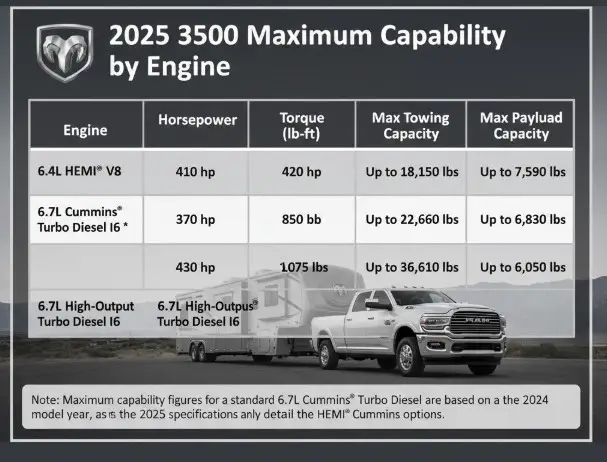
For those seeking a quick, high-level understanding of the 2025 Ram 3500’s capabilities, the maximum potential is best summarized by engine choice. Each of the available powerplants is engineered for a different balance of power, payload, and trailering prowess.
A critical decision for any buyer is understanding the inverse relationship between maximum towing and maximum payload. The engine that delivers the highest tow rating, the High-Output Cummins diesel, is also the heaviest. A truck’s payload capacity is calculated by subtracting its curb weight from its Gross Vehicle Weight Rating (GVWR).
Because the heavy diesel engine increases the truck’s curb weight, it leaves less available payload capacity—the combined weight of passengers, cargo, and the trailer’s tongue weight. Conversely, the lighter 6.4L HEMI® V8 gasoline engine allows for the highest possible payload capacity but provides a lower maximum tow rating. This trade-off is fundamental to configuring a heavy-duty truck for a specific job.
Deconstructing Towing Capacity: Key Factors You Must Understand
The maximum towing figures are impressive, but they are only achievable with a very specific truck configuration. Understanding the individual components that contribute to these ratings is essential for selecting the right truck and towing safely.
Engine Power & Torque (HEMI vs. Cummins)
While horsepower is a familiar metric, torque is the force that truly matters for getting a heavy load in motion. Torque is the rotational power an engine produces, and in the world of heavy-duty trucks, more torque means more pulling power.
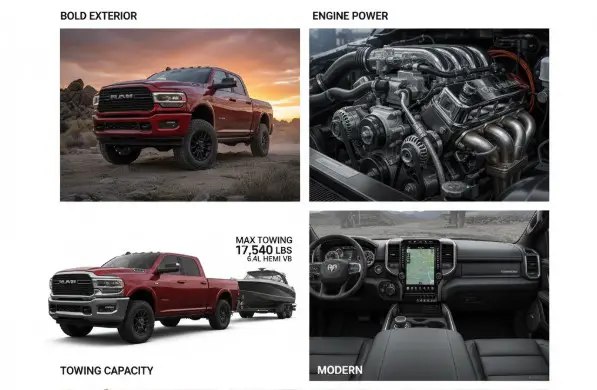
The difference between the Ram 3500’s engine options illustrates this perfectly. The standard 6.4L HEMI® V8 produces a respectable 429 lb-ft of torque, enabling it to tow up to 18,150 pounds. In stark contrast, the available High-Output 6.7L Cummins® Turbo Diesel I6 generates a colossal 1,075 lb-ft of torque, which is the primary reason it can be configured to tow more than 36,000 pounds.
Axle Ratio (The Torque Multiplier)
The axle ratio is a set of gears in the truck’s differential that multiplies the engine’s torque one final time before it reaches the wheels. A higher numerical ratio (e.g., 4.10) provides more torque multiplication than a lower one (e.g., 3.73).
This makes the truck feel more powerful when accelerating from a stop and allows it to handle heavier trailers, but it often comes at the cost of slightly lower fuel efficiency when unloaded.
The impact of axle ratio is significant. For example, a 2024 Ram 3500 4×4 with the 6.4L HEMI® V8 engine and a 3.73 axle ratio is rated to tow 15,350 pounds. By simply changing to the available 4.10 axle ratio, that same truck’s towing capacity jumps by 2,400 pounds to 17,750 pounds.
Drivetrain (4×2 vs. 4×4)
Choosing between a two-wheel-drive (4×2) and a four-wheel-drive (4×4) configuration also affects towing capacity, though to a lesser degree. The components of a 4×4 system—including a front differential, transfer case, and front driveshaft—add several hundred pounds to the truck’s curb weight.
Towing capacity is ultimately derived from the Gross Combined Weight Rating (GCWR), which is the maximum weight of the truck and trailer combined. Because the heavier 4×4 truck uses more of that combined weight rating for itself, it leaves slightly less available for the trailer.
This difference is often a few hundred pounds, as seen in the official towing charts, where 4×2 models consistently have slightly higher ratings than their identical 4×4 counterparts.
SRW vs. DRW (The Dually Difference)
One of the most critical factors for achieving maximum towing capacity is the choice between a Single Rear Wheel (SRW) and a Dual Rear Wheel (DRW), or “dually,” configuration. While some sources may confuse, the official Ram towing charts make it clear: a DRW setup is mandatory to unlock the Ram 3500’s top-tier tow ratings.
The highest rating for any 2025 Ram 3500 SRW model equipped with the High-Output Cummins is 26,080 pounds. Every single rating above that, all the way to the maximum of 36,610 pounds, is exclusive to DRW models.
The reason for this is not just about pulling power but about safety and stability. The four rear tires of a dually create a wider, more stable platform that dramatically reduces trailer sway and increases control when managing the immense tongue weight and lateral forces of trailers that can weigh over 15 tons.
Official Ram 3500 Towing Capacity Charts (2025-2021)
The following charts provide the official, detailed towing specifications for the Ram 3500 across recent model years. It is crucial to note that the absolute maximum towing capacity is almost always achieved with a Regular Cab, 4×2, DRW configuration.
However, since the Crew Cab 4×4 is a more popular choice for many consumers, it’s important to find the specific rating for your desired configuration to set realistic expectations.
For example, a 2024 Ram 3500 may be advertised with a 37,090-pound max capacity, but a common Crew Cab 4×4 DRW version with the same engine and axle has a lower rating of 34,070 pounds—a difference of over 3,000 pounds.
2025 Ram 3500 Towing Capacity Chart
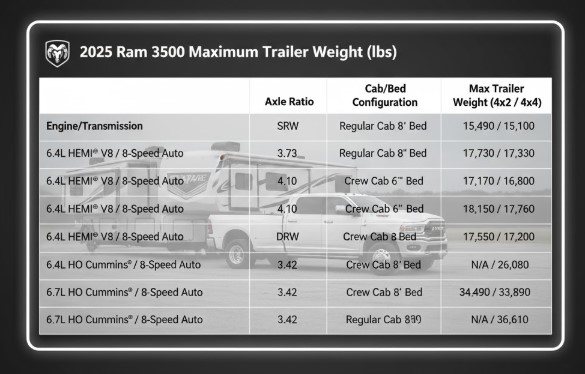
The 2025 model year introduced a new ZF Powerline 8-speed automatic transmission for the High-Output Cummins engine, replacing the previous Aisin 6-speed. This change in powertrain hardware resulted in a new certification under the SAE J2807 towing standard, leading to a slightly revised maximum capacity of 36,610 pounds, down from 37,090 pounds in 2024.
2025 Ram 3500 Maximum Trailer Weight
2024 Ram 3500 Towing Capacity Chart
The 2024 model year continued the peak capability established in 2022, offering a maximum gooseneck tow rating of 37,090 pounds when properly configured.
2024 Ram 3500 Maximum Trailer Weight (lbs) – 4×4 Configurations
| Engine/Transmission | Rear Wheels | Axle Ratio | Cab/Bed Configuration | Max Trailer Weight (4×4) |
| 6.4L HEMI® V8 / 8-Speed Auto | SRW | 4.10 | Regular Cab 8′ Bed | 17,290 |
| 6.4L HEMI® V8 / 8-Speed Auto | DRW | 4.10 | Regular Cab 8′ Bed | 17,750 |
| 6.7L Cummins® / 6-Speed Auto | SRW | 3.73 | Regular Cab 8′ Bed | 20,570 |
| 6.7L Cummins® / 6-Speed Auto | DRW | 4.10 | Regular Cab 8′ Bed | 22,220 |
| 6.7L HO Cummins® / 6-Speed Aisin | SRW | 3.73 | Regular Cab 8′ Bed | 26,020 |
| 6.7L HO Cummins® / 6-Speed Aisin | DRW | 3.73 | Crew Cab 8′ Bed | 32,710 |
| 6.7L HO Cummins® / 6-Speed Aisin | DRW | 4.10 | Regular Cab 8′ Bed | 34,610 |
Ram 3500 Max Towing Capacity by Year (2021-2025)
The capability of the Ram 3500 has evolved significantly over the past several years, with major increases in torque and towing power. This chart provides a quick reference for the maximum advertised ratings for each model year, which is particularly useful for buyers considering a used truck.
Ram 3500 Maximum Capability by Model Year
| Model Year | Max Towing Capacity | Max Payload Capacity |
| 2025 | 36,610 lbs | 7,590 lbs |
| 2024 | 37,090 lbs | 7,680 lbs |
| 2023 | 37,090 lbs | 7,680 lbs |
| 2022 | 37,090 lbs | 7,680 lbs |
| 2021 | 37,100 lbs | 7,680 lbs |
A Truck Owner’s Glossary: Decoding Towing Terminology
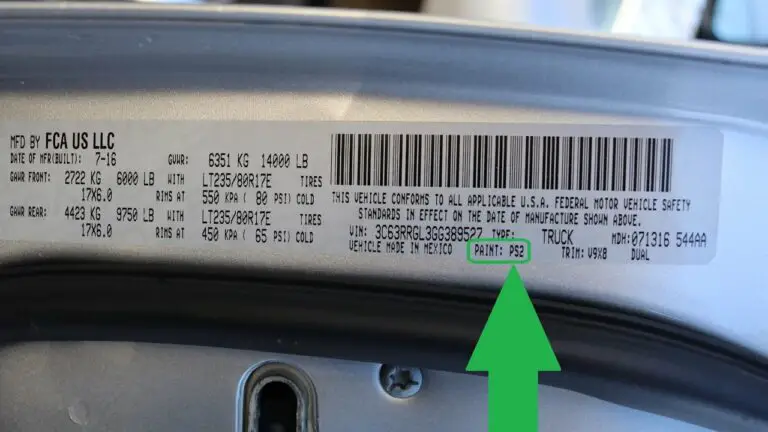
To tow safely and legally, it is essential to understand the key weight ratings that govern your truck and trailer. These ratings are set by the manufacturer and can be found on a sticker inside the driver’s side door jamb. Never exceeding these limits is the most important rule of towing.
Key Towing Terms Explained
| Term | Acronym | Definition | Why It Matters |
| Curb Weight | – | The weight of the truck with standard equipment and a full tank of fuel, but NO passengers or cargo. | This is the baseline weight of your truck. It is the starting point for all other weight calculations. |
| Payload Capacity | – | The maximum weight of all passengers, cargo in the cab and bed, and trailer tongue weight that the truck can safely carry. | Exceeding this overloads your truck’s suspension, brakes, and tires. This is often the first limit you will hit when towing a heavy 5th-wheel trailer. |
| Gross Vehicle Weight Rating | GVWR | The absolute maximum safe weight of the truck itself, including its curb weight, all passengers, all cargo, and the trailer’s tongue weight. | You must NEVER exceed this weight. It is a legal and safety limit set by the manufacturer, found on the door jamb sticker. |
| Gross Combined Weight Rating | GCWR | The absolute maximum safe weight of the fully loaded truck AND the fully loaded trailer combined. | This is the ultimate limit for your entire rig. Your truck’s maximum towing capacity is derived by subtracting the truck’s weight from this number. |
| Tongue Weight | – | The downward force that the trailer’s coupler exerts on the truck’s hitch. It should be 10-15% of the total trailer weight. | This weight counts against your truck’s payload capacity. Proper tongue weight is critical for preventing dangerous trailer sway. |
Hitch Types Explained: Conventional vs. 5th-Wheel vs. Gooseneck
The method used to connect the trailer to the truck is just as important as the truck’s power. The Ram 3500 utilizes different hitch types to handle its wide range of towing capabilities.
- Conventional Towing: This refers to towing with a receiver hitch and ball mount located at the rear of the truck’s frame, below the bumper. It is suitable for a wide variety of trailers, but on the Ram 3500, it is typically limited to a maximum of around 23,000 pounds.
- 5th-Wheel & Gooseneck Towing: To achieve the highest tow ratings, the Ram 3500 requires an in-bed hitch system. Both 5th-wheel and gooseneck hitches mount in the truck bed directly over the rear axle. This placement transfers the trailer’s heavy tongue weight (or pin weight) to the part of the truck’s frame and suspension best designed to handle it, providing vastly superior stability and control for heavy loads. Ram explicitly requires a 5th-wheel or gooseneck hitch for any trailer weighing over 18,000 pounds, with some documentation noting a 23,000-pound threshold.
Ram 3500 vs. The Competition: A Head-to-Head with the Ford F-350
In the heavy-duty truck segment, the primary competitor for the Ram 3500 is the Ford F-350. While both trucks offer incredible power, they excel in slightly different areas. A close look at the specifications reveals a nuanced picture where the “better” truck depends entirely on the buyer’s specific needs.
For instance, in the 2025 model year, the Ford F-350 boasts higher peak horsepower, torque, and a higher maximum gooseneck towing capacity. However, the Ram 3500 offers a significantly higher maximum conventional (bumper pull) tow rating. Furthermore, while Ford claims a higher absolute maximum payload, the Ram 3500’s standard gas engine provides more horsepower. This highlights that the winner is not clear-cut and depends on whether a buyer prioritizes gooseneck capacity, conventional towing, or in-bed payload.
2025 Ram 3500 vs. 2025 Ford F-350 Spec Showdown
| Specification | 2025 Ram 3500 | 2025 Ford F-350 | Winner |
| Max Gas Horsepower | 410 hp (6.4L V8) | 405 hp (6.8L V8) | Ram |
| Max Diesel Horsepower | 430 hp | 500 hp | Ford |
| Max Diesel Torque | 1,075 lb-ft | 1,200 lb-ft | Ford |
| Max Gooseneck Towing | 36,610 lbs | 38,000 lbs | Ford |
| Max Conventional Towing | Up to 23,000 lbs | Up to 30,000 lbs | Ford |
| Max Payload | 7,680 lbs | 8,000 lbs | Ford |
| (Sources: Ram Trucks, Ford Motor Company, Dealership Data 27) |
Conclusion: Choosing the Right Ram 3500 for Your Load
The Ram 3500 is a titan of towing, but harnessing its full potential requires a clear understanding of its complex capabilities. The maximum advertised towing capacity is not a universal figure; it is the result of a very specific and often work-oriented configuration: typically a Regular Cab, 4×2, Dual Rear Wheel model with the High-Output Cummins engine, a specific axle ratio, and a gooseneck hitch.
The most critical takeaways for any potential buyer or current owner are:
- Configuration is Everything: The choice of engine, axle ratio, drivetrain, and cab/bed style can alter towing capacity by tens of thousands of pounds.
- Payload vs. Towing: There is a direct trade-off between maximizing payload (best achieved with the 6.4L HEMI® V8) and maximizing towing (which requires the High-Output Cummins®). You cannot have the best of both in a single truck.
- The Sticker is Law: Always verify the specific GVWR and GCWR ratings on the sticker inside the driver’s door jamb of the actual truck you are considering. These numbers are the final, legal authority for that vehicle’s capabilities. While many users find the capabilities of the(https://truckguider.com/ram-2500-towing-capacity/), those with the heaviest loads must choose the 3500.
Frequently Asked Questions (FAQ)
How much can a Ram 3500 dually tow?
For the 2025 model year, a properly configured Ram 3500 dually (DRW) can tow up to 36,610 pounds. A DRW setup is mandatory to achieve the highest tow ratings, as it provides the necessary stability and safety for handling the heaviest loads.
What is the best axle ratio for towing with a Ram 3500?
The 4.10 axle ratio generally provides the highest towing capacity by maximizing the engine’s torque application at the wheels. However, lower ratios like the 3.73 or 3.42 (on diesel models) offer better fuel economy when the truck is not towing. The best choice depends on how frequently you plan to tow heavy loads.
Do I need a CDL to tow with a Ram 3500?
For personal, recreational use (like towing your own RV or boat), a Commercial Driver’s License (CDL) is typically not required. However, a CDL may be necessary if the Gross Combined Weight Rating (GCWR) of your truck and trailer exceeds 26,000 pounds and you are operating for commercial purposes. Regulations vary by state, so it is crucial to check your local laws.
What is the difference between the standard Cummins and the High-Output Cummins?
The High-Output (H.O.) version of the 6.7L Cummins® Turbo Diesel is tuned to produce more horsepower (420-430 hp) and significantly more torque (1,075 lb-ft) compared to the standard version (370 hp and 850 lb-ft). This extra power is what unlocks the Ram 3500’s highest towing capacities, but comes at a higher price and with a slightly reduced payload capacity due to engine weight and tuning.
Can I increase my Ram 3500’s towing capacity?
No. The towing capacity is a legal and safety rating determined by the manufacturer based on the truck’s frame, suspension, brakes, engine, and cooling system. Aftermarket modifications like airbags or suspension helpers can improve ride quality and level the truck under load, but they do not legally or safely increase the manufacturer’s GVWR or GCWR. Exceeding the factory ratings is unsafe and can create significant legal liability in the event of an accident.