Ram eTorque Specs: The Complete Guide to Ram’s Mild-Hybrid Truck Engine

The Ram eTorque system represents a significant step in the evolution of the modern pickup truck, blending traditional internal combustion power with intelligent mild-hybrid technology. It is not a new engine, but rather a sophisticated system integrated into Ram’s proven powertrains to enhance performance, efficiency, and drivability without compromising the core capabilities truck owners demand.
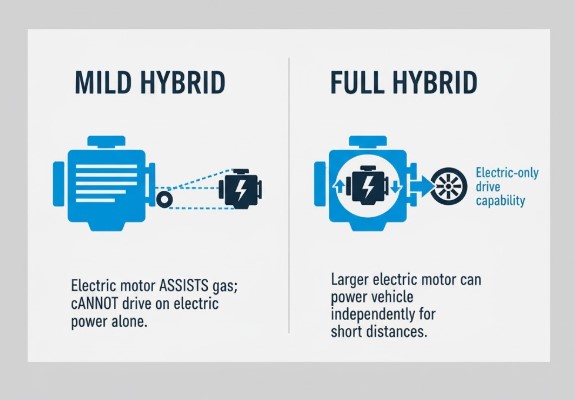
At its heart, eTorque is classified as a “mild-hybrid” system. This is a critical distinction. Unlike a full hybrid vehicle, such as a Toyota Prius or Ford’s F-150 PowerBoost, the electric motor in an eTorque-equipped Ram cannot propel the truck on its own. Instead, it functions as a powerful and intelligent assistant to the gasoline engine, providing boosts of power when needed and recapturing energy that would otherwise be wasted.
This approach allows Ram to deliver many of the benefits of hybridization—like improved fuel economy and smoother operation—in a less complex and more affordable package than a full hybrid system.
What is eTorque?
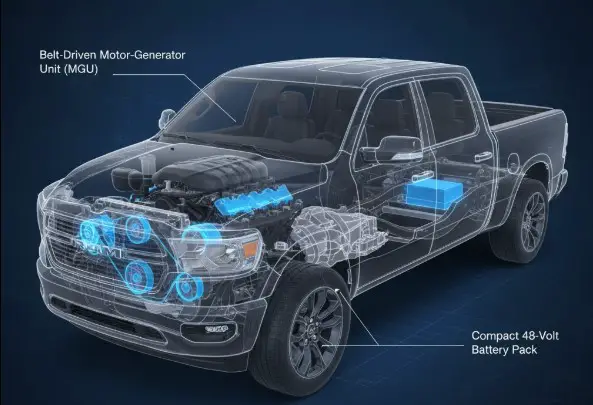
eTorque is a 48-volt mild-hybrid system that replaces the alternator with a motor-generator unit (MGU), seamlessly adding torque for acceleration and refining start-stop events.
(Added to the 5.7L HEMI V8)
The eTorque Efficiency Cycle
The system creates a virtuous cycle by capturing energy during deceleration and redeploying it to assist the engine, reducing fuel consumption and improving responsiveness.
1. Deceleration
Braking energy captured
2. Power Generation
MGU charges battery
3. Energy Storage
430Wh battery pack
4. Torque Assist
Power applied at launch
Launch Torque Boost by Engine
The HEMI V8 benefits from a 44% greater instant torque boost compared to the Pentastar V6, significantly improving off-the-line acceleration and smoothness.
Fuel Efficiency Gains
eTorque can improve combined fuel economy by up to 15%, primarily through ultra-smooth start-stop functionality and electrical assistance under load.
Core Drivetrain Specifications
While eTorque enhances drivability, Ram’s maximum towing and payload ratings remain the same. The primary benefits are felt in responsiveness and refinement, not increased peak capacities.
| Engine Spec | 3.6L Pentastar V6 | 5.7L HEMI V8 |
|---|---|---|
| Base Horsepower | 305 hp | 395 hp |
| Base Torque | 269 lb-ft | 410 lb-ft |
| eTorque Boost | +90 lb-ft | +130 lb-ft |
| Max Towing Capacity | ~7,730 lbs | ~12,750 lbs |
Note: Maximum capacities vary based on individual truck configuration, model year, and selected options. Figures are representative.
How it Works: The Core Components of eTorque
The eTorque system is composed of three primary components working in concert to optimize the truck’s powertrain.
- The Motor-Generator Unit (MGU): The centerpiece of the system is a robust, belt-driven motor-generator unit that completely replaces the traditional alternator. This advanced piece of hardware serves a dual purpose. As a generator, it produces electricity to charge the system’s batteries. As a motor, it can apply torque directly to the engine’s crankshaft, assisting with acceleration and smoothing out the powertrain’s operation.
- The 48-Volt Battery Pack: Energy for the MGU is stored in a compact, 48-volt, 430-watt-hour lithium-ion battery pack.2 This briefcase-sized unit weighs approximately 30 pounds and is strategically mounted against the rear wall of the truck’s cabin, ensuring it doesn’t interfere with passenger legroom or under-seat storage. To maintain optimal operating temperatures, the battery pack is air-cooled by two internal fans and housed in a noise-insulated enclosure.
- The DC-to-DC Converter: To integrate the powerful 48-volt system with the truck’s conventional 12-volt electrical architecture, a 3-kilowatt DC-to-DC converter is used. This vital component steps down the 48-volt current to 12 volts, which is necessary to charge the traditional 12-volt lead-acid battery and power all of the vehicle’s accessories, including the lights, infotainment system, and power windows. This explains why an eTorque-equipped truck still retains a conventional 12-volt battery, which is also used for cold starts in extreme temperatures.
The Six Modes of Operation: What eTorque Does and When
The eTorque system’s intelligence lies in its ability to seamlessly transition between several functions, or “modes of operation,” to improve the driving experience.
- Seamless Engine Stop-Start: One of the most noticeable benefits is the incredibly smooth and fast engine stop-start function. When the truck comes to a stop, the engine can shut off to save fuel. The 48-volt MGU can then restart the engine and deliver torque to the crankshaft in as little as 400 milliseconds—more than twice as fast as a typical 12-volt system. This speed eliminates the shudder and delay often associated with older stop-start technologies. Under ideal conditions, the system can keep the engine off for up to 10 minutes while still powering accessories.
- eRoll Assist (Torque Fill): From a complete stop, the MGU provides an immediate burst of supplemental electric torque to the crankshaft. This “torque fill” helps get the truck’s mass moving during the first half-rotation of the wheels, just before the gasoline engine’s power fully engages. The result is quicker, more responsive, and noticeably smoother acceleration from a standstill.
- Brake Regeneration: During deceleration or braking, the MGU reverses its function. It uses the vehicle’s momentum to generate electricity, capturing kinetic energy that would otherwise be lost as heat and using it to recharge the 48-volt battery pack. This is the core principle that improves the system’s overall energy efficiency.
- Torque Smoothing & Shift Management: The eTorque system actively works to refine the transmission’s performance. During gear changes, the MGU can subtly add or subtract torque from the crankshaft to match the engine’s speed perfectly for the next gear. This action makes shifts virtually imperceptible, reducing lurching and driveline shock, which contributes significantly to the Ram 1500’s renowned luxury-quality ride.
- Cylinder Deactivation Smoothing: On the 5.7L HEMI V8, which features a Multi-Displacement System (MDS) that can shut down four cylinders to save fuel, eTorque provides a small amount of electric torque to smooth the transition as the engine switches between V8 and V4 modes. This makes the fuel-saving feature less noticeable to the driver.
- Electrical Power Generation: In addition to its hybrid functions, the MGU still performs the essential role of an alternator, continuously generating electricity to keep both the 48-volt and 12-volt batteries charged and to power all onboard electrical systems.
While often marketed for its efficiency benefits, a close analysis of the system’s functions reveals its profound impact on the overall quality of the driving experience. The fuel economy gains are measurable but modest for a vehicle of this size. The more significant, day-to-day benefit is the marked improvement in refinement. The seamless restarts, smoothed gear shifts, and instant torque fill from a stop all work together to reduce noise, vibration, and harshness (NVH).
This technological refinement is a key contributor to the Ram 1500’s reputation for having one of the most comfortable and car-like rides in the full-size truck segment, making the technology’s true value a blend of both efficiency and luxury.
Ram eTorque Engine Specs: A Data-Driven Breakdown
Ram has integrated the eTorque mild-hybrid system into two of its most popular and proven engines. This strategy allows buyers to choose between a capable and efficient standard V6 or a powerful and legendary V8, both enhanced by the hybrid technology. It is important for potential buyers to note the powertrain lineup changes between model years, particularly the temporary discontinuation of the 5.7L HEMI for 2025 and its announced return for the 2026 model year.
The Workhorse: 3.6L Pentastar V6 with eTorque
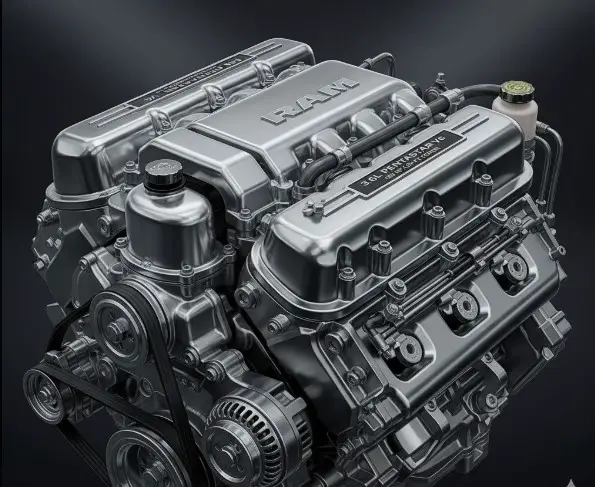
The 3.6L Pentastar V6 with eTorque serves as the standard powertrain for most Ram 1500 trims, offering a solid balance of capability and efficiency.
- Performance Metrics:
- Horsepower: 305 HP
- Torque: 269 lb-ft
- Supplemental Torque: The eTorque system provides up to 90 lb-ft of additional torque at launch for improved initial acceleration.
- Capability Numbers (Recent Model Years):
- Maximum Towing Capacity: Up to 8,130 pounds, depending on the truck’s configuration.
- Maximum Payload Capacity: Up to 2,370 pounds, a figure often highlighted as a best-in-class capability for a hybrid pickup.
The Legend: 5.7L HEMI V8 with eTorque
For those requiring maximum towing power and the unmistakable character of a V8, Ram offers the 5.7L HEMI V8 with the eTorque system.
- Performance Metrics:
- Horsepower: 395 HP
- Torque: 410 lb-ft
- Supplemental Torque: The eTorque system on the V8 delivers a more substantial boost of up to 130 lb-ft of supplemental torque from a standstill.
- Capability Numbers (Recent Model Years):
- Maximum Towing Capacity: Up to 12,750 pounds, a class-leading figure that makes it the top choice for serious towing tasks.
- Maximum Payload Capacity: Approximately 1,860 pounds.
The 2025 Hiatus and 2026 Return
For the 2025 model year, Ram temporarily replaced the 5.7L HEMI V8 with a new family of 3.0L Hurricane twin-turbocharged inline-six engines. However, in response to strong consumer demand and the engine’s iconic status, Ram officially announced the return of the 5.7L HEMI V8 with eTorque for the 2026 model year, reaffirming its importance to the brand and its customers.
| Specification | 3.6L Pentastar V6 w/ eTorque | 5.7L HEMI V8 w/ eTorque (2024 & 2026 models) |
| Horsepower | 305 HP | 395 HP |
| Torque | 269 lb-ft | 410 lb-ft |
| Supplemental eTorque | Up to 90 lb-ft | Up to 130 lb-ft |
| Max Towing Capacity | Up to 8,130 lbs | Up to 12,750 lbs |
| Max Payload Capacity | Up to 2,370 lbs | Up to 1,860 lbs |
| Transmission | 8-Speed Automatic (TorqueFlite) | 8-Speed Automatic (TorqueFlite) |
| Availability | Standard on most trims | Optional on most trims; Standard on Limited/Longhorn |
Real-World Impact: Fuel Economy, Towing, and Drivability
While the specifications provide a clear picture of each engine’s potential, their true value is measured by their performance in real-world conditions—from saving money at the pump to confidently pulling a heavy trailer.
eTorque MPG: Does it Actually Save Gas?
The eTorque system was engineered to provide a measurable improvement in fuel efficiency, particularly in city driving where the stop-start function is most active.
- EPA Ratings: Official EPA estimates show a clear, albeit modest, advantage for eTorque-equipped trucks. A 2019 Ram 1500 with the 5.7L HEMI eTorque achieved a combined rating of 19 MPG, a 2 MPG improvement over the same engine without the system. Real-world reports from owners often suggest a more conservative gain of 1 to 1.5 MPG over non-eTorque models, which is still a consistent and noticeable improvement.
| Engine & Drivetrain | EPA-Estimated MPG (City/Highway) |
| 3.6L V6 w/ eTorque (2WD) | 20 / 25-26 |
| 3.6L V6 w/ eTorque (4WD) | 19 / 24 |
| 5.7L HEMI V8 w/ eTorque (2WD) | 18 / 23 |
| 5.7L HEMI V8 w/ eTorque (4WD) | 17 / 22-23 |
The Towing Advantage: How eTorque Helps Pull Heavy Loads
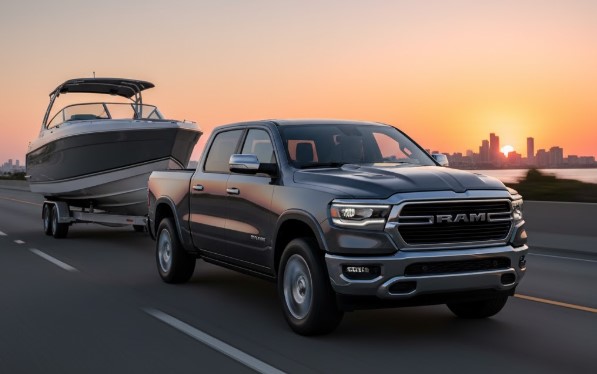
For towing, the eTorque system’s primary benefit is the immediate availability of electric torque from a complete stop. This “eRoll Assist” function helps overcome the initial inertia of a heavy trailer, reducing the strain on the gasoline engine and transmission and making for a much smoother and more confident start. This feature is a key reason why the Ram 1500’s maximum towing capacity of 12,750 pounds is consistently achieved with the 5.7L HEMI engine equipped with the eTorque system.
The introduction of the eTorque system in 2019 coincided with a significant increase in the Ram 1500’s maximum towing capabilities, as illustrated in the historical data below.
| Model Year | 3.6L V6 w/ eTorque | 5.7L HEMI V8 (non-eTorque) | 5.7L HEMI V8 w/ eTorque | 3.0L EcoDiesel V6 |
| 2024 | 7,730 lbs | N/A | 12,750 lbs | N/A |
| 2023 | 7,730 lbs | N/A | 12,750 lbs | 9,600 lbs |
| 2022 | 7,730 lbs | 11,610 lbs | 12,750 lbs | 12,560 lbs |
| 2021 | 7,730 lbs | 11,610 lbs | 12,750 lbs | 12,560 lbs |
| 2020 | 7,730 lbs | 11,610 lbs | 12,750 lbs | 12,560 lbs |
| 2019 | 7,730 lbs | 11,610 lbs | 12,750 lbs | N/A |
| 2018 | 7,600 lbs | 10,620 lbs | N/A | 9,210 lbs |
A detailed look at the specifications reveals a crucial trade-off between the V6 and V8 engines that goes beyond towing. While the 5.7L HEMI V8 is the undisputed champion for towing trailers, the standard 3.6L Pentastar V6 offers a significantly higher maximum payload capacity—up to 2,370 pounds compared to the V8’s 1,860 pounds.12 This seemingly counterintuitive difference stems from the weight of the engines themselves.
The larger, heavier V8 engine increases the truck’s curb weight, which in turn reduces the amount of weight it can carry in the bed and cabin before reaching its Gross Vehicle Weight Rating (GVWR). This creates a “payload paradox” for buyers. Those who need to tow heavy trailers, boats, or campers should opt for the V8.
However, for users who primarily haul heavy materials in the bed—such as landscapers, contractors, or those carrying ATVs—the standard V6 provides superior payload capacity, making it the more practical choice for those specific tasks.
Ram eTorque Reliability: The Full Story
As with any new automotive technology, the eTorque system has been the subject of scrutiny regarding its long-term reliability. A balanced assessment requires looking at both documented issues and the broad range of owner experiences.
A Balanced Perspective: Reported Problems vs. Owner Experiences
A number of issues have been reported, primarily concerning early model years of the system. These have been documented by owners and lemon law firms and include complaints such as:
- Sudden Engine Stalling: Perhaps the most serious complaint, some owners have experienced the engine stalling unexpectedly when coming to a stop. This issue was later linked to the powertrain control module (PCM) software running an overly rich air-fuel mixture.
- Battery Drain and Charging Failures: Some reports mention issues with the 12-volt or 48-volt batteries failing to charge properly or draining prematurely, sometimes exacerbated by cold weather conditions.
- Software Glitches: A range of electrical issues, including inconsistent start-stop performance and erroneous warning lights, have been attributed to software glitches.
While these reported problems are valid concerns, they must be weighed against the large volume of positive owner experiences. Across owner forums and communities, many drivers report high mileage—well past 60,000, 90,000, and even 140,000 miles—with no failures related to the eTorque system. This suggests that while some vehicles experienced issues, particularly in the initial production years, widespread systemic failure is not indicated.
The Official Word: Recalls and Warranty Coverage
Stellantis (Ram’s parent company) has actively addressed some of the most prominent issues. A notable recall was issued for the PCM software on certain 2021 models equipped with the 5.7L HEMI eTorque to correct the air-fuel mixture problem that could lead to stalling.
Crucially for potential buyers, the key components of the eTorque system are covered by a federally mandated 8-year/80,000-mile emissions warranty. This warranty includes the expensive parts of the system: the Motor-Generator Unit (MGU) and the 48-volt battery pack. This long warranty period provides significant protection and peace of mind, covering the system well beyond the standard bumper-to-bumper warranty.
The Verdict: Is eTorque a Reliable System?
The available evidence indicates that many of the most severe eTorque-related problems were concentrated in the early model years (2019-2021) and were often rooted in software that has since been updated. The existence of a specific recall and the overwhelming number of owners reporting trouble-free long-term use suggest that reliability has improved in later models.
The robust 8-year/80,000-mile warranty on the core hybrid components demonstrates the manufacturer’s confidence in the hardware’s durability. For a prospective buyer, this means the system can be considered reasonably reliable, especially on newer models, with the strong warranty serving as a valuable safety net.
Head-to-Head: Ram eTorque vs. The Competition
In the competitive landscape of full-size hybrid trucks, the Ram eTorque’s primary rival is the Ford F-150 PowerBoost. While both use hybrid technology, their approach and execution are fundamentally different.
Mild vs. Full Hybrid: Ram eTorque vs. Ford F-150 PowerBoost
The core distinction lies in their classification. The Ram eTorque is a mild hybrid, where the electric motor acts as an assistant to the gasoline engine. It cannot power the vehicle on its own. The Ford F-150 PowerBoost is a full hybrid, with a more powerful electric motor integrated directly with the transmission. This allows the F-150 to travel short distances at low speeds on electric power alone, something the Ram cannot do.
- Performance and Specs: The technological difference is reflected in the on-paper specifications. The Ford 3.5L PowerBoost V6 produces a combined 430 horsepower and a massive 570 lb-ft of torque, significantly outperforming the Ram 5.7L HEMI eTorque’s 395 horsepower and 410 lb-ft of torque.
- Efficiency: As a full hybrid, the PowerBoost generally delivers better fuel economy. Its ability to operate in an all-electric mode during city driving gives it a distinct advantage in EPA ratings and real-world efficiency over the eTorque system.
- Capability and Ride: The Ford F-150 often boasts a slightly higher maximum towing capacity on paper. However, the Ram 1500 is almost universally praised for its superior ride quality and comfort. This is largely due to its standard multi-link, coil-spring rear suspension (with available four-corner air suspension), which provides a smoother, more composed ride than the F-150’s traditional leaf-spring setup. According to a Car and Driver comparison test, the Ram’s suspension “soaked up nearly every bad road condition,” while the F-150 felt more “truckish”.
Ultimately, the choice between the two systems is a matter of priorities. The Ford F-150 PowerBoost offers superior horsepower, torque, fuel efficiency, and raw towing numbers. The Ram 1500 with eTorque offers a far more refined and comfortable ride, the classic sound and feel of a V8 engine, and a less complex hybrid system.
Practical Ownership: Maintenance and Battery Details
For current and prospective owners, understanding the long-term maintenance requirements and component specifics of the eTorque system is essential.
Ram eTorque Maintenance Schedule
A key advantage of the eTorque system’s design is that it requires no special maintenance. The system’s core components, including the MGU and the 48-volt battery, are engineered to be maintenance-free for the life of the vehicle. Therefore, owners of an eTorque-equipped Ram 1500 should simply follow the standard maintenance schedule recommended for the gasoline engine.
A typical maintenance schedule includes:
- Every 8,000-10,000 Miles: Change engine oil and filter, rotate tires.
- Every 20,000-30,000 Miles: Inspect brake system, suspension components, and replace engine and cabin air filters.
- Every 60,000 Miles: Inspect and, if necessary, replace transmission fluid and filters.
- Every 100,000 Miles: Replace spark plugs.
Deep Dive: The 48-Volt Battery
The 48-volt battery is the energy storage hub of the eTorque system.
- Specifications:
- Type: 48-volt Lithium-Ion Nickel Manganese Cobalt-Graphite.
- Capacity: 430 watt-hours ($0.43$ kWh).
- Weight: Approximately 30 pounds.
- Location: Mounted securely on the rear wall of the cab, behind the rear seat.
- Lifespan and Replacement Cost: The battery pack is engineered to last the life of the truck. Should a replacement be necessary outside of the 8-year/80,000-mile warranty, owner forums estimate the cost of the battery pack to be approximately $1,600, with the MGU costing around $1,300. However, reports of out-of-warranty failures are not common.
Frequently Asked Questions (FAQs) about Ram eTorque
Does eTorque increase horsepower?
No. The peak horsepower and torque ratings of the base engines are unchanged. The 3.6L V6 still produces 305 HP and the 5.7L HEMI V8 produces 395 HP. The eTorque system provides supplemental torque at launch (up to 90 lb-ft for the V6, 130 lb-ft for the V8) to improve acceleration and smoothness, but it does not increase the engine’s maximum output.
What kind of battery does the eTorque system use?
The system uses a compact, 48-volt, 430-watt-hour lithium-ion battery pack. It is located in an insulated, air-cooled case mounted behind the rear seat inside the cab.
Is the eTorque system expensive to repair?
The most critical components—the Motor-Generator Unit and the 48-volt battery—are covered by a federal emissions warranty for 8 years or 80,000 miles. While out-of-warranty repairs for these components could be costly (estimated at $1,300-$1,600 each by owners), failures after the warranty period are not widely reported.
Can you disable the eTorque start-stop feature?
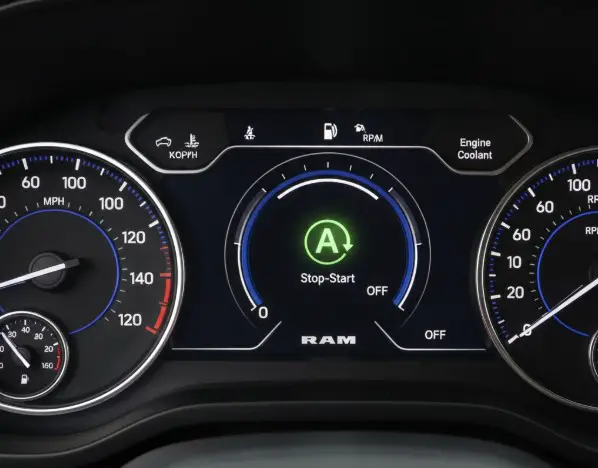
Yes. For drivers who prefer not to use the feature, there is a dedicated button on the dashboard that allows the automatic engine start-stop function to be temporarily disabled. The system will default back to “on” each time the truck is turned off and restarted.
What is the maintenance schedule for a Ram with eTorque?
The eTorque system itself is designed to be maintenance-free. Owners should follow the standard maintenance schedule for their Ram 1500’s gasoline engine, which typically includes oil changes every 8,000-10,000 miles and other inspections at regular intervals. For more details, see our guide to a proper truck maintenance schedule.
Which is better, eTorque or the 3.0L Hurricane engine?
This depends entirely on buyer priorities. The 5.7L HEMI V8 with eTorque offers the traditional V8 sound, feel, and proven performance that many truck owners prefer. The new 3.0L Hurricane inline-six engines represent Ram’s latest powertrain technology, delivering higher horsepower, more torque, and better fuel efficiency than the V8.
The fact that Ram is bringing the HEMI back for 2026 after a one-year hiatus demonstrates that there is strong market demand for both options. For a deeper analysis, you can read our Ram 1500 vs. Ford F-150 deep-dive comparison.