Ram Hurricane Engine Specs: The Definitive Guide

The arrival of the 3.0-liter Hurricane twin-turbo inline-six (I-6) engine marks a pivotal moment for the Ram 1500, signaling the end of an era for the long-reigning HEMI V8 in the 2025 model year lineup. This transition is far more than a simple powertrain swap; it represents a fundamental strategic pivot for parent company Stellantis. The Hurricane engine is a cornerstone of the Dare Forward 2030 strategic plan, a corporate initiative aimed at aggressively reducing emissions and improving fleet-wide fuel efficiency while, paradoxically, increasing power and performance.
This strategic shift is a direct response to a confluence of global pressures. Stricter government regulations, including Federal Tier III emissions standards, have made large-displacement, naturally aspirated engines like the HEMI increasingly difficult to engineer for future compliance. Simultaneously, the competitive landscape has been reshaped by rivals, most notably Ford’s successful EcoBoost family of turbocharged engines,
which proved that truck buyers would embrace smaller, more technologically advanced powerplants if they delivered on performance. Development of the Hurricane, which began as far back as 2013, was an explicit answer to this market evolution.
The core promise of the Hurricane engine is compelling: to deliver more horsepower and torque than many of its V8 competitors while simultaneously offering superior fuel economy and lower emissions. Stellantis has positioned this new engine as the primary internal combustion power plant for its future North American portfolio, destined for vehicles built on the critical STLA Large and STLA Frame platforms. This signifies a long-term commitment, making the Hurricane not just an option, but the new standard for Ram trucks and other large vehicles.
Of course, this transition is met with a healthy dose of skepticism from brand loyalists with a deep emotional attachment to the HEMI V8’s signature rumble and proven history. This guide will provide a deeply researched, data-driven analysis of the Hurricane engine’s specifications, technology, and real-world performance. It will not only detail what has changed but also explain why these changes matter for the modern truck owner, comparing the new I-6 against its legendary predecessor in every critical category.
Inside the Hurricane: A New Era for Ram
Stellantis’s 3.0L twin-turbo I6 Hurricane engine is the successor to the venerable HEMI V8, promising more power, greater efficiency, and a new performance standard for the Ram 1500 and other platforms. This is a deep dive into its specifications and the technology that makes it possible.
Performance Showdown: Hurricane vs. HEMI
The Hurricane engine, particularly the High-Output (H.O.) variant, decisively outperforms the entire outgoing HEMI V8 lineup in both horsepower and torque, all from a smaller, more efficient package. The Standard-Output (S.O.) version is positioned as a powerful and efficient replacement for the workhorse 5.7L HEMI.
Key Engine Specifications
Displacement
3.0L
(183 cu in)
Configuration
I6
Inline-Six, Twin-Turbo
Bore x Stroke
84×90
millimeters
Max Boost
26 psi
(High-Output)
Core Technology Breakdown
The Hurricane’s impressive output is a result of several advanced engineering solutions working in concert. From its induction system to its internal coatings, every component is optimized for performance and durability.
Twin-Turbo Induction
Two low-inertia turbochargers each feed three cylinders, providing rapid boost response and minimizing lag for a broad, flat torque curve.
Dual Water-to-Air Intercoolers
Instead of a single front-mount intercooler, the Hurricane uses two liquid-cooled charge coolers for a shorter intake path and more consistent air temperatures.
High-Pressure Direct Injection
Fuel is injected directly into the combustion chamber at over 5,000 psi, enabling precise fuel control for increased power and efficiency.
Plasma Transfer Wire Arc (PTWA)
A microscopic, low-friction coating is sprayed onto the cylinder walls, reducing weight and friction far better than traditional iron sleeves.
Forged Internals (H.O.)
The High-Output variant utilizes a forged steel crankshaft and forged aluminum pistons to handle the increased cylinder pressures and higher redline.
Projected Efficiency
Stellantis projects up to a 15% improvement in fuel economy over the larger V8 engines, a key driver for the powertrain switch.
Torque Curve Comparison
One of the Hurricane’s biggest advantages is its torque delivery. The twin-turbo setup allows it to produce over 90% of its peak torque from just 2,350 RPM all the way to its redline, providing a much wider and more usable powerband for towing and acceleration compared to the naturally aspirated HEMI V8s.
Ram Hurricane Engine Specs: A Technical Deep Dive
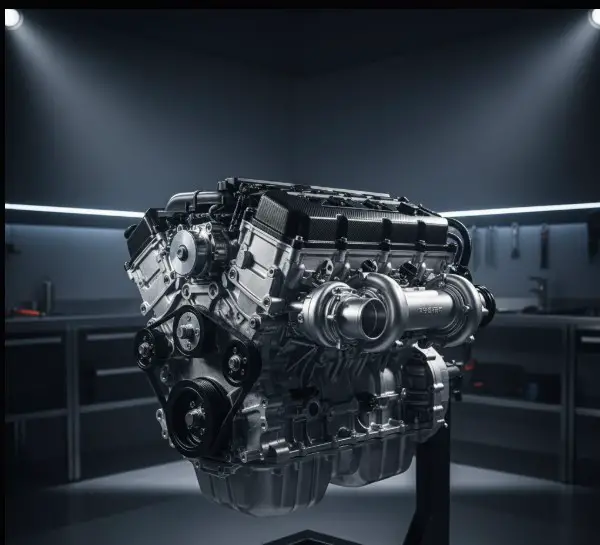
At its heart, the Hurricane, officially designated GME-T6 (Global Medium Engine – Turbo 6), is an engineering statement. It leverages cutting-edge technology to extract maximum performance from a smaller, more efficient package.
Core Architecture
The foundation of the Hurricane engine is a 3.0-liter (2,993 cc or 183 cubic inches) inline-six cylinder configuration. This layout is inherently balanced, providing smoother operation than a V6. The engine block is a deep-skirt cast-aluminum design, which provides a strong, rigid base, further reinforced by cross-bolted steel main bearing caps and a structural die-cast aluminum alloy oil pan. This robust bottom end is crucial for handling the high cylinder pressures generated by twin turbochargers.
The cylinder head is also an aluminum alloy, featuring pent-roof combustion chambers for efficient burning of the air-fuel mixture.3 The engine utilizes a bore of 84.0 mm and a stroke of 90.0 mm. These dimensions are shared with Stellantis’s globally produced 2.0-liter I-4 engine, indicating a shared design philosophy and manufacturing efficiency, though the company states that less than 5% of parts are actually shared between the two powerplants.
The valvetrain consists of dual overhead camshafts (DOHC) acting on 24 valves, with wide-range, fully independent variable valve timing to optimize performance and efficiency across the entire RPM range. The engine’s firing order is 1-5-3-6-2-4.
Breakthrough Technologies Explained
The Hurricane’s impressive output is not merely the result of its turbochargers; it’s a product of several state-of-the-art technologies working in concert.
Plasma Transfer Wire Arc (PTWA) Cylinder Coating
Perhaps the most significant innovation is the use of Plasma Transfer Wire Arc (PTWA) coating on the cylinder walls, a technology adapted from the aerospace industry. Instead of pressing heavy cast iron liners into the aluminum block, this process uses a plasma torch to melt a steel alloy wire at over 4,150°F ($2,300^{\circ}C$). The molten metal is then sprayed onto the cylinder bores at high velocity, where it forms an ultra-thin, low-friction, and incredibly durable surface.
The benefits are numerous: the PTWA coating is ten times more wear-resistant than traditional liners, significantly reduces weight, and improves heat transfer, allowing the engine to run more efficiently and reliably under high loads.
Twin Low-Inertia Turbochargers
Stellantis engineers opted for two smaller, low-inertia turbochargers rather than a single, larger unit. Each turbo is responsible for feeding compressed air to three of the six cylinders. This design choice is critical for throttle response. Smaller turbos have less rotating mass (inertia), allowing them to spool up much more quickly and deliver boost at lower engine speeds.
This engineering decision is directly responsible for the Hurricane’s signature broad, flat torque curve, with Stellantis claiming that at least 90% of the engine’s peak torque is available from just 2,350 RPM all the way to its redline.
High-Pressure Direct Injection
The fuel system is a high-pressure direct injection setup operating at an immense 5,075 psi (350 bar). The fuel injectors are mounted centrally in the cylinder head, spraying a fine mist of fuel directly into the combustion chamber. This high pressure creates finer atomization of the fuel, leading to a more complete and controlled burn. The result is an optimal air/fuel mixture that enhances power output while simultaneously reducing emissions.
Advanced Cooling Systems
Managing heat is paramount in a high-output turbocharged engine. The Hurricane employs a multi-faceted cooling strategy. First, compressed air from the turbos passes through an engine-mounted water-to-air charge cooler (also known as an intercooler) before entering the intake manifold. Cooling the air makes it denser, which allows for more advanced ignition timing and higher performance.
Second, the dual exhaust manifolds are water-cooled and integrated directly into the cylinder head. This design helps cool the hot exhaust gases, which benefits the turbochargers and emissions systems, and also helps the engine warm up to its optimal operating temperature more quickly. Finally, an electric pump continues to circulate coolant through the system even after the engine is turned off.
This prevents “heat soak,” a condition where residual heat can damage the turbochargers’ sensitive bearings, thereby improving long-term durability.
Core Hurricane Engine Architecture
| Feature | Specification |
| Configuration | Inline 6-Cylinder, Twin-Turbocharged |
| Displacement | 3.0 Liters (2,993 cc / 183 cu in) |
| Block/Head Material | Cast Aluminum |
| Valvetrain | DOHC, 24-Valve, Independent VVT |
| Cylinder Bore | 84.0 mm (3.31 in) |
| Piston Stroke | 90.0 mm (3.54 in) |
| Fuel System | High-Pressure Direct Injection (5,075 psi) |
| Cylinder Lining | Plasma Transfer Wire Arc (PTWA) Coating |
| Cooling | Water-to-Air Charge Cooler, Integrated Exhaust Manifolds |
| Firing Order | 1-5-3-6-2-4 |
Standard vs. High Output: Choosing Your Level of Force
From its inception, the Hurricane was engineered to exist in two distinct forms: a Standard Output (SO) version optimized for a balance of robust capability and fuel economy, and a High Output (HO) version tuned for maximum performance. The differences between them are not merely a software tune; they involve significant mechanical hardware changes designed to handle different levels of stress and performance.
The most obvious distinction is in power. For the 2025 Ram 1500, the SO engine is rated at a potent 420 horsepower and 469 lb-ft of torque. The HO variant raises the stakes considerably, producing 540 horsepower and 521 lb-ft of torque. It is worth noting that these figures can vary slightly in other Stellantis vehicles for example, the Dodge Charger Scat Pack uses an HO tune that pushes output to 550 horsepower.
These power differences are achieved through several key engineering changes. The compression ratio is a primary differentiator: the SO engine uses a higher 10.4:1 ratio to maximize thermal efficiency, while the HO employs a lower 9.5:1 ratio to safely accommodate higher boost pressures without risking engine knock (detonation). The turbos themselves are tuned differently, with the SO delivering a peak boost of 22.4 psi, while the HO pushes that figure to 26.0 psi.
To withstand the increased stress of a higher boost, the HO engine is fortified with stronger internal components. While the SO uses durable die-cast aluminum alloy pistons, the HO features stronger forged aluminum alloy pistons that are also cooled by oil jets to manage temperatures. The piston pins in the HO are coated with a diamond-like carbon (DLC) finish to minimize friction under extreme pressure. The fueling system is also upgraded for the HO, which requires dual high-pressure fuel pumps to meet its greater demand, compared to the single pump used in the SO version. Even the intercooler is enhanced, featuring a dual-inlet design on the HO for increased cooling capacity versus the single inlet on the SO.
This performance focus extends to the engine’s operating range. The SO has a maximum engine speed (redline) of 5,800 RPM, while the HO is tuned to rev slightly higher to 6,100 RPM. To protect these high-performance components, the HO requires a more robust 0W-40 viscosity engine oil, whereas the SO is specified with 0W-20 oil. Both versions have a 7.5-quart oil capacity and officially recommend the use of 91 octane premium fuel to achieve their rated power and ensure longevity.
Ram Hurricane SO vs. HO: Complete Specification Comparison
| Specification | Standard Output (SO) | High Output (HO) |
| Horsepower (in Ram 1500) | 420 hp @ 5,200 rpm | 540 hp @ 5,700 rpm |
| Torque (in Ram 1500) | 469 lb-ft @ 3,500-3,900 rpm | 521 lb-ft @ 3,500 rpm |
| Compression Ratio | 10.4:1 | 9.5:1 |
| Peak Turbo Boost | 22.4 psi | 26.0 psi |
| Piston Material | Die-Cast Aluminum Alloy | Forged Aluminum Alloy (Oil-Jet Cooled) |
| Fuel Pumps (High-Pressure) | Single | Dual |
| Max Engine Speed (Redline) | 5,800 rpm | 6,100 rpm |
| Recommended Fuel | 91 Octane Premium | 91 Octane Premium |
| Required Engine Oil | Pennzoil 0W-20 | Pennzoil 0W-40 |
| Oil Capacity | 7.5 Quarts | 7.5 Quarts |
| Key Application | Balanced Performance & Capability | Maximum Performance |
Performance Showdown: Hurricane I-6 vs. 5.7L HEMI V8

For Ram owners, the ultimate benchmark is the venerable 5.7L HEMI V8 with eTorque. The central question is whether the new, smaller I-6 can truly outperform the legendary V8 in the real world. A detailed look at the data reveals a decisive victory for the Hurricane in nearly every performance metric, though with some important nuances in capability and cost.
Power and Acceleration
On paper, the contest is not close. The outgoing 5.7L HEMI V8 produced 395 horsepower and 410 lb-ft of torque. The Standard Output Hurricane surpasses this with an additional 25 horsepower and 59 lb-ft of torque. The High Output Hurricane represents a massive leap forward, boasting an incredible 145 more horsepower and 111 more lb-ft of torque than the V8 it replaces.
This power advantage translates directly to on-road speed. Independent testing has shown that both Hurricane-equipped trucks are significantly quicker than their HEMI-powered predecessors. Car and Driver clocked a 2025 Ram 1500 with the 420-hp SO engine accelerating from 0 to 60 mph in just 4.9 seconds, while a model with the 540-hp HO engine achieved a blistering 4.2-second time.
These are acceleration figures more commonly associated with sports sedans than full-size pickup trucks. Dyno testing further confirms the Hurricane’s superiority, revealing a substantial advantage in mid-range torque delivery compared to the HEMI, which contributes to its effortless feeling of power during daily driving.
Capability: Towing & Payload
While the Hurricane dominates in straight-line speed, the story of its capability is more complex. An analysis of Ram’s official specifications reveals a crucial and counterintuitive detail: the most powerful engine is not the most capable for towing. The Standard Output Hurricane, when properly configured, offers the highest maximum towing capacity in the 2025 Ram 1500 lineup, rated at up to 11,610 pounds. This figure slightly exceeds the maximum capacity of the previous 5.7L HEMI V8.
Conversely, the 540-hp High Output Hurricane has a lower maximum towing capacity, rated at approximately 9,990 pounds.8 This is not due to any weakness in the engine itself but is a result of vehicle packaging. The HO engine is exclusively available on higher-end trims like the Limited, Limited Longhorn, Tungsten, and the off-road-focused RHO.
These models often come standard with features like air suspension tuned for comfort, larger wheels with less-aggressive tires, or different axle ratios that, while enhancing luxury and performance, result in a lower SAE J2807 certified tow rating. The SO engine, available on work-oriented trims like the Tradesman and Big Horn, can be configured specifically to maximize towing prowess.
For payload, the lineup’s highest rating of 2,370 pounds actually belongs to the base 3.6L Pentastar V6 engine.
Fuel Economy
The Hurricane was designed to be up to 15 percent more efficient than larger engines, and the EPA ratings reflect a modest improvement. A 4×4 Ram 1500 with the Hurricane SO achieves an EPA-estimated 17 mpg city, 24 mpg highway, and 19 mpg combined. This is a slight improvement over the final HEMI V8 models, which were rated around 18 mpg city, 22 mpg highway, and 19 mpg combined. The more powerful Hurricane HO is less efficient, with an EPA rating of 15 mpg city, 21 mpg highway, and 17 mpg combined.
However, a critical factor for the total cost of ownership is fuel type. The Hurricane engines both require more expensive 91 octane premium gasoline to achieve their rated performance. The 5.7L HEMI, by contrast, recommended 89 octane mid-grade fuel. Depending on the price difference between fuel grades, the small MPG advantage of the SO Hurricane could be entirely offset by the higher cost per gallon, potentially making the new engine more expensive to fuel per mile than the V8 it replaced. For a complete breakdown of how these figures translate to real-world costs.
In a testament to the V8’s enduring appeal, Ram announced that due to strong customer demand, the 5.7L HEMI V8 with eTorque will be reintroduced as an option for the 2026 model year, ensuring buyers have a choice between the new-school tech of the Hurricane and the old-school rumble of a HEMI.
Power & Capability Showdown: Hurricane vs. 5.7L HEMI V8
| Metric | 5.7L HEMI V8 w/ eTorque | 3.0L Hurricane SO | 3.0L Hurricane HO |
| Horsepower | 395 hp | 420 hp (+25 hp) | 540 hp (+145 hp) |
| Torque | 410 lb-ft | 469 lb-ft (+59 lb-ft) | 521 lb-ft (+111 lb-ft) |
| Max Towing Capacity | ~11,330 lbs | ~11,610 lbs | ~9,990 lbs |
| Max Payload Capacity | ~1,750 lbs | ~1,980 lbs | ~1,520 lbs |
| EPA MPG (Combined, 4×4) | 18-19 MPG | 19 MPG | 17 MPG |
| Recommended Fuel | 89 Octane Mid-Grade | 91 Octane Premium | 91 Octane Premium |
Real-World Reliability and Owner Insights
As with any new powertrain, long-term reliability is a primary concern for potential buyers. While the Hurricane engine is new to the Ram 1500 for the 2025 model year, it first debuted in the 2022 Jeep Wagoneer, providing several years of initial real-world data. Synthesizing early owner reports and forum discussions reveals a nuanced picture.
The consensus among many early adopters is positive regarding the engine’s core performance. Owners frequently praise the Hurricane’s smooth, quiet power delivery, often noting that it feels more responsive and powerful in everyday driving than the HEMI it replaced. Some owners report driving their vehicles aggressively with no mechanical issues to date.
However, the launch of the 2025 Ram 1500 has not been without problems. It is crucial to distinguish between issues with the Hurricane engine itself and issues with the broader vehicle platform. The most prevalent complaints are not about the engine’s mechanical components but rather the truck’s all-new electrical architecture. Owners have reported a variety of software bugs, intermittent check engine lights (CELs) that are often resolved with software updates, and faulty sensors, such as the brake fluid level sensor. Glitches with the Uconnect infotainment system have also been a common source of frustration.
These “ecosystem” problems risk unfairly tarnishing the engine’s reputation. The evidence suggests that many of the “Hurricane problems” being discussed online are actually “2025 Ram problems” related to debugging a new, highly complex electronic platform.
Engine-specific concerns, while less common, have been reported. A small number of owners have experienced what they consider to be excessive oil consumption, with one notable case requiring the addition of two quarts of oil within the first 2,700 miles. This concern is amplified by Ram’s decision to omit a physical oil dipstick, forcing owners to rely solely on the electronic gauge in the instrument cluster.
There has also been at least one documented instance of an oil leak traced back to the timing cover or oil pan gasket area. Finally, some drivers have noted drivability quirks, such as a “clunky” or “chugging” sensation during low-speed shifts, which may be related to the transmission’s software tuning rather than a mechanical fault.
From an engineering perspective, the inline-six is an inherently balanced and robust design. While any new, complex engine will have some initial teething issues, the current body of evidence suggests that the Hurricane’s core mechanical design is sound. Prospective buyers should be aware that the primary risk with an early-production 2025 Ram 1500 appears to be potential software and electrical bugs, which can often be resolved with dealer updates, rather than a fundamental flaw in the engine itself.
Living with the Hurricane: Maintenance, Fuel, and Longevity
Proper maintenance is key to ensuring the longevity and performance of any modern engine, and the technologically advanced Hurricane is no exception. Adhering to the correct service intervals and using the specified fluids are critical.
Fuel and Oil Requirements
As previously noted, Stellantis officially recommends 91 octane premium unleaded gasoline for both the Standard Output and High Output variants. While the engine may run on lower-octane fuel, doing so will likely result in reduced power output and could potentially harm the engine over the long term under heavy load.
The oil specifications are precise and differ between the two versions. The Standard Output engine requires a synthetic oil meeting the 0W-20 viscosity grade, such as Pennzoil Ultra Platinum. The higher-stress High Output engine requires a more robust 0W-40 synthetic oil to provide adequate protection. The oil capacity for both engines is 7.5 quarts.
Maintenance Schedule Highlights
The recommended maintenance schedule also varies between the SO and HO models, reflecting their different performance targets and internal components. The most significant difference is the oil change interval. The SO engine follows a longer interval of up to 10,000 miles or 12 months, whichever comes first. The HO engine requires more frequent service, with an oil and filter change recommended every 6,000 miles or 6 months.
Other key service intervals include:
- Cabin Air Filter: Should be replaced every 12,000 miles on both versions.
- Spark Plugs: Replacement is recommended every 60,000 miles.
- Transfer Case Fluid: The service for this component differs significantly. On HO models (including the RHO), the transfer case fluid should be drained and refilled every 30,000 miles. On SO models, the fluid should be inspected at 30,000-mile intervals, but the replacement interval is much longer at 150,000 miles.
- Engine Coolant: The long-life coolant should be flushed and replaced every 10 years or 150,000 miles.
Ram Hurricane Maintenance Schedule Highlights
| Service Item | Standard Output (SO) Interval | High Output (HO) Interval |
| Oil & Filter Change | 10,000 miles / 12 months | 6,000 miles / 6 months |
| Cabin Air Filter | 12,000 miles | 12,000 miles |
| Transfer Case Fluid | Inspect @ 30k mi, Change @ 150k mi | Change @ 30,000 miles |
| Spark Plugs | 60,000 miles | 60,000 miles |
| Engine Coolant | 150,000 miles / 10 years | 150,000 miles / 10 years |
Frequently Asked Questions (FAQ)
What are the horsepower and torque specs for the Ram Hurricane engine?
The Standard Output (SO) version produces 420 horsepower and 469 lb-ft of torque. In the Ram 1500, the High Output (HO) version is rated at 540 horsepower and 521 lb-ft of torque.
Does the Ram Hurricane engine require premium gas?
Yes. To achieve the advertised performance figures and ensure long-term engine health, Stellantis recommends using 91 octane premium unleaded fuel for both the Standard and High Output versions.
Is the Hurricane engine more powerful than the 5.7L HEMI V8?
Yes, by a significant margin. The SO version has 25 more horsepower and 59 more lb-ft of torque than the HEMI. The HO version produces a massive 145 more horsepower and 111 more lb-ft of torque.
Which Hurricane engine tows more, the SO or the HO?
Counter-intuitively, the Standard Output (SO) engine has the higher maximum towing capacity, rated at up to 11,610 pounds when properly configured. The High Output (HO) is rated lower at around 9,990 pounds, a difference attributed to the specific configurations of the luxury and performance trims it is available in.
What is the real-world MPG of the Ram Hurricane engine?
Real-world mileage varies, but many owners of the Standard Output version report combined fuel economy in the high-teens to low-20s (17-22 MPG), which is generally a slight improvement over the 5.7L HEMI V8.24 The High Output version has a lower EPA combined rating of 17 MPG.
Is the Ram Hurricane engine reliable?
As a new engine, long-term reliability data is still being gathered. The core inline-six design is mechanically sound and balanced. Most early owner complaints regarding the 2025 Ram 1500 have focused on the truck’s new electrical architecture and software bugs, not on catastrophic mechanical engine failures.
What vehicles use the Hurricane engine?
In addition to the 2025 Ram 1500, the Hurricane engine family is also used in the Jeep Wagoneer, Jeep Grand Wagoneer, and the new 2025 Dodge Charger.
Why did Ram get rid of the HEMI V8?
Ram replaced the HEMI in the 2025 1500 lineup with the Hurricane engine as part of Stellantis’s “Dare Forward 2030” strategy. The goal was to meet stricter emissions and fuel economy standards while simultaneously increasing power and performance. However, due to strong customer demand, the 5.7L HEMI V8 is scheduled to return as an option for the 2026 model year.