
Where is the Car Outside Temperature Sensor? Location Guide 2026

If your dashboard is showing the wrong outside temperature, the first thing you may want to know is: where is the outside temperature sensor located on a car?
In most vehicles, the car outside temperature sensor, also called the ambient air temperature sensor or external temperature sensor, is located behind the front bumper, behind the grille, or near the radiator support. This position allows the sensor to measure outside air temperature while staying relatively protected from direct sunlight and engine heat. Some vehicles, however, place the sensor inside or near an exterior side mirror.


The exact car temperature sensor location varies by manufacturer, model, and model year. In this guide, we’ll explain where to find the outside temperature sensor, how to identify it, what it does, common failure symptoms, and how to test or replace it.
Quick Answer: Where Is the Outside Sensor Located?
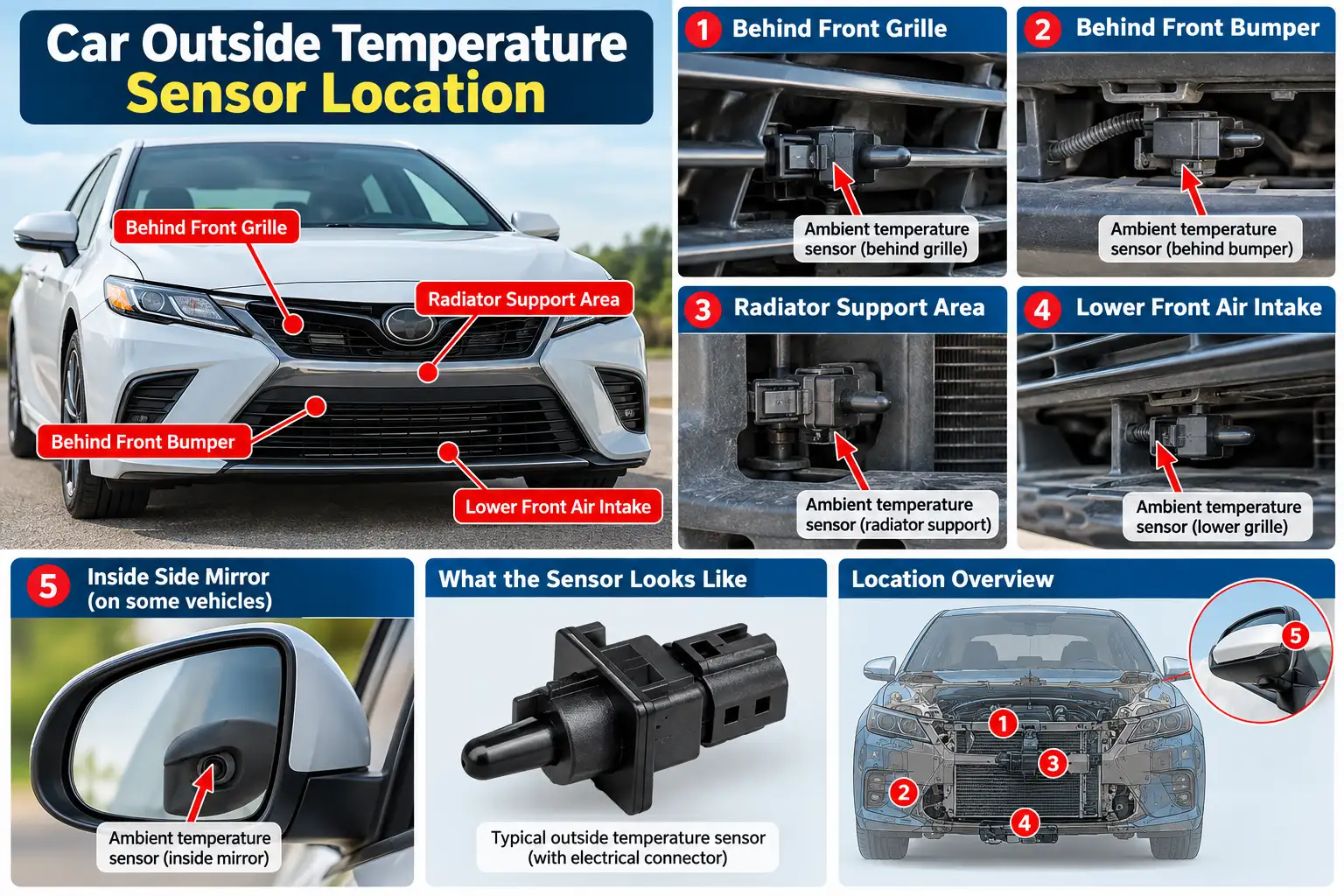
The outside temperature sensor is usually mounted in the front section of the vehicle, most commonly behind the grille or front bumper.
| Common Location | How Common? | What to Look For |
|---|---|---|
| Behind front grille | Very common | Small plastic sensor attached to a bracket |
| Behind front bumper | Very common | Sensor clipped near bumper reinforcement or wiring harness |
| Radiator support area | Common | Small two-wire sensor ahead of radiator |
| Lower front air intake | Common | Sensor clipped behind lower grille opening |
| Side mirror | Used on some vehicles | Sensor mounted inside or behind mirror housing |
| Front fascia area | Vehicle-dependent | Small sensor near grille shutters or bumper components |
CarParts notes that the ambient temperature sensor is typically located inside or near the front bumper or behind the grille around the radiator support area. Delphi also notes that some manufacturers locate the sensor behind the glass of a door mirror.
What Is a Car Outside Temperature Sensor?
A car outside temperature sensor measures the temperature of the air outside your vehicle. It is commonly called the ambient air temperature sensor, outside air temperature sensor, or external temperature sensor.
The sensor sends temperature information to one or more electronic modules in the vehicle. Depending on the vehicle, that information may be used by the dashboard temperature display, automatic climate control system, HVAC module, body control module, or powertrain control module.
Many ambient temperature sensors operate as thermistors. Their electrical resistance changes as temperature changes, allowing the vehicle’s electronic control system to calculate the approximate outside air temperature.
Why Is the Outside Temperature Sensor Located at the Front of the Car?
Manufacturers need to place the sensor somewhere that can receive outside air without being excessively influenced by cabin temperature or engine heat.
That is why the area behind the front grille or bumper is such a common location.
Placing the sensor toward the front of the vehicle provides airflow around the sensor while helping keep it away from the engine compartment’s hottest areas. However, radiator heat, road conditions, vehicle speed, sunlight, and extended idling can still temporarily affect the displayed temperature.
The reading on your dashboard therefore may not instantly match a nearby weather station or smartphone weather app.
Car Temperature Sensor Location: What Does It Look Like?
The ambient temperature sensor is usually a small plastic electrical component.
It often has a rounded, pointed, or probe-like end exposed to outside airflow. A small electrical connector is attached to it, commonly using two wires.
It may be clipped directly into a plastic bracket, grille support, bumper reinforcement area, radiator support, or wiring harness holder.
Do not assume every small sensor behind the grille is the outside temperature sensor. Modern vehicles can also have parking sensors, crash sensors, adaptive cruise control radar, airbag-related components, active grille shutter wiring, and other electronics in the same area.
A factory service manual or vehicle-specific parts diagram is the safest way to confirm the exact component.
Where Is the External Temperature Sensor on Different Cars?
There is no universal location for every vehicle.
Behind the Front Grille
One of the most common locations is directly behind the grille. The sensor is exposed to incoming air while remaining protected behind the vehicle’s exterior bodywork.
Look around the grille supports and ahead of the radiator or condenser.
Behind the Front Bumper
Many cars, trucks, and SUVs mount the sensor behind the bumper cover.
It may be clipped to a bracket, bumper reinforcement component, wiring harness, or front-end support.
CarParts identifies the bumper or grille area as the typical ambient sensor location.
Near the Radiator Support
Some vehicles position the sensor around the center or side of the radiator support.


Although the sensor may appear close to the radiator, manufacturers normally position and shield it to reduce the effect of radiator heat.
Lower Grille or Air Intake
Check behind the lower bumper grille if you cannot see a temperature sensor behind the upper grille.
Some manufacturers place the sensor lower down where it receives outside airflow.
Inside the Side Mirror
A less common design places the outside temperature sensor in an exterior mirror assembly.
Delphi notes that although ambient temperature sensors are often behind the front bumper, some vehicles use a sensor located in the door mirror behind the glass.
How to Find the Outside Temperature Sensor on Your Car
Start by switching the ignition off and allowing the vehicle to cool if you have recently driven it.
Stand in front of the vehicle and inspect through the upper and lower grille openings with a flashlight. Look for a small plastic sensor with an electrical connector attached to a bracket.
If you cannot see it, inspect behind the front bumper from a safe position. Depending on the vehicle, you may need to remove a trim panel, splash shield, grille, or bumper cover for access.
Ford service-related documentation, for example, shows an ambient air temperature sensor mounted around the front fascia/active grille shutter area on certain Mustang applications, illustrating how location can be highly vehicle-specific.
Before removing major body components, check the repair manual for your exact year, make, model, and engine configuration.
Outside Temperature Sensor vs. Other Car Temperature Sensors
A common source of confusion is that a vehicle contains several different temperature sensors.
| Sensor | What It Measures | Typical Location |
|---|---|---|
| Ambient air temperature sensor | Air outside the vehicle | Front grille, bumper, radiator support, or mirror |
| Intake air temperature sensor | Air entering the engine | Intake tube or intake manifold |
| Engine coolant temperature sensor | Engine coolant temperature | Engine/cylinder head/coolant passage |
| Cabin temperature sensor | Passenger compartment temperature | Dashboard or HVAC control area |
| Evaporator temperature sensor | A/C evaporator temperature | HVAC housing |
The outside air temperature sensor should not be confused with the intake air temperature sensor.
HELLA explains that an intake air temperature sensor measures the temperature of air in the engine’s intake system and provides that information to the engine control unit. That is a different job from measuring outdoor ambient temperature.
What Does the Outside Temperature Sensor Control?
Its exact role depends on the vehicle.
The most obvious function is supplying the outside temperature reading on the dashboard. On many vehicles, however, its information can also be used by the automatic climate control system.
For example, the HVAC system can use outside temperature information along with cabin temperature and other sensor inputs to determine how aggressively to heat or cool the interior.
Some vehicle control modules also monitor ambient air temperature information as part of their overall operating strategy.
Symptoms of a Bad Outside Temperature Sensor
A failing ambient temperature sensor does not always produce the same symptoms on every vehicle.
| Symptom | Possible Explanation |
|---|---|
| Outside temperature reading is incorrect | Sensor output may be inaccurate |
| Temperature display is stuck | Sensor or circuit may have failed |
| Extremely high or low reading | Open/short circuit or sensor fault |
| Automatic climate control behaves incorrectly | HVAC system may be receiving incorrect ambient data |
| A/C operation is abnormal | Certain systems depend on ambient temperature input |
| Check engine light appears | Some vehicles monitor the circuit through the PCM |
| Temperature reading disappears | Sensor, connector, wiring, or module communication problem |
An inaccurate dashboard temperature reading and problems with automatic HVAC operation are common signs associated with ambient temperature sensor faults.
Why Is My Car Showing the Wrong Outside Temperature?
A wrong temperature reading does not automatically mean the sensor itself needs replacement.
A damaged sensor is one possibility, but wiring problems, corroded connectors, loose plugs, collision damage, bumper repairs, or a sensor that has been knocked out of its correct mounting position can cause similar problems.
Heat soak can also temporarily create misleading readings.


For example, after a vehicle sits in direct sunlight or idles near a hot radiator for an extended period, the displayed temperature may be higher than the true surrounding air temperature. The system may require some driving time before the display updates.
How to Test a Car Outside Temperature Sensor
A useful first test is to compare the vehicle’s reported ambient temperature with the actual outside temperature after the car has been parked for several hours.
The vehicle, engine, and surrounding components should ideally be close to ambient temperature.
If you have a compatible OBD scan tool, check the ambient air temperature data parameter. Compare the scan-tool reading with the dashboard display and actual outside conditions.
Next, inspect the sensor connector and wiring for moisture, corrosion, broken wires, loose terminals, impact damage, or previous bumper-repair damage.
Some sensors can also be tested with a multimeter by measuring resistance as temperature changes. However, resistance specifications vary significantly between sensor designs. Use the service information for your specific vehicle rather than relying on a universal resistance value.
Ambient Temperature Sensor Trouble Codes
On vehicles that monitor the ambient air temperature sensor through the diagnostic system, a sensor or circuit fault may trigger an OBD-II trouble code.
| Code | General Description |
|---|---|
| P0070 | Ambient Air Temperature Sensor Circuit |
| P0071 | Ambient Air Temperature Sensor Range/Performance |
| P0072 | Ambient Air Temperature Sensor Circuit Low |
| P0073 | Ambient Air Temperature Sensor Circuit High |
| P0074 | Ambient Air Temperature Sensor Circuit Intermittent |
For example, P0071 indicates that the control module has detected ambient temperature sensor information outside the expected range or performance parameters. However, definitions and diagnostic procedures can vary between manufacturers.
A trouble code does not automatically prove the sensor itself is defective. Wiring, connectors, and control-module problems can also cause ambient sensor circuit codes.
How to Replace an Outside Temperature Sensor
Replacement difficulty depends mainly on how accessible the sensor is.
On some cars, you can reach it through the grille or underneath the bumper and replace it within a few minutes. On others, the grille, lower splash shield, bumper cover, or another front-end component must be removed.
Once access is available, the usual process involves switching the ignition off, disconnecting the electrical connector, releasing the sensor from its retaining clip or bracket, installing the replacement sensor, reconnecting the wiring, and reinstalling any removed panels.
Some vehicles may require a relearn, reset procedure, ignition cycle, or driving period before the outside temperature display begins showing the correct value.
Always follow the service information for your particular vehicle.
Can You Drive With a Bad Outside Temperature Sensor?
In many vehicles, a failed outside temperature sensor will not prevent the engine from running or make the vehicle immediately undrivable.
However, the dashboard temperature reading may be incorrect, and automatic climate control or A/C operation may be affected.
CarParts notes that ambient sensor faults can affect the outside temperature display and HVAC behavior.
Because operation varies by manufacturer, diagnose the problem rather than assuming the sensor has no effect beyond the temperature display.
How Much Does It Cost to Replace an Outside Temperature Sensor?
The sensor itself is generally a relatively small component, but total repair cost depends heavily on the vehicle.
A sensor that can be accessed directly behind the grille may require very little labor. A vehicle that requires bumper or fascia removal can take considerably longer.
OEM versus aftermarket parts, local labor rates, vehicle design, and whether the connector or wiring also needs repair will all affect the final price.
For this reason, it is better to identify your exact vehicle and confirm the sensor location before estimating replacement cost.


Frequently Asked Questions
Where is the outside temperature sensor located on a car?
On most cars, the outside temperature sensor is located behind the front bumper, behind the grille, or near the radiator support. Some vehicles place it in an exterior mirror.
Where is the external temperature sensor?
The external temperature sensor is generally at the front of the vehicle where it can measure outside airflow. Check behind the grille, front bumper, lower air intake, and radiator support first.
Is the outside temperature sensor near the radiator?
It can be mounted near the radiator support, but it is normally positioned so that outside airflow reaches it and excessive engine or radiator heat has less influence on the measurement.
Is the ambient temperature sensor the same as the outside temperature sensor?
Yes. In automotive terminology, ambient air temperature sensor, outside temperature sensor, and external temperature sensor commonly refer to the sensor that measures outside air temperature.
Is the outside temperature sensor the same as the coolant temperature sensor?
No. The outside temperature sensor measures ambient air outside the vehicle. The engine coolant temperature sensor measures the temperature of the engine coolant.
Why does my outside temperature display show the wrong temperature?
Possible causes include a faulty sensor, damaged wiring, a poor electrical connection, incorrect sensor placement, heat soak, or a temporary delay in the vehicle updating its temperature reading.
Why does my car show -40 degrees outside?
An extremely low fixed temperature can indicate an open circuit, disconnected sensor, damaged wiring, or failed sensor on some vehicles. The exact fallback value varies by manufacturer, so scan-tool data and vehicle-specific diagnostic information should be used to confirm the cause.
Can a bad outside temperature sensor affect the AC?
Yes, on some vehicles. Automatic climate control systems can use ambient temperature information to determine how the HVAC or air-conditioning system should operate. A faulty sensor can therefore cause abnormal climate-control behavior.
Can I replace the ambient temperature sensor myself?
If the sensor is easily accessible behind the grille or bumper, replacement can be a straightforward DIY repair. If bumper removal, advanced diagnostics, or wiring repair is required, professional assistance may be more appropriate.
Final Thoughts
If you’re searching for the car outside temperature sensor location, begin at the front of the vehicle.
In most cases, you’ll find a small sensor behind the front grille, behind the bumper, around the radiator support, or near the lower front air intake. Some manufacturers instead mount the sensor in an exterior mirror.
Because the exact car temperature sensor location depends on the vehicle, checking a factory repair manual or vehicle-specific wiring diagram is the most reliable way to locate it.
If your outside temperature display is inaccurate, don’t replace the sensor immediately. First inspect its position, connector, and wiring, and compare the temperature reading with scan-tool data when possible. A simple wiring or mounting problem can sometimes look exactly like a failed sensor.