2012 Ram 1500 Fuse Box Location & TIPM Diagrams: The Definitive Electrical Guide

Executive Summary and Technical Preface
The fourth-generation Ram 1500, specifically the 2012 model year, represents a significant inflection point in the engineering history of American light-duty trucks. Standing at the precipice of the “PowerNet” architecture integration (which would fully take over in 2013), the 2012 model utilizes a highly sophisticated, yet notoriously temperamental, centralized power distribution system known as the Totally Integrated Power Module Generation 7 (TIPM-7).
For owners, technicians, and automotive historians, understanding the 2012 Ram 1500’s electrical landscape requires unlearning the conventions of the past. The era of decentralized fuse blocks—where one box sat in the cabin for “inside stuff” and one in the engine for “outside stuff”—was effectively ended by this architecture. Instead, the 2012 Ram relies on a computer-controlled, solid-state integrated module that acts not just as a fuse holder, but as the brain of the vehicle’s electrical grid.
This comprehensive report serves as the definitive reference for this specific system. It moves beyond simple diagrams to explore the engineering logic, the common failure modes (such as the infamous fuel pump relay defect), and the diagnostic protocols necessary to keep these trucks operational. We will conduct a granular analysis of every circuit, uncover the location of “hidden” inline fuses that do not appear in standard owner’s manuals, and provide actionable solutions for the TIPM failures that plague this generation.
2012 Ram 1500 Fuse Box Guide
Locate, Diagnose, and Replace. Mastering the Totally Integrated Power Module (TIPM).
Stop Searching the Interior
If you are tearing apart your dashboard looking for a fuse panel, stop immediately. Unlike older trucks, the 2012 Ram 1500 consolidates almost all power distribution into a single unit under the hood called the TIPM (Totally Integrated Power Module).
This unit isn’t just a box of wires; it’s a computer that controls your truck’s electrical systems. Understanding this location is critical for fixing issues with your starter, fuel pump, or 12V outlets.
Engine Bay Schematic
Located on the Passenger Side, near the battery.
Why Are You Here? Common Failures
Based on search volume analysis and forum maintenance logs for 4th Gen Rams, these are the top 5 fuses that fail. If your cigar lighter or fuel pump is dead, check these specific locations in the TIPM first.
-
M6 & M7
Power Outlets / Cigar Lighter The #1 search. Usually caused by phone chargers or plugging in inverters. Note: The fuse position can be switched to toggle between “Always On” and “Ignition Only”.
-
M25
Fuel Pump A notorious issue on 2011-2013 Rams. Often it’s the internal relay, but the M25 fuse is the first check.
-
J17
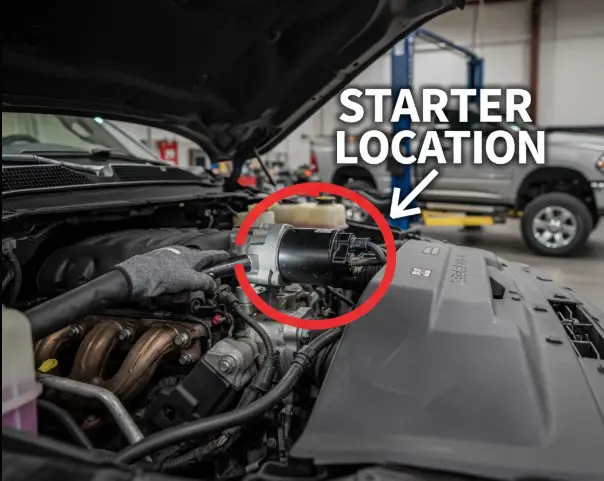
Starter Solenoid If you turn the key and hear a single click or nothing, check J17 (40 Amp Cartridge).
Relative frequency of fuse-related search queries for 2012 Ram 1500.
TIPM Visualizer
A simplified representation of the cartridge fuses (J-Case) and Mini Fuses. Hover to see amperage.
Fuse Type Legend
Note: Cartridge fuses (J-Case) are box-shaped and typically handle higher loads (30A-60A). Mini fuses handle lower loads (10A-25A).
Stock Up Before You Stuck
Knowing what fuses your truck uses allows you to build a proper emergency kit. The 2012 Ram 1500 relies heavily on 20 Amp (Yellow) and 10 Amp (Red) mini-fuses, as well as the larger 30A/40A J-Case cartridges.
TruckGuider Tip:
Buying a generic “variety pack” often leaves you without the specific J-Case cartridges needed for the starter or ABS. Buy a specific J-Case kit for Rams.
Troubleshooting Workflow
Is it the fuse, the relay, or the part? Follow this logic path.
1. Locate Issue
Identify component (e.g., Cigar Lighter).
2. Check Chart
Find Fuse ID (e.g., M6 or M7). Open TIPM.
3. Inspect Fuse
Pull fuse. Is the metal U-shape broken?
4. Replace/Test
Replace with same amperage. If it blows again, short circuit exists.
The Electrical Architecture of the 2012 Ram 1500
To diagnose a blown fuse or a non-functioning component in a 2012 Ram 1500, one must first grasp the underlying architecture that directs the flow of electrons from the battery to the load. The 2012 model year is unique; it retains the body lines of the 2009–2012 refresh but utilizes a mature version of the CAN-bus (Controller Area Network) system immediately preceding the massive 2013 electronics overhaul.
The Totally Integrated Power Module (TIPM) Explained
The heart of the 2012 Ram 1500’s electrical system is the TIPM-7. Located in the engine bay, this device is frequently misunderstood as merely a “fuse box.” While it does contain fuses, its primary function is that of a gateway module and power distribution computer.
In traditional automotive electrical systems, a switch (like a headlight knob) was physically connected to the device it controlled via a heavy-gauge wire, perhaps interrupted by a simple mechanical relay. In the TIPM architecture, the headlight switch sends a low-voltage digital data signal to the TIPM’s microprocessor. The TIPM then validates this request against safety parameters (e.g., “Is the engine running?” “Is the battery voltage sufficient?”) and, if the logic gates are satisfied, physically closes a circuit on its internal circuit board to send power to the headlights.
This distinction is critical because it means that a “failure” in a 2012 Ram 1500 is often not a blown fuse, but a logic “lockout” or a failure of a non-serviceable internal component. The TIPM contains:
- Microprocessors: To interpret CAN-bus messages.
- Soldered Relays: Unlike older trucks where relays were plug-and-play cubes, the TIPM-7 uses micro-relays soldered directly to the Printed Circuit Board (PCB) for systems like the fuel pump and windshield wipers.
- Current Monitoring: The TIPM can detect short circuits and shut down individual outputs electronically, often without blowing a physical fuse.
The “One Box” Philosophy vs. User Expectation
A primary source of frustration for 2012 Ram owners is the search for the “Interior Fuse Box.” For decades, Dodge trucks featured a fuse panel accessible through the side of the dashboard or the driver’s kick panel.
For the 2012 Ram 1500, there is no traditional interior fuse box..
All user-serviceable fuses for interior components—radio, cigar lighter, power seats, windows—are routed back through the firewall to the single TIPM unit under the hood. The dashboard side panels, which pop off easily, reveal only structural dashboard supports and wiring harnesses, but no fuses.6 This centralization strategy reduced vehicle weight and assembly complexity for the manufacturer but increased the diagnostic difficulty for the end-user. As we will discuss in Section 6, there are exceptions in the form of “inline” fuses for specific audio components, but the “Interior Fuse Box” as a centralized entity does not exist in this model year.
Primary Fuse Box (TIPM) Location and Access
The Totally Integrated Power Module is the nerve center of the truck. Accessing it is the first step in almost all electrical troubleshooting procedures.
Precise Physical Location
The TIPM is located in the engine compartment, situated on the driver’s side (left front) of the vehicle.
- Orientation: It is mounted longitudinally, parallel to the driver’s side fender.
- Proximity: It is positioned directly adjacent to the 12-volt battery and the air cleaner housing box. This location is strategic; by placing the distribution center next to the battery, engineers minimized the length of the heavy-gauge 12V+ supply cable, thereby reducing resistance and potential voltage drop across the primary supply line.
Access Procedure and Safety Protocols
Accessing the TIPM is straightforward, but care must be taken to avoid damaging the moisture seals that protect the sensitive electronics within.
Step-by-Step Access:
- Vehicle Prep: Ensure the transmission is in Park and the ignition is in the OFF position. While fuses can be checked with the car on, removing them while a circuit is active can cause arcing, which damages the fuse blades and the socket terminals.
- Locate the Tabs: The black plastic cover of the TIPM is secured by two retention tabs.
- One tab is located on the right side of the box (closest to the engine/air box).
- The second tab is located on the left side (closest to the fender).
- Release and Lift: Depress both tabs simultaneously with your thumbs or a non-marring trim tool. Lift the cover straight up.
- Note: The cover is designed to be removable, but on some production runs, it may have a hinge-like behavior. Do not force it; if it resists, ensure both tabs are fully cleared.
- Cover Inspection: Once removed, flip the cover over. The underside typically contains a diagram or “legend” printed or molded into the plastic. This legend identifies the fuse cavities (e.g., J01, M38). However, due to heat and age, these diagrams often fade or become illegible on 2012 models, necessitating the use of the detailed charts provided in this report.
Integrated Tools and Spare Fuses
The 2012 Ram 1500 TIPM assembly includes a yellow fuse puller tool.
- Location: This tool is usually clipped into a dedicated storage slot within the fuse box itself, often near the main positive cable terminal, or sometimes clipped to the underside of the lid.
- Usage: The tool has two ends: one for gripping the thin “Mini” fuses and a wider end for the “J-Case” cartridge fuses. Using pliers is discouraged as the hardened steel can crack the plastic fuse housing, potentially leaving the conductive legs stuck in the TIPM socket—a nightmare scenario requiring TIPM disassembly to repair.
Comprehensive Fuse Layout and Circuit Analysis
The 2012 Ram 1500 utilizes a hybrid fuse arrangement consisting of Cartridge Fuses (J-Case) for high-current applications and Micro/Mini Fuses for lower amperage logic and accessory circuits.
The following sections analyze every fuse position. We move beyond simple descriptions to explain the implication of each circuit—what fails when the fuse blows, and what symptoms to look for.
J-Case Cartridge Fuses (High Current)
These box-shaped fuses feature a clear window on top for visual inspection. They generally protect systems that draw between 20 and 60 Amps.
Table 1: J-Case Cartridge Fuse Assignments
| Cavity | Amps | Color | Circuit Description & Expert Insight |
| J01 | 40A | Pink | Air Suspension / Trailer Tow / Steering Column Control Module (SCCM). Insight: If equipped with air suspension, a blown J01 usually indicates a failing compressor motor that is drawing excessive amperage. This fuse also feeds the 12V+ charge line to the 7-pin trailer connector. |
| J02 | 30A | Pink | Electric Trailer Brake / Power Transfer Unit. Insight: Powers the integrated trailer brake controller. If you lose trailer braking but lights work, check this fuse. Also involves the transfer case shift motor on 4WD models. |
| J03 | 30A | Pink | Diesel Powertrain Control Module (PCM). Insight: Only populated on diesel models. The 2012 1500 was predominantly gas, but this cavity remains for HD/Diesel variants sharing the TIPM. |
| J04 | 25A | Clear | Driver Door Node (DDN). Insight: The “Node” is the computer inside the driver’s door. A failure here kills the driver’s window, mirror, and door lock, and often prevents the other windows from operating via the master switch. |
| J05 | 25A | Clear | Passenger Door Node (PDN). Insight: Similar to J04, but for the passenger side. Loss of power here creates a “dead door” scenario. |
| J06 | 40A | Green | ABS Pump / ESP System. Insight: Critical safety fuse. If blown, the ABS pump cannot cycle. You will see the ABS, BRAKE, and Traction Control lights illuminated on the dash immediately. |
| J07 | 30A | Pink | ABS Valve / ESP System. Insight: Powers the solenoids that modulate brake pressure. Often blows in conjunction with J06 if the ABS module suffers an internal short. |
| J08 | 40A | Green | Power Seats. Insight: These high-torque motors draw significant current. If the seat track is jammed with debris (coins, pens), the motor stall current can blow this fuse quickly. |
| J09 | 30A | Pink | E-Brake / Flex Fuel. Insight: Used for the electronic parking brake system (if equipped) or Flex Fuel sensor heating elements. |
| J10 | — | — | Spare / Not Used |
| J11 | 30A | Pink | Power Transfer Unit / Thatcham. Insight: Relates to the 4WD shifting mechanism and, in export models, the Thatcham security alarm system. |
| J12 | 30A | Pink | Rear Defroster. Insight: The grid on the rear window is a high-resistance heater. If this fuse blows repeatedly, check for a short in the sliding rear window contacts. |
| J13 | 60A | Yellow | Main Ignition Off Draw (IOD) / Cabin Node. Insight: The “Big One.” This feeds the Body Control Module (BCM) and interior memory. It is often pulled by dealers for showroom storage to prevent battery drain. It has a special “detent” position allowing it to be popped up without full removal. |
| J14 | 20A | Blue | Trailer Tow Lamps. Insight: Separates the trailer running lights from the truck’s lights. If your trailer goes dark but the truck is fine, this is the culprit. |
| J15 | 40A | Green | Front Blower Motor. Insight: Powers the HVAC fan. If the AC display is on but no air comes out, verify J15 before replacing the blower motor. |
| J17 | 40A | Green | Starter Solenoid. Insight: Critical. This fuse powers the starter engagement. A blown J17 results in a definitive “click-less” no-start condition. |
| J19 | 60A | Yellow | Radiator Fan. Insight: The electric cooling fan is vital for the Hemi/V6 engines. Failure here leads to overheating specifically when idling or in traffic. |
| J20 | 30A | Pink | Front Wiper Motor. Insight: Powers the high/low speed functions. If wipers are stuck mid-wipe, check this. |
| J21 | 20A | Blue | Washer Fluid Pump. Insight: Powers the fluid sprayers. Note that the 2012 TIPM has known internal relay issues for wipers/washers. |
| J22 | 25A | Clear | Sunroof Module. Insight: Powers the sunroof motor and logic. |
Mini Fuses (System Logic & Accessories)
These smaller fuses handle the control side of the electrical system. They are the most frequent source of “minor” electrical annoyances like dead outlets or radios.
Table 2: Mini/Micro Fuse Assignments
| Cavity | Amps | Color | Circuit Description & Expert Insight |
| M01 | 15A | Blue | Center High Mount Stop Lamp (CHMSL). Insight: Also provides the “brake pressed” signal to the PCM for cruise control deactivation. |
| M02 | 20A | Yellow | Trailer Lighting (Stop/Turn). Insight: Isolated trailer brake/turn signals. |
| M03 | 20A | Yellow | Front/Rear Axle Lockers. Insight: Power Wagon specific. Controls the electronic locking differentials. |
| M04 | 10A | Red | Trailer Tow Back-Up Lamps. |
| M05 | 25A | Natural | Power Inverter (115V). Insight: Powers the AC outlet on the dash. This system will self-disable if the battery voltage is low; check the battery health if this fuse is good but the outlet is dead. |
| M06 | 20A | Yellow | Power Outlet (Console/Seats) – Selectable. Insight: Crucial Feature: This fuse can often be placed in two positions (A or B). One position makes the outlet “Ignition Switched” (on only when driving), the other makes it “Battery Fed” (always on). |
| M07 | 10A | Red | Power Outlet (Rear/Selectable). Insight: Similar selectable logic as M06 for the rear seat outlet. |
| M08 | 20A | Yellow | Front Heated Seats. |
| M09 | 20A | Yellow | Rear Heated Seats. |
| M10 | 15A | Blue | Hands-Free (UConnect) / Satellite Radio / DVD. Insight: If the Bluetooth module hangs or the radio freezes, pulling this fuse performs a “hard reset” of the telematic system. |
| M11 | 10A | Red | HVAC Control Module. Insight: Powers the climate control buttons/screen (the brain), not the fan. |
| M12 | 30A | Green | Radio / Amplifier. Insight: Main power feed for the head unit. If this is good but the radio is dead, see the “Hidden Fuse” section. |
| M13 | 20A | Yellow | Instrument Cluster / CCN. Insight: Powers the gauges and information display. |
| M14 | 20A | Yellow | Back-Up Camera. |
| M15 | 20A | Yellow | Power Pedals / Multifunction Switch. |
| M16 | 10A | Red | Airbag Module (ORC). Insight: Safety Warning: Never remove or test this fuse without first disconnecting the battery negative terminal. |
| M19 | 25A | Natural | Auto Shut Down (ASD) Relay 1 & 2. Insight: Critical. The ASD relay cuts fuel and spark if the engine stops rotating (safety feature). A blown M19 causes a “Crank, No Start” condition. |
| M20 | 15A | Blue | Instrument Cluster / Interior Lighting. |
| M21 | 20A | Yellow | Auto Shut Down (ASD) Relay 3. |
| M25 | 20A | Yellow | Fuel Pump. Insight: The Most Important Fuse. This protects the fuel pump circuit. However, on the 2012 Ram, the relay that feeds this fuse is the weak link (see Section 4). |
| M26 | 10A | Red | Power Mirror Switch / Driver Window Switch. |
| M27 | 10A | Red | Ignition Switch / Wireless Control Module (WCM/WIN). Insight: If this fuse blows, the truck will not recognize the key fob (RKE). The dash will say “Key Not Detected” or simply do nothing when the fob is turned. |
| M33 | 10A | Red | PCM / Transmission Controller. |
| M38 | 25A | Natural | Lock/Unlock Motors. Insight: Powers the door lock actuators directly. |
The TIPM-7 Relay Crisis: The Fuel Pump Defect
No discussion of the 2012 Ram 1500 electrical system is complete without addressing the specific, widespread failure of the TIPM-7’s internal fuel pump relay. This is arguably the most common “fuse box” issue for this generation, affecting Ram 1500, 2500, and 3500 trucks.
Technical Anatomy of the Failure
In previous automotive generations, relays (electromechanical switches that allow a low-power signal to control a high-power device) were external, plug-in components. If a relay failed, you pulled it out and plugged in a new $10 unit.
For the TIPM-7 (used roughly 2011–2013/14 in Rams), engineers moved several key relays inside the TIPM structure.
- The Component: The fuel pump relay is a micro-relay (typically manufactured by NEC/Tokin or Omron) soldered directly to the internal Printed Circuit Board (PCB) of the TIPM.
- The Flaw: The relay specified was marginally rated for the amperage draw of the Ram’s fuel pump. Over time, the repeated cycling (turning on/off) creates electrical arcs across the relay contacts. These arcs cause carbon buildup and pitting, eventually leading to two failure modes.
Failure Modes and Symptoms
- Stuck Open (The “No Start”):
- Symptom: The relay contacts are burnt and cannot conduct electricity. The owner turns the key, the engine cranks (turn over) vigorously, but never fires.
- Diagnosis: There is no sound of the fuel pump priming (a generic 2-second hum from the rear) when the key is turned to “Run”.
- Stuck Closed (The “Battery Drain”):
- Symptom: The relay contacts weld together due to heat. The fuel pump runs continuously, even after the truck is turned off and the key is removed.
- Result: The owner wakes up to a completely dead battery. In severe cases, the fuel pump burns out from running dry or running for hours against a closed regulator.
Diagnostic Verification
Before replacing parts, confirm the failure using the M25 Fuse Bypass Test:
- Locate Fuse M25 (Fuel Pump) and Fuse M37 (Acc/Run).
- Create a jumper wire.
- Connect the positive side of M37 to the downstream side of M25.
- Result: If the fuel pump kicks on and the truck starts, the fuel pump itself is good, but the internal TIPM relay logic is failed.11
Solutions and Recalls
Factory Recall (NHTSA Campaign P54 / R09)
Chrysler issued safety recall P54 (and later R09) for the Dodge Durango and Jeep Grand Cherokee, which share the TIPM-7 architecture.12 While the Ram 1500 suffers the exact same failure, the recall application was inconsistent.
- The Fix: The dealer does not replace the TIPM. Instead, they cut the fuel pump wire leading out of the TIPM and wire in an external heavy-duty relay, effectively bypassing the soldered internal component.
The “Bypass Cable” (DIY Solution)
For owners not covered by the recall, a “TIPM Bypass Cable” is a popular stop-gap.
- Mechanism: It creates a bridge between a fuse slot that is only hot when the car is running (like the cigar lighter or run/start circuit) and the fuel pump fuse slot.
- Pros: Cheap, easy to install, gets you home.
- Cons: If the “source” fuse blows, you lose both systems. It is not a permanent “factory-style” repair.
Circuit Board Repair vs. Replacement
- Rebuilt TIPM: Companies offer rebuilt units where the weak relay is replaced with a higher-amperage component.
- Plug-In Relay Systems: Newer patented solutions involve a circuit board that plugs into the top of the fuse box, rerouting the signal to a replaceable relay mounted on top, avoiding the need to cut wires or solder.
The “Hidden” Inline Fuses: What the Manual Doesn’t Tell You
One of the most elusive aspects of the 2012 Ram 1500 is the existence of fuses that are not in the TIPM and not in any interior panel. These are “inline” fuses, often wrapped in the wiring harness during assembly to support specific option packages like premium audio.
The Hidden Radio/Amplifier Fuse
Technicians frequently encounter 2012 Rams where the radio (UConnect/MyGig) is completely dead, yet fuses M10 and M12 in the TIPM are perfectly healthy.
- The Culprit: There is often an inline fuse added for the factory amplifier or head unit noise suppression.
- Location: This fuse is notoriously difficult to find. It is typically located hidden behind the dashboard structure, often accessible by looking up from the passenger side footwell toward the firewall, or near the steering column support on the driver’s side.
- Visuals: It usually looks like a small black rubber cap or a “weather-pack” connector taped to the main wire bundle. It typically houses a 10A or 15A mini fuse.
- Function: It acts as a secondary failsafe and noise isolator. If your radio is dead and the TIPM is good, you must hunt for this fuse before condemning the $1,000 radio unit.
The “Phantom” Interior Fuse Box
To reiterate for clarity: There is no dashboard fuse panel.
When you open the driver’s door and pop off the semi-circular plastic panel on the side of the dashboard (a common location for fuses in the 2002-2008 Rams), you will see only metal dashboard framing and perhaps a few harness connectors.6 Do not waste time disassembling the lower dashboard (knee bolster) looking for a fuse block; it does not exist in the 2012 architecture.
Detailed Diagnostics and Troubleshooting Scenarios
Using the knowledge of the TIPM layout and the common failure points, we can construct robust diagnostic trees for the most common issues.
Scenario: “Crank, No Start” (Engine turns over but won’t run)
This is the hallmark 2012 Ram issue.
- Step 1: Listen for the Pump. Turn the key to RUN. Listen for the hum. No hum = Fuel delivery issue.
- Step 2: Check Fuse M25. Inspect the 20A Fuel Pump fuse in the TIPM.
- If blown: Replace. If it blows again immediately, the fuel pump itself is seized.
- If good: Suspect the TIPM Internal Relay (Section 4).
- Step 3: The ASD Relay (Auto Shut Down). The ASD relay (M19/M21) cuts power to the coil packs and injectors.
- Test: Swap the ASD relay (if external/accessible on your specific build date) or check the M19 fuse.
- Resource: For a deeper dive into the ASD system, which details how to jumper the ASD system for testing.
Scenario: “Electronic Throttle Control (ETC) Light” (Lightning Bolt Symbol)
The “Lightning Bolt” on the dash indicates a discrepancy between the accelerator pedal position and the throttle body plate.
- TIPM Connection: The TIPM supplies the 5V reference signal to these sensors. A failing TIPM with internal corrosion can cause voltage fluctuations that trigger this light.
- Reset Procedure: Before replacing the throttle body, try a system reset.
Scenario: “Parasitic Draw” (Battery Dies Overnight)
If the fuel pump relay isn’t stuck closed, the TIPM itself may be failing to enter “Sleep Mode.”
- The Cause: The TIPM logic board stays awake, polling the door locks or security system.
- The Test: Perform a parasitic draw test with a multimeter in series with the negative battery cable.
- Normal: <50 milliamps (mA) after 30 minutes.
- Abnormal: >200mA.
- The Fix: Pull fuse J13 (IOD). If the draw drops, the issue is in the cabin (radio, instrument cluster). If the draw remains, the TIPM internal circuits are shorted.
Comparative Analysis: 2012 vs. Other Model Years
Understanding where the 2012 fits in the lineage of Ram trucks helps in sourcing parts and understanding compatibility.
vs. 2009-2010 (TIPM-6)
The earlier 4th-gen Rams used the TIPM-6. While visually similar, the internal pinouts are different. You cannot swap a 2010 TIPM into a 2012 Ram. The firmware and CAN-bus speeds differ.
vs. 2013+ (PowerNet)
The 2013 model year introduced the “PowerNet” architecture, a high-speed electrical system that replaced the TIPM with a slightly different Power Distribution Center design and completely different interior electronics (the rotary shifter era).
- Implication: Diagnostic advice for a 2013+ Ram (like resetting the 8.4″ UConnect) does not apply to the 2012 model. The 2012 is the “last of the old guard” in terms of electrical communication.
Preventative Maintenance and Best Practices
To extend the life of the 2012 Ram 1500 TIPM and electrical system:
The “Hard Reset” (Battery Disconnect)
When electrical gremlins appear (radio freezes, windows stick), perform a “Hard Reset” before buying parts.
- Disconnect the Negative (-) battery cable.
- Leave it disconnected for 30 minutes.
- Reconnect.
- Why: This drains the capacitors in the TIPM and Body Control Module, forcing a reboot of the software, which can clear temporary logic “latches” or error states.
Jump Starting Safety
The TIPM is extremely sensitive to voltage spikes.
- Warning: When jump-starting a dead 2012 Ram, NEVER hook the negative jumper cable directly to the battery negative terminal. Always clamp it to a solid chassis ground or the engine block.
- Physics: Connecting to the battery terminal forces the surge current past the TIPM’s voltage sensors. Connecting to the block allows the battery to buffer the spike.
- Risk: Incorrect jumping can weld the fuel pump relay contacts instantly.
Moisture Mitigation
The TIPM is not waterproof; it is “splash resistant.” The cover seals are prone to drying out.
- Inspection: At every oil change, verify the TIPM lid is snapped tight.
- Cleaning: If green corrosion is found on fuse legs, use electrical contact cleaner. Do not use dielectric grease on the fuse blades (it is an insulator); use it only on the rubber seals to keep water out.
Frequently Asked Questions (FAQ)
Q: Where is the fuse box inside the cab of a 2012 Ram 1500?
A: There is no user-serviceable fuse box inside the cab. The sole fuse box (TIPM) is under the hood near the battery. Some inline fuses may be hidden under the dash for audio components, but there is no central panel.
Q: Which fuse controls the fuel pump on a 2012 Ram 1500?
A: Fuse M25 (20 Amp) protects the fuel pump circuit. However, the relay that turns the pump on is soldered inside the TIPM and is a common failure point.
Q: Why does my radio not work but the fuses are fine?
A: If fuses M10 and M12 in the TIPM are good, check for a hidden inline fuse behind the passenger side dashboard or perform a battery disconnect reset to reboot the radio module.
Q: Can I replace the fuel pump relay myself?
A: Not easily. It is soldered to the circuit board. You must either use a bypass cable, install an external relay kit (cutting wires), or send the TIPM out for a rebuild.
Q: What is the J13 “IOD” fuse?
A: “Ignition Off Draw.” It is the main feed for the interior memory (clocks, radio presets). Pulling it up (it has a special “pop up” holder) kills power to these systems to save battery during long-term storage.
Conclusion
The electrical system of the 2012 Ram 1500 is a study in transition—moving away from the simplicity of analog circuits toward the complexity of integrated digital logic. The TIPM-7 is a robust, if flawed, piece of engineering that centralized power distribution into a single, efficient node.
For the owner, this means that the days of searching under the dash for a blown fuse are over; the focus must shift to the engine bay and the health of the TIPM. By understanding the critical role of the M25 fuse circuit, the hidden inline audio fuses, and the correct reset procedures, owners can troubleshoot the vast majority of electrical issues without a trip to the dealership.
Whether you are bypassing a faulty fuel pump relay or simply trying to get your cigarette lighter to work with the ignition off, the diagrams and insights provided in this report serve as your roadmap to the 2012 Ram 1500’s nervous system.