2014 Chevy Silverado Parts Diagram: 2026 Component Breakdown

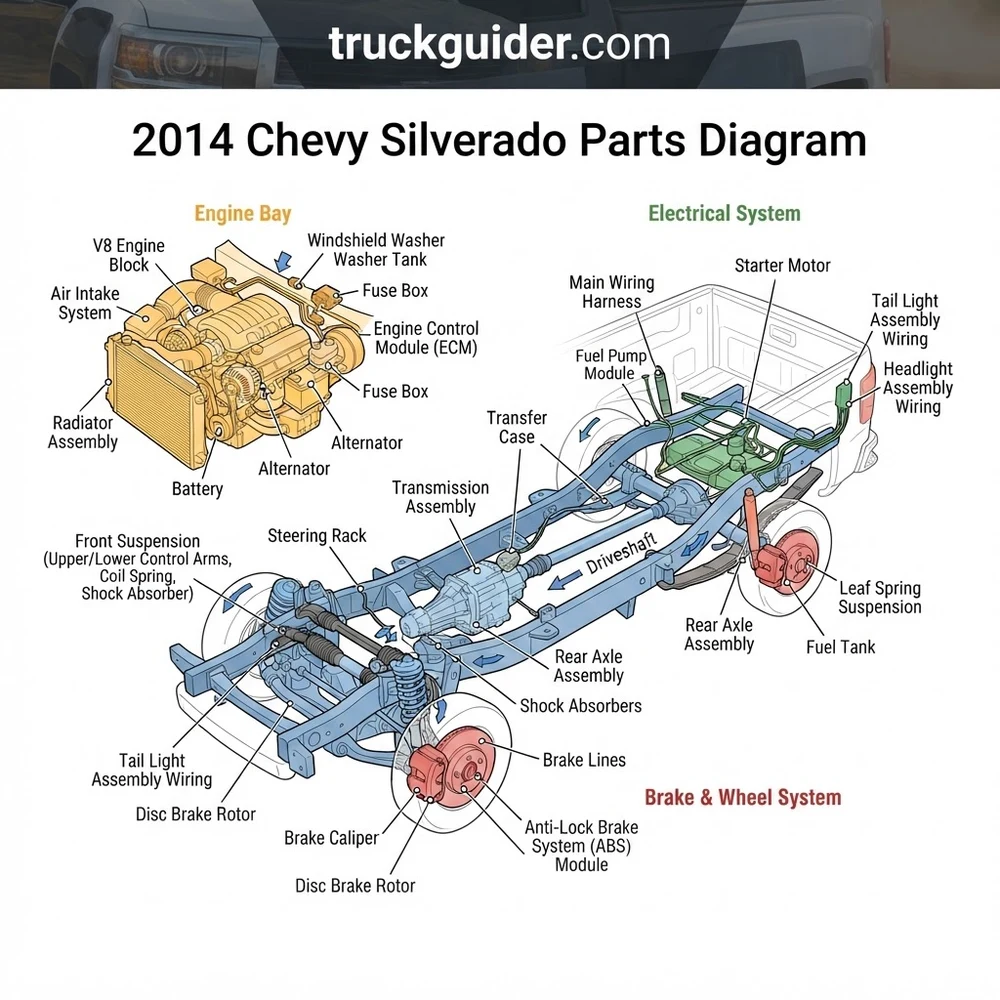
The 2014 Chevy Silverado parts diagram maps the K2XX platform’s mechanical and electrical architecture. It illustrates major assemblies including the EcoTec3 5.3L V8 (L83) engine layout, 6L80 transmission assembly, front independent coil-over suspension, and rear leaf spring structure, indexing exact OEM part groups, fastener torque references, and subassembly mounting locations.
📌 Key Takeaways
- Illustrates factory exploded views for 4.3L LV3, 5.3L L83, and 6.2L L86 engine configurations on the K2XX platform.
- Identifies precise OEM group numbers (e.g., Group 0.000 for Engine/Cradle, Group 2.000 for Electrical).
- Lists critical torque specs such as front hub assembly bolts at 133 lb-ft and caliper bracket bolts at 148 lb-ft.
- Highlights recurrent high-wear failure points, including AFM lifters, transmission thermal bypass valves, and ground straps.
- Differentiates simple bolt-on DIY component replacements from critical modules requiring GM MDI/Techline programming.
The 2014 model year represents a critical engineering divergence for General Motors full-size trucks. Navigating a 2014 chevy silverado parts diagram requires an understanding that GM introduced the ground-up redesigned K2XX platform for half-ton models, while heavy-duty 2500HD and 3500HD variants retained the outgoing GMT900 architecture. Sourcing correct replacement parts, rebuilding sub-assemblies, or tracing structural components demands a methodical approach to interpreting factory exploded views, cross-referencing callout indices, and isolating platform-specific chassis variations. This technical guide breaks down the factory schematic architecture, mechanical sub-assemblies, electronic parts catalog (EPC) workflows, and configuration codes required to service the 2014 Chevrolet Silverado accurately.
2014 Chevy Silverado Parts Diagram: K2XX Platform Layout



The structural layout of the 2014 Chevrolet Silverado 1500 marked the inaugural year of the GM K2XX platform, introducing fundamental departures from the preceding generation. When referencing a 2013 Chevy Silverado parts diagram alongside a 2014 edition, technicians will observe substantial metallurgical and geometry revisions throughout the chassis and cab blueprint. The 2014 Silverado 1500 frame utilizes hydroformed front box sections coupled with roll-formed, high-strength steel center rails and rear sections, dropping overall mass while increasing torsional rigidity by roughly 30 percent.


A primary source of cataloging error stems from cross-generational overlap. While the light-duty 1500 adopted the K2XX architecture for 2014, the heavy-duty lineup did not. A 2014 Silverado 2500HD/3500HD parts diagram remains rooted in the older GMT900 chassis schematic. Components such as steering gearboxes, torsion-bar front suspensions, full-floating rear axles, and structural cab mountings do not interchange between the 2014 1500 and its 2014 HD siblings. Technicians looking up components must immediately verify chassis tonnage to avoid cross-catalog contamination.
Do not use 2014 Silverado 1500 parts schematics for 2500HD or 3500HD models. The 2014 1500 utilizes the K2XX platform with rack-mounted Electric Power Steering (EPS) and coil-over-shock front suspension. The 2014 2500HD/3500HD lines utilize the GMT900 platform featuring hydraulic recirculating-ball steering linkages and torsion bar front springing.
The K2XX layout also altered cab mounting engineering. In place of standard solid or straight rubber biscuits, GM incorporated shear-style cab mounts on the forward positions alongside hydraulic cab mounts beneath the rear cab corners to isolate high-frequency road vibrations. Suspension layouts on the 2014 1500 also feature split component architectures depending on option packages: select models carry forged aluminum upper control arms and cast aluminum steering knuckles, while others utilize stamped steel upper control arms paired with cast iron knuckles. Identifying these suspension variations in the chassis diagram requires reading the factory Regular Production Option (RPO) codes, as geometry and ball joint press-fit diameters differ between the steel and aluminum configurations.
Chassis electrical routing also diverges sharply on K2XX schematics. The 1500 platform integrates the power distribution center directly adjacent to the battery on the passenger-side cowl, distributing harness runs down the frame rails via modular quick-disconnect bulkhead connectors. In-depth evaluations of this platform often tie directly into broader Chevy Silverado electrical wiring diagrams to trace low-speed and high-speed GMLAN serial data buses that interface between the body control module (BCM) and powertrain control module (PCM).
2014 Chevy Silverado Parts Diagram: Major Component Breakdown


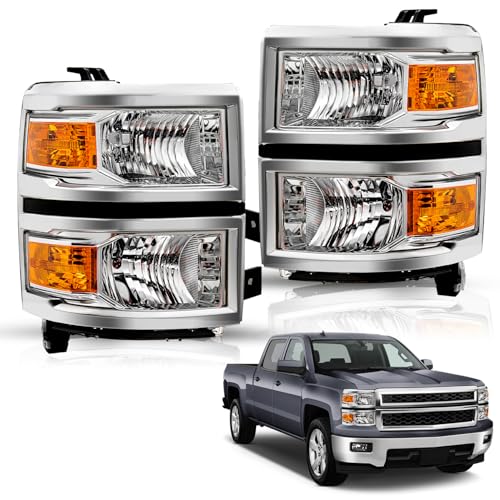

Factory parts schematics segment the vehicle into standardized functional groups. An exploded view illustration separates assemblies into discrete components, visually indicating their orientation along an assembly axis. Understanding these groups allows you to isolate engine dress, driveline links, and structural elements within the parts catalog.


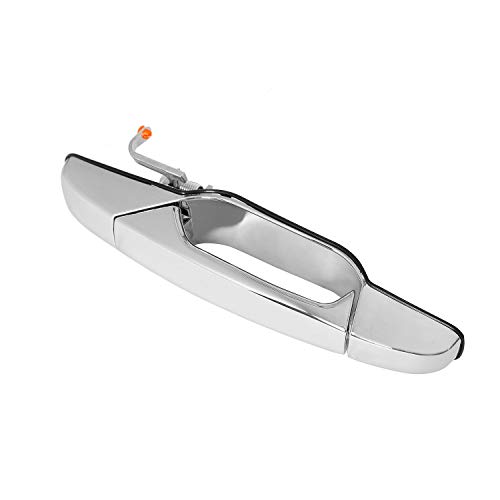

For the 2014 model year, GM introduced the Gen-V EcoTec3 Engine Family into the Silverado 1500 line: the 4.3L V6 (LV3), 5.3L V8 (L83), and 6.2L V8 (L86). These engines represent complete mechanical redesigns compared to Gen-IV Vortec predecessors, incorporating high-pressure direct injection (operating up to 2,175 PSI / 15 MPa), continuously variable valve timing (VVT), and Active Fuel Management (AFM). In any engine subsystem diagram, you will observe distinct hardware and fastener listings designating torque-to-yield (TTY) fasteners on cylinder heads, harmonic balancers, and connecting rod caps that must be discarded after a single installation.
Factory schematics designate critical assembly hardware with specific torque protocols. The L83/L86 crankshaft balancer bolt (OEM Part #11570163) requires an initial seating torque of 110 lb-ft (150 Nm), followed by loosening 360 degrees, retorquing to 59 lb-ft (80 Nm), and applying a final pass of 125 degrees rotation using an angle gauge. Balancer bolts are one-time-use TTY components.
The transmission schematics for the 2014 Silverado 1500 primarily highlight the Hydra-Matic 6L80 six-speed automatic (RPO MYC), while select early-run heavy-duty applications retained the 6L90 (RPO MYD) or Allison 1000 paired with the Duramax diesel. Proper interpretation of exploded views requires matching section/subsystem categorization to the transmission housing casting numbers and fluid circuit plate designs, especially when diagnosing pressure control solenoids via GM 6L80 transmission valve body schematics.
| Subsystem / Diagram Section | Primary Components & Architecture | Key Hardware & OEM Reference Specs |
|---|---|---|
| Engine: Cylinder Block & Internals | Gen-V EcoTec3 (LV3 4.3L, L83 5.3L, L86 6.2L); deep-skirt aluminum block; nodular iron crankshaft; cross-bolted main bearing caps; high-pressure direct injection pump pocket. | Cylinder head bolts: M12 & M8 TTY; Main cap side bolts: M8 (22 lb-ft); Direct injection fuel rail cross-over pipe: one-time use crush rings. |
| Transmission: Valve Body & Case | Hydra-Matic 6L80 (MYC); integrated Transmission Electro-Hydraulic Control Module (TEHCM); variable bleed pressure solenoids; 300mm torque converter. | Case-to-engine bellhousing bolts: M10x1.5 (37 lb-ft); TEHCM-to-valve body bolts: M5x0.8 (71 in-lb / 8 Nm); Pan filter seal with friction fit neck. |
| Steering: Rack & Cross-Member | Belt-driven rack-mounted Electric Power Steering (EPS) unit; aluminum gear housing; integrated electronic power control module; tie rod inner ball pivots. | Rack-to-crossmember structural bolts: M16x2.0 (133 lb-ft); Outer tie rod end-to-knuckle prevailing torque nut: 26 lb-ft + 90-degree final turn. |
| Front Suspension: Control Arms | Independent Front Suspension (IFS); twin-tube strut assemblies; stamped steel or forged aluminum upper A-arms; high-angle lower ball joints. | Upper ball joint nut: 37 lb-ft; Lower ball joint nut: 37 lb-ft + 90 degrees; Lower control arm frame pivot bolts: 107 lb-ft + 90-degree rotation. |
| Rear Axle: Differential & Brakes | GM 9.5-inch or 9.76-inch ring gear axle; cast iron housing; semi-floating axle shafts with C-clips; Duralife Ferritic Nitro-Carburized (FNC) brake rotors. | Ring gear bolts (left-hand thread on select carriers): 65 lb-ft + 30 degrees; Pinion nut crush sleeve: 240–300 lb-ft seating target; Diff cover: 30 lb-ft. |
How to Read the 2014 Chevy Silverado Parts Diagram Step by Step
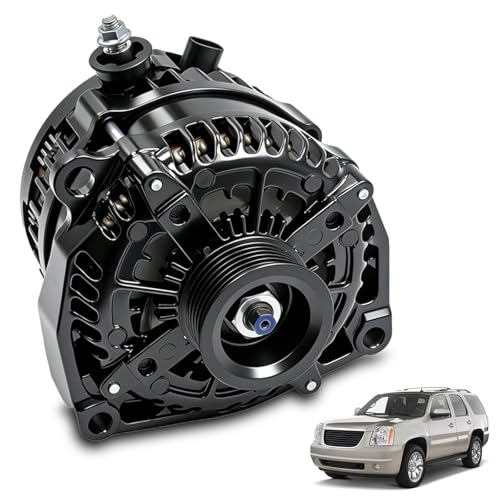


Interpreting a factory blueprint or diagram requires moving systematically from vehicle-level grouping down to specific piece-part part numbers. Bypassing this logical order leads to ordering incorrect parts or omitting necessary installation seals, gaskets, and fasteners.


- Navigate the General Motors Electronic Parts Catalog (EPC) Group Index: Begin by selecting the top-level functional section. General Motors EPC databases divide the vehicle into primary divisions: Group 00 (Engine/Cooling), Group 01 (Air/Fuel/Exhaust), Group 02 (Electrical), Group 04 (Transmission/Transfer Case), Group 06 (Brakes), Group 07 (Chassis/Suspension), and Group 14 (Body/Frame/Sheet Metal).
- Locate the Exploded View Illustration for the Target Assembly: Open the detailed schematic matching your repair target. Ensure you observe the coordinate orientation arrows (typically indicating the front of the vehicle or the centerline). Observe whether the assembly is depicted as installed or rotated along an axis for visibility.
- Identify Component Callout Numbers: On the schematic graphic, parts are not labeled with 8-digit GM part numbers; they are labeled with index or callout numbers (e.g., callout “14” or “bracket (item 3)”). These numbers are temporary visual pointers keyed specifically to the reference table on that individual catalog page.
- Trace Callouts to the OEM Part Number List: Cross-reference the callout number with the data table located adjacent to or below the exploded view illustration. Here, you will locate the exact GM part number (typically an 8-digit string such as 12668984), a standardized text description, and the quantity per vehicle.
- Examine Fastener and Supporting Hardware Listings: True factory schematics place fasteners immediately adjacent to the structural component they secure. Pay close attention to brackets, rubber O-rings, and bracket-to-block alignment pins. These will often carry distinct callout numbers that route to specific grade ratings, lengths, and pitch configurations (e.g., Bolt, M10x1.5×45, 10.9 hardness).
- Verify Part Notes and Footnotes: Many EPC entries contain critical conditional notes below the description line. Read these carefully for designations such as “Includes items 12 through 18,” “For vehicles with RPO Z71,” or “Except Heavy Duty Payload Package (NHT).”
In GM schematics, dashed bounding boxes enclosing multiple callout numbers represent sub-assemblies serviced only as a complete unit. If individual components inside that dashed line do not carry their own distinct callout number, GM does not supply them separately, requiring purchase of the entire boxed sub-assembly.
Decoding RPO Codes and VIN Data for Exact System Configuration


A single 2014 chevy silverado parts diagram will often present four or five different component variants for a single location, such as three distinct radiator assemblies or multiple steering gear variations. To filter these options and confirm the correct configuration, you must decode the Vehicle Identification Number (VIN) and the Service Parts Identification (SPID) label.
The 17-digit VIN provides top-level baseline filtering. For the 2014 Silverado, the 8th character identifies the factory engine configuration:
- Character “H”: 4.3L V6 LV3 (EcoTec3, FlexFuel capable)
- Character “C”: 5.3L V8 L83 (EcoTec3, Active Fuel Management)
- Character “J”: 6.2L V8 L86 (EcoTec3, High Output)
While the VIN filters broad powertrain requirements, granular suspension, cooling, drivetrain, and chassis options require referencing the Service Parts Identification (SPID) label. On the 2014 Silverado, this white adhesive matrix is located inside the glove box compartment (or occasionally affixed to the driver door latch pillar). The SPID label lists the complete array of three-character Regular Production Option (RPO) codes assigned to that specific chassis on the assembly line.
When searching the General Motors Electronic Parts Catalog (EPC), entering these specific RPO codes eliminates incorrect components. Key 2014 Silverado codes include:


- Z71: Off-Road Suspension Package (specific 46mm monotube Rancho shocks, skid plates, high-capacity air cleaner).
- NHT: Max Trailering Package (larger 9.76-inch rear axle, specific spring rates, high-capacity radiator).
- JL4: StabiliTrak Active Yaw Control (determines ABS module, brake line configuration, and yaw rate sensor layout).
- NPO vs. NP4 vs. NQH: Drivetrain transfer case identification (NPO: manual shift 2-speed; NP4: single-speed open differential; NQH: active two-speed electronic shift with Auto4WD mode). Diagnosing engagement failures on these systems often intersects with transfer case shift motor diagnosis procedures.
- G80: Mechanical locking rear differential (Eaton Gov-Lock assembly requiring specific ring gear carrier spacing).
Troubleshooting Common 2014 Silverado Diagram Lookup Pitfalls
Catalog lookup errors can sideline a repair, create comebacks, or result in costly return shipping and restocking fees. The architectural nuances of the 2014 model year introduce several operational pitfalls that mechanics encounter during part queries.
- Cross-Platform Generation Confusion: As noted, selecting components from a 2014 Silverado 2500HD/3500HD parts diagram when repairing a 1500 model causes total incompatibility. The heavy-duty truck shares the body exterior design cues of the previous generation and uses entirely different suspension arm geometry, wheel hub bolt patterns (8x180mm vs. 1500’s 6×139.7mm / 6×5.5 inch), and brake caliper mounting spreads.
- Ignoring Part Supersession and Engineering Revisions: GM issued numerous technical service bulletins and running production changes on the K2XX platform. For example, early-production 2014 Silverado A/C condensers (OEM Part #23349725) frequently cracked at the upper receiver-drier weld joint due to chassis vibration. The parts catalog reflects multiple superseded part numbers (updating to #84545089, then #84287383) incorporating revised mounting brackets and dampener cushions. Always select the highest numerical superseded part number indicated by the catalog system.
- Mistaking Graphic Callout Numbers for Part Number Suffixes: A common error involves confusing the drawing callout number (e.g., callout 2, 4, 8) with the internal sequence or final digits of a GM production part number. Callout numbers exist exclusively to connect the visual illustration to the text index table on that specific EPC page; they bear no relation to the actual manufacturing part number stamped on the component.
- Neglecting One-Time-Use Hardware in Assembly Listings: Gen-V EcoTec3 engines and K2XX chassis designs make extensive use of torque-to-yield (TTY) bolts and prevailing torque locknuts. Technicians checking an exploded view often order the primary component (such as an intermediate steering shaft or front lower control arm) but fail to order the designated replacement pinch bolts and locknuts listed directly under the sub-assembly callouts. Reusing worn fasteners compromises clamping loads and component safety.
- Front Brake Caliper Carrier and Rotor Diameter Mismatches: The 2014 Silverado 1500 came standard with 13.0-inch front rotors and Duralife FNC technology. However, trucks equipped with the NHT Max Trailering Package or police/special service configurations utilize alternative caliper bracket offsets and rotor thicknesses. Ordering rotors without confirming brake system RPO codes (such as J61 or JD9) frequently leads to caliper carrier contact or excessive clearance issues.
2014 Chevy Silverado Parts Blueprint and Schematic FAQs
How do I identify whether my 2014 Silverado has aluminum or stamped steel control arms in the suspension schematic?


Inspect the front upper and lower control arms physically with a magnet or cross-reference the build codes on your SPID label. Aluminum control arms are non-magnetic, display smooth silver castings, and correspond to RPO code variations found on select Z71 or high-trim models. Stamped steel arms are welded two-piece dark metal assemblies and use completely different ball joint tapers and press-in bushing outer shells, meaning their catalog part numbers do not interchange.
Why does the 2014 Silverado parts diagram show different water pump assemblies for the 5.3L V8?
The Gen-V L83 5.3L engine underwent an early-run thermostatic housing and cooling circuit revision. General Motors catalog diagrams show two distinct water pump body configurations based on engine build dates and whether the truck is equipped with standard cooling (RPO KNP absence) or enhanced auxiliary cooling systems. The outlet angles and belt pulley offsets differ between these designs, making strict VIN verification essential.
What causes part numbers in the 2014 Silverado EPC to differ from the physical stamp on the factory component?
Physical components pulled from a 2014 Silverado frequently feature an 8-digit “casting” or “engineering” number stamped directly into the metal or plastic. This casting number indicates the bare part prior to complete machining, paint, or integration into a sub-assembly. The actual OEM part number found in the diagram index represents the final, packaged “service part” assembly, which frequently carries a completely different numerical identifier.
Can I interchange front bumper components between a 2014 Silverado 1500 and a 2014 Silverado 2500HD?



No. The 2014 Silverado 1500 uses the K2XX front clip design, featuring an integrated bumper profile matched to the raised hood, active aero shutters, and restyled front fenders. The 2014 2500HD and 3500HD retained the GMT900 exterior design, requiring completely different steel bumper center sections, impact absorption brackets, fog light bezels, and frame attachment horns.
Where can I verify the correct transfer case model when browsing the four-wheel-drive schematics?
To confirm your transfer case model, reference the interior 4WD dash control switch alongside the SPID label in your glovebox. A 4-position selector switch with an “AUTO” mode indicates the Magna MP3023 / MP3024 active transfer case (RPO NQH). A 3-position switch without an Auto setting designates the simpler part-time unit (RPO NPO or NP4). Additionally, inspect the circular metal identification tag riveted to the rear case half of the transfer case assembly itself.
Step-by-Step Guide to Understanding the 2014 Chevy Silverado Parts Diagram
Identify – Match your vehicle’s VIN and glovebox RPO code sticker to ensure correct platform configuration and subsystem options.
Locate – Isolate the target subsystem on the master index, navigating to the engine, chassis, steering, or suspension layout.
Reference – Trace the exploded schematic lines to identify component callout numbers, adjoining fasteners, and required seal placements.
Connect/Route – Align replacement components according to factory structural mounting tabs, indexing dowels, and torque sequences specified in the layout.
Verify – Inspect clearance margins around adjacent mechanical components and verify all critical fasteners meet OEM torque-to-yield specifications.
Troubleshoot – Consult the assembly callout notes if components exhibit misalignment, checking for updated GM supersession numbers or modified mounting brackets.