2020 Ram 3500 Towing Capacity Chart 2026 Full Reference

Quick Answer
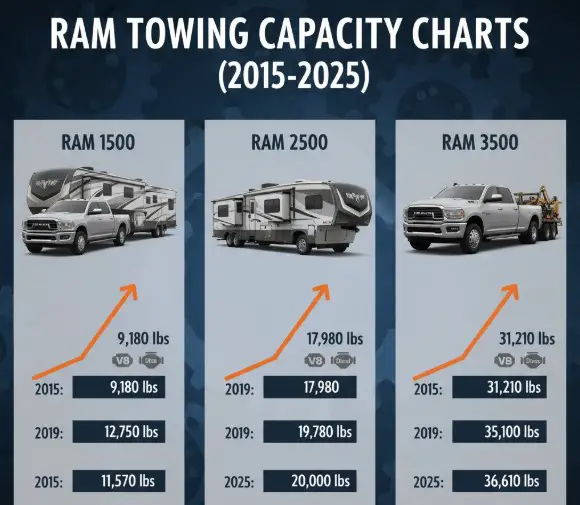
The 2020 Ram 3500 offers a maximum towing capacity of up to 35,100 lbs when properly equipped with the High-Output Cummins Turbo Diesel engine and a gooseneck hitch. Towing capacity ranges significantly based on engine choice, cab configuration, and axle ratio. Always consult your vehicle’s specific payload door sticker and GCWR to determine your truck’s safe, legal towing limit.
Knowing your 2020 Ram 3500 towing capacity is the most critical step in ensuring road safety, legal compliance, and vehicle longevity. Many owners mistakenly assume all Ram 3500 trucks share the same capacity based on the model name alone; in reality, the rating varies significantly based on engine, cab configuration, axle ratio, and drivetrain. This guide provides the official data, explains the essential configuration variables, and walks you through how to verify your specific truck’s limits using factory documentation.
2020 Ram 3500 Towing Capacity Chart: Complete Specs and Data
Recommended Best Deal Products


This reference covers the 2020 Ram 3500 Heavy Duty series. Ratings reflect maximum Gross Trailer Weight (GTW) when properly equipped. These figures are based on factory specifications; actual capacity varies by specific trim, axle ratio, and towing package. Last reviewed: August 2026.
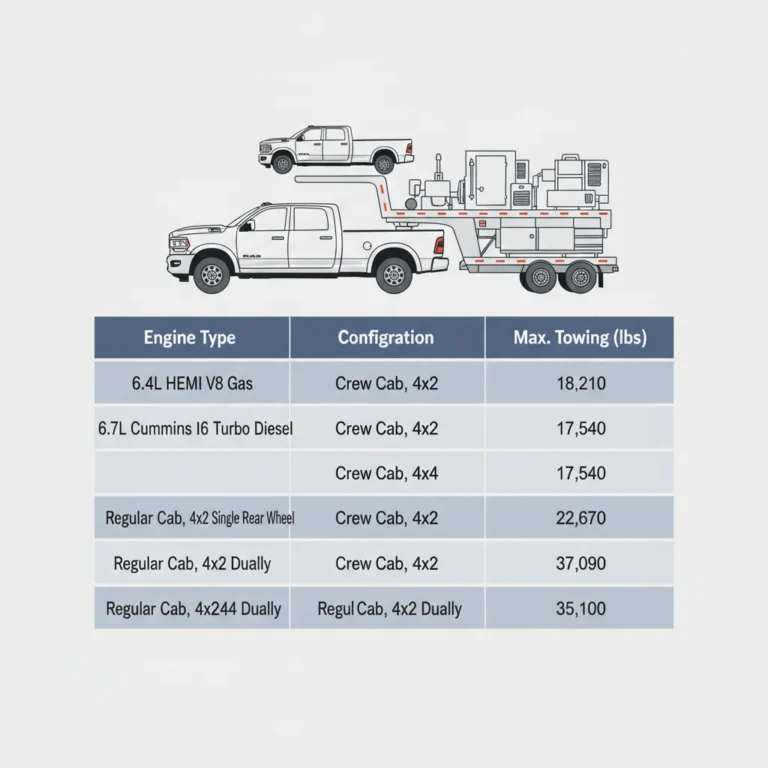
| Engine | Drivetrain / Cab | Max Towing | Notes |
|---|---|---|---|
| 6.4L HEMI V8 | 4×2 Regular Cab | 18,210 lbs | Requires 4.10 axle ratio |
| 6.7L Cummins I6 | 4×2 Regular Cab | 22,670 lbs | Standard Output |
| 6.7L HO Cummins | 4×2 Regular Cab | 35,100 lbs | Requires Gooseneck/5th Wheel |
Understanding Conventional vs. Gooseneck Ratings
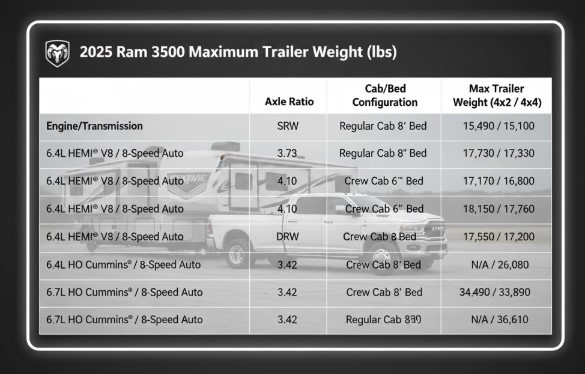
It is vital to distinguish between conventional towing (using a standard bumper-mounted receiver hitch) and gooseneck/fifth-wheel towing. Conventional towing is limited by the physical strength of the hitch receiver and the truck’s rear frame section. Gooseneck and fifth-wheel towing utilize the truck’s bed, placing the weight directly over the rear axle, which allows for significantly higher structural stability and higher maximum tow ratings.
What Affects 2020 Ram 3500 Towing Capacity Ratings
How Engine Torque Influences Payload
While horsepower is important for top-end speed, torque is the “muscle” that gets a heavy trailer moving. The 6.7L High Output (HO) Cummins engine is designed for maximum towing, producing 1,000 lb-ft of torque. This immense pulling power allows the vehicle to maintain momentum on grades, provided the chassis and cooling systems are rated to handle the stress.
The Impact of Axle Ratio on Towing Performance
The axle ratio—for example, the difference between a 3.73 and a 4.10 ratio—determines how many times the driveshaft rotates per wheel revolution. A higher numerical ratio (like 4.10) provides more mechanical advantage, allowing the engine to operate in a more efficient power band while accelerating a heavy load. If you are regularly towing near the maximum rating, opting for the 4.10 ratio is essential for drivetrain longevity.
How to Determine Your 2020 Ram 3500 Towing Limit
Recommended Best Deal Products


📋
Step-by-Step Verification Guide
Locate the tire and loading information placard on your driver-side door jamb. This provides your vehicle’s specific GVWR (Gross Vehicle Weight Rating) and payload capacity.
Your GCWR (Gross Combined Weight Rating) is the absolute limit for the truck, fuel, passengers, cargo, and trailer combined. You must weigh your fully loaded truck to determine your available “towing headroom.”
2020 Ram 3500 Towing Capacity Compared to Ford and Chevy
Recommended Best Deal Products


Common 2020 Ram 3500 Towing Capacity Misconceptions
Do not rely on internet forum advice for towing limits. Modifications such as aftermarket hitches or larger tires do not increase your factory tow rating. In many cases, exceeding these ratings can void your powertrain warranty and lead to severe legal and safety liabilities in the event of an accident.
- Safety Systems Are Not Boosters: Features like integrated trailer brake controllers and trailer sway control are safety aids, not capacity boosters.
- Weight Distribution: Always ensure your trailer is properly balanced. Excessive tongue weight can compromise your payload capacity, even if the trailer weight is within limits.
- Warranty Risks: Overloading your truck puts extreme stress on the transmission and cooling systems; unauthorized towing loads are often flagged during warranty claims.
If you plan to tow at maximum capacity frequently, ensure your cooling system fluids are changed on an accelerated schedule, as heavy hauling significantly reduces the lifespan of transmission and engine oil.
Towing capacity is unique to your specific truck’s VIN and configuration. Always balance engine power, axle ratio, and payload limits to maintain control. Safety is ultimately determined by staying within the lowest-rated component limit of your vehicle. Check your driver-side door jamb sticker today and cross-reference it with our 2020 Ram 3500 towing capacity chart to confirm your load limits before your next trip.
2020 Ram 3500 Towing Capacity Chart: Frequently Asked Questions
Does the engine choice affect my towing limit?
Yes, significantly. The 6.4L HEMI V8 is designed for lighter commercial or recreational work with a lower towing ceiling, while the 6.7L Cummins Turbo Diesel provides the high torque necessary for heavy-duty hauling. Within the diesel category, the High-Output (HO) Cummins version offers the maximum towing capacity, often exceeding the standard diesel by several thousand pounds.
What is the difference between conventional and gooseneck towing?
Conventional towing uses a standard hitch receiver mounted to the frame beneath the bumper, which generally has lower weight limits due to tongue weight distribution. Gooseneck or fifth-wheel towing utilizes a hitch mounted in the center of the truck bed directly over the rear axle, allowing for significantly higher vertical load distribution and stability, enabling the vehicle to reach its maximum towing rating.
Can I exceed the manufacturer’s towing capacity safely?
No. Exceeding the manufacturer’s specified towing capacity is unsafe and illegal. It puts excessive stress on your braking system, engine cooling, transmission, and suspension components. Furthermore, operating beyond these limits can void your factory warranty and may result in liability issues in the event of an accident or equipment failure on public roads.
How does axle ratio impact towing performance?
The axle ratio represents the gear ratio in the differential; a higher numerical ratio (e.g., 4.10 vs 3.73) allows the engine to provide more torque to the wheels at lower speeds. This improves acceleration and pulling power when starting from a dead stop or climbing steep grades, making it a critical component for maximizing your towing and load-hauling performance.