2024 Ram 1500 Towing Capacity: Full Technical Guide

The 2024 Ram 1500 enters the market with a formidable advertised maximum towing capacity of 12,750 pounds and a peak payload capacity of 2,300 pounds. These figures place it firmly in the upper echelon of the highly competitive half-ton pickup truck segment. However, these numbers represent the absolute ceiling, achievable only with a highly specific and carefully selected vehicle configuration.
In reality, the towing capacity of a 2024 Ram 1500 can vary significantly, with some configurations rated as low as 6,330 pounds. This wide range underscores a critical reality for truck buyers: the number on the brochure is a starting point, not a universal guarantee. Factors such as engine choice, drivetrain, axle ratio, cab size, and trim level all play a decisive role in determining a specific truck’s true trailering and hauling capabilities.
This guide provides a comprehensive, data-driven analysis of the 2024 Ram 1500’s towing and payload ratings. It will deconstruct the complex interplay of mechanical and optional components, explain the critical but often misunderstood concept of payload, and equip prospective buyers with the knowledge to select a truck that precisely matches their towing requirements.
A Deep Dive into the 2024 Ram 1500’s Towing Capacity
Unpacking the power, performance, and configurations that define one of the market’s most capable light-duty trucks.
Maximum Available Towing Capacity
12,750 lbs
Achieved with the 5.7L HEMI® V8 engine with eTorque, 2WD, and the available Max Towing Package. Ram achieves these impressive numbers through robust engineering, all detailed on the official Ram Trucks website.
2024 Ram 1500 Towing Capacity by Engine
The engine is the heart of any truck’s towing capability. The Ram 1500 offers two primary powerplants, each delivering a different balance of power and efficiency.
The 5.7L HEMI® V8 with eTorque provides a significant boost in towing power, making it the preferred choice for heavy-duty tasks.
Ram 1500 vs. Competitors: Towing Showdown
While the Ram 1500 is a formidable hauler, the light-duty truck segment is fiercely competitive. Here’s how its maximum towing capacity stacks up against its main rivals.
All manufacturers test their trucks according to the SAE J2807 standard to ensure fair and consistent ratings.
Beyond Towing: Max Payload
Payload—the weight a truck can carry in its cab and bed—is just as crucial as towing. It’s vital not to overload your truck before hooking up a trailer.
For safe operation, understanding the difference between payload and towing is critical. You can learn more in our detailed guide on payload vs. towing capacity.
Key Factors Affecting Towing
Achieving the maximum rating isn’t automatic. A truck’s final towing capacity is a result of a specific combination of components.
Engine Choice
The 5.7L HEMI® V8 offers significantly more towing power than the 3.6L Pentastar® V6.
Drivetrain (2WD vs. 4WD)
Typically, 2WD models can tow slightly more due to their lower curb weight.
Axle Ratio
A higher numerical axle ratio (e.g., 3.92) provides more torque to the wheels, increasing towing capacity compared to a lower ratio (e.g., 3.21).
Cab & Bed Configuration
Smaller cabs and beds generally mean less weight, which can contribute to a higher towing rating.
✨ What Can You Tow?
Describe what you want to tow (e.g., “a 25-foot Airstream trailer”), and our AI assistant will estimate the weight and recommend the right engine.
Technology That Makes Towing Easier
eTorque Mild Hybrid System
Adds supplemental torque from a standstill for smoother starts under load and improves fuel efficiency.
Trailer Reverse Steering Control
Allows you to steer the trailer with a simple knob while the truck controls the steering wheel, simplifying backups.
Trailer Tire Pressure Monitoring
Provides live tire pressure readings for up to four trailers, enhancing safety on the road.
For serious towing, upgrading to a set of specialized towing mirrors for your Ram 1500 is highly recommended for safety.
Frequently Asked Questions (FAQ)
The high-performance Ram 1500 TRX is built for off-road speed, not maximum towing. Its capacity is rated at 8,100 pounds, which is lower than other V8 models due to its specialized suspension and off-road focus.
Yes. To achieve the 12,750-pound maximum, you need a 2024 Ram 1500 Quad Cab 2WD configured with the 5.7L HEMI® V8 with eTorque, a 3.92 axle ratio, and the Max Towing Package, which includes a Class IV receiver hitch and other necessary equipment.
The eTorque mild hybrid system uses a 48-volt battery and a motor-generator to provide supplemental torque during takeoff. This helps get the truck and trailer moving more smoothly and reduces the strain on the gasoline engine. According to tests by Car and Driver, the HEMI V8 provides effortless acceleration even when loaded.
Powerplant Breakdown: How Engine Choice Dictates Towing Potential
The engine is the heart of any truck’s towing capability, and the 2024 Ram 1500 offers three distinct powertrain options, each engineered for a different balance of power, efficiency, and purpose.
5.7L HEMI® V8 with eTorque: The Towing Champion
The key to unlocking the Ram 1500’s maximum towing potential is the available 5.7L HEMI® V8 engine equipped with the eTorque Mild Hybrid Technology System.
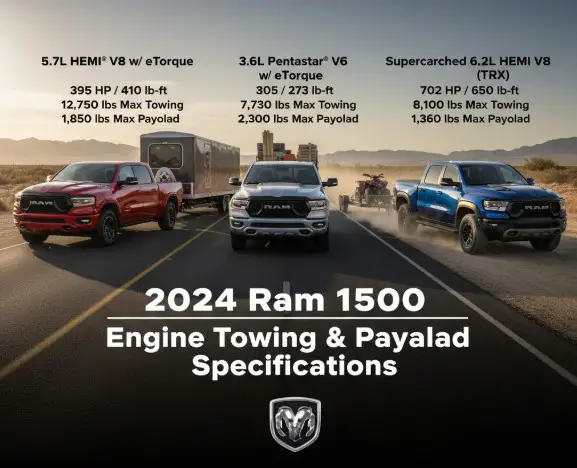
- Specifications: 395 horsepower and 410 lb-ft of torque.
- Maximum Towing Capacity: Up to 12,750 pounds.
The eTorque system is a crucial component of this powertrain’s success. It is not a traditional hybrid system but a 48-volt belt-driven motor-generator that replaces the conventional alternator. Its primary benefit for towing is the delivery of up to 130 lb-ft of supplemental torque from a standstill.
This instantaneous torque helps overcome the initial inertia of a heavy trailer, allowing the truck to launch smoothly with significantly less strain on the drivetrain. This feature is a primary reason this engine configuration achieves the lineup’s highest tow rating.
3.6L Pentastar® V6 with eTorque: The Efficient Workhorse
Serving as the standard engine for most of the Ram 1500 lineup, the 3.6L Pentastar® V6 is a capable and efficient option for lighter-duty applications.
- Specifications: 305 horsepower and 273 lb-ft of torque.
- Maximum Towing Capacity: Up to 7,730 pounds.
This engine, which also features the eTorque system, is best suited for owners who prioritize fuel economy and daily drivability over maximum towing force. It is an excellent choice for hauling small boats, utility trailers, or pop-up campers. Notably, it is within configurations using this V6 engine that the Ram 1500 achieves its maximum payload rating of 2,300 pounds, a point that will be explored in greater detail later in this report.
Supercharged 6.2L HEMI® V8: The Performance King (TRX)
Exclusive to the high-performance Ram 1500 TRX model, the Supercharged 6.2L HEMI® V8 is an engineering marvel focused on raw power and off-road speed.
- Specifications: 702 horsepower and 650 lb-ft of torque.
- Maximum Towing Capacity: 8,100 pounds.
The fact that the most powerful engine in the lineup does not possess the highest tow rating is a frequent point of confusion. This discrepancy highlights that towing capability is a function of the entire vehicle system, not just engine output. The TRX is purpose-built as a high-speed off-road vehicle.
Its suspension is engineered with long travel and specialized shocks to absorb large impacts at speed, a design that is fundamentally different from one optimized to manage the static load and forces of a heavy trailer. While its engine is immensely powerful, the TRX’s specialized frame and suspension tuning limit its ability to safely control a heavy conventional trailer, resulting in a tow rating that is substantial but far from the lineup’s maximum.
2024 Ram 1500 Engine Towing & Payload Specifications
The following table provides a clear comparison of the key performance metrics for each available engine in the 2024 Ram 1500 lineup.
Configuration is Key: The Factors That Really Determine Your Towing Capacity
Choosing an engine is only the first step. A truck’s final, official tow rating is determined by a combination of four additional factors: axle ratio, drivetrain, cab size, and bed length. Understanding how these elements interact is essential to configuring a truck for maximum capability.
The Power of Gearing: Axle Ratio Explained
The axle ratio is one of the most critical—and least understood—factors in determining towing capacity. It refers to the ratio between the rotations of the driveshaft and the rotations of the wheels. For example, a 3.92:1 ratio means the driveshaft turns 3.92 times for every single rotation of the wheels.
The choice of axle ratio involves a direct trade-off between power and efficiency.
- Higher Numerical Ratio (e.g., 3.92): This ratio acts as a torque multiplier, making it easier for the engine to turn the wheels under heavy load. This results in significantly higher towing capacity. The drawback is that the engine must run at a higher RPM at any given speed, leading to lower fuel economy.
- Lower Numerical Ratio (e.g., 3.21): This ratio is optimized for fuel efficiency during highway cruising, as the engine runs at a lower RPM. However, it provides less mechanical advantage for towing, resulting in a lower capacity.
The impact of this choice is not trivial. Consider a 2024 Ram 1500 4×2 Crew Cab with the 5.7L HEMI V8 engine. With the standard 3.21 axle ratio, its maximum tow rating is 8,420 pounds. By optioning the same truck with the 3.92 axle ratio, the towing capacity jumps to 11,520 pounds—a 3,100-pound increase based on gearing alone.
Drivetrain: 4×2 vs. 4×4
The choice between a two-wheel drive (4×2) and a four-wheel drive (4×4) configuration also affects towing. A 4×4 system includes additional components like a transfer case, a front differential, and front driveshafts, all of which add to the vehicle’s curb weight. Since towing capacity is derived from the Gross Combined Weight Rating (GCWR)—the maximum allowable weight of the truck and trailer combined—a heavier truck has less remaining capacity for a trailer.
Consequently, a 4×2 model will typically have a higher tow rating than an otherwise identically equipped 4×4 model. The Ram 1500’s absolute maximum rating of 12,750 pounds is only achievable with a 4×2 drivetrain.17
Cab and Bed Size: The Balancing Act
The principle of curb weight also applies to the truck’s physical size. Larger Crew Cabs are heavier than Quad Cabs, and longer beds add more weight than shorter ones. Each pound added to the truck’s own weight is a pound subtracted from its potential towing or payload capacity.
To achieve the 2024 Ram 1500’s maximum towing capacity of 12,750 pounds, a buyer must select a very specific configuration: a Quad Cab with the 6-foot-4-inch box, a 4×2 drivetrain, the 5.7L HEMI® V8 engine with eTorque, and the 3.92 axle ratio. Any deviation from this formula, such as opting for a 4×4 or a heavier Crew Cab, will result in a lower official tow rating.
The Payload Trap: The Most Overlooked Limit on Towing
While manufacturers prominently advertise maximum towing capacity, a truck’s payload capacity is often the more critical and restrictive limit, especially when towing heavy travel trailers or fifth wheels. Misunderstanding this relationship is one of the most common and dangerous mistakes a truck owner can make.
Defining the Key Weight Ratings
To tow safely, one must understand the official weight ratings provided by the manufacturer.
- Gross Vehicle Weight Rating (GVWR): The absolute maximum weight the truck itself can be, including its own curb weight, all passengers, cargo in the cab and bed, and the tongue weight of the trailer. This is the limit of the truck’s frame, suspension, axles, and tires.
- Gross Combined Weight Rating (GCWR): The absolute maximum weight of the fully loaded truck and the fully loaded trailer combined. This is the limit of what the powertrain can safely propel, and the brakes can safely stop.
- Payload: This is the total weight of all items that can be added to the truck. It is calculated by subtracting the truck’s curb weight from its GVWR. Payload includes passengers, pets, cargo, aftermarket accessories (like a tonneau cover), and, most importantly, the trailer’s tongue weight.
- Tongue Weight: This is the downward force that the trailer’s coupler exerts on the truck’s hitch ball. For a conventional trailer, this should be 10-15% of the total loaded trailer weight to ensure stable towing. This weight is carried by the truck and therefore counts directly against the payload capacity.
A Real-World Scenario: Why Payload Matters More
High-end trims like the Ram 1500 Limited and Limited Longhorn are equipped with numerous luxury features—panoramic sunroofs, power-deployable running boards, ventilated seats, and advanced sound systems. While desirable, these features add significant weight to the truck, which directly reduces its available payload capacity.
Consider this practical example: A buyer purchases a top-of-the-line 2024 Ram 1500 Limited. Due to its heavy optional equipment, the payload capacity listed on its door jamb sticker is only 929 pounds. The owner wants to tow a travel trailer that weighs 9,000 pounds when loaded.
- The truck’s advertised tow rating is likely over 11,000 pounds, so the 9,000-pound trailer seems well within its capability.
- However, the trailer’s tongue weight, at 12% of its total weight, is 1,080 pounds.
- This 1,080-pound tongue weight alone exceeds the truck’s entire 929-pound payload capacity before even accounting for the driver, passengers, or any cargo in the truck.
- This scenario creates an overloaded, unsafe towing condition that can lead to suspension damage, poor braking, and dangerous trailer sway, despite being well under the advertised “towing capacity.”
This demonstrates that for many real-world towing situations, particularly with heavy trailers, payload capacity is the true limiting factor. A less-optioned Tradesman or Big Horn trim often has a higher payload capacity and may be a more suitable and safer tow vehicle than a fully loaded luxury model.
To find a specific vehicle’s true payload, one must ignore brochure numbers and consult the yellow-and-white “Tire and Loading Information” sticker located on the driver’s side door jamb. This sticker lists the “Combined Weight of Occupants and Cargo” that should never be exceeded for that exact vehicle, as it was built at the factory. For a deeper dive into this topic, see our guide.
2024 Ram 1500 Towing Capacity by Trim Level
The towing and payload capacities vary across the Ram 1500’s trim lineup, reflecting differences in standard equipment, curb weight, and intended purpose. The following table provides representative weight ratings for common configurations of each trim. It is essential to verify the specific ratings of any individual truck, as options can alter these figures.
2024 Ram 1500 Towing & Payload by Trim (Example Configurations)
| Trim Level | GVWR (lbs) | GCWR (lbs) | Example Payload (lbs) | Example Towing (lbs) | Standard/Key Engine |
|---|---|---|---|---|---|
| Tradesman® | 7,100 | 12,900 | 2,320 | 7,760 | 3.6L Pentastar® V6 |
| Tradesman® HFE | 6,010 | 11,900 | 1,220 | 6,740 | 3.6L Pentastar® V6 |
| Big Horn® | 6,800 | 11,900 | 2,010 | 6,740 | 3.6L Pentastar® V6 |
| Laramie® | 6,900 | 11,900 | 1,890 | 6,520 | 3.6L Pentastar® V6 |
| Rebel® | 6,900 | 12,900 | 1,580 | 7,210 | 5.7L HEMI® V8 |
| Limited Longhorn™ | 6,900 | 11,900 | 1,700 | 6,330 | 5.7L HEMI® V8 |
| Limited | 6,900 | 13,900 | 1,550 | 8,190 | 5.7L HEMI® V8 |
| TRX® | 7,800 | 15,160 | 1,310 | 8,100 | 6.2L Supercharged HEMI® V8 |
Equipping for the Haul: Ram 1500 Towing Packages
To utilize the Ram 1500’s capabilities safely, Ram offers specialized packages that bundle the necessary hardware and technology.
Trailer-Tow Group
This is the foundational package for towing. It equips the Ram 1500 with the essential components needed for most trailering tasks. Contents typically include:
- Class IV Receiver Hitch
- Integrated Trailer Brake Controller
- Trailer Light Check
- Trailer Reverse Steering Control
- Power Trailer-Tow Mirrors (features like heating and power-folding may vary by trim level)
Max Tow Package
This package is a significant mechanical upgrade required to achieve the absolute maximum 12,750-pound tow rating. It is not available on all trims and is specifically offered on configurations like the 4×2 Quad Cab with the 5.7L HEMI® eTorque engine. The Max Tow Package includes all the features of the Trailer-Tow Group and adds:
- 3.92 Rear Axle Ratio: The critical gearing change for maximum torque application.
- Upgraded Rear Axle: A more robust axle to handle the increased stress.
- Upgraded On-/Off-Road Tires: Tires with a higher load rating suitable for heavy-duty use.
Smart Towing Technology
Beyond the core packages, Ram offers a suite of available technologies designed to enhance safety and convenience while towing. These include a 360° Surround View Camera system for easier maneuvering, Blind Spot Monitoring that can be configured to account for the length of the trailer, and the class-exclusive Active-Level™ Four-Corner Air Suspension, which can automatically level the truck to compensate for tongue weight, improving stability and headlight aim.
The Competitive Landscape: Ram 1500 vs. Ford F-150 & Chevy Silverado 1500
While the 2024 Ram 1500 is a highly capable truck, it does not lead the half-ton segment in the headline towing and payload figures. This positioning reflects a strategic choice by Ram to prioritize other attributes.
2024 Half-Ton Truck Towing & Payload Comparison
| Metric | Ram 1500 | Ford F-150 | Chevrolet Silverado 1500 |
|---|---|---|---|
| Max Towing Capacity | 12,750 lbs | 13,500 lbs | 13,300 lbs |
| Max Payload Capacity | 2,300 lbs | 2,445 lbs | 2,260 lbs |
| Top Towing Engine | 5.7L HEMI® V8 | 3.5L EcoBoost® V6 | 6.2L EcoTec3 V8 / 3.0L Duramax® Diesel |
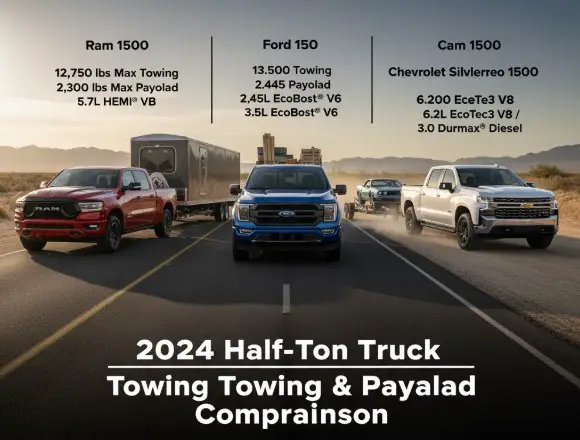
As the data shows, both the Ford F-150 and Chevrolet Silverado 1500 offer slightly higher maximum tow ratings. However, the Ram 1500’s defining characteristic in the market is its standard multi-link, coil-spring rear suspension. This design, unique among its primary competitors who use traditional leaf springs, provides a significantly smoother and more composed ride when the truck is unladen.
This makes the Ram 1500 a more comfortable daily driver and family vehicle. Ram has strategically balanced raw capability with class-leading ride quality, a trade-off that many buyers find appealing. For official manufacturer towing information, consult the(https://www.ramtrucks.com/towing/towing-capacity-guide.html). All ratings are calculated according to standards set by the(https://www.sae.org/), specifically the J2807 protocol. Reputable outlets like(https://www.caranddriver.com/ram/1500) have also extensively reviewed these trade-offs.
Conclusion & Key Takeaways
The 2024 Ram 1500 is a powerful and versatile pickup truck with a towing capacity that can handle the vast majority of consumer and light commercial needs. However, its ultimate capability is defined by its specific configuration, not just its advertised maximums.
Key takeaways from this analysis include:
- The maximum towing capacity is 12,750 pounds, and the maximum payload is 2,300 pounds. These figures are not achieved on the same vehicle configuration.
- The 5.7L HEMI® V8 with eTorque, combined with the 3.92 axle ratio and the Max Tow Package, is the definitive choice for achieving the highest tow rating.
- Payload capacity is often the true limiting factor for towing. The added weight of luxury options can significantly reduce payload. Always verify a specific truck’s payload by checking the “Tire and Loading Information” sticker on the driver’s door jamb.
- The Ram 1500’s primary competitive advantage is its class-leading ride comfort, a result of its standard coil-spring rear suspension. This positions it as an excellent dual-purpose vehicle for both work and daily life, even if it concedes the top towing spot to rivals by a narrow margin.
Frequently Asked Questions (FAQ)
What is the maximum towing capacity of a 2024 Ram 1500?
The 2024 Ram 1500 has a maximum towing capacity of up to 12,750 pounds.28 This is only achievable on a specific configuration: a 4×2 Quad Cab model equipped with the 5.7L HEMI® eTorque V8 engine, a 3.92 axle ratio, and the optional Max Tow Package.
Which Ram 1500 engine is best for towing?
The 5.7L HEMI® V8 with the eTorque mild-hybrid system is the best engine for maximizing towing capacity in the 2024 Ram 1500 lineup. It is specifically engineered to provide the power and torque necessary to achieve the 12,750-pound rating.
How does axle ratio affect the Ram 1500’s towing capacity?
The axle ratio is a critical factor. A higher numerical ratio, such as 3.92, provides more torque to the wheels, significantly increasing towing capacity at the expense of some fuel efficiency. A lower numerical ratio, like 3.21, prioritizes fuel economy and results in a lower towing capacity.
Can a Ram 1500 Limited tow as much as a Tradesman?
Not always. While a Limited can be equipped with the powerful 5.7L HEMI® V8, its extensive luxury features (sunroof, power running boards, etc.) make it heavier, which reduces its payload capacity. A base-model Tradesman is lighter and often has a higher payload rating, making it potentially better and safer for towing trailers with a heavy tongue weight, even if its theoretical tow rating is similar.
What is the Ram 1500 Max Tow Package?
The Max Tow Package is a factory-installed option required to achieve the 12,750-pound maximum tow rating. It bundles essential mechanical upgrades, including the 3.92 rear axle ratio, an integrated trailer brake controller, a Class IV hitch receiver, and other necessary hardware for heavy-duty towing.