6.0 Powerstroke Problems by Year: 2003-2007 Fixes

The most common 6.0 Powerstroke problems start with a clogged engine oil cooler that starves the EGR cooler of coolant until it ruptures, which then pushes the head gaskets and the stretched head bolts to fail.
Four more repeat offenders sit around that chain: FICM failure, high-pressure oil leaks, sticking injectors, and a sticky VGT turbo.


The 6.0L Powerstroke is the Navistar-built VT365 V8 that Ford used in 2003 to 2007 F-250 through F-550 Super Duty trucks, plus the Excursion and E-Series vans.
Every model year shares the same weak points, so a truck’s repair history tells you more than its year. Start with the three factors below, then jump to the symptom your truck is showing.
2003 to 2007 Ford Super Duty
6.0L Powerstroke Symptom Diagnosis Chart
Match the symptom, run the first check, then budget the fix.
The 6.0L failure chain
Coolant loss or white smoke
- Likely cause
- Clogged oil cooler, ruptured EGR cooler, stretched TTY head bolts
- Codes
- No single code. Watch EOT vs ECT on a scan tool
- First check
- EOT 15°F or more above ECT means replace the oil cooler
- Reported cost
- Oil cooler $3,000 to $7,000. Head stud job about $3,500
Long crank or no-start when hot
- Likely cause
- STC fitting (2005 to 2007), dummy plugs and standpipes, worn HPOP (2003 to 2004)
- Codes
- P2290ICP too low, part of the P2284 to P2291 range
- First check
- Air test the high-pressure oil system before buying parts
- Reported cost
- Dealer quotes of $488 for dummy plugs and $1,164 for the STC fitting
Rough or hard start when cold
- Likely cause
- FICM below 48 volts, or HEUI injector stiction with oil under 70°F
- Codes
- P0611P1378U0105
- First check
- Test batteries, then FICM voltage while cranking. Ford TSB 08-26-3
- Reported cost
- Remanufactured FICM $249 to $334
Slow boost or low power
- Likely cause
- Failing ICP sensor, fuel pressure under 45 psi, sooted EGR valve, sticking VGT vanes
- Codes
- P0299can be false from a bad ICP sensor
- First check
- Fuel pressure must hold 45 psi or more, even at wide-open throttle
- Reported cost
- Turbo rebuild from about $350
Costs are vendor estimates and owner-reported shop quotes. Check current labor rates in your area. Sources: Ford EOT and ECT road test procedure, Diesel Hub, Alliant Power, owner reports on Ford-Trucks.com.
3 Factors That Decide How Serious Your 6.0L Problem Is


Three things decide whether a 6.0L problem is a $300 fix or a $5,000 one.
Model Year and Build Date


The 6.0L arrived during the 2003 model year while the 7.3L was still on sale, so a 2003 Super Duty can have either diesel. Our 2003 7.3L Powerstroke specs and changeover guide shows how the two engines overlapped. Early 2004 trucks also carry the 2003 engine, and Diesel Hub puts the cutoff at a September 29, 2003 build date. Many updated parts, including FICMs and standpipe kits, are sorted by that late-September split. Read the month and year on the certification label in the driver door jamb instead of trusting the model year on the title.


Repair and Upgrade History
Ask for receipts for head studs, replacement oil and EGR coolers, and FICM repair. A 6.0L with documented fixes is a different engine from an untouched one, and a “bulletproofed” claim with no paperwork proves nothing.
The Symptom You Can See
- Coolant loss or white smoke points to the cooler and head gasket chain.
- A long crank or no-start when hot points to high-pressure oil leaks.
- Rough running or hard starts when cold point to the FICM or injectors.
- Slow boost or low power points to the turbo, sensors, and fuel pressure.
If coolant is disappearing, start with the cooler chain below.
If Your 6.0L Is Losing Coolant or Blowing White Smoke


On a 6.0L, coolant loss is rarely a single failure. Coolant leaves the water pump, flows through the engine oil cooler, and then feeds the EGR (Exhaust Gas Recirculation) cooler. A blockage upstream sets up the next failure downstream.
Clogged Engine Oil Cooler


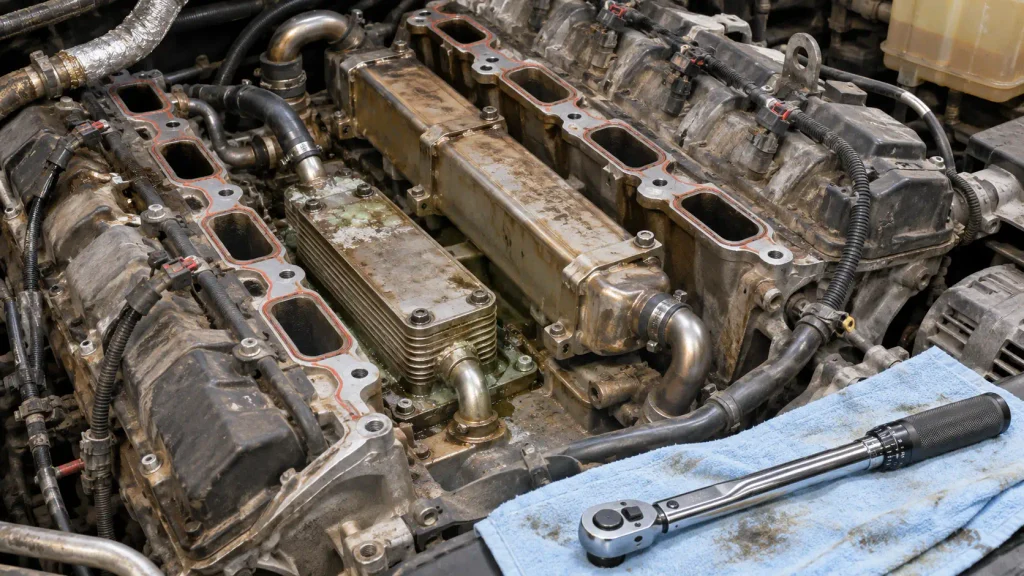
The factory oil cooler sits in the engine valley under the intake manifold, and its narrow coolant passages collect casting sand and broken-down coolant. As those passages plug, oil runs hotter than coolant. Ford’s diagnostic road test compares EOT (Engine Oil Temperature) with ECT (Engine Coolant Temperature) on a scan tool.


If EOT exceeds ECT by 15°F or more at any point in the test, the next step is replacing the oil cooler. If the gap stays under 15°F, the procedure moves on to testing the head gaskets.
If you see a split of 15°F or more at steady highway speed on a fully warm engine, then treat the oil cooler as restricted, even if no coolant has gone missing yet.
Ruptured EGR Cooler
The EGR cooler uses engine coolant to cool exhaust gas before it returns to the intake. When a plugged oil cooler cuts coolant flow, the EGR cooler overheats, cracks, and leaks coolant into the exhaust and intake. The signs are white exhaust smoke with a sweet smell, coolant loss with no puddle under the truck, and coolant pushed out of the degas bottle.
If you are losing coolant with no external leak, then pressure-test the cooling system and inspect the EGR cooler before steam starts stretching the head bolts. Replace the cooler with a new OEM or upgraded unit. Removing the EGR system is illegal on vehicles driven on public roads under the federal Clean Air Act, and a deleted truck fails inspection in states that test diesel emissions.


Blown Head Gaskets and Stretched Head Bolts
The real weakness is the fasteners, not the gaskets. The 6.0L clamps each head with torque-to-yield (TTY) bolts, four per cylinder and 10 per bank, while the 7.3L used six bolts per cylinder. TTY bolts stretch permanently when tightened, and combustion pressure or steam from a failed EGR cooler stretches them further until the gasket lets go.
Watch for coolant forced out of the degas bottle under load, a heater that blows cold as the coolant level drops, and overheating while towing.
If the gaskets have failed, then replace the TTY bolts with ARP head studs during the repair. Most independent diesel shops install studs as standard on any 6.0L head gasket job. Replace the oil cooler and EGR cooler in the same teardown, since the same parts come off for all three.
If the coolant level holds steady but the truck cranks forever when hot, the problem is on the oil pressure side.
If Your 6.0L Cranks Long or Won’t Start Hot


A 6.0L that starts cold but cranks long when hot is almost always leaking high-pressure oil. The injectors fire on engine oil pressurized by the HPOP (High Pressure Oil Pump), and the engine needs enough ICP (Injection Control Pressure) before it will start. One diesel technician on Diag.net puts that minimum at more than 500 psi. Hot oil is thin, so a small leak that hides on a cold morning turns into a no-start after a hot soak.
Failed STC Fitting
The 2005 model year brought a new HPOP, and those cast-iron pumps use an STC (Snap-To-Connect) fitting at the pump outlet. Owners report that the fitting fails suddenly with little warning. An updated one-piece fitting replaces it.
Leaking Dummy Plugs and Standpipes


Each oil rail has a dummy plug at its end and standpipes that carry oil up from the pump, and the O-rings on both harden and leak. Late 2005 to 2007 engines with Allen-head dummy plugs see the most failures, while the square-drive plugs on late 2004 to early 2005 engines tend to hold up better.
Worn High Pressure Oil Pump
On 2003 and 2004 engines, owners and technicians rank the HPOP itself as the first suspect for both hot-start and cold-start trouble.
Codes P2284 through P2291 cover ICP faults. P2290 means ICP dropped too low during the drive cycle, and P2291 means it was too low while cranking. Confirm the leak with an air pressure test of the oil system before buying parts. One owner on Ford-Trucks.com reported a dealer quote of $488 for dummy plugs and $1,164 for the STC fitting on a 2005 F-250.
Cold-start trouble usually points somewhere else, and the cause is often electrical.
If Your 6.0L Runs Rough or Starts Hard When Cold


Cold-start roughness on a 6.0L comes down to two parts: the FICM and the injectors.
Weak FICM Output Voltage
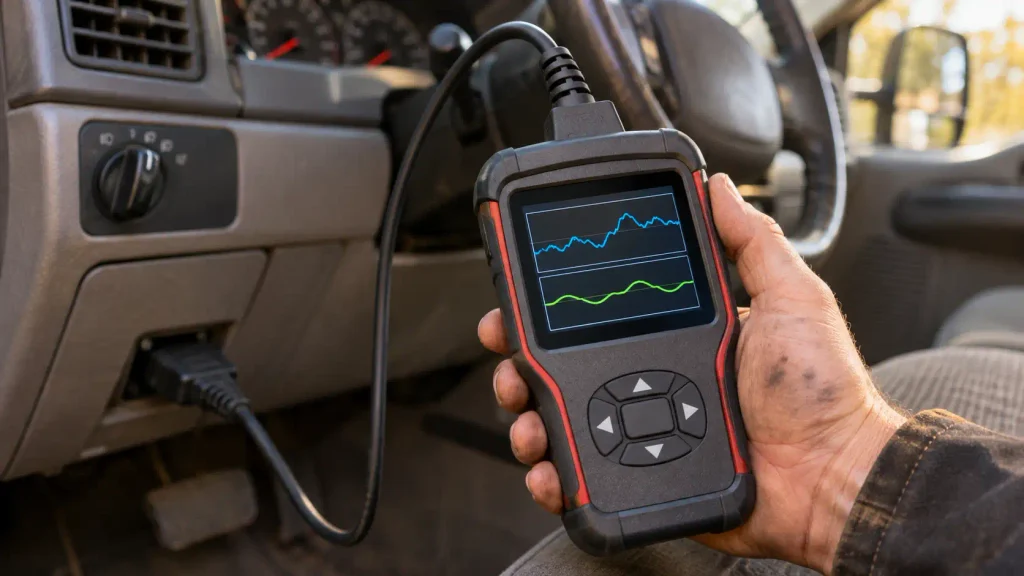
If a scan tool shows FICM voltage dropping below 48 volts during cranking, then repair or replace the FICM before touching the injectors. Replace weak batteries first, because low system voltage kills a new FICM too. Remanufactured FICMs list for $249 to $334.12 at IDParts and Industrial Injection, and the correct part depends on the build date.
The FICM (Fuel Injection Control Module) steps battery voltage up to 48 volts to fire the injectors. Heat, vibration, and weak batteries wear out its power supply, and low output shows up first on cold mornings as long cranking, misfires, and rough idle. The common codes are P0611 (FICM performance), P1378 (FICM supply voltage low), and U0105 (lost communication with the FICM).
Sticking HEUI Injectors
The 6.0L uses HEUI (Hydraulically actuated, Electronically controlled Unit Injector) injectors with spool valves that move on engine oil pressure. Old oil, soot, extended change intervals, the wrong viscosity, and long idling leave deposits that make those spool valves stick, a condition called stiction. Ford defines a cold engine as oil temperature below 70°F, and that is where stiction shows up. Alliant Power’s 6.0L stiction bulletin lists hard starts or no-starts, rough running, white smoke, and multiple-cylinder misses as typical symptoms. Symptoms that appear on a cold engine and clear as it warms point to stiction almost every time.
If the roughness disappears once the engine is warm, then don’t replace injectors first. Alliant recommends clean oil of the correct viscosity, Ford’s minimum change intervals of 7,500 miles for normal duty and 5,000 miles for severe duty, and the FICM calibration in Ford TSB 08-26-3, which adds inductive heating of the injector coils.
When the engine runs smoothly but feels flat under load, check the turbo and fuel system next.
If Your 6.0L Boosts Slowly or Lacks Power
A P0299 code on a 6.0L does not always mean a bad turbo. The engine uses a VGT (Variable Geometry Turbocharger) whose vanes change angle to control boost, and soot plus heat can make those vanes stick. Work through the cheaper checks first:
- ICP sensor: A failing ICP sensor can cause surging and set a false P0299, so check ICP readings before condemning the turbo.
- Fuel pressure: Fuel pressure must stay at 45 psi or higher at all times, including wide-open throttle. A key-on, engine-off reading of 45 to 55 psi is normal, and Ford’s updated “blue spring” regulator kit raises pressure by roughly 10 percent.
- EGR valve: Soot builds up in the EGR valve and passage, which cuts airflow and power.
- VGT vanes: Sticking vanes cause lazy spool, overboost, or underboost.
According to Banks Power, a standard turbo rebuild starts at around $350. Your truck’s model year changes which of these failures is most likely.
Which 6.0 Powerstroke Years to Avoid From 2003 to 2007
No 6.0L model year is problem-free, but the parts list changed almost every year as Ford and International chased failures. Diesel Hub’s model year change log tracks those running updates.
| Model Year | Key Engine Changes | Common Weak Points | Engine Recalls |
|---|---|---|---|
| 2003 | Revised injector clevis mid-year, rerouted wiring harnesses late in the year | Early FICM, original HPOP, round EGR cooler | Emissions recall 05E16 recalibrated engine modules on trucks built through September 28, 2003 |
| 2004 (built after September 29, 2003) | Wavy oil rails, V-type HPOP, ICP sensor moved, square EGR cooler, new FICM bracket | HPOP, FICM, coolers, head bolts | NHTSA 05V-270 stall recall |
| 2005 | Torque rises from 560 to 570 lb-ft, new HPOP with STC fitting, IPR moved to top of pump, EGR throttle removed | STC fitting, dummy plugs, coolers, head bolts | NHTSA 05V-270 stall recall |
| 2006 | No major engine changes listed | Allen-head dummy plugs, coolers, head bolts | Check your VIN |
| 2007 | Upgraded turbo oil drain tube and drain passage | Allen-head dummy plugs, coolers, head bolts | Check your VIN |
NHTSA campaign 05V-270 (Ford recall 05S34) covered 180,104 vehicles from the 2004 and 2005 model years, including F-250 to F-550 Super Duty trucks, E-350 and E-450 vans, and the Excursion. Their engines could stall without warning, and dealers upgraded the FICM wiring harness or installed a new ICP sensor connector. Run your VIN through the NHTSA recall lookup to see whether any campaign is still open on your truck.
Most owner and vendor guides single out 2003 and early 2004 trucks as the riskiest, and 2006 to 2007 trucks are the usual pick for buyers. Every year still shares the oil cooler, EGR cooler, head bolt, and FICM weaknesses. We recommend choosing the truck with the repair paperwork first and the later model year second.
Ford also settled the consolidated class action over these engines, which reimbursed between $50 and $825 for certain post-warranty repairs or deductibles. Eligible owners had until December 31, 2013 to file claims, so that program no longer pays out.
What Common 6.0 Powerstroke Repairs Really Cost
The labor, not the parts, makes 6.0L repairs expensive. The figures below are vendor estimates and owner-reported shop quotes from Ford-Trucks.com and PowerStroke Army threads. Several are years old, so adjust them for current labor rates in your area.
| Repair | Reported Cost | Reported By |
|---|---|---|
| Oil cooler replacement, parts and labor | $3,000 to $7,000, about 8 hours of labor | Bulletproof Diesel |
| Motorcraft replacement oil cooler, part only | $439.83 | Bulletproof Diesel |
| Head stud job at an independent shop | About $3,500 | PowerStroke Army member |
| Head gaskets with ARP studs, shop labor | About $5,000 | Ford-Trucks.com owner estimate, 2006 truck |
| Head gaskets with ARP studs, DIY parts | About $1,000, including a $425 ARP kit | Ford-Trucks.com owner, 2006 truck |
| Dummy plugs, dealer | $488 | Ford-Trucks.com owner, 2005 F-250 |
| STC fitting, dealer | $1,164 | Ford-Trucks.com owner, 2005 F-250 |
| Remanufactured FICM, part only | $249 to $334.12 | IDParts, Industrial Injection |
| Turbo rebuild | From about $350 | Banks Power |
The intake manifold, turbo, and oil filter housing all come off for an oil cooler job, so pairing the oil cooler, EGR cooler, and head studs in one teardown avoids paying for the same labor twice.
When to Repair, Bulletproof, or Walk Away From a 6.0
If you only read one section, read this table.
| Your Situation | What We Recommend |
|---|---|
| Stock 6.0L, no symptoms, tows regularly | Run the 15°F EOT and ECT test now, and replace the oil cooler and EGR cooler before they fail |
| Coolant loss or coolant pushed from the degas bottle | Head studs, oil cooler, and EGR cooler in one job |
| Hot no-start on a 2005 to 2007 engine | Air test, then update the STC fitting, dummy plugs, and standpipes |
| Cold rough running that clears when warm | Batteries, FICM voltage, then oil service and the TSB 08-26-3 calibration |
| Used truck with no repair records | Walk away, or take the cost of a stud job off the price |
| Used truck with receipts for studs, coolers, and FICM | A reasonable buy at fair money |
Buyers should watch for white smoke on a cold start, long cranking, coolant residue around the degas bottle, and “bulletproofed” claims without receipts. If you would rather tow with a newer Super Duty, compare current ratings in our Ford towing capacity chart.
Is a 6.0 Powerstroke Still Worth Owning in 2026
The 6.0 Powerstroke earned its reputation, but most of its problems now have known, permanent fixes. Head studs end the head gasket failures, healthy coolers protect the EGR system, and a strong FICM plus clean oil cures most cold-start trouble. A repaired truck with receipts can keep towing for years, while a stock truck with no history is a gamble dressed up as a bargain. Your next step costs nothing. Plug in a scan tool, compare EOT and ECT at highway speed, check FICM voltage while cranking, and run the VIN for open recalls. Those three checks tell you which of the 6.0 Powerstroke problems you are dealing with before a shop ever writes a quote.
Frequently Asked Questions About 6.0 Powerstroke Problems
What Year 6.0 Powerstroke Should You Avoid?


Most owner and vendor guides rank 2003 and early 2004 trucks built before late September 2003 as the riskiest. Every year from 2003 to 2007 still shares the oil cooler, EGR cooler, and head bolt weaknesses, so repair records matter more than the year.
Which Year Is the Best 6.0 Powerstroke?
The 2006 and 2007 trucks are the usual picks because they carry the latest running updates, including the upgraded turbo oil drain tube on 2007 engines. A later truck still needs head studs and healthy coolers to be dependable.
What Does It Mean to Bulletproof a 6.0 Powerstroke?
Bulletproofing means replacing the known weak parts: TTY head bolts with ARP head studs, the oil cooler and EGR cooler with new or upgraded units, and a weak FICM. Many owners also add coolant filtration and the blue spring fuel pressure update.
How Many Miles Can a 6.0 Powerstroke Last?
Owners and vendors commonly report 200,000 miles or more on well-maintained 6.0L engines, and some trucks pass 300,000 miles. Those are owner-reported figures, not Ford ratings, and they usually involve fixed coolers and head studs.
What Does Code P2290 Mean on a 6.0?
P2290 means injection control pressure dropped too low during the drive cycle. On a 6.0L it usually points to a high-pressure oil leak at the STC fitting, dummy plugs, or standpipes, or to a weak HPOP or a faulty IPR (Injection Pressure Regulator) valve.
How Much Oil Does a 6.0 Powerstroke Take?
The 6.0L takes 15 quarts of SAE 15W-40 with a filter change, according to Ford owner’s manual figures compiled by CarWhere and Diesel Hub. About one quart of that fills the oil filter.