6.0 Powerstroke Specs Chart: 2026 HP, Torque, Oil & Bore/Stroke

The 6.0 Powerstroke specs start with 325 hp and up to 570 lb-ft from a 365 cubic inch V8 built by Navistar. Every Super Duty pickup made 325 hp at 3,300 rpm. Torque rose from 560 lb-ft in 2003 and 2004 to 570 lb-ft for 2005 through 2007.
Ford phased the 6.0L Power Stroke in during the 2003 model year, so some 2003 trucks carry the older 7.3L instead. Early and late engines also differ in hardware and bolt torque values.



Below you will find the full spec sheet, ratings by application, year changes, firing order, fluid capacities, torque specs and towing ratings.
Engine Spec Card
6.0L Power Stroke Specs at a Glance
2003 to 2007 Ford F-250 to F-550 Super Duty · Navistar VT365 V8 Turbo Diesel
Early vs Late Engines
2003 to 2004
- 560 lb-ft @ 2,000 rpm
- Swash plate HPOP
- Round EGR cooler through Sept 22, 2003
- No biodiesel approval
2005 to 2007
- 570 lb-ft @ 2,000 rpm
- V-4 piston HPOP
- B5 biodiesel approved
- Commonized heads and injector hold-downs from Jan 2006
Firing Order
- 1
- 2
- 7
- 3
- 4
- 5
- 6
- 8
Odd cylinders on the passenger bank, even cylinders on the driver bank. Cylinder 1 is front passenger side.
Core Engine Specs
- Bore x stroke
- 3.74 x 4.134 in
- Valvetrain
- OHV, 32 valves
- Injection
- HEUI, 26,000 psi
- Turbo
- Garrett GT3782VA VGT
- FICM voltage
- 48 V, 45 V min
- Head bolts
- M14 TTY, 4 per cyl
- Oil capacity
- 15 qt with filter
- Coolant
- 27.5 qt
- Engine weight
- About 966 lb wet
- Transmissions
- 5R110W, ZF S6-750
Complete 6.0 Powerstroke Engine Specs for 2003 to 2007


This table covers the core 6.0L Power Stroke specs for every 2003 to 2007 Super Duty application.
| Spec | 6.0L Power Stroke |
|---|---|
| Engine family | Navistar International VT365 |
| Configuration | 90 degree V8, 4-stroke diesel |
| Displacement | 6.0L, 365 cu in advertised |
| Bore x stroke | 3.74 in x 4.134 in (95 x 105 mm) |
| Compression ratio | 18.0:1 |
| Block and heads | Cast iron block, cast iron heads |
| Valvetrain | OHV, gear-driven cam, 4 valves per cylinder (32 valves) |
| Head fasteners | M14 torque-to-yield bolts, 4 per cylinder |
| Fuel system | HEUI direct injection, up to 26,000 psi |
| Turbocharger | Garrett GT3782VA variable geometry |
| Aspiration | Turbocharged, air-to-air intercooled |
| Emissions | Cooled EGR and diesel oxidation catalyst |
| Firing order | 1-2-7-3-4-5-6-8 |
| Engine weight | About 966 lb with oil |
| Idle speed | About 670 rpm |
| Max governed speed | About 4,200 rpm |
| Oil filter | Motorcraft FL-2016 |
Two terms need a quick definition. EGR (Exhaust Gas Recirculation) routes cooled exhaust back into the intake to cut NOx. HEUI (Hydraulically actuated Electronically controlled Unit Injector) uses high-pressure engine oil to fire each injector.
Ford advertises 365 cubic inches, but the calculated displacement works out to about 363 cubic inches. The 6.0L also brought variable geometry turbocharging, an EGR system and second-generation fuel injection to the Power Stroke line.
Peak output did not stay the same across every year and application.
How Much Horsepower and Torque Does the 6.0 Powerstroke Make


Every Super Duty 6.0 Powerstroke made 325 hp, but torque moved from 560 to 570 lb-ft for 2005. Ford tuned the same engine differently for vans and medium-duty trucks.


| Application | Model Years | Horsepower | Torque |
|---|---|---|---|
| F-250 to F-550 Super Duty | 2003 to 2004 | 325 hp @ 3,300 rpm | 560 lb-ft @ 2,000 rpm |
| F-250 to F-550 Super Duty | 2005 to 2007 | 325 hp @ 3,300 rpm | 570 lb-ft @ 2,000 rpm |
| Excursion | 2003 to 2005 | 325 hp @ 3,300 rpm | 560 lb-ft @ 2,000 rpm |
| E-350 and E-450 vans | 2004 to 2010 | 235 hp @ 3,150 rpm | 440 lb-ft @ 1,600 rpm |
| F-650 and F-750 | 2003 to 2008 | 200 to 230 hp | 520 to 620 lb-ft |
Super Duty Pickup Ratings

Super Duty pickups never changed horsepower. The 10 lb-ft bump for 2005 came with a calibration update and the hardware changes covered in the next section.
Excursion and E-Series Van Ratings
The Excursion kept the early 560 lb-ft rating through its final 2005 model year. E-Series vans ran a much lower 235 hp tune with peak torque arriving earlier, at 1,600 rpm.
F-650 and F-750 Medium Duty Ratings
Medium-duty trucks offered four calibrations. They traded peak horsepower for more low-speed torque, with the top rating reaching 620 lb-ft.


The 2005 torque increase was only one of several running changes during production.
What Changed on the 6.0 Powerstroke From 2003 to 2007



Ford changed the 6.0 Powerstroke several times during production, and parts are not always interchangeable between early and late engines. Check your build date before ordering EGR, oil system or valvetrain parts.
Early 2003 and 2004 Engines


The 7.3L and 6.0L were both available in the 2003 model year while Ford used up its 7.3L stock. If you own a 2003, compare against our 2003 7.3 Powerstroke specs before buying parts.
Engines built through September 22, 2003 used a round EGR cooler. Ford switched to a square EGR cooler after that date. Early engines also used a swash plate high pressure oil pump (HPOP).
2005 Running Changes
For 2005 the HPOP changed to a V-4 piston design. Torque rose to 570 lb-ft, and the engine gained B5 biodiesel compatibility. Ford does not approve biodiesel blends for 2003 and 2004 engines.


The 2005 Super Duty also moved to a coil-spring front suspension while keeping the Dana 60 front axle.
2006 and 2007 Late Production
Starting January 2006, Ford “commonized” the cylinder head, rocker carrier and injector hold-down hardware, and the torque values changed with it. 2006 and 2007 engines also received an updated turbo oil drain tube.Build Period Key Change Why It Matters 2003 model year 7.3L and 6.0L built side by side Check the VIN before buying parts Through Sept 22, 2003 Round EGR cooler EGR cooler part numbers differ From Sept 23, 2003 Square EGR cooler Later cooler fits later engines only 2005 model year V-4 piston HPOP, 570 lb-ft, B5 approved HPOP and fuel guidance change January 2006 onward Commonized heads and injector hold-downs Different torque specs apply 2006 to 2007 Updated turbo oil drain tube Fewer drain tube oil leaks
Some specs never changed, starting with the firing order.
What Is the 6.0 Powerstroke Firing Order


The 6.0 Powerstroke firing order is 1-2-7-3-4-5-6-8. It matches the 7.3L Power Stroke but differs from every Power Stroke built after 2007.
Odd-numbered cylinders sit on the passenger bank and even-numbered cylinders sit on the driver bank. Cylinder 1 is the front cylinder on the passenger side.
| Position | Passenger Bank | Driver Bank |
|---|---|---|
| Front | 1 | 2 |
| Second | 3 | 4 |
| Third | 5 | 6 |
| Rear | 7 | 8 |
Some websites list 1-5-4-2-6-3 for this engine. That is a six-cylinder sequence and does not apply to the 6.0L V8. Use the correct order when you match a misfire code or cylinder contribution test to a specific injector.
Each cylinder fires through an oil-actuated injector, which makes the injection system the next spec set to understand.
How the 6.0 Powerstroke Injection System and Turbo Work
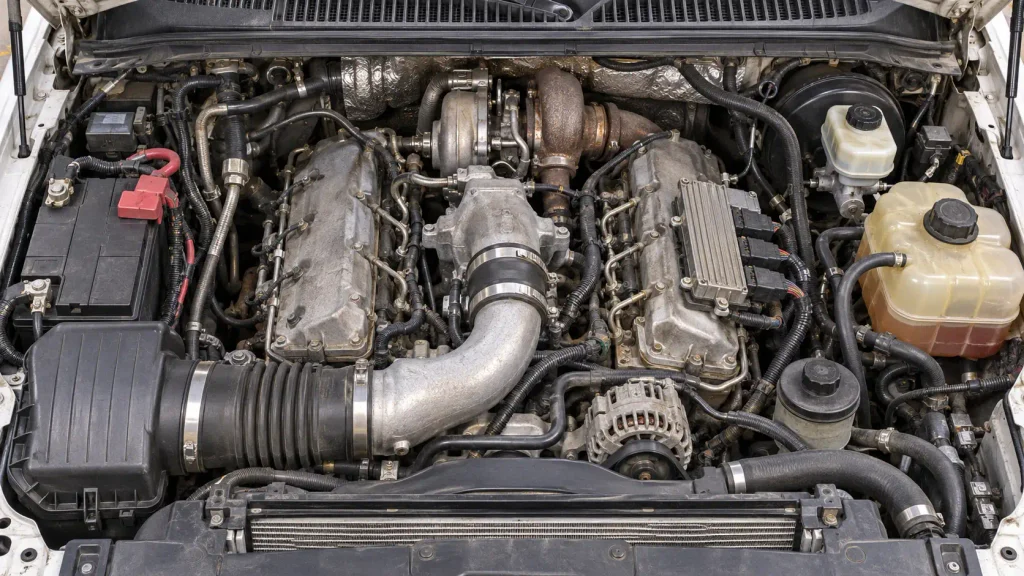
The 6.0 Powerstroke uses engine oil, not fuel pressure, to fire its injectors. The HPOP pressurizes oil and the Injection Pressure Regulator (IPR) controls how much reaches the injectors.
| Injection and Turbo Spec | Value |
|---|---|
| Injection control pressure (ICP) | About 500 to 3,600 psi |
| Injector intensifier ratio | About 7.1:1 |
| Peak injection pressure | Up to 26,000 psi |
| FICM injector voltage | 48 volts, 45 volts minimum |
| Fuel filtration | 10 micron primary, 4 micron secondary |
| Turbocharger | Garrett GT3782VA VGT |
The FICM (Fuel Injection Control Module) steps battery voltage up to 48 volts to fire each injector. Ford’s minimum is 45 volts with the key on, while cranking and while running. Readings below 45 volts point to a failing FICM.
The engine needs more than 500 psi of ICP before it will start. Technicians also expect about 50 psi of low-side fuel pressure at idle. Injectors can fail quickly if fuel pressure falls to 40 psi or less.
The VGT uses oil-actuated vanes to change exhaust flow, and it relies on the exhaust backpressure (EBP) sensor for control. Our exhaust pressure sensor location guide shows where to find it on Power Stroke engines.
Because oil runs the injectors, oil capacity and quality matter more on this engine than on most diesels.
How Much Oil and Coolant Does the 6.0 Powerstroke Hold
The 6.0 Powerstroke holds 15 quarts of oil with a filter change. The real fill runs slightly higher because the HPOP reservoir and injector oil rails do not drain.
| Fluid | Capacity | Spec |
|---|---|---|
| Engine oil with filter | 15.0 qt | API CI-4 or CH-4, Motorcraft FL-2016 filter |
| Engine coolant | 27.5 qt (6.875 gal) | Motorcraft Premium Gold, 50/50 mix |
| TorqShift automatic, total | 17.5 qt | Motorcraft MERCON SP |
| ZF 6-speed manual | 5.8 qt | Motorcraft MERCON ATF |
| Transfer case | 2.0 qt | Motorcraft MERCON ATF |
| Front differential | 3.0 qt | SAE 80W-90 |
The 27.5 quart coolant figure includes the heater circuit and about 5 quarts in the recovery tank. Some aftermarket charts list about 28 quarts for an initial fill. Ford’s own owner guide sends diesel owners to the separate 6.0L Owner’s Guide Supplement for this number.
Ford lists SAE 15W-40 as the preferred oil in warm weather and 10W-30 for colder starts. 5W-30 and 0W-30 are acceptable in severe cold.
Service the oil every 7,500 miles under normal use or 5,000 miles under severe use. Severe use includes towing, long idling and biodiesel blends. Overdue oil changes are a common cause of injector stiction on HEUI injectors.
Capacities get you through a service. A bigger job needs the bolt torque specs.
Key 6.0 Powerstroke Torque Specs for Common Repairs
Head bolt torque on the 6.0 Powerstroke is a multi-step torque-to-yield procedure, not a single number. Confirm every value against the Ford Workshop Manual for your build date, since the January 2006 hardware change altered several specs.Component Torque Spec Notes Head bolts, large M14 65 lb-ft, then 85 lb-ft, then 90 degrees three times Follow the sequence. Never reuse TTY bolts Head bolts, small M8 18 lb-ft, then 23 lb-ft Two-step Injector hold-down bolt 24 lb-ft early, 25.8 lb-ft commonized Split at January 2006 Rocker arm fulcrum bolts 23 lb-ft Check against your build date Oil cooler bolts M8 16 lb-ft, M6 89 lb-in Mixed units Oil filter housing bolts 11 lb-ft Oil filter cap 18 lb-ft EGR cooler bolts and studs 10 lb-ft Same as EGR valve bolts HPOP mounting bolts 18 lb-ft A later TSB lists 26 lb-ft Glow plugs 14 lb-ft Exhaust manifold bolts 28 lb-ft Connecting rod bolts 33 lb-ft, then 50 lb-ft Two-step Main bearing bolts 110, then 130, then 170 lb-ft Three-step Flywheel bolts 69 lb-ft
The torque list mixes lb-ft and lb-in, so check the unit before you pull the wrench. Factory torque specs assume factory-style hardware. Aftermarket head studs use the stud maker’s own torque value.
Those head fasteners also play a big part in how the 6.0 holds up under heavy towing.
6.0 Powerstroke Towing Capacity and Transmissions by Year
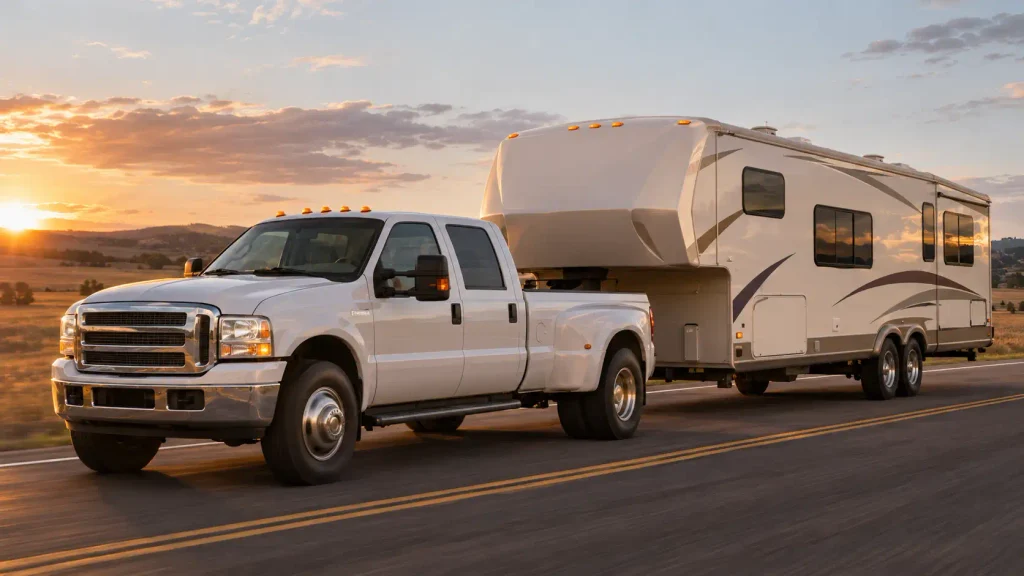
Properly equipped, a 6.0 Powerstroke F-350 dually could tow 15,000 pounds on a conventional hitch from 2005 onward. Earlier trucks were capped by a lower GCWR (Gross Combined Weight Rating, the maximum weight of the loaded truck and trailer together).
TorqShift and ZF Gear Ratios
Ford paired the 6.0L with the 5R110W TorqShift 5-speed automatic or the ZF S6-750 6-speed manual. The TorqShift has six ratios but normally shifts 1-2-3-5-6. It uses fourth gear only when the fluid is very cold.
| 5R110W Gear | Ratio |
|---|---|
| 1st | 3.11 |
| 2nd | 2.20 |
| 3rd | 1.54 |
| 4th, cold only | 1.09 |
| 5th | 1.00 |
| 6th | 0.71 |
| Reverse | 2.88 |
Conventional and Fifth Wheel Ratings


The table shows the best published 6.0L pickup ratings for each year. Your exact limit depends on cab, bed, axle ratio and 4×2 or 4×4. The 2004 Ford RV and Trailer Towing Guide lists every configuration.
| Model Year | Conventional, SRW | Conventional, best DRW | Fifth Wheel, best config | Max GCWR |
|---|---|---|---|---|
| 2003 | 12,500 lb | 13,400 lb | 13,700 lb | 20,000 lb |
| 2004 | 12,500 lb | 13,400 lb | 13,700 lb | 20,000 lb |
| 2005 | 12,500 lb | 15,000 lb | 17,000 lb | 23,000 lb |
| 2006 | 12,500 lb | 15,000 lb | 17,000 lb | 26,000 lb, TowBoss |
| 2007 | 12,500 lb | 15,000 lb | Up to 19,200 lb, F-350 | 26,000 lb, 4.30 axle |
The 2005 jump came from a stronger frame and a new 2.5 inch hitch receiver that replaced the old 2 inch receiver. Ford did not offer a factory fifth-wheel hitch, so 6.0L fifth-wheel setups over 10,000 lb need an aftermarket hitch.
Before you hitch up, compare these numbers with the newer trucks in our Ford towing capacity chart.
GCWR by Axle Ratio
The 2003 and 2004 6.0L pickups came with a 3.73 axle and a 20,000 lb GCWR. For 2007 Ford rated the 6.0L at 23,500 lb GCWR with either the 3.73 or 4.10 axle, and 26,000 lb with the 4.30 axle. The 26,000 lb rating came with the TowBoss package, which required an F-350 dually with the 6.0L and TorqShift automatic.
Those ratings applied across several Ford models, not just pickups.
Which Ford Trucks and Vans Came With the 6.0 Powerstroke
The 6.0 Powerstroke powered four Ford product lines between 2003 and 2010.
| Vehicle | Model Years |
|---|---|
| F-250, F-350, F-450, F-550 Super Duty | 2003 to 2007 |
| Excursion | 2003 to 2005 |
| E-350 and E-450 vans | 2004 to 2010 |
| F-650 and F-750 medium duty | 2003 to 2008 |
To confirm the engine in a 2003 truck, check the eighth character of the VIN. A P means the 6.0L Power Stroke and an F means the 7.3L.
To see where these numbers sit in the Power Stroke family, compare them with the engines before and after.
6.0 Powerstroke Specs vs the 7.3 and 6.4 Powerstroke
On paper the 6.0 out-powered the 7.3 by a wide margin. It added 50 hp over the final 7.3L rating while using 79 fewer cubic inches.
| Spec | 7.3L (1994 to 2003) | 6.0L (2003 to 2007) | 6.4L (2008 to 2010) |
|---|---|---|---|
| Displacement | 444 cu in | 365 cu in | 390 cu in |
| Bore x stroke | 4.11 x 4.18 in | 3.74 x 4.134 in | 3.87 x 4.13 in |
| Compression | 17.5:1 | 18.0:1 | 17.5:1 |
| Valves per cylinder | 2 | 4 | 4 |
| Injection | HEUI | HEUI, split-shot | High pressure common rail |
| Turbo | Fixed geometry | Single VGT | Twin sequential |
| Peak output | 275 hp, 525 lb-ft | 325 hp, 570 lb-ft | 350 hp, 650 lb-ft |
| Head bolt size | 18 per bank | 14 mm, 10 per head | 16 mm |
Ford upsized the head bolts from 14 mm to 16 mm on the 6.4L. For the full 7.3L numbers from its peak years, see our 2001 7.3L Powerstroke specs.
Specs only tell part of the story, because a few of these numbers explain the 6.0’s reliability record.
5 Specs That Explain Common 6.0 Powerstroke Problems
Most 6.0 Powerstroke failures trace back to five design specs, not to bad luck. Every model year shares these core issues, although some running changes helped.
Four TTY Head Bolts per Cylinder
The 6.0L uses only four 14 mm torque-to-yield head bolts per cylinder. Under high cylinder pressure the bolts can stretch, and the head gaskets leak. Head studs replace the factory bolts and solve the clamping problem.
Oil Cooler Inside the Engine Valley
The oil cooler has small coolant passages that clog over time. A clogged oil cooler starves the EGR cooler of coolant flow, and the EGR cooler then overheats and cracks.
48 Volt FICM Supply


The FICM mounts on the driver side valve cover, where heat and vibration wear its power supply. Low FICM voltage causes hard starts, rough idle and misfires.
Oil-Actuated HEUI Injectors
The injectors depend on clean oil to move their internal spool valves. Old or poor-quality oil makes them stick, which owners call stiction.
Early Turbo Oil Drain Tube
Soot can stick the VGT vanes. The 2003 to 2005 engines also used a turbo oil drain tube that Ford updated for 2006 and 2007.
“Bulletproofing” means fixing these weak points at once, usually with head studs, a new oil cooler and an upgraded EGR cooler. Ford-Trucks.com owners have reported shop quotes of about $5,500 for that three-part job. Head studs with head and block resurfacing alone run about $3,500 to $4,000 at independent shops. Current quotes vary by region and parts choice.
Two NHTSA recalls also cover the 6.0L. Recall 04V-327 replaced a loose engine ground stud on early 2003 trucks. Recall 05V-270 addressed stalling on 180,104 vehicles. Run your VIN through the NHTSA recall lookup to check for open campaigns.
With those weak points in view, the core numbers are easy to keep straight.
Key 6.0 Powerstroke Numbers Worth Remembering
The 6.0 Powerstroke specs come down to a short list. Every Super Duty made 325 hp, with 560 lb-ft through 2004 and 570 lb-ft from 2005. The firing order is 1-2-7-3-4-5-6-8, and the engine takes 15 quarts of oil with a filter.
Build date matters more on this engine than on most diesels. EGR coolers, HPOP design and head bolt torque all changed during production.
Before you order parts or hook up a heavy trailer, check the VIN’s eighth digit and the build date on the door sticker. Those two details tell you which specs apply to your truck.
Common Questions About 6.0 Powerstroke Specs
How much horsepower does a 6.0 Powerstroke have?
Every 2003 to 2007 Super Duty 6.0 Powerstroke makes 325 hp at 3,300 rpm. Torque is 560 lb-ft for 2003 and 2004 and 570 lb-ft for 2005 to 2007. E-Series vans used a lower 235 hp rating.
What year 6.0 Powerstroke should you stay away from?
The 2003 to 2005 trucks had the most high-profile problems, from injectors to oil coolers and head gaskets. The 2006 and 2007 engines received running changes, but no year is free of the head bolt and cooler issues. Maintenance history matters more than model year.
What does it mean when a 6.0 Powerstroke is bulletproofed?
A bulletproofed 6.0 has head studs in place of the factory TTY bolts, plus an upgraded oil cooler and EGR cooler. Many owners also add an updated FICM. Ask for receipts, since the term is used loosely in used truck listings.
What is the firing order of a 6.0 Powerstroke?
The 6.0 Powerstroke firing order is 1-2-7-3-4-5-6-8. Odd cylinders sit on the passenger bank and even cylinders on the driver bank, with cylinder 1 at the front passenger side.
How much oil does a 6.0 Powerstroke take with a filter?
The 6.0 Powerstroke takes 15 quarts of oil with a filter change. Use oil that meets API CI-4 or CH-4, with 15W-40 preferred in warm weather. Change it every 5,000 miles if you tow or idle often.
Is the 6.0 Powerstroke stronger than the 7.3?
Yes, on paper. The 6.0 makes 325 hp and up to 570 lb-ft, while the final 7.3 made 275 hp and 525 lb-ft. The 7.3 has a better reliability record, but a properly bulletproofed 6.0 tows harder.