Dodge Ram 1500 Starter Location: The Definitive Guide (by Engine)

A ‘crank no-start’ is one of the most common and frustrating issues a truck owner can face. When you turn the key in your Dodge Ram 1500, you expect to hear the engine roar to life, not a single ‘click’ or, even worse, silence.
The problem is often the starter motor, but the first question is always: “Where is the starter located?”
The answer is not a simple one. The starter’s location on a Ram 1500 depends critically on which engine your truck has. A 5.7L HEMI, a 3.6L V6, and a 3.0L EcoDiesel all have different starter locations.
This definitive guide will show you the exact location of the starter on your specific Ram 1500 model, help you diagnose if the starter is the actual problem, and provide a data-driven analysis of replacement costs.
The Ram 1500 Starter
A Visual Guide to Location, Symptoms & Replacement
Is Your Starter Failing?
Before you try to find the starter, it’s critical to know the signs of failure. A bad starter often mimics other issues, like a dead battery. Look for these common symptoms when you turn the key.
Single “Click”
A loud click from the engine bay, but no crank.
No Sound
You turn the key and get nothing; no click, no crank.
Grinding Noise
A harsh grinding sound during or after starting.
Intermittent Start
Works one day but fails to start the next.
First: The Diagnostic Flow
Don’t replace the starter until you’re sure! A weak battery is the most common cause of a “no-start” condition. Follow this simple process to rule out the battery first.
Turn Key to “ON”
Do your headlights and dashboard lights come on brightly?
YES (Bright Lights)
Try to start. If you hear a “click” or grinding, it’s likely the starter or solenoid.
NO (Dim or No Lights)
Your battery is dead or weak. Check connections or charge/replace the battery.
Starter Location by Engine
The most critical factor for finding your Ram 1500’s starter is the engine. The location, and the difficulty of replacing it, varies significantly between the V8 and V6 models.
5.7L HEMI V8 (and older 5.2L/5.9L V8s)
This is the more traditional and accessible location. The starter is mounted on the lower part of the engine block, right where the engine meets the transmission.
Location: Typically on the driver’s side, near the transmission bell housing. You will need to access it from underneath the truck.
3.6L Pentastar V6
This is a notoriously difficult location. The starter is not accessible from below. It is located in the “V” of the engine, underneath the entire upper and lower intake manifold assembly.
Location: In the center valley of the engine, completely hidden by the intake manifold. This requires removing the manifold to access.
DIY Difficulty Rating
Based on the location, the difficultly of replacing the starter yourself changes dramatically. Here is a rating from 1 (Easy) to 5 (Very Difficult).
Estimated Replacement Time
The time required for the job reflects the complexity. The V6 requires significant disassembly, drastically increasing labor time for both DIY and professional mechanics.
Estimated Cost Comparison
While the starter part itself costs roughly the same for both engines, the total replacement cost is dominated by labor. The V6’s location can triple or quadruple the labor bill from a professional shop.
Ram 1500 Starter Location: A Quick-Reference Guide
Before you grab your tools, use this table to pinpoint the starter’s location on your truck. The location is determined by the engine, not the trim level (Laramie, Sport, Big Horn, etc.).
Table: Ram 1500 Starter Location by Engine & Generation
This table provides a quick-lookup reference for the starter motor’s location based on the three most common engine types found in the Ram 1500 from the 3rd, 4th, and 5th generations.
| Engine | Generation (Years) | Starter Location (Summary) |
| 5.7L HEMI V8 | 3rd Gen (2002-2008) | Driver’s Side. Tucked low on the engine, mounted to the transmission bell housing. |
| 5.7L HEMI V8 | 4th Gen (2009-2018) | Driver’s Side. Under the truck, at the junction of the engine and catalytic converter, bolted to the transmission. |
| 5.7L HEMI V8 | 5th Gen (2019+) | Driver’s Side. Same as the 4th Gen, but often hidden by a small heat shield that must be removed for access.[4, 5, 6] |
| 3.6L Pentastar V6 | 4th & 5th Gen (2011+) | Passenger’s Side. Located under the exhaust manifold, accessible from underneath the truck. |
| 3.0L V6 EcoDiesel | 4th Gen (2014-2019) | Driver’s Side. Mounted low on the engine, where the engine block and transmission flange meet.[8, 9] |
Is It Your Starter? 5 Symptoms of a Bad Ram 1500 Starter
Before you crawl under your truck, it’s crucial to confirm the starter is the likely culprit. A bad starter can often be confused with a weak or dead battery.
The “Click”: A Tale of Two Sounds
The “clicking” sound is the single most important diagnostic clue, but you must listen carefully.
- Symptom 1: A Rapid “Click-Click-Click-Click”If you turn the key and hear a rapid, machine-gun-like clicking, the problem is almost certainly not your starter. This sound is the starter solenoid engaging, but there isn’t enough voltage in the battery to power the starter motor, so the solenoid immediately disengages and tries again, over and over.10 This indicates a weak or dead battery, or a bad battery connection.
- Symptom 2: A Single, Loud “Click”If you turn the key and hear one solid “CLICK” followed by silence, this is the classic sign of a bad starter. This sound means the battery has enough power to engage the solenoid (the “click”), but the starter motor itself is faulty and has failed to spin the engine.
Other Telltale Signs of Starter Failure
- Symptom 3: Engine Fails to Crank, No SoundYou turn the key, your dash lights come on, but you hear nothing—no click, no crank. If you’ve confirmed your battery is fully charged, this points to a failed starter solenoid or a problem in the electrical circuit (like a blown fuse or bad relay).
- Symptom 4: Grinding or Whirring NoiseYou may hear a high-pitched whirring or a harsh grinding sound when you attempt to start the engine. This suggests the starter motor is spinning, but its gear (known as the Bendix) is failing to engage the engine’s flywheel, or the teeth on the starter gear or flywheel are worn or broken.
- Symptom 5: Smoke or a Burning SmellIf you see smoke or smell burning plastic coming from the engine area when trying to start the truck, stop immediately. This indicates a severe electrical short. The starter motor may be drawing excessive current, overheating its wiring.
Before replacing your starter, be sure your battery is healthy and rule out other common electrical issues.
Pinpointing Your Starter: A Detailed Location Guide by Engine
Let’s expand on the quick-reference table. The location, tools, and access method are different for each engine.
5.7L HEMI V8 Starter Location (All Generations)
On all Ram 1500s equipped with the 5.7L HEMI V8, the starter is located on the driver’s side of the vehicle, mounted to the transmission bell housing where the engine and transmission meet.
- 3rd Gen (2002-2008): This is a relatively straightforward location. The starter is tucked between the engine block and transmission and is accessible from under the truck.
- 4th Gen (2009-2018): The location is the same, but access can be more constrained. It is found “under the junction point between the engine block and the catalytic converter”. Many DIY-ers recommend removing the driver’s side front wheel and the plastic fender liner (mudguard) to get a clear view and better access to the bolts.
- 5th Gen (2019+): The starter remains on the driver’s side, bolted to the bell housing. The primary difference is the common addition of a heat shield, which is often held on by 10mm bolts. This shield must be removed to access the starter’s mounting bolts and electrical connections.
Diagram 1 (Simple Annotated Illustration)
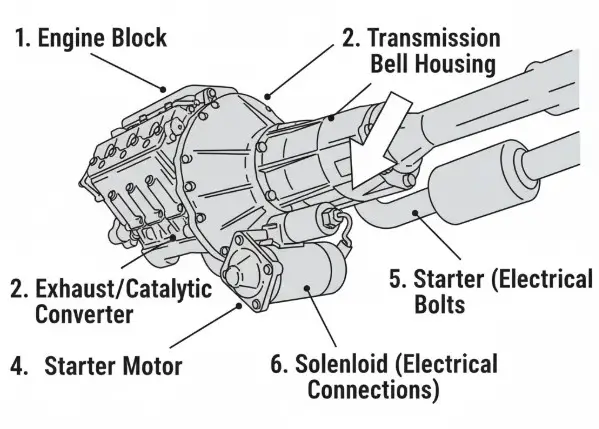
Description: A simple line diagram showing a view from underneath the driver’s side of the truck. An arrow points to the starter motor, showing it bolted to the bell housing and tucked next to the engine block and exhaust. Annotations: ‘Engine Block’, ‘Transmission Bell Housing’, ‘Exhaust/Catalytic Converter’, ‘Starter Motor’, ‘Mounting Bolts’, ‘Solenoid (Electrical Connections)’.
3.6L Pentastar V6 Starter Location (4th & 5th Gen)
This is the most common exception and a critical piece of information. On all 3.6L V6 engines, the starter is not on the driver’s side.
The 3.6L V6 starter is located on the passenger’s side of the engine.
Due to the Pentastar engine’s architecture, the starter is positioned underneath the truck on the passenger’s side, tucked below the exhaust manifold. Access is from underneath. You will need to locate and remove its mounting bolts (typically 15mm sockets) and electrical connections (often 13mm and 10mm sockets).
3.0L V6 EcoDiesel Starter Location (4th Gen)
The 3.0L EcoDiesel V6 reverts to the more traditional V-engine placement, similar to the HEMI.
The starter is located on the driver’s side of the engine.
While many online videos show full engine replacements , they are not helpful for locating this single component. The definitive evidence comes from official Mopar parts diagrams. These diagrams list mounting bolts with the description “Starter To Engine Block” and “Starter to Transmission”. This confirms the starter is in the traditional location, bolted to the flange where the engine and transmission meet. Given the engine’s layout and the placement on other Ram trucks, this location is on the driver’s side.
The eTorque Secret: Your Truck Has Two “Starters”
This is the single biggest point of confusion for 5th Generation (2019+) Ram 1500 owners. Many eTorque-equipped trucks have starting problems, and the answer is more complex.
Your eTorque-equipped truck has two distinct components that “start” the engine.
- The 48V Motor Generator Unit (MGU): This component, also called a Belt Starter Generator (BSG), replaces the traditional alternator. Its primary job is to handle the seamless Auto Stop-Start function (restarting the engine at a stoplight) and provide a mild torque boost.
- The 12V Starter Motor: Your truck still has a traditional 12-volt starter just like the non-eTorque models. This 12V starter is used for one job: the initial cold crank (i.e., when you first get in your truck and turn the key or press the button).
Where Are These Two Components?
- Your 12V Starter (for “Cranking”)This is in the exact same location as its non-eTorque counterpart.
- 5.7L eTorque: On the driver’s side, bolted to the transmission bell housing.
- 3.6L eTorque: On the passenger’s side, under the exhaust manifold.
- Your 48V MGU (for “Restarting”)This is located where the alternator used to be.
- 5.7L HEMI: Mounted on top of the engine.
- 3.6L V6: Mounted on the front of the engine.
The Diagnostic Conclusion: If your eTorque Ram 1500 won’t start in the morning (a “crank no-start”), your problem is almost certainly the traditional 12V starter, not the 48V MGU.
DIY Guide: Replacing Your Ram 1500 Starter (Overview)
Replacing a starter is a moderately difficult job. It requires working under the vehicle in tight spaces. This is not a beginner’s task.
Safety First: This repair is impossible without safely lifting the vehicle. Use a floor jack to lift the truck and secure it firmly on jack stands. Never work under a vehicle supported only by a jack.
Crucial First Step: Always disconnect the negative battery terminal and secure it away from the post before you begin. The main wire to the starter is a direct, high-amperage line from the battery. Touching it with a metal tool while it’s connected will create a dangerous electrical arc and short-circuit.
Before you buy, confirm the exact Mopar part number for your VIN. You can browse genuine Mopar parts at the(https://store.mopar.com/).
Essential Tools for Ram 1500 Starter Replacement
Description: This table synthesizes tool lists from multiple DIY repair guides into a single, comprehensive list for a Ram 1500 starter replacement.
| Tool | Common Sizes | Purpose |
| Floor Jack & Jack Stands | N/A | Safely lifting and securing the vehicle |
| Ratchet & Socket Set | 3/8-inch or 1/2-inch drive | Primary tool for all bolts |
| Socket Extensions | 6-inch and 12-inch | Crucial for reaching recessed mounting bolts |
| Sockets (6-point) | 10mm, 13mm, 15mm, 16mm | 10mm (heat shield), 13mm (electrical), 15mm/16mm (mounting bolts) |
| Wrenches | 13mm, 15mm | For tight spots (like the electrical nuts) where sockets won’t fit |
| Torque Wrench | N/A | Properly tightening new bolts to factory specifications |
| Pry Bar | Small | To help gently remove the old starter if it’s seized in place |
| Safety Glasses & Gloves | N/A | Non-negotiable safety items for working under a vehicle |
Generalized Step-by-Step Replacement Process
- Safety & Setup: Chock the rear wheels. Disconnect the negative battery terminal. Safely lift the front of the truck and secure it on jack stands.
- Access: Based on your model, remove any components blocking access. This may include the driver’s or passenger’s front wheel, the plastic fender liner/mudguard , or a heat shield (common on 5th Gen).
- Locate: Using the guide in Section 3, identify the starter.
- Disconnect Electrical: Using a 13mm wrench or socket, remove the nut for the main power (B+) cable. Using a 10mm or 13mm socket, remove the nut or plug for the smaller solenoid signal wire.
- Remove Mounting Bolts: Using a 15mm or 16mm socket, often with a long extension, remove the two or three main bolts holding the starter to the transmission bell housing. The top bolt is often the most difficult to reach.
- Remove Starter: The starter is heavy and may be held in place by friction. Wiggle it or use a small pry bar to gently break it free.
- Install New Starter: Installation is the reverse of removal. Position the new starter and hand-thread the bolts to avoid cross-threading. Use a torque wrench to tighten all mounting bolts and electrical nuts to the factory specifications (electrical nuts are typically torqued to a low value, around 8 foot-pounds).
Ram 1500 Starter Replacement Cost Analysis
The cost to replace a Ram 1500 starter varies dramatically. Repair estimates can range from under $300 to over $900.
This wide discrepancy is not a mistake. It reflects the three-tiered automotive repair market: DIY, Independent Shops, and Dealerships.
- Dealership: A Reddit user reported a $900 quote from a dealership for a 2013 Ram 1500. This price reflects the high labor rates and the cost of an OEM (Original Equipment Manufacturer) Mopar part.
- Independent Shop: RepairPal estimates the average cost at an independent shop to be between $258 and $375. This is broken down into $187 – $272 for the (likely aftermarket) part and $70 – $103 for labor.
- DIY (Do-It-Yourself): A new aftermarket starter can be purchased for $80 to over $350, depending on the brand and quality. In this case, your only cost is the part and your time.
To price-check parts for a DIY job, retailers like(https://www.rockauto.com/) offer a wide selection of aftermarket and remanufactured starters.
Estimated Ram 1500 Starter Replacement Cost (2024)
This table breaks down the expected total cost of a starter replacement by the service channel, explaining the differences in part and labor costs.
| Service Channel | Estimated Cost (Parts & Labor) | Parts Cost (Approx.) | Labor Cost (Approx.) | Best For |
| DIY (Do-It-Yourself) | $90 – $350 | $90 – $350 | $0 | Experienced DIY-ers with a good set of tools. |
| Independent Repair Shop | $260 – $400 | $187 – $272 | $70 – $103 | Budget-conscious owners seeking professional service. |
| Dealership / Chain | $700 – $900+ | $250 – $450 (OEM) | $450 – $600+ | Warranty work, complex 5th Gen eTorque models, or owners who prefer OEM parts.[27, 30] |
Conclusion & Recommended Next Steps
Finding your Ram 1500’s starter location is the first step in diagnosing and fixing a no-start problem. The key takeaway is that the location changes based on your engine:
- 5.7L HEMI & 3.0L EcoDiesel: Look on the driver’s side.
- 3.6L V6: Look on the passenger’s side.
Before you spend a dime, confirm your battery is healthy by testing it and cleaning the terminals. Listen closely to what kind of “click” your truck is making. And if you own a 5th Gen eTorque model, remember the distinction: a “crank no-start” problem is the 12V starter, not the 48V MGU.
Frequently Asked Questions (FAQ)
Q: Where is the starter on a 2014 Ram 1500 5.7L HEMI?
A: On the driver’s side, underneath the truck. It’s mounted to the transmission bell housing, near the catalytic converter. Access is best achieved by removing the driver’s side front wheel and fender liner.
Q: Why does my Ram 1500 just click when I try to start it?
A: This depends on the click. A rapid, fast clicking is a classic sign of a weak or dead battery. A single, loud click followed by silence usually means your battery is good, but the starter motor has failed.
Q: Where is the starter on a 5th Gen Ram 1500 with eTorque?
A: Your truck has two. The main 12V starter, used to crank the engine, is in the traditional location (driver’s side for the 5.7L HEMI, passenger’s side for the 3.6L V6). The 48V MGU, which replaces the alternator and handles auto-restarts, is on top of the HEMI engine or on the front of the V6 engine.
Q: How much does it cost to replace a Ram 1500 starter?
A: Costs vary widely. Expect to pay $90-$350 for a DIY part 27, $260-$400 at an independent shop 26, and $700-$900+ at a dealership.
Q: Where is the starter on a Ram 1500 3.6L V6?
A: On the passenger’s side of the engine, located underneath the exhaust manifold.