Dodge Ram 2500 Generations Chart (1994-Present)

The Ram 2500 is more than just a heavy-duty truck; it’s a benchmark for power, a titan of towing, and a rolling testament to the evolution of the American pickup. For decades, it has served as a cornerstone of job sites, farms, and highways, consistently pushing the boundaries of what a three-quarter-ton truck can achieve.
This guide serves as the definitive resource for understanding the complete history of the Dodge Ram and Ram 2500, from its game-changing debut to the tech-laden, luxury-appointed models of today.
This deep dive will explore each generation’s unique characteristics, powertrain developments, and capability milestones. It includes detailed charts, engine breakdowns, and expert analysis to help anyone buy, own, or simply appreciate these formidable machines.
Before diving into the specifics, a quick-reference chart provides a high-level overview of the truck’s lineage.
The Evolution of an American Workhorse
Ram 2500 Generations
From a revolutionary redesign in 1994 to today’s tech-packed titan, the Ram 2500 has consistently set benchmarks for power, capability, and innovation in the heavy-duty truck world.
A Legacy of Power: Generation Timeline
2nd Gen
1994-2002
3rd Gen
2003-2009
4th Gen
2010-2018
5th Gen
2019-Present
The Heartbeat: Cummins Torque & Horsepower Growth
The legendary Cummins inline-six diesel engine is the cornerstone of the Ram’s heavy-duty reputation. Its relentless evolution in power output is the primary driver behind the truck’s ever-increasing capability. This chart tracks the peak horsepower and torque of the flagship diesel across generations.
2nd Gen (1994-2002): The Game Changer
This era’s revolutionary “big-rig” styling and the legendary 12-valve 5.9L Cummins engine cemented the Ram’s place in the market. It was a simple, powerful, and durable combination.
3rd Gen (2003-2009): Refined Power
Building on success, this generation introduced the Common Rail 5.9L and later the 6.7L Cummins, alongside the powerful 5.7L HEMI V8, offering more power and a more modern package.
4th Gen (2010-2018): The Ram Brand
Now a standalone brand, Ram focused on luxury and ride comfort with a coil-spring rear suspension, while the 6.7L Cummins’ torque output soared to new heights, solidifying its capability.
5th Gen (2019-Pres): The Tech Leader
The current generation leads the class with a luxurious, tech-forward interior featuring a massive 12-inch screen, while a stronger frame allows for the highest towing capacities ever seen in a Ram 2500.
Capability Climb: Max Towing Capacity
More than just engine power, each generation brought significant frame, suspension, and braking improvements. This chart shows the dramatic increase in maximum conventional towing capacity from the start of the 2nd generation to today.
Ram 2500 Generations at a Glance
| Generation | Model Years | Platform Code | Key Powertrain | Defining Feature |
| First Generation | 1994–2002 | BR/BE | 5.9L 12v/24v Cummins | Revolutionary “big-rig” styling |
| Second Generation | 2003–2009 | DR/DH | 5.7L Hemi V8 / Common-Rail Cummins | Introduction of the Mega Cab |
| Third Generation | 2010–2018 | DS/DJ | 6.4L Hemi V8 / 6.7L Cummins | Ram becomes a standalone brand |
| Fourth Generation | 2019–2024 | DT | 6.4L Hemi w/ 8-speed / 6.7L Cummins | Unprecedented luxury and technology |
| Fourth Gen (Facelift) | 2025–Present | DT | 6.4L Hemi / 6.7L Cummins | Major tech and styling refresh |
The Great Divide: When Did Dodge and Ram Split?
One of the most common points of confusion surrounding the Ram 2500 is its name. For years, it was the Dodge Ram 2500, but today it stands alone as the Ram 2500. The official split occurred in 2009, with the 2010 model year marking the first time Ram was marketed as a standalone truck brand.
This was not merely a marketing decision but a strategic corporate restructuring by Chrysler (then part of Fiat Chrysler Automobiles, now Stellantis). The primary goal was to create distinct brand identities. The Dodge brand was repositioned to focus on its performance car heritage, producing vehicles like the Charger and Challenger, while the Ram brand could dedicate all its resources and innovation to the singular goal of building the best trucks on the market for “serious truck customers”.
This focused approach had tangible results. By separating from Dodge’s car-centric portfolio, the Ram engineering and design teams could concentrate exclusively on truck-specific innovations. This strategic pivot was the catalyst for many of the game-changing features seen in subsequent generations, including class-exclusive suspension systems and record-breaking torque figures.
For owners and buyers, the distinction is simple: trucks manufactured in 2009 or earlier proudly wear the “Dodge RAM” emblem, while those from the 2010 model year onward are simply “Ram” trucks. If you want to learn more about the brand’s lineage.
First Generation (1994–2002): The Game Changer
When the second-generation Dodge Ram platform (codenamed BR/BE) debuted for the 1994 model year, it didn’t just update the existing truck; it revolutionized the entire pickup market. Its groundbreaking “big-rig” styling, with a massive crosshair grille and lowered front fenders, was a radical departure from the boxy, utilitarian designs of its competitors. This bold aesthetic is credited with reinvigorating the brand and capturing a massive new segment of the market, setting a design precedent that would influence truck styling for decades.
Powertrain Deep Dive
The first-generation 2500 offered a robust lineup of gasoline and diesel engines that became legendary in their own right.
Gas Engines: The standard gasoline powerplants were the dependable Magnum V8s. The 5.2L Magnum V8 offered around 220-230 hp and 295-300 lb-ft of torque, while the larger 5.9L Magnum V8 produced 230-245 hp and 330-345 lb-ft of torque.7 For those needing maximum gas-powered capability, Dodge offered the formidable 8.0L Magnum V10, a cast-iron beast that delivered 300-310 hp and a massive 450 lb-ft of torque.
The Legendary 12-Valve Cummins (1994-1998.5): The true star of the powertrain lineup was the 5.9L 6BT Cummins diesel. This engine, particularly the versions equipped with the Bosch P7100 mechanical injection pump (known as the “P-pump”), is revered for its incredible simplicity, bulletproof reliability, and immense tuning potential. Its purely mechanical nature, free from complex electronics, made it a favorite among diesel purists.
Power output varied based on the transmission, with manual-equipped trucks producing 175-215 hp and 420-440 lb-ft of torque, while automatic versions were rated at 160-180 hp and 400-420 lb-ft of torque.
The Shift to the 24-Valve Cummins (1998.5-2002): Midway through the 1998 model year, Dodge transitioned to the updated 24-valve 5.9L ISB Cummins. This engine introduced four valves per cylinder for improved airflow and switched to the electronically controlled Bosch VP44 injection pump.
This change brought more power, with a new “High Output” (H.O.) version available exclusively with a manual transmission that produced 245 hp and a class-leading 505 lb-ft of torque.
Key Features and Capabilities
A major milestone for this generation was the 1998 introduction of the four-door “Quad Cab,” which dramatically improved practicality and passenger space. The interior was also more modern and ergonomic than its predecessor, featuring a driver’s side airbag for the first time.
Towing and payload capabilities were formidable for the era. Depending on the engine and configuration, towing capacity ranged from around 7,400 pounds with the 5.2L V8 to over 14,000 pounds with the V10 and Cummins diesel engines. Payload capacity started around 2,500 pounds and grew to over 3,300 pounds by the end of the generation.
1st Gen Dodge Ram 2500 Engine Specifications (1994-2002)
| Engine | Model Years | Horsepower | Torque | Key Technology |
| 5.2L Magnum V8 | 1994–2001 | 220–230 hp | 295–300 lb-ft | Multi-port Fuel Injection |
| 5.9L Magnum V8 | 1994–2002 | 230–245 hp | 330–345 lb-ft | Multi-port Fuel Injection |
| 8.0L Magnum V10 | 1994–2002 | 300–310 hp | 450 lb-ft | Multi-port Fuel Injection |
| 5.9L 12v Cummins (Manual) | 1994–1998 | 175–215 hp | 420–440 lb-ft | Bosch P7100 Mechanical Pump |
| 5.9L 12v Cummins (Auto) | 1994–1998 | 160–180 hp | 400–420 lb-ft | Bosch P7100 Mechanical Pump |
| 5.9L 24v Cummins (Std/Auto) | 1998.5–2002 | 215–235 hp | 420–460 lb-ft | Bosch VP44 Electronic Pump |
| 5.9L 24v Cummins (H.O.) | 2001–2002 | 245 hp | 505 lb-ft | Bosch VP44 Electronic Pump |
Second Generation (2003–2009): Hemi Power and Common-Rail
The 2003 model year ushered in the third-generation Ram platform (DR/DH), bringing a new era of refinement and power. The truck featured a stronger, stiffer frame built with hydroformed rails, which improved ride and handling while reducing weight.21 It also moved to new, robust axles from American Axle & Manufacturing (AAM). While the exterior was an evolution of the iconic big-rig look, the powertrain lineup saw a revolutionary overhaul.
Powertrain Overhaul
The Hemi Arrives: The most significant change for gasoline buyers was the introduction of the legendary 5.7L Hemi V8. Producing 345 hp and 375 lb-ft of torque at launch, it was a massive technological leap forward, replacing both the aging 5.9L Magnum V8 and the thirsty 8.0L V10 in the 2500 lineup. By 2009, its output had increased to 383 hp and 400 lb-ft of torque, solidifying its place as a modern workhorse.
Cummins Goes Common-Rail: The diesel engine also underwent a critical transformation. In 2003, the 5.9L Cummins switched to a high-pressure common-rail fuel injection system. This technology made the engine significantly quieter, cleaner, and more powerful, debuting with 305 hp and 555 lb-ft of torque. This kicked off an intense “torque war” with Ford and GM, leading to rapid power increases. By mid-2004, the “Cummins 600” arrived with 600 lb-ft of torque, which was pushed to 610 lb-ft in 2005.
The 6.7L Cummins Debut (2007.5): To meet tightening emissions standards, Dodge introduced the larger 6.7L Cummins midway through the 2007 model year. This engine came equipped with new emissions hardware, including a Diesel Particulate Filter (DPF), and produced a potent 350 hp and 650 lb-ft of torque. This move signaled the end of the “simple” diesel era, as more power and cleaner emissions now came with increased electronic complexity and new maintenance requirements.
Key Features and Capabilities
This generation saw the introduction of two iconic and highly practical models.
- Power Wagon (2005): The legendary Power Wagon nameplate was resurrected as a supremely capable off-road model based on the 2500 platform. It came standard with the 5.7L Hemi, front and rear electronic locking differentials, a factory suspension lift, 33-inch all-terrain tires, and an integrated 12,000-pound Warn winch.
- Mega Cab (2006): In 2006, Dodge introduced the massive “Mega Cab,” a stretched crew cab that offered an unparalleled 22 inches of additional cab space over the Quad Cab. With best-in-class rear-seat room and reclining rear seats, it was the ultimate truck for hauling passengers in comfort.
Capability saw another significant jump. Hemi-equipped models could tow up to 11,550 pounds, while the Cummins diesel pushed the maximum towing capacity to an impressive 13,600 pounds. Payload capacity for the 2500 models typically ranged between 2,000 and 3,000 pounds.
2nd Gen Dodge Ram 2500 Engine Specifications (2003-2009)
| Engine | Model Years | Horsepower | Torque | Key Technology |
| 5.7L Hemi V8 | 2003–2009 | 345–383 hp | 375–400 lb-ft | Multi-Displacement System (MDS) |
| 5.9L Common-Rail Cummins | 2003–2007 | 305–325 hp | 555–610 lb-ft | High-Pressure Common-Rail |
| 6.7L Cummins | 2007.5–2009 | 350 hp | 650 lb-ft | Variable Geometry Turbo (VGT) |
Third Generation (2010–2018): The Ram Brand Era
The 2010 model year marked a pivotal moment: it was the first generation to be sold exclusively under the new, standalone Ram Trucks brand.1 While based on the previous platform, the truck (codenamed DS/DJ) received a significant refresh with updated exterior styling, a vastly improved interior, and major powertrain and chassis advancements that would once again redefine the segment.
Powertrain Evolution and the Torque Race
The battle for heavy-duty supremacy intensified, with Ram making huge strides in both gas and diesel performance.
Gas Engines: The 5.7L Hemi V8, now making 383 hp and 400 lb-ft of torque, carried over as the standard engine. The big news came in 2014 with the introduction of the larger 6.4L Hemi V8. This engine, producing a best-in-class 410 hp and 429 lb-ft of torque, provided a powerful gasoline alternative for heavy hauling and became the standard engine in upper trim levels.
6.7L Cummins Dominance: The torque wars went into overdrive during this generation. The 6.7L Cummins began the era with 650 lb-ft of torque, but a high-output option with a staggering 800 lb-ft became available in mid-2011. This relentless pursuit of power continued, with torque figures climbing throughout the generation, solidifying Ram’s reputation as the king of diesel torque.
Key Features and Capabilities
This generation is defined by a strategic move to differentiate Ram not just on power, but on ride quality and user experience.
- 2013 Refresh: A major mid-cycle update introduced a stronger frame, revised front-end styling, and a significantly upgraded interior featuring the new, user-friendly 8.4-inch Uconnect infotainment system.
- 2014 Suspension Revolution: In a move that changed the heavy-duty landscape, Ram introduced a class-exclusive five-link coil-spring rear suspension on the Ram 2500. This system provided a dramatically smoother and more comfortable ride than the harsh leaf springs used by all competitors, all without sacrificing payload or towing capability. This challenged the long-held belief that a capable work truck had to ride poorly, forcing rivals to eventually follow suit. An optional rear air suspension system was also introduced for even greater load-leveling capability.
- 2018 Tech Update: As the generation concluded, modern technology was integrated, with a rearview camera becoming standard and Apple CarPlay and Android Auto connectivity becoming available for the first time.
Maximum towing capacity for the Ram 2500 soared to 17,980 pounds with the Cummins engine, while the 6.4L Hemi could confidently tow up to 16,320 pounds. Maximum payload also saw a significant increase, reaching up to 3,990 pounds with the 6.4L Hemi.
3rd Gen Ram 2500 Engine Specifications (2010-2018)
| Engine | Model Years | Horsepower | Torque | Transmission(s) |
| 5.7L Hemi V8 | 2010–2018 | 383 hp | 400 lb-ft | 6-Speed Automatic |
| 6.4L Hemi V8 | 2014–2018 | 410 hp | 429 lb-ft | 6-Speed Automatic |
| 6.7L Cummins Turbo Diesel | 2010–2018 | 350–370 hp | 650–800 lb-ft | 6-Speed Manual / 6-Speed Auto |
Fourth Generation (2019–Present): Luxury Meets Brute Force
The 2019 model year marked the debut of the current DT generation, a complete, ground-up redesign that represented a quantum leap forward. Built on a stronger yet lighter high-strength steel frame, this generation was engineered to deliver more capability, more technology, and an unprecedented level of luxury that blurred the lines between a workhorse and a premium vehicle.
Modern Powertrains and Year-by-Year Updates
Powertrains: The 6.4L Hemi V8 (410 hp, 429 lb-ft) became the standard engine across the board and was paired with a sophisticated and efficient new 8-speed automatic transmission, a major upgrade that improved performance and drivability. The 6.7L Cummins Turbo Diesel was refined to produce 370 hp and 850 lb-ft of torque in the 2500, matched with a heavy-duty 6-speed automatic.
Key Annual Changes:
- 2020: New driver aids became available, including Lane-Keeping Assist and adaptive steering. A massive 50-gallon fuel tank was offered as an option for crew cab models.
- 2021: A high-tech digital rearview mirror was added to the options list.
- 2022: The infotainment system was upgraded to the faster, more capable Uconnect 5 software. New advanced trailering camera systems also became available.
- 2023: The off-road-focused Rebel trim debuted, bridging the gap between the Laramie and the Power Wagon. A new fully digital instrument cluster and Trailer Reverse Steering Control were introduced.
- 2024: A “Tailgate Ajar” warning lamp became standard equipment on all trims.
- 2025 Facelift: The truck received a major refresh with a redesigned front fascia, new LED lighting, and even more technology. Inside, an available 14.5-inch vertical touchscreen became the new centerpiece, and Adaptive Cruise Control was made standard.
This generation’s defining characteristic is its luxury-car-level interior. Premium materials like real wood and leather, combined with features like the massive 12-inch Uconnect touchscreen and advanced driver-assistance systems (ADAS) like Forward Collision Warning with Active Braking, fundamentally altered market expectations for what a heavy-duty truck could be. This move successfully captured a highly profitable segment of buyers who demand both extreme capability and premium comfort, a trend Ram capitalized on to become a leader in the segment.
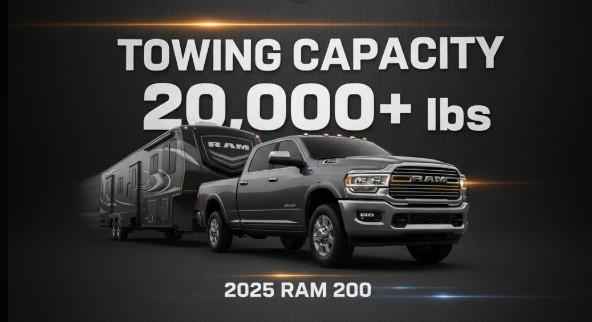
Maximum towing for the 2500 reached its current peak of 20,000 pounds with the diesel engine, while payload capacity tops out at 4,010 pounds with the gas engine.
4th Gen Ram 2500 Engine Specifications (2019-Present)
| Engine | Horsepower | Torque | Transmission |
| 6.4L Hemi V8 | 410 hp | 429 lb-ft | 8-Speed Automatic |
| 6.7L Cummins Turbo Diesel | 370 hp | 850 lb-ft | 6-Speed Automatic |
Cummins vs. Hemi: Which Ram 2500 Engine is Right for You?
Choosing between the legendary 6.7L Cummins Turbo Diesel and the powerful 6.4L Hemi V8 is one of the most significant decisions for any Ram 2500 buyer. Each engine has distinct advantages tailored to different needs and use cases.
- Towing and Torque (Advantage: Cummins): For those who frequently tow heavy loads—large fifth-wheel campers, heavy equipment, or livestock trailers—the diesel is the undisputed champion. Its massive low-end torque (850 lb-ft) allows it to pull immense weight with less strain, maintaining speed on steep grades with far more ease than a gasoline engine.
- Horsepower and Acceleration (Advantage: Hemi): The Hemi V8 boasts higher horsepower (410 hp), which translates to quicker acceleration when the truck is unloaded. This makes it feel more responsive and agile in daily driving and city traffic.
- Cost (Advantage: Hemi): The Hemi holds a significant advantage in cost. The initial purchase price for a gas-powered truck is substantially lower than its diesel counterpart. Furthermore, routine maintenance like oil changes and parts is generally less expensive and more straightforward.
- Longevity and Resale Value (Advantage: Cummins): Diesel engines are engineered with heavier-duty components to withstand higher compression and are renowned for their longevity, often lasting for hundreds of thousands of miles with proper care. This durability typically results in a higher resale value over time.
- Fuel Economy (Advantage: Cummins): Diesel engines are more fuel-efficient, offering 30-35% greater economy than comparable gas engines, according to the U.S. Department of Energy. This advantage is especially pronounced when towing or driving long highway distances. However, the higher price of diesel fuel can sometimes narrow the overall cost savings.
- Driving Experience and Complexity (Advantage: Hemi): Gas engines are inherently quieter and produce fewer vibrations, offering a smoother driving experience. Modern diesel engines are complex, requiring emissions systems like Diesel Exhaust Fluid (DEF) and a Diesel Particulate Filter (DPF) that performs periodic “regeneration” cycles. For owners who don’t tow often or primarily make short trips, these systems can add a layer of complexity and potential maintenance concerns.
Cummins Diesel vs. Hemi Gas Engine Comparison
| Factor | Cummins Diesel | Hemi Gas |
| Best For | Heavy, frequent towing; long-haul driving | Daily driving; occasional/moderate towing |
| Upfront Cost | Higher | Lower |
| Maintenance Cost | Higher | Lower |
| Longevity | Excellent | Good |
| Resale Value | Higher | Lower |
| Fuel Economy | Better (especially when loaded) | Lower |
| Towing Performance | Superior (High Torque) | Good (High Horsepower) |
Ram 2500 Reliability: Best and Worst Years to Buy
While the Ram 2500 is a highly capable truck, its reliability record is mixed, with certain model years developing a reputation for excellence while others are known for common and costly problems. According to data from owner complaints and sources like(https://repairpal.com/problems/dodge/ram-2500), which gives the truck an average reliability rating, some clear trends emerge.
Years to Approach with Caution
- 2001-2003: The transition from the 12-valve to the 24-valve Cummins brought the less reliable Bosch VP44 injection pump, which is a known failure point. The 2003 model, being the first year of a major redesign, also suffered from early issues with its new common-rail fuel system and other electrical gremlins.
- 2012-2016 & 2018: This stretch of the third generation is frequently cited by owners for a range of significant issues. Potential buyers should be aware of:
- “Death Wobble”: A violent and dangerous shaking of the front end, often triggered by hitting a bump at highway speeds. This issue is typically linked to worn-out steering and suspension components like the track bar, ball joints, or steering damper.
- Transmission Problems: Reports of fluid leaks, overheating, and premature failure were common, particularly in the 2018 model year.
- Engine and Electrical Issues: Both Cummins and Hemi engines had specific faults, including turbo actuator failures on the diesel and broken exhaust manifold bolts on the gas V8. Failures of the ABS module and other electrical components were also widespread.
The Most Reliable Years
- 1994-1998 (12-Valve Cummins): These trucks are legendary. The combination of the robust BR/BE chassis and the mechanically simple 5.9L 12-valve Cummins engine makes them one of the most durable and sought-after used diesel trucks on the market.
- 2010 and Newer: In general, the trucks produced after the brand split have a better reliability record than the mid-2000s models. The engineering and quality control improved significantly during this period.
- 2019-2022: As the most modern trucks, these models benefit from the latest engineering and manufacturing processes. While no vehicle is perfect, the 2019-2022 model years are considered solid choices, especially with the nearly indestructible Cummins engine. The primary long-term concerns revolve around the complexity of the emissions systems and advanced electronics.
Conclusion
The journey of the Ram 2500 is a story of relentless evolution. It began in 1994 with a design that shattered industry norms and a powertrain that built a legacy of durability. Through the subsequent decades, it has led the charge in the industry’s torque wars, consistently setting new benchmarks for diesel power.
More than just a workhorse, the Ram 2500 has also pioneered comfort and refinement in the heavy-duty segment, proving that extreme capability doesn’t have to come at the expense of a smooth ride or a premium interior. From the mechanical simplicity of the original 12-valve Cummins to the tech-infused luxury of the latest generation, the Ram 2500 has not only adapted to the changing demands of truck owners but has actively shaped them, cementing its place as an enduring icon of American automotive strength.
Frequently Asked Questions (FAQs)
What are the Ram 2500 generations?
There are four primary generations of the Ram 2500, with a major facelift for the fourth generation:
- First Generation: 1994–2002
- Second Generation: 2003–2009
- Third Generation: 2010–2018
- Fourth Generation: 2019–2024
- Fourth Generation (Facelift): 2025–Present
What year did the Dodge Ram 2500 become just Ram 2500?
The official brand split happened in 2009. The 2010 model year was the first to be sold under the standalone Ram brand, and all trucks from that point forward are officially “Ram” trucks, not “Dodge Ram”.
What is the most reliable Ram 2500 year?
While reliability can vary, the 1994-1998 models equipped with the 5.9L 12-valve Cummins diesel engine are widely regarded as some of the most reliable and durable trucks ever built due to their simple, mechanical design.52 For a more modern option with advanced features, the 2019-2022 models are generally considered solid choices.
What is the “death wobble” on a Ram 2500?
The “death wobble” is a term used to describe a violent shaking of the front wheels and steering components. It is often triggered by hitting a bump at highway speeds and can be severe enough to force the driver to slow down dramatically to regain control. It is typically caused by worn or loose front-end parts like the track bar, ball joints, tie rod ends, or steering damper and was a known issue on some third-generation models.
How much can a Ram 2500 with a Cummins engine tow?
The towing capacity depends heavily on the model year and specific configuration. Modern Ram 2500 trucks (2019 and newer) equipped with the 6.7L Cummins Turbo Diesel engine can tow up to 20,000 pounds when properly equipped.
Is a Cummins or Hemi better for a Ram 2500?
The better engine depends entirely on your needs. The Cummins diesel is the superior choice for frequent, heavy towing due to its immense torque and better fuel economy under load. The Hemi gas engine is a better choice for those who prioritize daily driving comfort, quicker acceleration, a lower initial purchase price, and less expensive maintenance.