Dodge Ram Axle Ratio Chart by Year: 2026 Complete Guide 1500, 2500, 3500

A Dodge Ram axle ratio chart by year is useful only when you separate Ram 1500, Ram 2500, and Ram 3500 by engine, drivetrain, cab, and tow package.
Axle ratio affects how your truck pulls, how it cruises on the highway, and how much trailer weight the factory rated it to handle. A 3.21 Ram 1500 and a 3.92 Ram 1500 may look similar on a used lot, but their towing behavior can be very different.
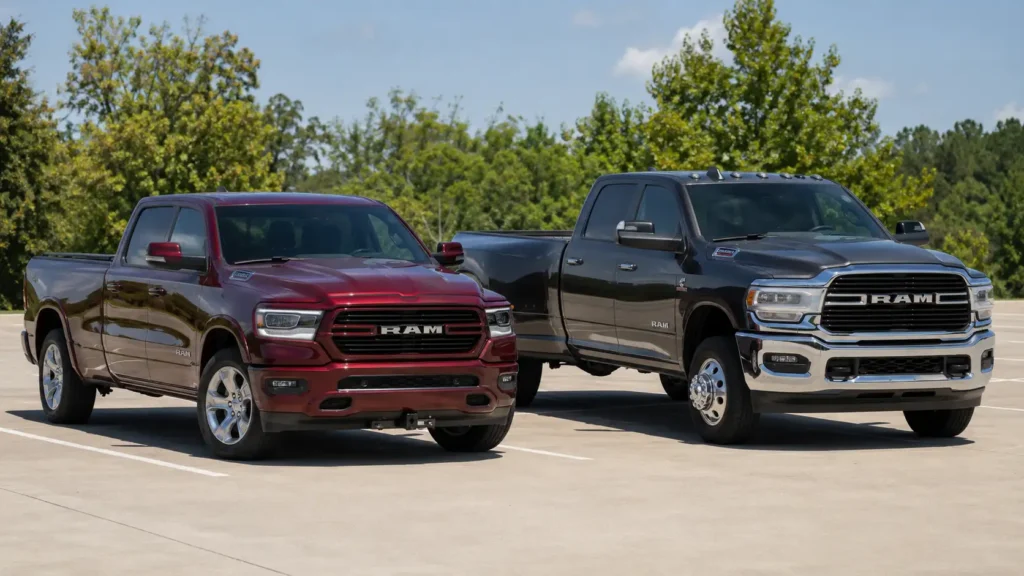
This guide covers common Dodge Ram and Ram axle ratios by year, explains what each ratio means, and shows how to verify the exact ratio on your truck before you tow or regear.
Dodge Ram Axle Ratio Chart By Year
Recommended Best Deal Products


The chart below lists common factory axle ratios by Dodge Ram and Ram model range. It is not a substitute for your truck’s build sheet, because axle ratio changes by engine, trim, drivetrain, cab, bed, and towing package.
For exact towing numbers by engine and year, check the Ram towing capacity chart by year before you hook up a trailer.
| Year Range | Model | Common Factory Axle Ratios | Best Use Case | Notes |
|---|---|---|---|---|
| 1994 to 2001 | Dodge Ram 1500 | 3.55, 3.92 | Daily driving, light towing, V8 towing | Verify by VIN or axle tag because older build combinations vary. |
| 1994 to 2002 | Dodge Ram 2500 and 3500 | 3.55, 3.73, 4.10 | Work trucks, diesel towing, heavy loads | Heavy-duty diesel and gas trucks often used 3.73 or 4.10 ratios. |
| 2002 to 2008 | Dodge Ram 1500 | 3.55, 3.92 | 4.7L V8 and 5.7L Hemi V8 towing | Ram Body Builder data for 2006 lists 3.55 and 3.92 in Ram 1500 towing tables. |
| 2003 to 2009 | Dodge Ram 2500 and 3500 | 3.73, 4.10 | Fifth-wheel towing, diesel work trucks | 2004 Ram technical specs list 3.73 and 4.10 for Ram 2500 and 3500. |
| 2009 to 2018 | Ram 1500 | 3.21, 3.55, 3.92, limited 4.10 | MPG, mixed towing, max half-ton towing | The 2013 Ram 1500 brochure lists 3.21, 3.55, 3.92, and 4.10 availability. |
| 2010 to 2018 | Ram 2500 and 3500 | 3.42, 3.73, 4.10 | Cummins diesel towing and 6.4L Hemi V8 towing | Diesel trucks commonly used taller gearing than older 5.9L Cummins trucks. |
| 2019 to 2024 | Ram 1500 DT | 3.21, 3.55, 3.92 | Daily use, V6 towing, 5.7L Hemi V8 max tow | Official Ram towing charts list axle ratio, GCWR, payload, and max trailer weight by configuration. |
| 2023 to 2024 | Ram 1500 Classic DS | 3.21, 3.92 | Older body style fleet and work trucks | 2023 Ram 1500 Classic towing data shows 3.21 and 3.92 examples with different GCWR ratings. |
| 2025 to 2026 | Ram 1500 | 3.21, 3.55, 3.92 | 3.6L Pentastar V6 and 3.0L Hurricane I6 towing | Ram’s 2025 and 2026 payload and towing charts still list axle ratio as a key tow-rating field. |
| 2025 to 2026 | Ram 2500 and 3500 | 3.73, 4.10 | Heavy-duty gas and 6.7L Cummins Turbo Diesel towing | 2025 Ram HD specs list 3.73 and 4.10 axle gear ratios in the HD specification sheet. |
Use this chart as a starting point. Your exact truck can still be different, especially if it has a special package, fleet spec, off-road package, or previous-owner gear change.
Ram 1500 Axle Ratios From 3.21 To 3.92
For Ram 1500 owners, the key comparison is usually 3.21 vs 3.92. The 3.55 ratio sits between them when offered, especially on V6 and newer I6 configurations.
Ram 1500 towing ratings change because axle ratio affects Gross Combined Weight Rating, or GCWR. GCWR means the maximum combined weight of the loaded truck and loaded trailer.
3.21 Ratio For Daily Driving
The 3.21 ratio is the highway-friendly choice in many Ram 1500 configurations. It keeps engine speed lower at cruising speed, which helps unloaded comfort and fuel economy.
The tradeoff is towing feel. A 3.21 truck can tow within its rating, but it will usually feel less eager on grades, at launch, and when pulling heavier campers.
3.55 Ratio For Mixed Use
The 3.55 ratio is the middle-ground setup. It gives more mechanical advantage than 3.21 without the higher cruising RPM of 3.92.
This ratio makes sense for owners who daily drive their Ram 1500 but still tow utility trailers, small campers, boats, or work equipment. In newer Ram 1500 charts, 3.55 appears often with the 3.6L Pentastar V6 and 3.0L Hurricane I6.
3.92 Ratio For Towing
The 3.92 ratio is the strongest half-ton towing choice in most modern Ram 1500 applications. It multiplies torque harder at the wheels and helps the truck move weight from a stop.
Ram’s 2024 customer payload and towing document ties the highest 12,750 lb Ram 1500 tow rating to a 5.7L Hemi V8 eTorque Quad Cab 4×2 with the Max Tow Package, 10-inch axle, and 3.92 ratio. For a broader half-ton tow breakdown, use the Ram 1500 towing capacity guide alongside your build sheet.
Ram 2500 And 3500 Axle Ratios For HD Towing
Recommended Best Deal Products



Ram 2500 and Ram 3500 axle ratios are less about light-truck MPG and more about GCWR, payload, rear axle rating, and trailer weight.
The main HD ratios are 3.73 and 4.10 on many gas and diesel configurations. Some Cummins years also used 3.42 gearing, especially where diesel torque and transmission gearing allowed a taller final drive.
| Ratio | Common HD Use | Best Match | Tradeoff |
|---|---|---|---|
| 3.42 | Diesel highway towing in some years | 6.7L Cummins Turbo Diesel | Lower cruising RPM, less aggressive launch feel |
| 3.73 | Balanced HD towing | 6.7L Cummins Turbo Diesel and some gas configs | Strong towing without going as short as 4.10 |
| 4.10 | Heavy gas towing and high GCWR work | 6.4L Hemi V8 and heavy trailer use | Higher RPM and usually lower unloaded MPG |
The 6.4L Hemi V8 often benefits from 4.10 gears when the truck regularly pulls heavy. The 6.7L Cummins Turbo Diesel has more low-speed torque, so it can work well with taller gearing in many configurations.
For HD towing, axle ratio is only one part of the rating. Pair this article with the Ram 2500 towing capacity guide when comparing 3.73 and 4.10 trucks.
How To Find Your Dodge Ram Axle Ratio
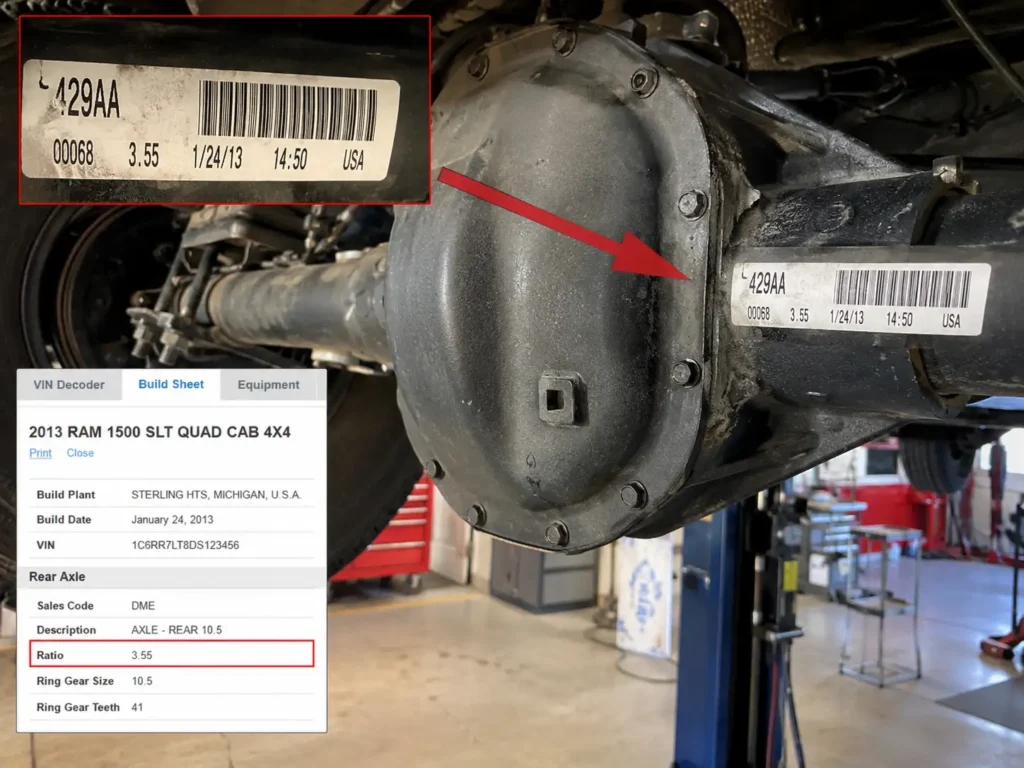
The fastest way to confirm your Dodge Ram axle ratio is to check the factory equipment listing, build sheet, or original window sticker.
Do not rely only on the seller’s listing. Many used truck listings skip axle ratio or copy generic trim information from another truck.
- Use The Mopar VIN Lookup
Go to Mopar’s official VIN lookup page and enter the 17-character VIN. Mopar says the tool can show vehicle features, specs, and equipment information. - Check The Ram Equipment Listing
Ram’s equipment listing page can show standard and optional equipment tied to a VIN. Look for terms like rear axle ratio, anti-spin differential, limited-slip differential, or axle package. - Read The Original Window Sticker
The window sticker often lists the axle ratio if it was part of a towing, off-road, or axle package. - Inspect The Axle Tag
Some trucks have a metal tag on the differential cover bolts. This tag may show the ratio, especially on older Dodge Ram trucks. - Verify Before Regearing Or Towing Heavy
Previous owners may have changed the gears. If the truck has larger tires, aftermarket differentials, or a lifted suspension, inspect the axle mechanically before making tow-rating assumptions.
Once the ratio is confirmed, the next question is how that number changes towing, MPG, and drivability.
What Axle Ratio Means For Towing And MPG
Recommended Best Deal Products


A higher number like 3.92 or 4.10 gives the truck more mechanical advantage at the wheels. That helps launch, low-speed pulling, and climbing grades with a trailer.
A lower number like 3.21 or 3.42 usually keeps engine RPM lower at highway speed. That can help unloaded cruising comfort and fuel economy, but it gives up some towing punch.
| Axle Ratio | Driving Feel | Towing Feel | MPG Tendency |
|---|---|---|---|
| 3.21 | Relaxed highway driving | Best for lighter trailers | Usually better unloaded MPG |
| 3.55 | Balanced response | Good for mixed use | Moderate MPG tradeoff |
| 3.73 | Stronger HD pull | Good for heavier loads | Higher RPM than taller gears |
| 3.92 | Strong half-ton tow feel | Best Ram 1500 tow ratio in many years | Lower MPG than 3.21 |
| 4.10 | Strong low-speed pull | Best for heavy gas towing | Highest RPM in this group |
Tire size matters too. Larger tires effectively make the final drive ratio taller. That means a Ram with 35-inch tires and 3.21 gears may feel much lazier than the same truck on stock tires.
Best Dodge Ram Axle Ratio By Use Case
The best Dodge Ram axle ratio depends on what the truck does most often. A daily driver, camper tow rig, diesel hauler, and lifted trail truck do not need the same gearing.
| Use Case | Best Ratio To Look For | Why It Fits |
|---|---|---|
| Highway daily driving | 3.21 or 3.42 | Lower RPM and better unloaded cruising |
| Mixed commuting and light towing | 3.55 or 3.73 | Better balance between MPG and pulling feel |
| Ram 1500 frequent towing | 3.92 | Stronger launch and higher tow ratings in many configurations |
| Ram 2500 gas towing | 4.10 | Helps the 6.4L Hemi V8 move heavy trailers |
| Ram 2500 or 3500 diesel towing | 3.73 or factory diesel ratio | Works with the 6.7L Cummins Turbo Diesel torque curve |
| Larger tire build | 3.92, 4.10, or deeper | Helps recover lost mechanical advantage |
Do not choose an axle ratio from a forum post alone. The right ratio depends on engine, transmission, tire size, trailer weight, and factory rating.
5 Common Axle Ratio Mistakes Ram Owners Make
The biggest axle ratio mistake is treating one Ram spec as if it applies to every cab, engine, axle, and drivetrain.
- Assuming Every Truck From One Year Is The Same
A 2024 Ram 1500 with 3.21 gears is not rated like a 2024 Ram 1500 with 3.92 gears and Max Tow equipment. The same year can have multiple ratings. - Confusing Axle Ratio With Towing Capacity
Axle ratio helps determine tow rating, but it does not replace GVWR, payload, GCWR, brakes, cooling, hitch rating, or tire load rating. - Ignoring Payload
A truck can have the right axle ratio and still run out of payload. Tongue weight, passengers, cargo, and accessories all count against payload. Use the Ram payload capacity chart before choosing a trailer. - Forgetting About Tire Size
Bigger tires reduce effective gearing. A 3.92 truck on oversized tires may feel closer to a taller factory ratio. - Assuming 4.10 Is Always Better
A 4.10 ratio is strong for heavy towing, especially with gas HD trucks. But if the truck spends most of its life unloaded on the highway, the higher RPM may not be worth it.
Axle ratio matters, but it only works inside the full truck configuration.
Which Dodge Ram Axle Ratio Should You Choose
Choose 3.21 if your Ram 1500 is mostly a commuter and only tows light trailers. Choose 3.92 if you tow often with a Ram 1500 and want the strongest factory half-ton towing setup.
For Ram 2500 and Ram 3500 trucks, 3.73 is the safer all-around HD ratio for many diesel buyers, while 4.10 makes sense for heavy gas towing, work trailers, and high-load use.
The correct Dodge Ram axle ratio chart by year gets you close. The build sheet, window sticker, and official towing chart confirm what your truck can actually handle.
FAQ
How Do I Know My Dodge Ram Axle Ratio
Use the Mopar VIN lookup, Ram equipment listing, original window sticker, or axle tag. The build sheet is usually the best source because it shows the factory-installed equipment tied to your VIN.
Is 3.21 Or 3.92 Better For Ram 1500 Towing
The 3.92 ratio is better for frequent Ram 1500 towing because it gives stronger torque multiplication and higher tow ratings in many configurations. The 3.21 ratio is better for unloaded highway driving and lighter trailer use.
What Axle Ratio Is Best For A 6.7L Cummins
For a 6.7L Cummins Turbo Diesel, the best axle ratio depends on year, transmission, SRW or DRW setup, and trailer weight. Many diesel owners prefer 3.73 for balanced towing, while 4.10 can make sense for heavier work use where offered.
Does Axle Ratio Change Towing Capacity
Yes, axle ratio can change towing capacity because it affects GCWR and drivetrain load. It is still only one part of the rating, so you must also check engine, transmission, cab, bed, drivetrain, payload, GVWR, and trailer equipment.
Can I Change My Dodge Ram Axle Ratio
Yes, you can change the axle ratio by regearing the differential. This job requires correct gear setup, backlash adjustment, bearing preload, and calibration checks, so most owners should use a professional differential shop.