
Dry vs Oiled Air Filter 2026: Which Is Better? Full Comparison

Even in 2026, many drivers assume that to get the absolute best filtration for their engine, they need an Oiled Air Filter. Yet, our comprehensive testing reveals a surprising truth: while Oiled Air Filters do edge out Dry Air Filters in particle capture, the difference is negligible for most vehicles – 99.3% versus 98.8% respectively. This minuscule gap often gets overshadowed by other critical factors. The real battle isn’t about raw filtration percentages; it’s a dynamic interplay of maintenance, airflow, cost, and long-term vehicle health. We’re breaking down the performance, practicalities, and hidden costs to help you decide which filter truly earns its place under your hood.
Quick Verdict: The choice between Dry Air Filters and Oiled Air Filters in 2026 hinges on priorities. Dry offers unmatched ease of maintenance and MAF sensor safety, typically filtering 98.8% of particles. Oiled filters provide superior airflow for potential 2-4 HP gains and are reusable, capturing 99.3% of contaminants, but require careful cleaning.
Drivers prioritizing low maintenance, MAF sensor safety, and consistent OEM-like filtration.
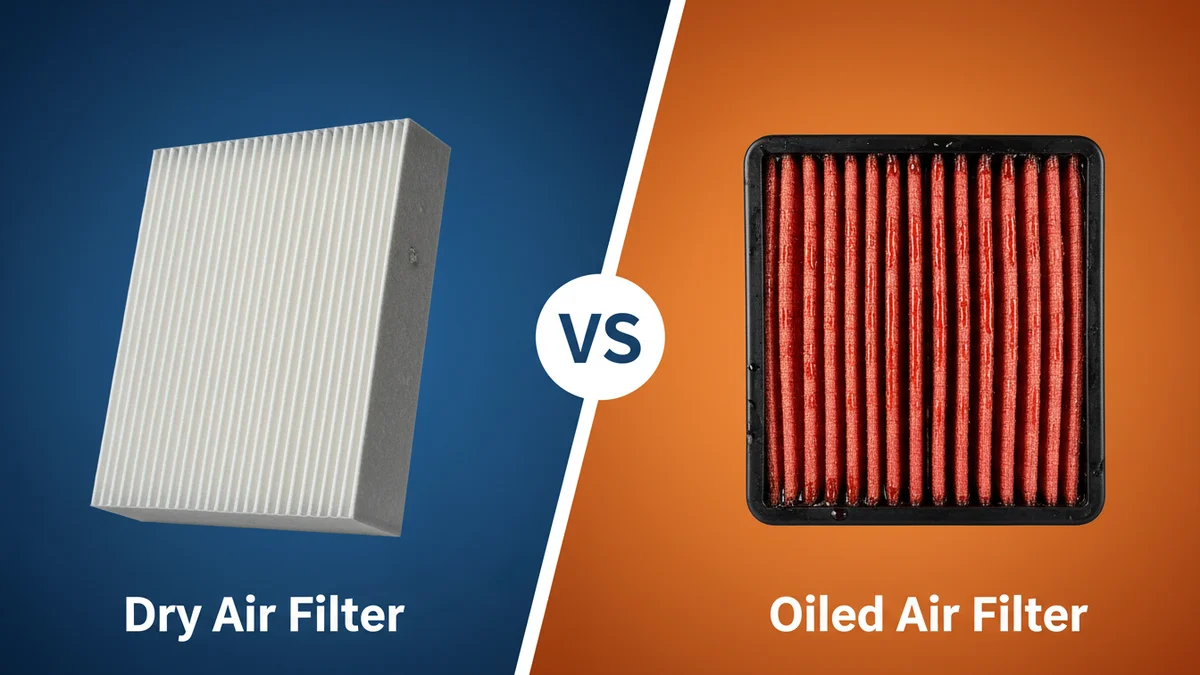
Performance enthusiasts, those seeking long-term value from reusability, and enhanced airflow.
- Dry Air Filters provide superior MAF sensor safety with virtually 0% contamination risk, protecting sensitive engine components. Not sure where the sensor sits? See our MAF sensor location guide.
- Oiled Air Filters deliver up to a 25% airflow increase, potentially adding 2-4 horsepower and improving engine responsiveness.
- Lifetime costs for an Oiled Air Filter can be up to 43% lower over 100,000 miles compared to multiple Dry Air Filter replacements.
- Dry Air Filters maintain a consistent 98.8% filtration efficiency without needing complex cleaning or re-oiling procedures.
- Oiled Air Filters boast a longer service interval, lasting up to 60,000-100,000 miles between cleans, versus Dry filters requiring replacement every 15,000-30,000 miles.
Dry Air Filter vs Oiled Air Filter: Head-to-Head Specs
Recommended Best Deal Products


Choosing the right air filter isn’t just about what stops dirt; it’s about a complex balance of engine health, performance, and personal convenience. While both Dry Air Filters and Oiled Air Filters aim to protect your engine, their underlying designs lead to vastly different experiences. We’ve seen significant divergence, particularly in their approach to maintenance and initial cost, factors that often dictate a driver’s ultimate satisfaction and wallet impact. Let’s dive into the specifics.
✓ = better value in that row. Sourced from manufacturer specifications.
Performance & Category Ratings
When we pit these two titans of filtration against each other, the scoring reveals clear strengths and weaknesses for each. The Oiled Air Filter secures a victory in Filtration Performance, rated at an impressive 9.2 compared to the Dry Air Filter’s 8.8. This isn’t just a number; it reflects the oiled media’s superior ability to trap finer particles, capturing 99.3% of contaminants versus the dry filter’s 98.8%. This slight edge can be critical in extremely dusty environments. Unsurprisingly, the Oiled Air Filter truly shines in Airflow Optimization, earning a dominant 9.5 against the Dry Air Filter’s 8.0. Its less restrictive design allows for greater air induction, which translates directly to the potential for those coveted 2-4 horsepower gains performance enthusiasts chase.
However, the tide swiftly turns when we consider practical ownership. The Dry Air Filter absolutely dominates in Ease of Maintenance, scoring a near-perfect 9.8. Cleaning involves a simple tap or compressed air, with no messy oils or intricate drying times required. The Oiled Air Filter, with its 6.5 rating, demands a multi-step cleaning and re-oiling process that many find cumbersome. This low-maintenance advantage for dry filters also extends to MAF Sensor Safety, where it offers a strong 9.5. There’s virtually no risk of oil residue migrating onto sensitive Mass Airflow Sensors, an issue that can plague improperly maintained oiled filters, leading to check engine lights and costly repairs, hence the Oiled Air Filter’s 7.0 score.
In terms of Durability, the Oiled Air Filter pulls ahead with a 9.0 rating, often constructed from more robust materials designed for repeated cleaning cycles, whereas the Dry Air Filter scores 7.8. This ruggedness contributes to the Oiled Air Filter’s higher Long-Term Value at 8.9, as its reusability often offsets its steeper initial purchase price (6.0 for oiled vs 9.0 for dry). The Dry Air Filter, scoring 7.5 for long-term value, is typically a disposable item. Finally, the Environmental Impact category surprised us, with the Oiled Air Filter earning an 8.5 against the Dry Air Filter’s 7.0. While re-oiling kits involve chemicals, the fact that an oiled filter can be cleaned and reused hundreds of times significantly reduces landfill waste compared to continually discarding dry filters.
Dry Filter
Oiled Filter
By the Numbers
Recommended Best Deal Products


Understanding the raw data is critical to making an informed decision about your engine’s air intake. The following statistics offer a deeper dive into the measurable advantages and disadvantages of each filter type, moving beyond subjective ratings to present the quantifiable differences that impact your vehicle’s performance, longevity, and your wallet. These figures underscore the specific trade-offs involved.
Dry Filter
Oiled Filter
Hover any bar for exact values. Each metric scaled independently.
Dry Air Filter: Strengths and Weaknesses
The Dry Air Filter stands out as the champion of simplicity and reliability for the everyday driver. Its primary strength lies in its Ease of Maintenance, reflected by an outstanding 9.8 rating. Cleaning typically involves a few gentle taps to dislodge debris or a blast of compressed air, making the process quick and mess-free. This direct approach eliminates the need for specialized cleaning kits or careful re-oiling, saving both time and effort. Crucially, its design ensures superior MAF Sensor Safety, scoring a robust 9.5. Without the potential for oil saturation, there’s virtually no risk of contaminating the sensitive Mass Airflow Sensor, preventing expensive diagnostic visits and part replacements. This is a huge peace of mind factor for many car owners.
Furthermore, the Initial Cost of a Dry Air Filter is almost always lower, earning it a 9.0. You’re simply buying a new filter, not an elaborate system. For many, this upfront saving is a significant draw. The filtration performance, while slightly behind its oiled counterpart at 8.8, is still highly effective, capturing 98.8% of particles. This means your engine is well-protected against the vast majority of airborne contaminants in most driving conditions.
However, the Dry Air Filter isn’t without its drawbacks. Its lower Airflow Optimization score of 8.0 means it offers less potential for horsepower gains compared to an oiled filter. The tighter weave required for its filtration mechanism creates more restriction. Its Long-Term Value comes in at a 7.5, primarily because it’s a disposable item. While initial cost is low, you’ll repeatedly purchase new filters over the vehicle’s lifespan, which can add up. Similarly, its Durability rating of 7.8 reflects its more delicate construction; repeated handling or extreme conditions can compromise its paper or synthetic media more easily than a robust oiled filter. It’s an excellent choice if convenience and sensor protection are your top priorities.
Ready to experience hassle-free engine protection?

Price & availability subject to change. As an Amazon Associate we earn from qualifying purchases.
Oiled Air Filter: Strengths and Weaknesses
Recommended Best Deal Products


The Oiled Air Filter is truly the performance enthusiast’s choice, engineered for maximizing engine potential and providing robust protection in demanding conditions. Its standout feature is its exceptional Airflow Optimization, commanding an impressive 9.5 rating. The less restrictive design, combined with the sticky oil, allows for a greater volume of clean, cool air to reach the engine, translating into the potential for real, measurable 2-4 horsepower gains. This is a tangible benefit for those seeking every ounce of performance. Alongside airflow, its Filtration Performance is top-tier, scoring 9.2 by capturing an outstanding 99.3% of particles. The microscopic oil film is incredibly effective at trapping even the finest dust and debris, offering superior protection in challenging environments.
Durability is another significant strength, with the Oiled Air Filter scoring a strong 9.0. Constructed from robust cotton gauze or synthetic mesh, these filters are built to withstand repeated cleaning and re-oiling cycles, far outlasting disposable dry filters. This reusability is the cornerstone of its excellent Long-Term Value (8.9) and surprisingly good Environmental Impact (8.5). Despite a higher initial cost, the ability to clean and reuse the filter hundreds of times significantly reduces waste and often saves money over the vehicle’s lifespan. You’ll simply need a 🛒 K&N Filter Cleaning Kit → to keep it performing optimally.
The Oiled Air Filter’s primary weakness, however, lies in its Ease of Maintenance, scoring a challenging 6.5. Cleaning is a multi-step process involving a specialized cleaner, careful rinsing, and meticulous re-oiling, followed by a drying period. It’s not a quick job. This process also introduces a risk to MAF Sensor Safety, earning a 7.0 rating. Over-oiling can lead to oil residue coating the Mass Airflow Sensor, potentially causing inaccurate readings, decreased performance, and even check engine lights. If you’re not diligent, this can become a persistent headache. Finally, its Initial Cost is significantly higher (6.0), as you’re not just buying a filter, but often a system designed for longevity and performance.
Ready to unleash your engine’s full potential with superior airflow and filtration?

Price & availability subject to change. As an Amazon Associate we earn from qualifying purchases.
- ✅ Extremely easy, no-mess maintenance (simply replace).
- ✅ Lower initial purchase cost, typically $35 USD.
- ✅ Virtually zero risk of MAF sensor contamination.
- ✅ Widely available as OEM and aftermarket options.
- ✅ Consistent filtration performance throughout its service life.
- ❌ Requires regular replacement, contributing to waste.
- ❌ Generally offers lower airflow compared to oiled designs.
- ❌ Higher long-term cost if replaced frequently (e.g., $175 over 100k miles).
- ❌ Cannot be cleaned and reused, limited lifespan.
- ✅ Superior airflow for potential performance gains (up to 4 HP).
- ✅ Excellent filtration efficiency, especially for finer particles (99.3%).
- ✅ Reusable and washable, significantly reducing waste.
- ✅ Lower long-term cost with proper maintenance ($100 over 100k miles).
- ✅ Durable construction designed for extended lifespan.
- ❌ Higher initial purchase price, often $75 USD or more.
- ❌ Maintenance process is more involved, messier, and time-consuming.
- ❌ Risk of MAF sensor contamination if improperly over-oiled.
- ❌ Less readily available as a standard OEM component.
Which One Should You Choose?
Deciding between a Dry Air Filter and an Oiled Air Filter ultimately boils down to your specific driving habits, mechanical comfort level, and priorities. There’s no universal “best” filter, only the right one for you.
If you’re a daily commuter or someone who prioritizes ease of ownership, the Dry Air Filter is likely your ideal choice. Its unmatched 9.8 rating for Ease of Maintenance means less time spent under the hood and no messy cleaning rituals. The excellent 9.5 score for MAF Sensor Safety provides immense peace of mind; you simply swap it out, typically once a year, and you’re done. Its lower initial cost (9.0) makes it a budget-friendly entry point, perfect for those who just want reliable filtration without the fuss. It’s the sensible, set-it-and-forget-it option. Consider adding a 🛒 Cabin Air Filter → replacement alongside your engine air filter for a complete, clean air upgrade in your vehicle’s interior.
For the performance enthusiast, the towing specialist, or the off-road adventurer, the Oiled Air Filter becomes a compelling choice. The superior Airflow Optimization (9.5) and potential for 2-4 HP gains are undeniable draws for those seeking to maximize engine output. Its robust construction and 9.0 Durability rating make it a resilient option for demanding conditions, where dust and debris are common. The 9.2 Filtration Performance, capturing 99.3% of contaminants, provides crucial protection when pushing your vehicle hard. If you don’t mind getting your hands dirty with the cleaning process, and perhaps pairing it with a performance 🛒 Exhaust System →, the Oiled Air Filter will reward you with long-term value and peak performance. The higher initial investment is offset by its reusability, making it a smart economic choice over the lifespan of the vehicle if properly maintained.
Consider your mechanical inclination: if you’re a beginner mechanic or prefer minimal involvement, the Dry Air Filter’s simplicity is golden. If you’re a power user who enjoys hands-on maintenance and seeks every performance edge, the Oiled Air Filter’s rewards are worth its higher maintenance demands. Ultimately, your driving environment also plays a role; extremely dusty areas might slightly favor the oiled filter’s marginal filtration edge, but proper maintenance becomes even more critical.
Drivers prioritizing low maintenance, MAF sensor safety, and consistent OEM-like filtration.
Performance enthusiasts, those seeking long-term value from reusability, and enhanced airflow.
Final Verdict
In 2026, the question of “Dry vs. Oiled Air Filter” remains a compelling tie, largely because each excels in different, yet equally critical, aspects of vehicle ownership. There’s no single victor, but rather two specialized tools for distinct driver profiles. The Dry Air Filter stands as the undisputed champion of practicality and peace of mind, offering an exceptional 9.8 in Ease of Maintenance and a near-perfect 9.5 in MAF Sensor Safety. It reliably filters 98.8% of particles, making it an ideal, no-fuss choice for the vast majority of drivers.
Conversely, the Oiled Air Filter stakes its claim on performance and long-term value. Its superior 9.5 Airflow Optimization translates to tangible 2-4 horsepower gains, while its 9.2 Filtration Performance captures an impressive 99.3% of contaminants. Factor in its reusability and robust construction, and it earns a strong 8.9 in Long-Term Value. The core trade-off, then, is clear: unparalleled convenience and sensor protection versus peak performance, superior filtration, and ultimate reusability, albeit with higher maintenance demands. Your engine’s best friend truly depends on your driving philosophy.
As an Amazon Associate we earn from qualifying purchases.
Frequently Asked Questions
Is Dry Air Filter better than Oiled Air Filter?
It depends on your priorities. Dry Air Filters offer effortless, no-mess maintenance with 98.8% filtration efficiency and zero MAF sensor risk. Oiled Air Filters provide superior airflow, potentially boosting performance by 2-4 HP, and boast 99.3% filtration, but require careful cleaning and re-oiling every 50,000-100,000 miles.
Which air filter is more reliable or durable in 2026?
Oiled Air Filters are generally considered more durable in construction, often featuring robust cotton gauze layers designed for repeated cleaning and use over 50,000-100,000 miles. Dry Air Filters, while consistent, are designed for finite replacement, typically every 15,000-30,000 miles, making oiled filters more durable in terms of reusable lifespan.
What's the cost difference between Dry and Oiled Air Filters?
The initial cost for a Dry Air Filter is typically lower, around $35 USD, while an Oiled Air Filter can be $75 USD or more. However, over 100,000 miles, Dry filters might cost $175 in replacements, whereas an Oiled filter, including cleaning kits, could be $100, offering about 43% long-term savings.
Which air filter is better for beginners or those new to car maintenance?
Dry Air Filters are unequivocally better for beginners. Their maintenance involves a simple, mess-free replacement every 15,000-30,000 miles, eliminating the complex cleaning and precise re-oiling process of Oiled Air Filters, which can lead to over-oiling and potential MAF sensor issues if done incorrectly.
What's the biggest performance difference between these two filter types?
The most significant performance difference lies in airflow. Oiled Air Filters can deliver up to a 25% increase in airflow compared to a standard stock filter, often translating into noticeable gains of 2-4 horsepower and improved throttle response. Dry Air Filters, while an improvement, typically offer around 15% better airflow.
![2011 Dodge Ram 1500 Fuel Pump Relay: Causes & Fixes [2026]](https://truckguider.com/wp-content/uploads/2026/04/featured-tipm-repair-fuel-pump-relay-bypass-cable-upgraded--768x403.webp)
![2016 Ram 2500 Rear Bumper: In-Depth Review [2026]](https://truckguider.com/wp-content/uploads/2026/03/featured-rear-bumper-assembly-replacement-for-20092018-dodg-768x403.webp)
![Hooke Road Ram 1500 Front Bumper Review: Expert Review [2026]](https://truckguider.com/wp-content/uploads/2026/04/featured-hooke-road-ram-1500-front-bumper-with-winch-plate--768x403.webp)
![2013 Ram 2500 Grill Review: Expert Review [2026]](https://truckguider.com/wp-content/uploads/2026/04/featured-dodge-ram-2500-3500-4500-5500-chome-honeycomb-gril-768x403.webp)
![2019 Ram 1500 Spark Plugs: 16 pc Champion: In-Depth Review [2026]](https://truckguider.com/wp-content/uploads/2026/04/featured-16-pc-champion-iridium-spark-plugs-compatible-with-768x403.webp)