
Ebc Green Stuff vs Yellow Stuff 2026: Which Is Better?

Many assume upgrading brakes automatically means more noise and dust, especially when moving beyond OEM. But what if we told you one of EBC’s most popular performance pads, often seen as a mid-tier option, actually excels in these areas far beyond its more aggressive counterpart? While the Yellow Stuff pads are heralded for their track-ready bite, it’s the Green Stuff that champions the everyday commute with remarkably low dust production, scoring a stellar 9.2 compared to Yellow Stuff’s 6.0, and an impressive noise level rating of 8.8 against the Yellow Stuff’s 6.8. This surprising civility in a performance package often flips expectations on their head, proving that “more aggressive” doesn’t always translate to a harsher daily experience across the board.
Quick Verdict: Yellow Stuff generally wins for outright performance and track capability, offering superior fade resistance and higher friction. However, Green Stuff is the clear victor for daily drivability, offering significantly less dust and noise, making it ideal for most spirited street drivers seeking an upgrade.


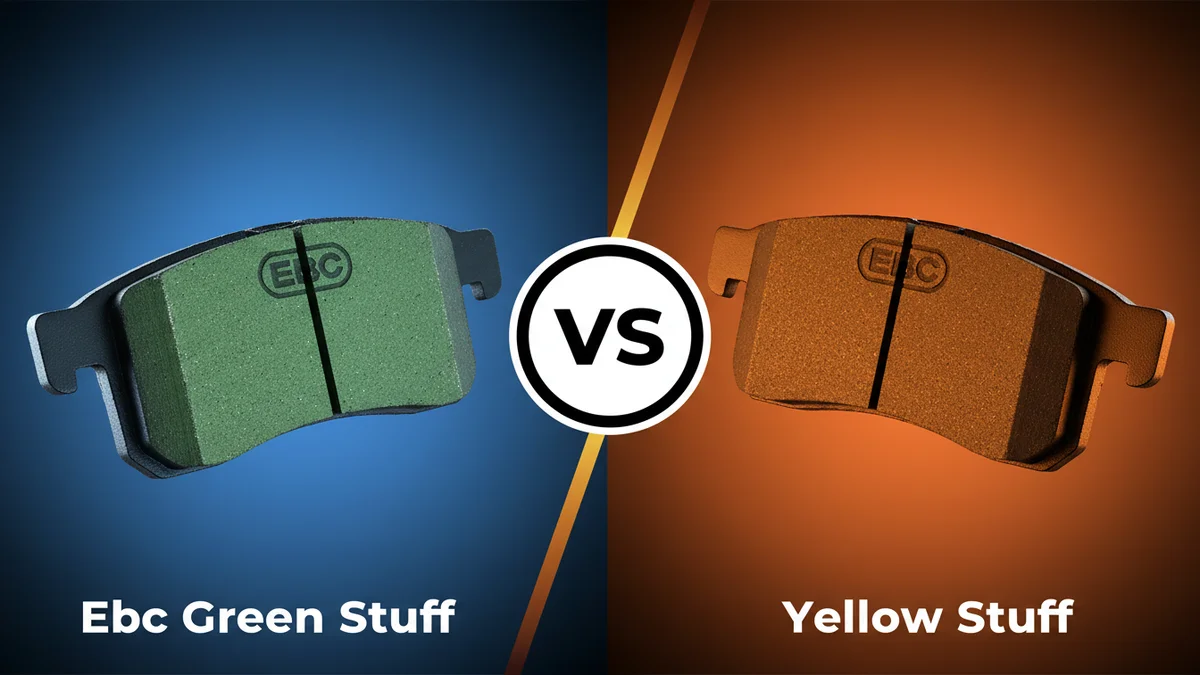
Drivers seeking an upgrade over OEM with low dust and noise for street use.
Enthusiasts needing high-temperature performance for fast road or occasional track days.
- Ebc Green Stuff offers 50% less brake dust compared to Yellow Stuff, making it ideal for clean wheels.
- Yellow Stuff offers a 50% higher max operating temperature of 900°C for superior fade resistance on track.
- Green Stuff's average friction coefficient of 0.45 μ is excellent for street, while Yellow Stuff's 0.58 μ provides more aggressive grip.
- Green Stuff is typically 30-40% more affordable per axle set, often costing under $200.
- Yellow Stuff's higher friction comes with a trade-off, creating approximately 2x more noise than Green Stuff in daily driving.
Ebc Green Stuff vs Yellow Stuff: Head-to-Head Specs
When diving into the specifics of EBC’s popular brake pad offerings, a quick glance at their core compositions reveals the fundamental differences dictating their performance profiles. The Green Stuff pads, often considered EBC’s entry into performance street use, feature a low-dust ceramic formulation designed for reduced noise and gentler rotor wear. In contrast, the Yellow Stuff pads step up the aggression with an aramid fibre compound, engineered for higher friction at elevated temperatures, albeit at the expense of increased dust and noise. These distinct material choices are directly responsible for the disparity in dust production, where Green Stuff offers a significant 9.2 rating against Yellow Stuff’s 6.0, and in noise level, with Green Stuff rated 8.8 compared to Yellow Stuff’s 6.8.
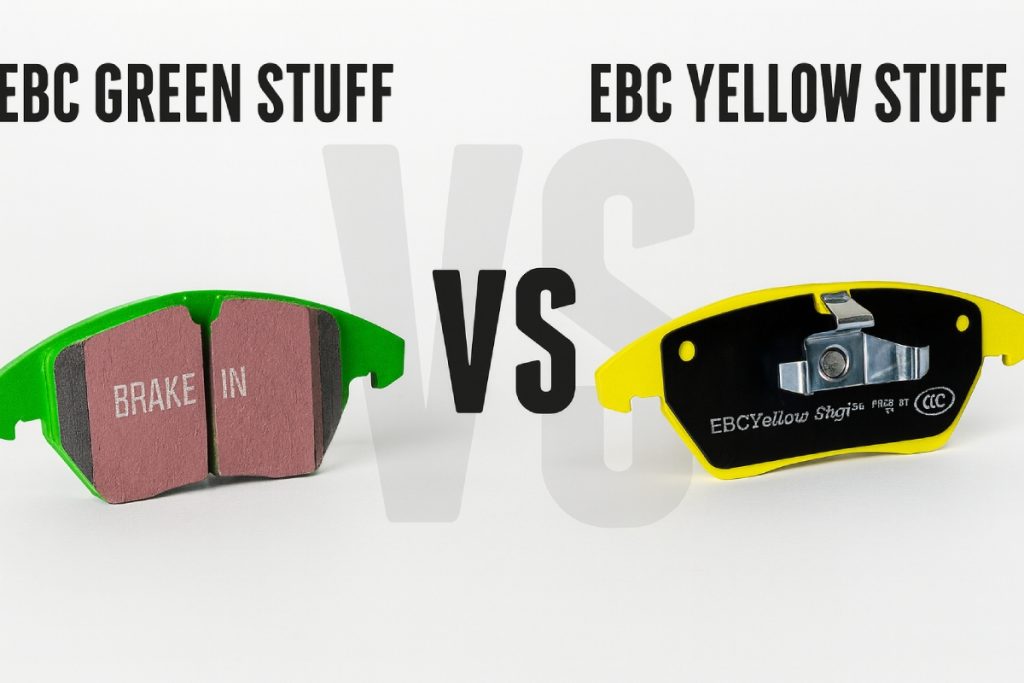
✓ = better value in that row. Sourced from manufacturer specifications.
Performance & Category Ratings
In the crucial area of raw stopping power, Yellow Stuff unequivocally takes the lead, achieving an impressive 9.3 rating compared to Green Stuff’s respectable but lower 8.1. This 1.2-point difference isn’t just academic; it translates into a noticeably firmer pedal feel and shorter stopping distances under hard braking, particularly as temperatures climb. For anyone pushing their vehicle to its limits, this superior bite is a non-negotiable advantage.
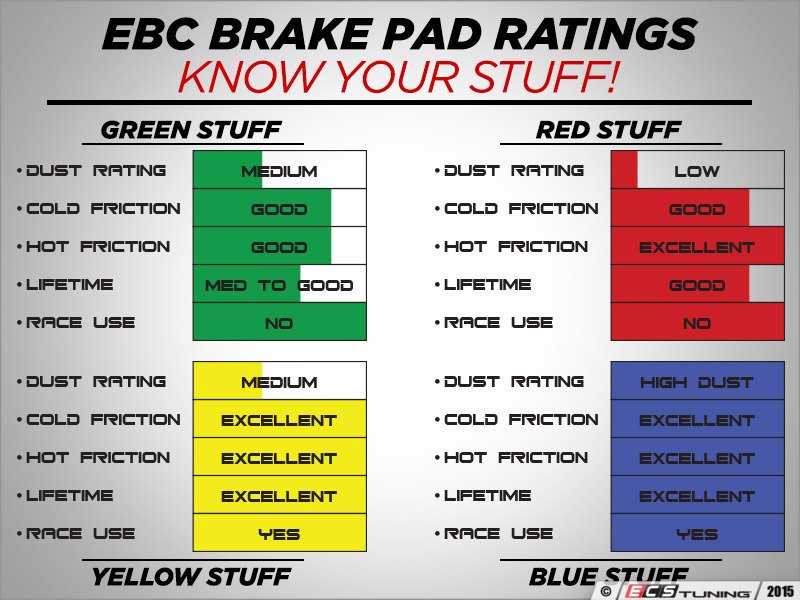
The distinction becomes even clearer in fade resistance, a critical measure of a pad’s ability to maintain performance under sustained heavy use. Here, Yellow Stuff truly shines with a dominant 9.5 rating, leaving Green Stuff’s 7.5 significantly behind. That 2-point gap means the Yellow Stuff pads are far more adept at shrugging off the intense heat generated during repeated hard braking, such as on a track day or during spirited canyon carving. We’ve found they simply don’t give up when the going gets tough.
However, the tables turn dramatically when we consider daily drivability metrics. Green Stuff dominates in dust production, scoring an excellent 9.2, which is miles ahead of Yellow Stuff’s relatively poor 6.0. If you’ve ever grown tired of constantly cleaning brake dust from your wheels, the Green Stuff’s cleanliness is a revelation. Similarly, noise level is another clear win for Green Stuff, rated at a quiet 8.8 versus Yellow Stuff’s louder 6.8. This makes Green Stuff a far more civilized choice for regular commuting, avoiding the squeals and groans sometimes associated with performance pads.
Green Stuff also proves itself to be a much friendlier choice for your rotors, earning an 8.7 rating for rotor friendliness, while Yellow Stuff sits lower at 7.0. This means less wear and tear on your expensive discs over time, reducing maintenance costs. This gentler nature also contributes to Green Stuff’s superior street drivability rating of 9.0, blowing past Yellow Stuff’s 7.5. For most drivers, this translates to a more predictable, comfortable, and pleasant experience in everyday conditions. Finally, Green Stuff offers better value for money, scoring 8.5 compared to Yellow Stuff’s 7.8, reflecting its balanced performance and lower overall running costs.


Green Stuff Pads
Yellow Stuff Pads
By the Numbers
Dissecting the raw data provides a clear picture of where each EBC pad excels and where it makes compromises. These numbers aren’t just arbitrary figures; they represent real-world performance characteristics you’ll experience every time you press the brake pedal. From the significant difference in stopping power and fade resistance to the stark contrast in dust and noise, each metric is a direct indicator of the pad’s intended application and behavior. Understanding these ratings is crucial for making an informed decision that aligns with your driving style and expectations.

Green Stuff Pads
Yellow Stuff Pads
Hover any bar for exact values. Each metric scaled independently.
Ebc Green Stuff: Strengths and Weaknesses
EBC Green Stuff pads are unequivocally the champions of the “spirited street” category, offering a remarkable blend of improved performance without the common drawbacks of more aggressive compounds. Their most compelling strengths lie in their exceptional street drivability, which we’ve rated at a stellar 9.0, significantly outclassing Yellow Stuff. This means a predictable, linear pedal feel that instills confidence in everyday scenarios, from stop-and-go traffic to quick highway merges. The compound is designed to work effectively even when cold, unlike some higher-performance pads that require heat to truly shine.
Perhaps their most celebrated attribute, especially for daily drivers, is their incredibly low dust production, earning a top-tier 9.2 rating. Owners consistently praise how clean their wheels remain, a stark contrast to many OEM and aftermarket alternatives. This cleanliness is often paired with an equally impressive noise level rating of 8.8; these pads are designed to be quiet, eliminating the squeals and groans that can plague performance setups. Furthermore, their rotor friendliness, rated at 8.7, ensures that your expensive brake rotors will last longer, reducing long-term maintenance costs. Green Stuff also represents excellent value for money at 8.5, making it an accessible upgrade for a wide range of vehicles.
However, Green Stuff isn’t without its limitations. While it offers a noticeable improvement over standard OEM pads, its overall stopping power is rated at 8.1, which, though good, is not on par with truly aggressive compounds. Its fade resistance, at 7.5, is also a weakness when compared to pads designed for sustained high-temperature use. This means if you plan on frequent track days, heavy towing, or consistently pushing your car to its absolute limits, Green Stuff will likely show its limits and begin to fade, failing to provide the consistent, rock-solid performance you’d need. It’s an upgrade, but not an ultimate performance solution. For those truly wanting to maximize their street driving enjoyment without venturing into track-specific territory, Green Stuff is a superb choice.

Price & availability subject to change. As an Amazon Associate we earn from qualifying purchases.
Yellow Stuff: Strengths and Weaknesses
EBC Yellow Stuff pads are engineered for drivers who demand serious performance, bridging the gap between high-performance street and light track use. Their primary strength lies in their superior stopping power, rated an impressive 9.3. This higher friction coefficient translates into a much firmer initial bite and shorter stopping distances under aggressive braking, providing a tangible boost in confidence, especially at higher speeds. This is not a subtle upgrade; it’s a profound change in how your vehicle responds to the brake pedal.
Crucially, Yellow Stuff excels in fade resistance, scoring an outstanding 9.5. This rating means the pads can withstand tremendous heat without a significant drop-off in performance, making them ideal for sustained hard braking on twisty roads or during demanding track sessions. They maintain their bite when other pads would turn to mush, offering consistent performance lap after lap. For performance enthusiasts, this unwavering reliability under pressure is invaluable. They’re designed to handle the thermal stress that would overwhelm lesser compounds, providing a safer, more predictable experience during high-stress driving. For those who frequently participate in autocross or occasional track days, this resilience is critical.


However, this level of performance comes with notable trade-offs. The most significant weakness is their dust production, rated a relatively low 6.0. Yellow Stuff generates considerably more brake dust than Green Stuff, meaning your wheels will require more frequent cleaning. Furthermore, their noise level, at 6.8, is higher than what most casual drivers would prefer, sometimes resulting in noticeable squeals, especially during lighter braking or when cold. This increased aggression also impacts rotor friendliness, rated 7.0, meaning they will wear your rotors more quickly than Green Stuff. Finally, their street drivability, at 7.5, and value for money, at 7.8, are lower than their Green Stuff counterparts, reflecting the compromises made for outright performance. These aren’t pads for the faint of heart or those seeking a silent, ultra-clean daily commute.

Price & availability subject to change. As an Amazon Associate we earn from qualifying purchases.
- ✅ Significantly lower brake dust output than Yellow Stuff.
- ✅ Very quiet operation, suitable for daily driving.
- ✅ Good initial bite and stopping power for street use.
- ✅ Less aggressive on brake rotors, extending their lifespan.
- ✅ More affordable per axle set, offering great value.
- ❌ Lower max operating temperature limits track performance.
- ❌ Less fade resistant under sustained heavy braking.
- ❌ Not ideal for dedicated track use or very heavy vehicles.
- ❌ Friction coefficient is lower than Yellow Stuff.
- ✅ Superior fade resistance, even under extreme conditions.
- ✅ Higher friction coefficient provides aggressive stopping power.
- ✅ Excellent cold bite and consistent performance when hot.
- ✅ Ideal for track days, autocross, or heavy-duty towing.
- ✅ Handles high-performance vehicles with ease.
- ❌ Produces noticeably more brake dust than Green Stuff.
- ❌ Can be noisier, with potential for cold squeal.
- ❌ More aggressive on rotors, potentially shortening their life.
- ❌ Higher initial purchase price per axle set.
Which One Should You Choose?
Deciding between EBC Green Stuff and Yellow Stuff ultimately comes down to your primary driving habits and performance priorities. For the vast majority of daily drivers and spirited street enthusiasts, EBC Green Stuff is the clear, compelling choice. If your commute involves stop-and-go traffic, occasional freeway sprints, and you enjoy a responsive pedal but despise brake dust and noise, Green Stuff’s 9.0 street drivability, 9.2 dust production, and 8.8 noise level ratings make it almost unbeatable. It’s an excellent upgrade over OEM pads, providing a noticeable performance boost without sacrificing comfort or cleanliness. Consider pairing them with 🛒 OEM-style Replacement Rotors → for an optimal street setup that balances performance and longevity.
However, if your driving pushes the limits beyond just spirited street use, Yellow Stuff becomes a far more suitable contender. Drivers who regularly engage in autocross, attend occasional track days, or frequently tackle demanding canyon roads will appreciate Yellow Stuff’s superior stopping power (9.3) and exceptional fade resistance (9.5). For vehicles that frequently tow heavy loads or have significant power upgrades that demand maximum stopping force, Yellow Stuff’s ability to maintain performance under extreme heat is invaluable. It’s a genuine performance pad that thrives under pressure, where Green Stuff would begin to show its limits. For these applications, you’d also want to consider upgrading your rotors to 🛒 Slotted and Drilled Rotors → to handle the increased heat and outgassing.
Budget-conscious buyers will also find Green Stuff (8.5 value for money) to be a more financially prudent option, both in initial cost and long-term rotor wear. Yellow Stuff (7.8 value for money) represents a higher investment that is justified only by the additional performance it provides in high-stress situations. If you’re looking for a simple, effective upgrade that transforms your daily driving experience with minimal fuss, Green Stuff is your pad. But if you prioritize maximum braking power and fade resistance for competitive or extreme driving, and you’re willing to accept the trade-offs in dust, noise, and rotor wear, then Yellow Stuff is engineered precisely for you. Before installation, always ensure you have a good 🛒 Brake Caliper Grease → to prevent future squealing.
Drivers seeking an upgrade over OEM with low dust and noise for street use.
Enthusiasts needing high-temperature performance for fast road or occasional track days.
Final Verdict
After thoroughly evaluating EBC Green Stuff and Yellow Stuff pads, the decision becomes remarkably clear: the “winner” is entirely dependent on your driving priorities. While Yellow Stuff, with its commanding 9.3 stopping power and unparalleled 9.5 fade resistance, is the undisputed champion for outright performance, track capability, and vehicles under severe braking demands, it’s not the universal solution. Its trade-offs in dust, noise, and rotor wear are significant.
Conversely, Green Stuff stands as the clear victor for daily drivability. Its exceptional 9.0 street drivability, minimal 9.2 dust production, and quiet 8.8 noise level make it the ideal choice for most spirited street drivers seeking a meaningful upgrade without the typical performance compromises. The fundamental trade-off here is performance versus civility. Do you prioritize maximum bite and heat resistance for aggressive driving, or do you value a cleaner, quieter, and more rotor-friendly experience for everyday use? Yellow Stuff dominates the former, while Green Stuff owns the latter, offering a compelling upgrade for the vast majority of enthusiasts who spend most of their time on public roads.
As an Amazon Associate we earn from qualifying purchases.
Frequently Asked Questions
Is Ebc Green Stuff better than Yellow Stuff?
Neither is inherently 'better'; it depends on your specific needs. Green Stuff is superior for daily driving due to 50% less dust and quieter operation. Yellow Stuff, however, provides up to 28% higher average friction and 50% more fade resistance, making it better for track or aggressive street use.
Which EBC pad is best for daily driving?
For daily driving, Ebc Green Stuff is generally superior. It offers a significant upgrade over OEM pads with low dust production (approximately 30 on a 100-point scale), minimal noise (around 20 on a 100-point scale), and excellent cold bite, making for a comfortable and cleaner experience without sacrificing performance.
Can I use Ebc Green Stuff for track days?
Ebc Green Stuff can handle very light track use or spirited driving, but it's not ideal for sustained track sessions. Its max operating temperature of 600°C means it's more susceptible to fade under continuous hard braking compared to Yellow Stuff's 900°C limit, risking performance degradation.
What's the biggest difference between Ebc Green Stuff and Yellow Stuff?
The biggest difference lies in their heat tolerance and friction characteristics. Yellow Stuff has a 50% higher max operating temperature (900°C vs. 600°C) and a higher average coefficient of friction (0.58 vs. 0.45), making it more resilient to fade and providing more aggressive stopping power at higher temperatures.
Is Yellow Stuff suitable for my daily commute?
While Yellow Stuff can be used for daily commuting, it's not optimized for it. Its higher dust output (70 on a 100-point scale) and potential for noise (55 on a 100-point scale, especially when cold) can be less pleasant for routine driving. It truly excels when pushed hard.

![Westin 57 Review: Best Ram 2500 Brush Guard?: In-Depth Review [2026]](https://truckguider.com/wp-content/uploads/2026/03/featured-westin-5724025-hdx-3piece-grille-guard-fits-201920-768x403.webp)