F250 vs F350 Which to Buy for Work and Towing in 2026

If you are comparing F250 vs F350 and wondering which to buy, start with your heaviest expected load, not the badge. Buy a 2026 Ford F-250 if its specific payload, axle, and trailer ratings cover everything you plan to carry and tow.
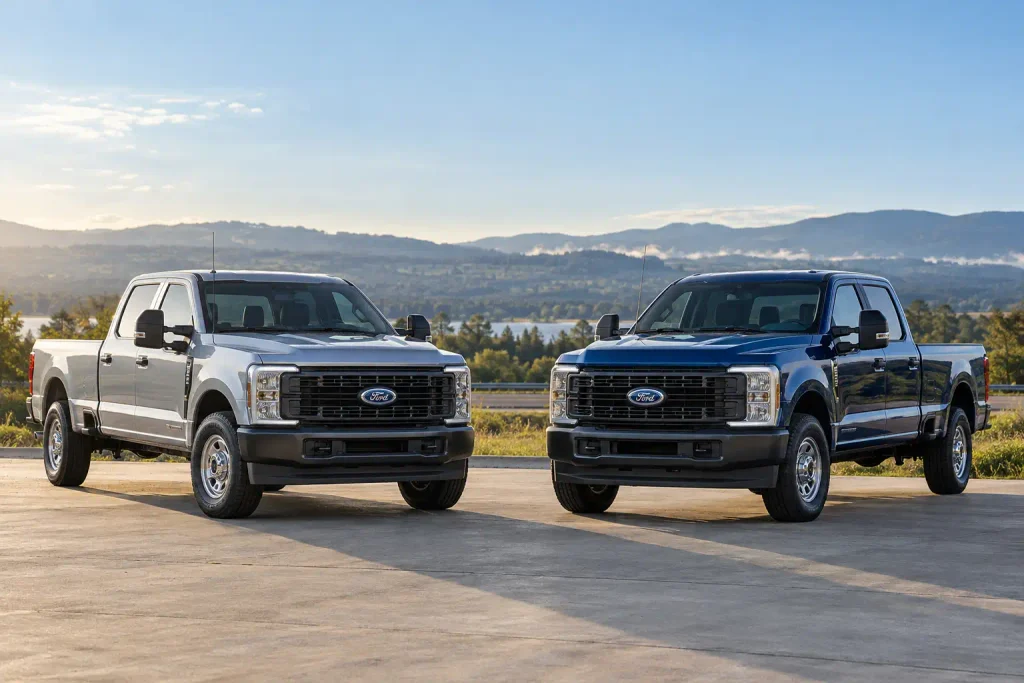
Choose an F-350 single-rear-wheel (SRW) when that same load exceeds an appropriate F-250’s limits. Consider an F-350 dual-rear-wheel (DRW) when you need its higher-rated configurations and can accept a wider truck.
We will compare Ford’s 2026 numbers against real loading needs.
Why the 2026 F250 vs F350 Choice Matters
Recommended Best Deal Products


Both trucks share Super Duty engines and cab styles, but their configuration-specific weight ratings differ.
The terms three-quarter-ton for the F-250 and one-ton for the F-350 are traditional class names, not literal payload guarantees. A truck’s usable payload depends on its gross vehicle weight rating (GVWR) and the weight of that particular truck with its equipment.
There are also two distinct F-350 choices. An F-350 SRW has one tire on each side of its rear axle, like the F-250. An F-350 DRW, often called a dually, has two rear tires per side and is available in higher-capacity towing and hauling configurations.
Buy enough rated capability without needless size or cost.
Why 2026 F250 and F350 Towing Maximums Mislead Buyers
A maximum towing claim describes a properly equipped configuration under specified conditions. It does not mean every truck wearing that badge can tow the same trailer. Engine, axle ratio, cab, 4×2 or 4×4 drivetrain, tire and equipment packages, and installed options can change the rating.
Ford publishes separate conventional and fifth-wheel/gooseneck towing tables. These ratings differ. The official 2026 Ford Super Duty towing guide also requires the truck to remain within its payload-related limits, rear gross axle weight rating (GAWR), GVWR, and gross combined weight rating (GCWR).
Here is a useful matched example from Ford’s conventional towing tables:
- F-250 SRW: 16,200 lb maximum loaded trailer weight.
- F-350 SRW: 20,000 lb maximum loaded trailer weight.
Both figures refer to a 2026 Regular Cab, 4×4, 8-foot bed, standard-output 6.7L Power Stroke V8 Turbo Diesel, 3.31 rear axle configuration. They are not universal ratings, and the actual truck still needs its payload and equipment verified.
The 3,800 lb difference matters near the F-250 limit, but it does not automatically justify an F-350 for lighter loads. See our Ford towing capacity chart for additional models.
Which 4 Ratings Decide Between F250 and F350
Recommended Best Deal Products


The right purchase depends on four checks. Trailer rating alone answers only part of the question.
Loaded Trailer and Hitch Weight
Use loaded trailer weight, including supplies, water and equipment. Brochure dry weight is not a substitute.
Tongue weight on a conventional hitch and pin weight in a fifth-wheel hitch both consume truck payload.
Ford uses 10% conventional tongue weight and 15% fifth-wheel/gooseneck pin weight in its guidance. Actual loads can be higher.
Available Payload After Passengers
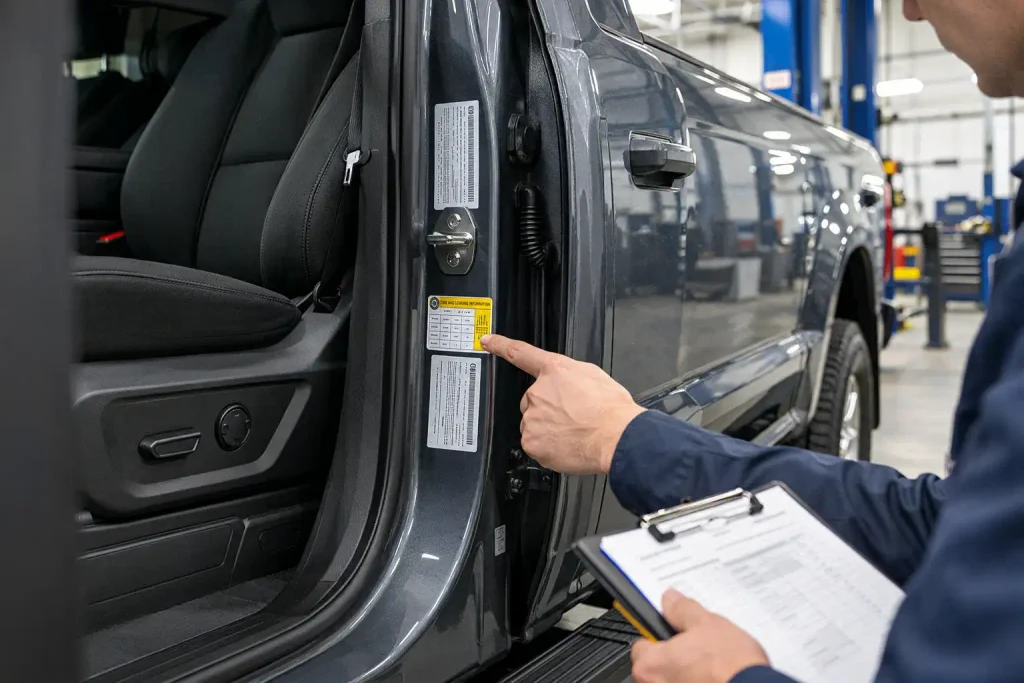
Check the Tire and Loading Information label on the driver’s door jamb. It gives a vehicle-specific combined occupant-and-cargo limit. Passengers, tools, extra accessories, the fifth-wheel hitch, and trailer tongue or pin weight all draw from that allowance.
Consider a hypothetical 16,000 lb loaded fifth-wheel. At a measured 20% pin weight, it puts 3,200 lb on the truck. Add 400 lb of occupants, a 200 lb hitch, and 250 lb of gear. The total load carried by the pickup becomes 4,050 lb.
An example truck with a 3,000 lb payload label would be 1,050 lb over its stated payload before considering other limits. An example truck with a 4,500 lb label would have 450 lb remaining by this calculation, but rear axle, tire, hitch, and combined ratings must still pass. Those two label values are illustrative, not published specifications for named trims.
At 15% pin weight, the same trailer would instead impose 2,400 lb at the hitch and 3,250 lb total under the same occupant and gear assumptions. This range shows why a measured loaded pin weight changes the buying decision.
Rear Axle and Combined Ratings
GVWR limits loaded truck weight; rear GAWR limits rear-axle load; GCWR limits combined truck-and-trailer weight.
Meeting tow rating is insufficient if payload or rear GAWR is exceeded. Verify labels, tires and hitch limits; weigh the loaded combination.
Cab Engine and Axle Configuration
Ford offers the 2026 Super Duty range with a 6.8L gas V8, 7.3L gas V8, 6.7L Power Stroke V8 Turbo Diesel, and high-output 6.7L Power Stroke V8 Turbo Diesel. The powertrain affects performance and equipment weight.
The 2026 Ford technical specifications list 405 hp for the 6.8L gas V8, 430 hp for the 7.3L gas V8, 475 hp and 1,050 lb-ft for the standard-output diesel, and 500 hp and 1,200 lb-ft for the high-output diesel. Availability depends on the selected truck and trim.
Do not assign a diesel Crew Cab the payload rating of a lighter gas Regular Cab.
When the 2026 F250 Is the Better Buy
The F-250 is the sensible choice when its actual ratings meet your towing and hauling requirements. It can suit travel trailers, boats, utility trailers, and work cargo within its limits.
Buy an F250 for These Loads
Start with the F-250 if the trailer’s loaded weight is comfortably within the applicable towing rating and its tongue or pin weight fits the vehicle-specific payload allowance. Include every passenger, the hitch, tools, a bed cover, and any other gear. Confirm rear GAWR and GCWR separately.
Ford publishes fifth-wheel ratings for the F-250; compatible, appropriately loaded trailers can be within those limits.
Daily drivers should prioritize their needed configuration and test-drive it unloaded.
When an F250 Stops Making Sense
Cross the F-250 off your shortlist when the intended trailer exceeds the truck’s applicable trailer rating, its loaded pin weight uses more than the available payload, or the combined setup fails any axle or weight limit.
Do not assume an upgrade package fixes every limitation. Ford identifies a High-Capacity Axle Upgrade Package requirement for certain F-250 towing configurations above 18,200 lb. Check the exact equipment and rating row before ordering.
When the 2026 F350 SRW Is Worth Buying
Recommended Best Deal Products


The F-350 SRW is the stronger choice when you need a higher-rated single-rear-wheel pickup. Its appeal is additional available carrying and towing capacity in configurations that can retain dimensions comparable to an F-250 with the same cab and bed.
Higher Payload Without Dual Rear Wheels
For fifth-wheel owners and crews hauling heavy material, the limiting factor is often what the truck carries, not what the engine can pull. Suitable F-350 SRW configurations can provide more rated capacity than comparable F-250 configurations.
The key word is suitable. A heavily equipped F-350 can have less available cargo allowance than a different, lighter F-350 configuration. Compare the door labels of the actual trucks in stock. Our Ford F-350 payload capacity chart explains why year, engine, cab, and equipment matter.
Fifth Wheel Buyers Who Need More Capacity
Choose an F-350 SRW when measured or conservatively calculated pin weight makes the F-250 unsuitable and the single-rear-wheel F-350 satisfies every rating. Passengers, hitch hardware, and bed cargo increase the carrying demand.
A future camper upgrade can also justify shopping the F-350 now. Use the planned trailer’s realistic loaded weight and pin weight, not a guess about what you might buy someday. If neither SRW passes, consider a DRW configuration.
2026 F250 vs F350 Specs and Costs Compared
Price is closer than some buyers expect, but capacity does not rise uniformly from one configuration to the next. Ford’s 2026 Super Duty model lineup lists the F-250 XL from $45,975 and the F-350 XL from $47,270, a $1,295 starting-MSRP difference. Those are model starting prices, not dealer offers or equally optioned quotes.
| Buying Factor | F-250 SRW | F-350 SRW | F-350 DRW |
|---|---|---|---|
| Rear tires | One per side | One per side | Two per side |
| Starting XL MSRP | $45,975 | $47,270 for F-350 XL model family | Price a specific DRW build |
| Conventional receiver limit in Ford guide | Up to 22,000 lb | Up to 25,000 lb | Up to 28,000 lb |
| Real trailer rating | Depends on exact build | Depends on exact build | Depends on exact build |
| Available payload | Vehicle-specific | Vehicle-specific | Vehicle-specific |
| Cab and bed footprint | Configuration-dependent | Can match F-250 SRW | Wider rear body |
| Primary reason to buy | Requirements already fit | More rated capacity without dual rear wheels | Higher-capacity applications needing DRW |
The hitch receiver figures are Ford’s maximum receiver ratings, not guaranteed tow ratings for each truck. The lower applicable truck, hitch, trailer, axle, or combined limit governs. The F-350 starting MSRP is a model-level figure, not a verified DRW-specific quote.
For a tightly matched Regular Cab 4×4, 8-foot-bed, 6.7L standard-output diesel, 3.31 axle comparison, Ford’s conventional towing selector lists 16,200 lb for F-250 SRW versus 20,000 lb for F-350 SRW. That is a specific 3,800 lb advantage for the F-350, not a rule for all Super Duty trucks.
The lineup’s advertised 40,000 lb gooseneck maximum and 8,000 lb payload maximum belong to qualifying configurations, not a typical F-350 diesel Crew Cab.
Ride comfort is more nuanced than badge choice. Both F-250 and F-350 use independent twin I-beam front suspension in 4×2 form and a solid Mono-Beam front axle in 4×4 form. Their rear suspension uses a solid axle and leaf springs. Spring ratings, tires, pressures, wheelbase, and load change how a particular truck rides. Judge ride comfort from the exact trucks, not outdated comparisons.
Insurance and registration vary by state, use, and specification. Get quotes for the actual truck; avoid assumed national cost differences.
F250 vs F350 Which to Buy in 2026
There is no useful universal trailer-weight cutoff that automatically separates F-250 from F-350 buyers. Make the recommendation from your loaded numbers.
Choose the F-250 if its applicable trailer rating, payload label, GVWR, rear GAWR, GCWR, tire limits, and hitch equipment cover your heaviest use. This is the practical choice for buyers who do not need the F-350’s additional rated capability.
Choose the F-350 SRW if a suitable F-250 fails one of those tests but the single-rear-wheel F-350 passes them. This is often the next candidate for heavier fifth-wheel pin loads or regular hauling with passengers and equipment.
Choose an F-350 DRW if the load calls for a qualifying dual-rear-wheel configuration, especially when higher rear-axle capacity is necessary. Accept that its wider rear body changes parking and maneuvering.
Before signing, use this purchase check:
- Record the trailer’s expected loaded weight and actual or defensible pin/tongue weight.
- Add the weight of passengers, hitch hardware, accessories, and cargo the truck carries.
- Compare that total with the exact truck’s occupant-and-cargo label and GVWR.
- Check front and rear axle loads, GCWR, tires, hitch ratings, and the correct Ford towing row.
- Compare similarly equipped F-250 and F-350 quotes, then drive both unloaded if daily comfort matters.
If the numbers are close to a limit, leave room for realistic changes in cargo and trailer loading rather than treating a published maximum as your regular operating target.
When an F350 Dually Changes the Recommendation
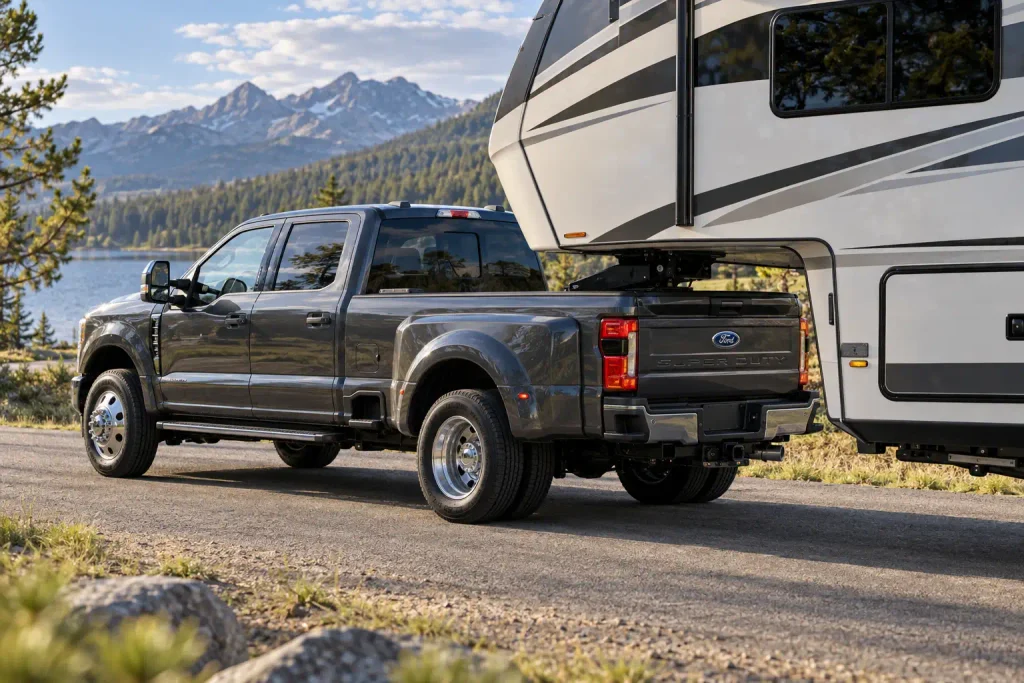
Consider an F-350 DRW when higher-capacity fifth-wheel, gooseneck, or bed hauling requires it.
When Dual Rear Wheels Help
A dually may be the right answer after the actual loaded pin weight, rear axle load, and truck-and-trailer ratings rule out suitable SRW pickups. Compare a specific F-350 DRW build against the real job. Do not assume every dually has the same capacity, especially across different engines, cabs, and equipment.
If a suitable SRW passes all ratings, DRW is optional, not mandatory.
What Dually Ownership Costs
Compared with a similar SRW pickup, the dually’s wide rear fenders demand more clearance in parking spaces, driveways, and tight access roads. It also has six road tires rather than four, affecting replacement planning.
If you regularly park in tight spaces and a suitable SRW passes all limits, it may be more practical.
Which 2026 Super Duty Should You Buy
For the F250 vs F350 which to buy decision, start with the total load the pickup must carry, then check the trailer and axle ratings. The F-250 is a sound buy when its specific ratings are sufficient. The F-350 SRW earns its higher price when its extra available capacity solves a real limitation. A dually is for buyers whose requirements point to a suitable DRW configuration and who can manage its extra width.
Do not substitute an advertised maximum or an engine’s horsepower for a door-label payload figure. Get the exact truck specifications, confirm the trailer’s loaded weight, and compare both trucks with the same cab and equipment. That final check is more useful than choosing by badge alone.
F250 vs F350 Buying Questions for 2026
Is an F350 Worth the Extra Money Over an F250?
Yes, if the extra rated capability of a suitable F-350 is needed for your real load. The 2026 F-350 XL starts $1,295 above the F-250 XL, but options and dealer quotes can change the difference. If a correctly equipped F-250 already meets every rating, the upgrade may deliver no practical benefit.
Does an F350 Ride Rougher Than an F250?
Not necessarily. Suspension rates, tire choice and pressure, bed and cab configuration, and the presence of a load all influence ride. Both models use the same basic front-suspension type when the drivetrains match. Test-drive the exact configurations instead of assuming a particular badge guarantees a softer or harsher ride.
Should I Buy an F250 or F350 for a Fifth Wheel?
Buy whichever truck safely supports the fifth-wheel’s loaded pin weight, passengers, hitch, and cargo while satisfying towing, GVWR, rear GAWR, and GCWR limits. An F-250 can tow some fifth-wheels. A heavier combination may require an F-350 SRW or DRW, depending on the particular ratings.
Is the F350 More Expensive to Insure and Register?
It can be, but the difference is not uniform across the United States. Insurers consider the driver, location, vehicle, coverage, and use; registration rules also differ by state and rated weight. Get comparable quotes and check your state’s DMV requirements before making price a deciding factor.
Does an F250 Have the Same Engine as an F350?
The 2026 F-250 and F-350 share several engine offerings, including the 6.8L gas V8, 7.3L gas V8, and 6.7L Power Stroke V8 Turbo Diesel family, subject to configuration availability. Sharing an engine does not mean sharing the same GVWR, axle ratings, payload, or trailer rating. Always compare the full specification.