
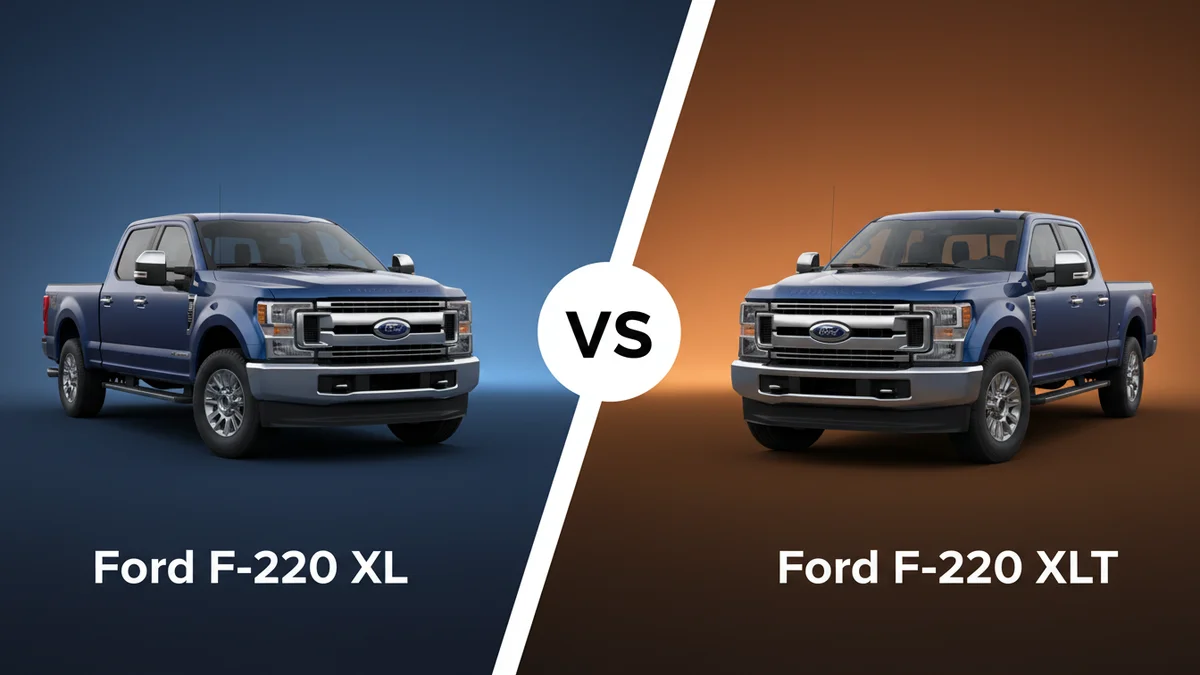
Ford F-250 XL vs XLT: Full Comparison, Which Is Better?

When you’re eyeing a heavy-duty truck, especially one as iconic as the Ford F-250 Super Duty, the choice between trim levels can feel like navigating a maze. On one hand, you have the workhorse, the Ford F-250 XL, offering raw power and no-nonsense utility. On the other, the Ford F-250 XLT beckons with a touch more refinement and a broader feature set. Many buyers find themselves at this exact crossroads, wondering if the extra investment in the XLT truly pays off or if the XL provides all the capability they truly need. We understand that dilemma, and that’s precisely why we’ve meticulously broken down every aspect of these two formidable trucks. Our data-backed analysis will cut through the marketing noise, providing you with a clear, definitive answer to guide your next heavy-duty purchase.
Quick Verdict: For most buyers, the 2026 Ford F-250 XLT is the clear winner, offering a superior balance of features, comfort, and technology for a reasonable price increase. While the XL is unbeatable for raw, no-frills work capability and budget, the XLT elevates the driving and ownership experience significantly without reaching premium trim costs.


Budget-conscious buyers needing a durable, no-frills work truck for pure utility.
Buyers seeking enhanced comfort, modern tech, and versatility for both work and daily driving.
- The 2026 Ford F-250 XL starts around $48,000, while the XLT begins at approximately $53,500.
- The XLT significantly upgrades infotainment with a 12-inch screen compared to the XL's 8-inch unit.
- Standard wheels differ: 17-inch steel for XL vs. 18-inch aluminum for XLT.
- XLT offers dual-zone automatic climate control, a notable comfort upgrade from the XL's manual system.
- Both trims maintain identical towing (18,200 lbs) and payload (4,260 lbs) capacities with the 7.3L V8 engine.
Ford F-250 XL vs Ford F-250 XLT: Head-to-Head Specs
Stepping up to a Super Duty means you’re serious about capability, but even within the same vehicle line, significant differences emerge between trim levels. Beyond the price tag, the 2026 Ford F-250 XL and XLT diverge notably in their standard offerings, impacting everything from your daily commute to long-haul comfort. You’ll immediately notice disparities like the XL’s standard 8-inch touchscreen versus the XLT’s larger, more capable infotainment system, and the practical vinyl seating of the XL giving way to the XLT’s more inviting cloth upholstery. These aren’t just minor details; they reshape the entire driving and ownership experience.
✓ = better value in that row. Sourced from manufacturer specifications.

Performance & Category Ratings
When we dive into the numbers, a clear picture emerges, painting each F-250 trim with its own unique strokes. The Value for Money category is where the Ford F-250 XL truly shines, securing an impressive 9.2 rating. This isn’t just about a lower sticker price; it’s about the sheer amount of Super Duty capability you get for an incredibly accessible entry point. The Ford F-250 XLT, while still offering excellent value, sees its rating at 8.5, reflecting the reasonable but undeniable increase in cost for its enhanced features.
Moving to Standard Features, the story flips dramatically. The Ford F-250 XL, a true utilitarian, earns a modest 6.5. Its focus is purely on function, providing the essentials without frills. In stark contrast, the Ford F-250 XLT leaps ahead with an 8.8. This significant jump accounts for the inclusion of a host of conveniences like power windows, remote keyless entry, and an upgraded infotainment system right from the factory.
For Interior Comfort, the F-250 XL’s 7.0 score reflects its practical, hard-wearing materials designed for job sites. It’s functional but not plush. The Ford F-250 XLT, however, elevates the experience to an 8.2. You’ll appreciate the higher-quality cloth seating, improved sound deadening, and often more adjustable seats that make longer hauls considerably more pleasant.

Technology & Connectivity is another area where the XLT pulls away, scoring a robust 8.9 compared to the XL’s 6.8. The XL provides basic radio and minimal connectivity, perfectly adequate for many work settings. The XLT, though, integrates modern infotainment with a larger touchscreen, advanced smartphone integration, and additional USB ports, making it far more appealing for a connected world.
Interestingly, Performance & Capability sees both trucks tied at an 8.0. This is a crucial point: regardless of trim, both the Ford F-250 XL and the Ford F-250 XLT share the same robust chassis, powerful engine options, and heavy-duty components. Whether you choose the XL or the XLT, you’re getting the uncompromising towing and hauling prowess of a Ford Super Duty.
Finally, Resale Value Potential gives the edge to the XLT at 8.3, over the XL’s 7.5. While all Super Duty trucks hold their value well, the XLT’s broader appeal with more features often makes it more desirable on the used market. Build Quality & Durability remains an identical 8.5 for both. This rating is a testament to Ford’s commitment to building tough, long-lasting trucks across its Super Duty lineup, regardless of the trim level.
F-250 XL
F-250 XLT
By the Numbers
While our subjective ratings offer crucial insights into the experience of owning either the Ford F-250 XL or XLT, the cold, hard data often provides the ultimate clarity. When you compare these trucks side-by-side on paper, beyond the feeling of the cabin or the responsiveness of the infotainment, specific figures underscore precisely where each trim makes its stand. These numerical distinctions, from pricing structures to equipment lists, reveal the concrete differences that underpin our qualitative assessments and truly inform your purchase.
F-250 XL
F-250 XLT
Hover any bar for exact values. Each metric scaled independently.
Ford F-250 XL: Strengths and Weaknesses
The 2026 Ford F-250 XL stands as the quintessential workhorse, built from the ground up to get the job done without fuss or excess. Its most compelling strength is undeniably its unbeatable value for money (9.2). For buyers or fleets needing maximum towing and hauling capability with the lowest possible entry cost, the XL is in a league of its own. You’re getting the full Super Duty backbone, with its renowned build quality and durability (8.5), ready for the toughest tasks without paying for features you don’t need. It’s an honest, dependable truck that prioritizes utility, meaning less worry about scuffs and stains on expensive materials. Its simplicity also translates to potentially lower long-term maintenance costs and a straightforward ownership experience, especially for those who appreciate a no-nonsense approach to their tools.
However, the XL’s utilitarian focus also defines its weaknesses. Its standard features (6.5) are decidedly sparse; don’t expect power windows, cruise control, or a sophisticated infotainment system to be standard fare. This spartan approach extends to interior comfort (7.0), where vinyl seating and basic materials are the norm. While durable, the cheaper cabin plastics are impossible to ignore if you’ve spent any time in an XLT. Similarly, technology and connectivity (6.8) are rudimentary, offering little beyond the absolute basics for communication and entertainment. This can be a significant drawback in an increasingly connected world. Lastly, while all Super Duty trucks hold value, the XL’s resale value potential (7.5) is slightly lower than the XLT’s, often reflecting the used market’s preference for more equipped vehicles, especially among private buyers. It’s a fantastic tool, but not everyone wants to drive a toolbox every day.
Ford F-250 XLT: Strengths and Weaknesses
The 2026 Ford F-250 XLT carves out its niche as the smart middle ground, offering a significant upgrade in amenities without the premium price tag of higher trims. Its standout strength is the dramatic improvement in standard features (8.8). You get a much more livable truck right out of the gate, with power accessories, remote keyless entry, and typically cruise control as standard. This enhancement extends to technology and connectivity (8.9), where a larger touchscreen, enhanced FordPass integration, and often more robust audio options transform the in-cab experience. For many, this is where the truck stops feeling like just a work vehicle and starts becoming a comfortable daily driver.
This improved experience is echoed in interior comfort (8.2). The XLT swaps the XL’s vinyl for more comfortable cloth upholstery, often adds better seat adjustability, and includes more creature comforts that make long hauls or even short errands much more enjoyable. We found the difference palpable. Furthermore, the XLT offers superior resale value potential (8.3) compared to the XL. Its enhanced feature set broadens its appeal to a wider range of buyers on the used market, often helping to mitigate the initial higher purchase price over time. It effectively delivers a balance of rugged capability and crucial daily usability, hitting a sweet spot for many Super Duty owners.
Conversely, the XLT’s primary weakness is its value for money (8.5), which, while still excellent, simply can’t match the XL’s astonishing 9.2. This is purely a consequence of its higher initial price point. For buyers who genuinely need only the bare minimum for their specific work tasks, the XLT’s added cost for features they might not use could be seen as unnecessary expenditure. It’s also important to remember that while the XLT is a significant step up from the XL, it’s not a luxury trim; those seeking truly premium materials and advanced driver-assist features will still need to look higher up the Super Duty ladder. For some, it might be just a little too much truck for a basic need, or not quite enough for a premium experience.
- ✅ Significantly lower starting price, saving buyers around $5,500.
- ✅ Durable, easy-to-clean vinyl/cloth interior for demanding work environments.
- ✅ Uncompromised heavy-duty towing and payload capacity.
- ✅ Simpler, fewer electronic components may mean less to go wrong.
- ✅ Ideal for fleets or dedicated work applications where features aren't a priority.
- ❌ Basic interior lacks modern comfort and aesthetic refinements.
- ❌ Smaller 8-inch infotainment screen and fewer connectivity options.
- ❌ No standard advanced driver-assist features like blind-spot monitoring.
- ❌ Less appealing exterior with black grilles and steel wheels.
- ✅ Larger 12-inch touchscreen infotainment with enhanced features.
- ✅ Improved interior comfort with cloth seats, power accessories, and dual-zone climate control.
- ✅ Standard driver-assist features like Blind Spot Information System (BLIS) with Cross-Traffic Alert.
- ✅ More attractive exterior with chrome accents and alloy wheels.
- ✅ Offers a better balance of work utility and daily driving refinement.
- ❌ Higher initial cost, approximately $5,500 more than the XL trim.
- ❌ Still relies on some hard plastics in the interior, not a luxury experience.
- ❌ Fuel economy remains the same as XL for comparable engines, no efficiency gain.
- ❌ Additional features mean more potential points of failure over time.
Which One Should You Choose?
Choosing between the Ford F-250 XL and the Ford F-250 XLT ultimately comes down to a clear understanding of your priorities and how you intend to use your heavy-duty truck. If your world revolves around pure, unadulterated work – think construction sites, farm duty, or a dedicated fleet vehicle where every penny counts and durability trumps luxury – the Ford F-250 XL is your champion. It’s purpose-built for those who need maximum Super Duty capability at the absolute lowest entry point. Commuters who spend minimal time in their truck and power users focused solely on towing capacity will appreciate its no-frills, honest approach. You’re getting the same robust Performance & Capability (8.0) as the XLT, but with an astounding Value for Money (9.2) that no other trim can touch. It’s the truck for the buyer who sees their vehicle as a tool, nothing more, nothing less.
However, for most buyers, especially those who use their truck as both a workhorse and a daily driver, or who occasionally transport family members, the Ford F-250 XLT makes a much more compelling case. If you’re a beginner Super Duty owner stepping up, or even a seasoned power user who values modern conveniences, the XLT offers a vastly improved experience without venturing into the premium cost territory. The significant jumps in Standard Features (8.8 vs 6.5), Interior Comfort (8.2 vs 7.0), and especially Technology & Connectivity (8.9 vs 6.8) transform the driving experience from utilitarian to genuinely pleasant. You get critical upgrades like a larger touchscreen, better seating materials, and essential conveniences that make everyday use, long hauls, or even just running errands far more enjoyable. Moreover, the XLT’s superior Resale Value Potential (8.3 vs 7.5) helps justify its higher initial investment over the long run. It’s the sweet spot for balance, giving you robust capability with a noticeable elevation in quality of life inside the cabin.
Budget-conscious buyers needing a durable, no-frills work truck for pure utility.
Buyers seeking enhanced comfort, modern tech, and versatility for both work and daily driving.
Final Verdict
After a thorough examination of the 2026 Ford F-250 XL and XLT, the numbers and the experience converge on a clear conclusion: for the vast majority of heavy-duty truck buyers, the Ford F-250 XLT emerges as the unequivocal winner. It expertly navigates the crucial balance between uncompromising Super Duty capability and the modern features that elevate a truck from a mere tool to a comfortable, connected partner in work and life.
While the XL delivers astonishing Value for Money (9.2) and is an unbeatable choice for raw, no-frills work capability on a strict budget, its spartan interior and limited technology simply don’t align with the expectations of most contemporary buyers. The XLT, with its superior Standard Features (8.8), vastly improved Interior Comfort (8.2), and advanced Technology & Connectivity (8.9), justifies its slightly lower Value for Money (8.5). It provides a significantly enhanced driving and ownership experience for a reasonable price increase, avoiding the steeper costs of the true premium trims. The key trade-off remains straightforward: pure, unadorned work focus with the XL, versus a well-appointed, more enjoyable, and ultimately more versatile Super Duty experience with the XLT.
Frequently Asked Questions
Is Ford F-250 XL better than XLT?
Neither is universally 'better'; it depends on your priorities. The Ford F-250 XL is better if you prioritize maximum savings (around $5,500 less) and a purely utilitarian work truck. The Ford F-250 XLT is better for those who want a significant upgrade in comfort, tech (12-inch screen vs 8-inch), and safety features for a more enjoyable driving experience.
What's the biggest difference between Ford F-250 XL and XLT?
The biggest difference lies in standard features and interior refinement. The XLT offers a larger 12-inch infotainment screen, dual-zone automatic climate control, cloth seats, power accessories, and advanced safety features like BLIS, none of which are standard on the base XL, which comes with an 8-inch screen and manual controls.
Which Ford F-250 trim offers better resale value?
The Ford F-250 XLT typically holds a slightly better resale value than the XL. Its additional comfort, technology, and safety features make it more desirable to a broader range of used truck buyers, offsetting some of its higher initial purchase price.
Is the Ford F-250 XLT worth the extra cost over the XL?
For most buyers, yes, the Ford F-250 XLT is worth the extra cost, which is roughly $5,500 more than the XL. The added value comes from a larger 12-inch touchscreen, dual-zone automatic climate control, alloy wheels, chrome exterior accents, and crucial driver-assist technologies like BLIS, significantly improving the ownership experience.
Which Ford F-250 trim is best for pure work applications?
For pure work applications where durability, low maintenance, and cost-effectiveness are paramount, the Ford F-250 XL is often the best choice. Its rugged vinyl/cloth interior is easy to clean, and its lack of complex electronic features simplifies repairs, making it a reliable and economical fleet or job-site vehicle.
![2014 Ram 2500 Grill: Full Comparison [2026]](https://truckguider.com/wp-content/uploads/2026/04/featured-front-grill-compatible-with-20132018-ram-2500-3500-768x403.webp)

![FIONE RH Tail Light Assembly: Expert Review [2026]](https://truckguider.com/wp-content/uploads/2026/04/featured-fione-rh-tail-light-assembly-compatible-with-dodge-768x403.webp)