Ford F-150 Curb Weight Chart: 2004-2026 Year, Cab & Engine

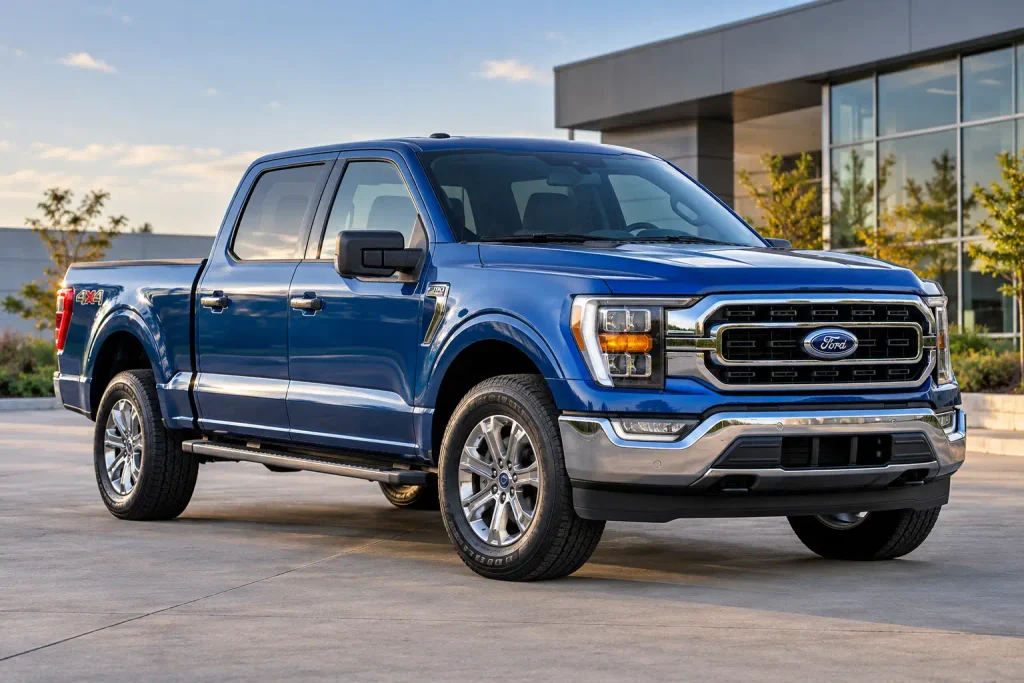
A Ford F-150 curb weight chart is useful only when the weight is tied to the right model year and truck configuration. For example, Ford lists a 2021 F-150 Regular Cab with the 3.3L V6 at 4,021 pounds, while a 2021 SuperCrew with the 3.5L PowerBoost hybrid can weigh 5,540 pounds in a different configuration.
Cab style, bed length, engine, drivetrain, and factory equipment all affect the number. The chart below gives a documented example for each model year from 2004 through 2026, and configuration comparisons. These are curb weights, not GVWR figures.


How Much Weight Does 4WD Add?
Compare three matched Ford F-150 configurations. Each pair uses the same engine, cab and wheelbase, changing only the listed 4×2 or 4×4 specification.
Regular Cab
3.3L V6 | shorter wheelbase
SuperCrew
5.0L Ti-VCT V8 | shorter wheelbase
SuperCrew Hybrid
3.5L PowerBoost V6 | shorter wheelbase
Ford F-150 Curb Weight Chart by Year Through 2026
The table shows one published configuration per year, not the minimum or maximum weight of every F-150 sold that year. A Regular Cab 4×2 and SuperCrew 4×4 can have different curb weights.
| Model Year | Example Curb Weight | Documented Configuration | Data Basis |
|---|---|---|---|
| 2026 | 4,220 lb | Regular Cab, 6.5-ft bed, 2WD | Configuration database |
| 2025 | 4,220 lb | Regular Cab, 6.5-ft bed, 2WD | Configuration database |
| 2024 | 4,220 lb | Regular Cab, 6.5-ft bed, 2WD | Configuration database |
| 2023 | 4,019 lb | Regular Cab, 6.5-ft bed, 2WD | Configuration database |
| 2022 | 4,021 lb | XL Regular Cab, 3.3L V6, 6.5-ft bed, 2WD | Trim-level listing |
| 2021 | 4,021 lb | Regular Cab, 3.3L V6, 4×2, standard wheelbase | Ford technical specifications |
| 2020 | 4,069 lb | XL Regular Cab, 3.3L V6, 6.5-ft bed, 2WD | Trim-level listing |
| 2019 | 4,069 lb | XL Regular Cab, 3.3L V6, RWD | Trim-level listing |
| 2018 | 4,069 lb | XL Regular Cab, 3.3L V6, RWD | Trim-level listing |
| 2017 | 4,051 lb | XL Regular Cab, 3.5L V6, RWD | Trim-level listing |
| 2016 | 4,150 lb | XL Regular Cab, 3.5L V6, RWD | Trim-level listing |
| 2015 | 4,154 lb | XL Regular Cab, 3.5L V6, RWD | Trim-level listing |
| 2014 | 4,764 lb | XL Regular Cab, 3.7L V6, RWD | Trim-level listing |
| 2013 | 4,685 lb | XL Regular Cab, 3.7L V6, RWD | Trim-level listing |
| 2012 | 4,685 lb | XL Regular Cab, 3.7L V6, RWD | Trim-level listing |
| 2011 | 4,685 lb | XL Regular Cab, 3.7L V6, RWD | Trim-level listing |
| 2010 | 4,693 lb | XL Regular Cab, 4.6L V8, RWD | Trim-level listing |
| 2009 | 4,707 lb | XL Regular Cab, 4.6L V8, RWD | Trim-level listing |
| 2008 | 4,524 lb | STX Regular Cab, 4.2L V6, RWD | Trim-level listing |
| 2007 | 4,557 lb | STX Regular Cab, 4.2L V6, RWD | Trim-level listing |
| 2006 | 4,525 lb | STX Regular Cab, 4.2L V6, RWD | Trim-level listing |
| 2005 | 4,615 lb | STX Regular Cab, 4.2L V6, RWD | Trim-level listing |
| 2004 | 4,758 lb | XL Regular Cab, 4.6L V8, RWD, redesigned body | Trim-level listing |
How to read the chart: All figures are pounds. The 2023–2026 configuration database identifies the body, bed, and drive layout but does not specify the engine in these particular rows. Do not assume its figures apply to every engine or trim with the same cab. The 2004 example refers to the redesigned F-150, not the separately sold Heritage body style.
Historical trim examples were checked against AutoPadre’s F-150 weight listings. Recent body-configuration examples were checked against AutoSpecData’s F-150 curb-weight table. The 2021 entry is independently documented by Ford. These are illustrative published weights, not a claimed factory-certified full-lineup minimum-to-maximum range.
For a 2026 comparison, the configuration database lists a Regular Cab 6.5-foot-bed 2WD pickup at 4,220 pounds and a Raptor R SuperCrew 4×4 at 5,950 pounds. Those trucks differ in much more than their number of driven wheels. The difference must not be interpreted as the weight added by 4WD alone.
How Much Did Older Ford F-150 Trucks Weigh
Older F-150s also varied widely by body style and equipment. As two documented examples, a 2002 Regular Cab XLT with the 4.2L V6 and rear-wheel drive is listed at 3,923 pounds. A 2003 Regular Cab XLT with the 4.2L V6 and rear-wheel drive is listed at 4,032 pounds.
These are examples, not complete weight ranges for their respective years. For 1975–2001 pickups, compare the original model-year brochure, wheelbase, engine, and drivetrain before using a historical weight figure. The 2004 Heritage and redesigned trucks also differ.
For newer pickups, differences between cab sizes are easier to isolate using Ford’s detailed specification tables.
How Cab and Bed Size Change F-150 Weight
An F-150 Regular Cab generally has less cab structure than a SuperCab or SuperCrew. Bed length and wheelbase also matter, so a larger cab does not automatically mean that two trucks are otherwise equivalent.
Regular Cab Weight Differences
Ford lists the 2021 Regular Cab 3.3L V6 with the shorter wheelbase and 4×2 drivetrain at 4,021 pounds. A longer-wheelbase Regular Cab with the same engine and drive layout is listed at 4,122 pounds, a difference of 101 pounds.


SuperCab Weight Differences
The 2021 SuperCab with the 3.3L V6 and 4×2 drivetrain is listed at 4,345 pounds in Ford’s shorter SuperCab configuration. This is heavier than the Regular Cab example, although the wheelbases and bed arrangements are not identical.
SuperCrew Weight Differences
The 2021 SuperCrew 3.3L V6 4×2 example weighs 4,465 pounds. Compared with the 4,021-pound Regular Cab example, that is 444 pounds more, but the difference reflects the complete body and wheelbase configurations, not just the extra doors.
Ford’s 2021 F-150 technical specifications provide the supporting cab, powertrain, and curb-weight figures. For the same model year, compare the full column headings before selecting a number.
How F-150 Engine Choices Change Curb Weight
Engine comparisons become meaningful when the cab, bed, and drivetrain are held constant. Ford’s 2021 SuperCrew 4×2 figures provide several examples from the same body configuration.
| 2021 F-150 SuperCrew Powertrain | Base Curb Weight |
|---|---|
| 2.7L EcoBoost V6 | 4,584 lb |
| 5.0L Ti-VCT V8 | 4,661 lb |
| 3.5L EcoBoost V6 | 4,696 lb |
| 3.5L PowerBoost Full Hybrid V6 | 5,260 lb |
These published examples use Ford’s shorter-wheelbase SuperCrew 4×2 configuration. The hybrid is 564 pounds heavier than the 3.5L EcoBoost non-hybrid example in this comparison. That figure is not a universal hybrid weight penalty across every F-150 model year.
The diesel-powered 3.0L Power Stroke V6 was also offered on earlier recent F-150 models, including 2021. Do not apply its historical weight to a current gasoline-only configuration or assume an engine remains available in every newer model year.
Engine weight is only one factor. Changing from rear-wheel drive to four-wheel drive also changes curb weight.
How Much Weight Does F-150 Four Wheel Drive Add
Four-wheel-drive F-150s need equipment that 4×2 trucks do not, including a front driveline and transfer-case system. The added equipment increases curb weight, but the increase depends on the exact configuration.
Ford’s 2021 specification examples show these differences:
| 2021 F-150 Configuration | 4×2 Weight | 4×4 Weight | Difference |
|---|---|---|---|
| Regular Cab, 3.3L V6, shorter wheelbase | 4,021 lb | 4,275 lb | +254 lb |
| SuperCrew, 5.0L V8, shorter wheelbase | 4,661 lb | 4,912 lb | +251 lb |
| SuperCrew, 3.5L PowerBoost Hybrid, shorter wheelbase | 5,260 lb | 5,517 lb | +257 lb |
These matched Ford examples show an increase of 251–257 pounds for the configurations listed. This is not a universal F-150 4WD weight allowance. Different model years, engines, suspension equipment, and wheelbases can produce other results.
A 4×4 system may also affect how much weight a truck can carry, depending on its Gross Vehicle Weight Rating and equipment. That relationship is explained below.
How Heavy Are the F-150 Raptor and Lightning
Off-road performance trucks and electric pickups should not be mixed into a single curb-weight range for conventional F-150 models.
F-150 Raptor Curb Weight
The configuration database reports 5,710 pounds for the 2026 F-150 Raptor SuperCrew 4×4 and 5,950 pounds for the 2026 Raptor R SuperCrew 4×4. These figures are database-listed configuration weights, not scale results for any particular customer’s truck.
Raptor models have specialized tires, suspension and other equipment. A Raptor’s weight should not be used as the reference value for an XL, XLT or Lariat pickup.


F-150 Lightning Curb Weight
The battery-electric F-150 Lightning differs significantly from gasoline models. Published 2022 examples include a 6,015-pound Lightning Pro with the standard-range battery and a 6,893-pound Lightning Platinum with the extended-range battery.
These figures depend on the Lightning’s battery and trim, and do not cover every model year.
The next distinction is just as important: a truck’s curb weight is not its maximum allowed loaded weight.
How Curb Weight Differs From F-150 GVWR and Payload
Base curb weight is the truck’s weight with standard equipment, fluids, and a full fuel tank, but without passengers, cargo, or optional equipment. Gross Vehicle Weight Rating (GVWR) is the maximum permitted weight of the loaded truck, as specified by Ford.
Gross Vehicle Weight (GVW) is what the truck actually weighs at a given moment. It includes the truck, people, accessories, and everything currently in the vehicle. Payload is the weight available for occupants and cargo, within the vehicle’s ratings.
A useful planning relationship is:
Available carrying capacity = GVWR − actual empty truck weight, subject to axle, tire, and manufacturer limits.
For example, a truck with a 7,000-pound GVWR that weighs 5,200 pounds in its current empty condition has 1,800 pounds of theoretical remaining GVWR capacity. This example is not a specific F-150 rating. Check the door-jamb occupant-and-cargo label.
For configuration-based maximum ratings, see TruckGuider’s Ford F-150 payload capacity chart. Payload, towing capacity, and curb weight answer different questions.
How to Find Your Actual Ford F-150 Weight
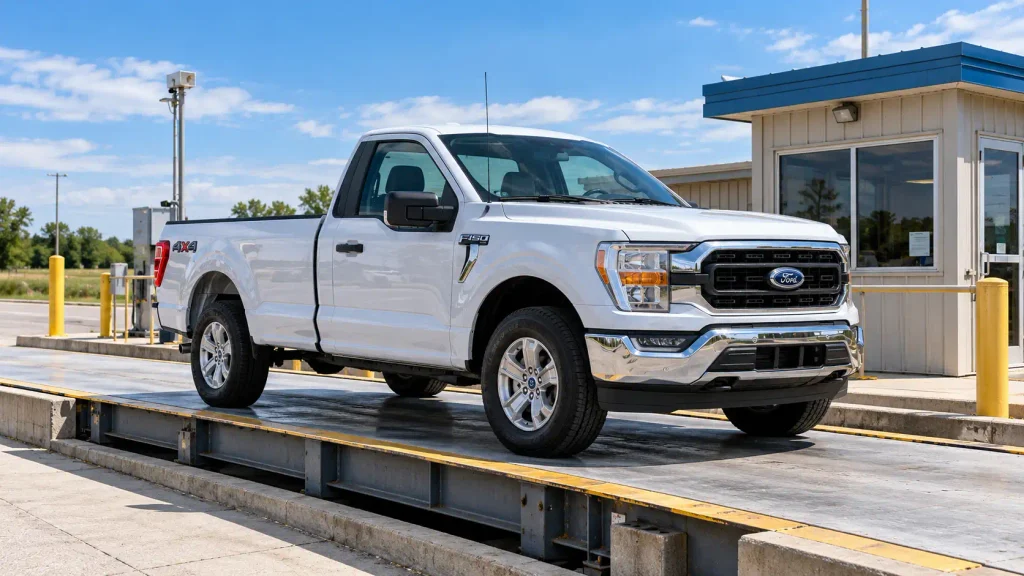
Factory base curb weight is a useful comparison number. Your truck may weigh more with factory options, aftermarket parts, a bed cover, tools, or other equipment installed.
- Identify the truck. Note the model year, cab, bed length, engine, 4×2 or 4×4 drivetrain, and relevant equipment packages.
- Check the matching specifications. Look for a Ford model-year weight table and use the column that matches your configuration. Do not rely only on a broad internet weight range.
- Read the driver’s door labels. The certification label provides GVWR and axle ratings. The tire and loading label identifies the vehicle’s occupant-and-cargo weight limit. Neither label is a substitute for weighing the truck.
- Use a suitable vehicle scale. Weigh the truck in the condition relevant to your question. For an empty-equipment baseline, remove unrelated cargo and record the fuel level and installed accessories.
- Check the loaded combination separately. If towing, measure the loaded truck and trailer as required and compare the results with the truck’s GVWR, axle ratings, Gross Combined Weight Rating (GCWR), and tow rating.
Ford’s 2026 RV and Trailer Towing Guide explains the weight terms and recommends weighing a fully loaded truck and trailer when preparing to tow.
Curb weight does not tell you how heavy a trailer the truck can pull. For model-year towing ratings, TruckGuider’s 2013–2023 F-150 towing capacity chart addresses the separate towing question.
Why F-150 Curb Weight Changed Across Generations
F-150 weight has not increased in a straight line. Body construction, cab choices, equipment, and hybrid or electric powertrains changed their weights.
Consider the 2014 XL Regular Cab 3.7L V6 rear-drive example at 4,764 pounds and the 2015 XL Regular Cab 3.5L V6 rear-drive example at 4,154 pounds. The listed difference is 610 pounds, but the engines and generation changed together. It would be misleading to attribute the entire difference to body material alone.
The 2015 redesign introduced an aluminum-alloy body paired with a high-strength steel frame. Later developments added the PowerBoost hybrid and additional driver-assistance or comfort equipment. Consistent comparisons must always account for cab, drivetrain, powertrain and options.


Which Ford F-150 Curb Weight Should You Use
Use the weight that matches your specific F-150 model year, engine, cab, bed and drivetrain. The Ford F-150 curb weight chart above provides one documented example for every year from 2004 to 2026, but none of those examples is a substitute for an exact factory build or scale measurement.
A curb-weight figure helps with truck comparisons and initial payload planning. It does not authorize a towing load, and it does not replace the ratings on the vehicle’s certification and tire labels.
If you’re planning to tow or haul near your limits, weigh the truck in its actual operating condition and use Ford’s model-specific ratings. TruckGuider’s broader Ford towing capacity chart can help you locate the separate towing information you need.
Common Ford F-150 Curb Weight Questions
How Much Does a Ford F-150 Weigh in Pounds
The answer varies by model year and configuration. For example, Ford lists a 2021 F-150 Regular Cab 3.3L V6 4×2 at 4,021 pounds and a 2021 SuperCrew PowerBoost 4×4 at 5,517 pounds in the corresponding shorter-wheelbase configuration. Use the year-wise chart for other documented examples.
What Is the Curb Weight of a 2026 Ford F-150
The referenced configuration database lists 4,220 pounds for a 2026 Regular Cab 6.5-foot-bed 2WD F-150 and 5,950 pounds for a 2026 Raptor R SuperCrew 4×4. They are different configurations, not a factory weight range for every version.
Does an F-150 SuperCrew Weigh More Than a Regular Cab
Generally, comparable SuperCrew trucks weigh more because they have a larger passenger cabin and different body structure. Ford’s 2021 3.3L V6 4×2 examples list 4,465 pounds for a SuperCrew and 4,021 pounds for a Regular Cab. Their different cab and wheelbase arrangements contribute to the 444-pound difference.
How Much More Does a 4WD F-150 Weigh
For Ford’s listed 2021 Regular Cab 3.3L V6 shorter-wheelbase example, 4WD adds 254 pounds compared with 4×2. Matched 2021 SuperCrew examples show increases of 251 to 257 pounds with the engines described above. Do not apply these figures unchanged to other F-150 configurations.
Is Ford F-150 Curb Weight the Same as GVWR
No. Curb weight describes the truck with specified equipment and fluids but without passengers or cargo. GVWR is the manufacturer’s maximum permitted loaded weight. Compare the actual loaded truck weight with GVWR and the applicable axle and tire limits when assessing load safety.