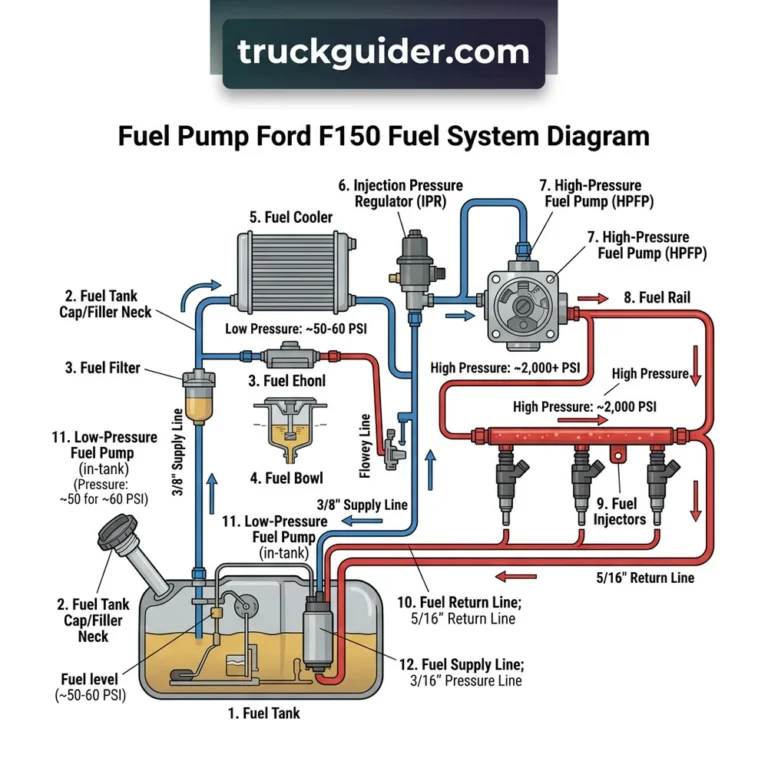
Ford F150 Fuel Tank Size Chart: Year 1997-2026

The Ford F150 fuel tank size chart by year covers model years 1997–2026, with factory capacities from 23 to 36 US gallons depending on the configuration. Documented sizes include 23, 24.5, 25, 26, 27, 30, 30.6, 35.7, and 36 gallons. Not every capacity was offered in every year or on every truck.
For example, a modern non-hybrid Regular Cab may have a 23-gallon tank, while a properly equipped SuperCrew may have 36 gallons. The 3.5L PowerBoost Full Hybrid V6 uses a different 30.6-gallon setup. Use the chart to find the possibilities for your year, then check your original equipment before relying on one number.


TRUCKGUIDER / F-150 SPECIFICATIONS
Ford F-150 Fuel Tank Sizes
Compare factory capacity choices. The correct size depends on model year, cab, powertrain and installed options.
2026 F-150 Capacity Comparison
Bars show relative fuel volume, not driving range. Based on Ford’s published 2026 owner’s manual.
Capacity Choices Through the Years
Period summaries indicate documented options, not availability on every truck within that date range.
- 1997–2003 24.5 / 25 / 30 Wheelbase and drivetrain matter
- 2004 Heritage 24.5 / 25 / 30 Earlier-generation body
- 2004–2008 New Body 26 / 27 / 30 / 35.7 Cab, bed and optional tank
- 2009–2014 26 / 36 Standard and extended range
- 2015–2020 23 / 26 / 36 Cab and equipment vary
- 2021–2026 23 / 26 / 30.6 / 36 30.6 gal applies to PowerBoost
Heritage and redesigned F-150 models use different fuel tank schedules. Identify your body style before selecting a replacement tank.
Ford F150 Fuel Tank Size Chart by Year
This chart lists documented factory fuel-tank capacities, not the capacity of every individual trim. Values are US gallons, with liters rounded to one decimal. A slash separates different available tank configurations; it does not mean the truck has multiple tanks. The 2004 Heritage and new-body F-150 appear separately because their factory specifications differ.
| Model Year | Factory Tank Size in US Gallons | Capacity in Liters | Key Configuration Notes |
|---|---|---|---|
| 1997 | 24.5 / 25 / 30 | 92.7 / 94.6 / 113.6 | Wheelbase and 4×2 or 4×4 |
| 1998 | 24.5 / 25 / 30 | 92.7 / 94.6 / 113.6 | Wheelbase and drivetrain |
| 1999 | 24.5 / 25 / 30 | 92.7 / 94.6 / 113.6 | Short versus long wheelbase |
| 2000 | 24.5 / 25 / 30 | 92.7 / 94.6 / 113.6 | Cab, wheelbase and drivetrain |
| 2001 | 24.5 / 25 / 30 | 92.7 / 94.6 / 113.6 | Cab, wheelbase and drivetrain |
| 2002 | 24.5 / 25 / 30 | 92.7 / 94.6 / 113.6 | Cab, wheelbase and drivetrain |
| 2003 | 24.5 / 25 / 30 | 92.7 / 94.6 / 113.6 | Cab, wheelbase and drivetrain |
| 2004 Heritage | 24.5 / 25 / 30 | 92.7 / 94.6 / 113.6 | Previous-generation body |
| 2004 New Body | 26 / 27 / 30 / 35.7 | 98.4 / 102.1 / 113.6 / 135.1 | Cab, bed and optional larger tank |
| 2005 | 26 / 27 / 30 / 35.7 | 98.4 / 102.2 / 113.6 / 135.1 | Cab, bed and optional tank |
| 2006 | 26 / 27 / 30 / 35.7 | 98.4 / 102.2 / 113.6 / 135.1 | Cab, bed and optional tank |
| 2007 | 26 / 27 / 30 / 35.7 | 98.4 / 102.2 / 113.6 / 135.1 | Cab, bed and optional tank |
| 2008 | 26 / 27 / 30 / 35.7 | 98.4 / 102.2 / 113.6 / 135.1 | Cab, bed and optional tank |
| 2009 | 26 / 36 | 98.4 / 136.3 | Standard and extended-range options |
| 2010 | 26 / 36 | 98.4 / 136.3 | Standard and extended-range options |
| 2011 | 26 / 36 | 98.4 / 136.3 | Factory equipment; check Raptor cab |
| 2012 | 26 / 36 | 98.4 / 136.3 | Factory equipment; check Raptor cab |
| 2013 | 26 / 36 | 98.4 / 136.3 | Factory equipment; check Raptor cab |
| 2014 | 26 / 36 | 98.4 / 136.3 | Standard and extended-range options |
| 2015 | 23 / 26 / 36 | 87.1 / 98.4 / 136.3 | Cab style and optional tank |
| 2016 | 23 / 26 / 36 | 87.1 / 98.4 / 136.3 | Cab style and optional tank |
| 2017 | 23 / 26 / 36 | 87.1 / 98.4 / 136.3 | Cab style; Raptor variation |
| 2018 | 23 / 26 / 36 | 87.1 / 98.4 / 136.3 | Diesel models have a 26-gal tank |
| 2019 | 23 / 26 / 36 | 87.1 / 98.4 / 136.3 | Diesel models have a 26-gal tank |
| 2020 | 23 / 26 / 36 | 87.1 / 98.4 / 136.3 | Cab style; diesel exception |
| 2021 | 23 / 26 / 30.6 / 36 | 87.1 / 98.4 / 115.8 / 136.3 | 30.6-gal PowerBoost Hybrid |
| 2022 | 23 / 26 / 30.6 / 36 | 87.1 / 98.4 / 115.8 / 136.3 | Hybrid and factory options |
| 2023 | 23 / 26 / 30.6 / 36 | 87.1 / 98.4 / 115.8 / 136.3 | Hybrid and factory options |
| 2024 | 23 / 26 / 30.6 / 36 | 87.1 / 98.4 / 115.8 / 136.3 | Hybrid and factory options |
| 2025 | 23 / 26 / 30.6 / 36 | 87.1 / 98.4 / 115.8 / 136.3 | Check trim’s standard equipment |
| 2026 | 23 / 26 / 30.6 / 36 | 87.1 / 98.4 / 115.8 / 136.3 | Check trim, cab and PowerBoost |
How to read the chart: A 2019 F-150 could have a 23-, 26-, or 36-gallon factory tank. That does not mean every 2019 truck offered all three choices. Match the cab, engine and installed options. A modified truck may have a replacement tank that differs from Ford’s original specification.
How F150 Tank Capacities Changed From 1997 to 2003
Ford used three principal tank sizes on these trucks: 24.5, 25, and 30 gallons. The difference was not simply the engine. Wheelbase and drivetrain mattered.
The 1999 Ford F-150 owner’s guide specifies 24.5 gallons for a short-wheelbase 4×4 Regular Cab, 25 gallons for a short-wheelbase 4×2 Regular Cab or SuperCab, and 30 gallons for a long-wheelbase configuration.
This is why a 1999 V8 truck and another 1999 V8 truck can hold different amounts of gasoline. For any 1997–2003 F-150, check wheelbase and drive type rather than selecting the largest number in the row.
Why 2004 Ford F150 Heritage Tank Sizes Differ
The 2004 model year is unusual because Ford sold an F-150 Heritage based on the previous design alongside a redesigned F-150. The two trucks use different fuel-tank capacity schedules.
The 2004 F150 Heritage
The 2004 Heritage owner’s guide lists 24.5 gallons for short-wheelbase 4×4 Regular Cab trucks, 25 gallons for certain other short-wheelbase cabs, and 30 gallons for long-wheelbase models.


The 2004 New Body F150
The 2004 new-body F-150 owner’s guide identifies 26 gallons for Regular Cab 6.5-foot-bed and SuperCab 5.5-foot-bed trucks. The SuperCrew uses 30 gallons. Certain longer-bed configurations have 27 gallons standard or an optional 35.7-gallon tank.
A generic result stating that every 2004 F-150 holds 25 or 30 gallons misses the redesigned truck. Confirm whether yours is a Heritage before ordering a replacement tank.
Ford F150 Fuel Tank Changes From 2005 to 2014
The 2005–2008 F-150 continued to use tank sizes that depended strongly on cab and bed length. The documented capacities were 26, 27, 30, and 35.7 gallons, although the available combinations varied by configuration.
On these trucks, a 5.5-foot-bed SuperCrew commonly used the 30-gallon tank. Some longer-bed models had a 27-gallon standard tank or a 35.7-gallon optional tank. The 26-gallon tank appeared on shorter Regular Cab and SuperCab configurations.
For 2009–2014, the main factory choices changed to 26 and 36 gallons. The larger tank was an extended-range option on applicable models. Raptor owners must still check cab style; for example, Ford’s 2013 Raptor supplement distinguishes a 26-gallon SuperCab from a 36-gallon SuperCrew.
How 2015 to 2020 F150 Cab Types Affect Capacity
The 2015 redesign brought the familiar 23-, 26-, and 36-gallon capacity choices. Ford’s standard non-diesel pattern was 23 gallons for Regular Cab and SuperCab, 26 gallons for SuperCrew, and 36 gallons where the extended-range option was fitted.
Those are equipment-dependent ratings, not a guarantee based on cab style alone. The optional 36-gallon tank was not available on every trim and wheelbase combination. Check the build information rather than assuming that an EcoBoost or 5.0L V8 automatically received the larger tank.
One exception is the 3.0L Power Stroke Turbo Diesel V6 offered during part of this period. Ford’s 2018 quick reference guide specifies a 26-gallon fuel tank for diesel-equipped F-150 trucks, so the 36-gallon gasoline option should not be assigned to the diesel without confirming the exact equipment.
Which 2021 to 2026 F150 Fuel Tanks Are Available
The 2021–2026 F-150 range includes 23-, 26-, and 36-gallon non-hybrid configurations, plus the 30.6-gallon PowerBoost Hybrid tank. The 36-gallon tank may be optional on some trims and standard on others.
For a reference point, Ford’s 2026 F-150 owner’s manual lists 23 gallons for Regular Cab and SuperCab, 26 gallons for Crew Cab, and an optional 36 gallons. These are general manual categories; the actual truck’s trim and factory equipment control the result.
The key difference for used-truck shoppers is not necessarily model year. Two 2024 or 2026 F-150s can have different fuel capacities because they left the factory with different tank equipment.
How Ford F150 PowerBoost and Raptor Tanks Differ
PowerBoost Hybrid Fuel Tank
The 3.5L PowerBoost Full Hybrid V6 uses a 30.6-gallon (115.8-liter) tank for the 2021–2026 model years covered here. Ford’s 2026 owner’s manual confirms this hybrid-specific capacity separately from the conventional gasoline F-150 tanks.
Do not substitute the 36-gallon conventional-engine option when estimating a PowerBoost truck’s fuel range. The battery-electric F-150 Lightning is a different vehicle and has no gasoline tank.


F150 Raptor Fuel Tank
Raptor capacities also depend on generation. The 2013 Raptor used a 26-gallon tank in SuperCab form and 36 gallons in SuperCrew form. Later Raptor configurations, including the 2026 Raptor, use a 36-gallon factory tank.
Always match a Raptor’s model year and body configuration before treating 36 gallons as universal across the entire nameplate.
How to Verify Your Ford F150 Tank Capacity
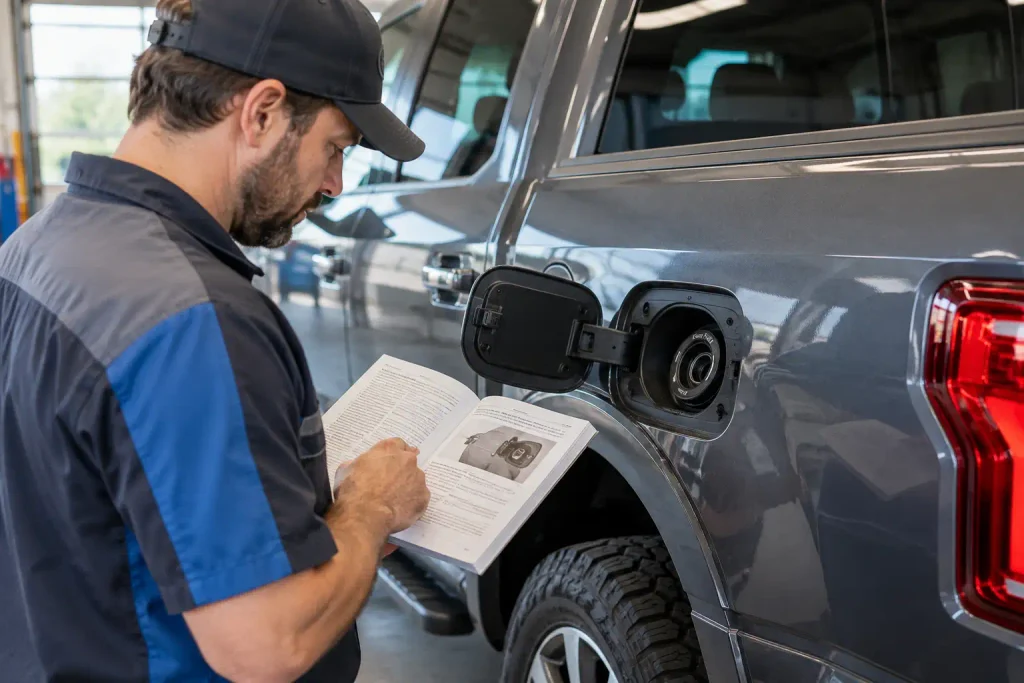
A chart identifies which capacities existed. The following checks establish which one your truck was built with.
- Record the model year and cab. Distinguish Regular Cab, SuperCab and SuperCrew. For a 2004 truck, identify Heritage versus new body. On older trucks, also check bed length, wheelbase and 4×2 or 4×4.
- Open the correct owner’s manual. Find the Fuel Tank or Refill Capacities section. Compare the manual’s configurations with your truck rather than picking a number solely from the year.
- Check the original window sticker or build record. Look for extended-range fuel tank equipment or a package that includes it. VIN-based services may help retrieve factory records, but the VIN alone does not encode a simple, reliable tank-size answer.
- Account for modifications. If a previous owner installed an aftermarket replacement tank, factory capacity charts may no longer describe it. Verify the installed part before ordering another tank.
If you are investigating a fuel gauge, sender or pump problem rather than capacity, a model-specific fuel-system inspection is the next step. Do not remove fuel lines or drop a fuel tank merely to measure its volume.
How Far Can an F150 Drive Per Tank
Fuel tank capacity sets the amount of fuel available, but miles per gallon determines driving range. A simple estimate is:
Theoretical driving range = tank capacity in gallons × fuel economy in MPG.
For example, at an assumed 20 MPG, a 26-gallon tank gives 520 theoretical miles, while a 36-gallon tank gives 720 theoretical miles. These are arithmetic examples, not Ford-certified driving-range ratings for a particular engine or trim.
Actual range changes with speed, traffic, temperature, payload and trailer towing. When planning a towing trip, our Ford F-150 towing capacity chart can help you check configuration-specific towing ratings, while your own trip MPG provides the better range estimate.
A larger tank also carries more fuel weight when full. Truck owners planning a heavy load should check their specific Ford F-150 payload capacity and door-jamb loading label instead of relying on a generic maximum rating.
Why Ford F150 Refills Differ From Rated Capacity
If a truck has a 36-gallon factory tank, that does not mean every fuel stop should accept 36 gallons. The gauge can reach Empty while some fuel remains in the tank. Ford describes this as an empty reserve and does not promise a fixed amount for every truck.
The displayed distance-to-empty is also an estimate based on operating conditions, not a direct measurement of the tank’s total volume. One pump receipt showing 24 gallons cannot prove that a truck has a 26-gallon tank rather than a larger one.
Refuel according to Ford’s instructions and stop when the nozzle automatically shuts off. Repeatedly topping off or deliberately running the truck out of fuel is not a reliable way to determine tank capacity.



Which Ford F150 Fuel Tank Capacity Should You Use
The Ford F150 fuel tank size chart by year gives you a starting range, not a substitute for the truck’s factory equipment record. For 1997–2003 models, wheelbase and drivetrain are especially important. The 2004 Heritage and redesigned F-150 require different specifications. From 2009 onward, optional extended-range tanks make the exact build more important than a generic model-year figure.
For a 2021–2026 PowerBoost, use the dedicated 30.6-gallon specification instead of the conventional-engine chart. For other newer F-150s, verify whether the 23-, 26-, or 36-gallon setup was installed. Before buying a replacement tank or calculating long-distance range, confirm your model year, body configuration and original equipment.
Ford F150 Fuel Tank Size Questions Answered
How Many Gallons Does a Ford F150 Gas Tank Hold?
Ford F-150 factory tanks vary across the 1997–2026 model years, with documented sizes ranging from 23 to 36 gallons on conventional modern configurations and several older capacities. The correct figure depends on the truck’s year, cab, bed and factory options. PowerBoost Hybrids use a 30.6-gallon tank.
Which Ford F150 Models Have a 36 Gallon Tank?
A 36-gallon extended-range tank appears as a factory option on many 2009-and-newer conventional-engine F-150s and is standard on certain trims, including the modern Raptor. Availability is not universal across every cab, wheelbase or model year. Check the original window sticker or equipment listing.
How Do I Know if My F150 Has a 26 or 36 Gallon Tank?
First, check the owner’s manual and the original factory equipment or window sticker for the extended-range fuel tank option. Do not decide using a single refueling receipt, fuel gauge reading or engine badge. An aftermarket replacement tank may also change the answer.
How Big Is the Ford F150 PowerBoost Fuel Tank?
The 2021–2026 Ford F-150 with the 3.5L PowerBoost Full Hybrid V6 has a 30.6-gallon (115.8-liter) fuel tank. This is different from the 36-gallon conventional-engine extended-range tank. Match the model year and powertrain before estimating range.
Can I Find My F150 Fuel Tank Size Using the VIN?
A VIN can help identify the truck and access available factory build information, but the VIN characters alone should not be used as a fuel-tank capacity lookup formula. Confirm the installed option using the original window sticker, build documentation or the correct Ford manual. If the tank was replaced, inspect the actual replacement part.