Ford F-250 Gear Ratio Chart by Year: Complete Axle Guide 2026

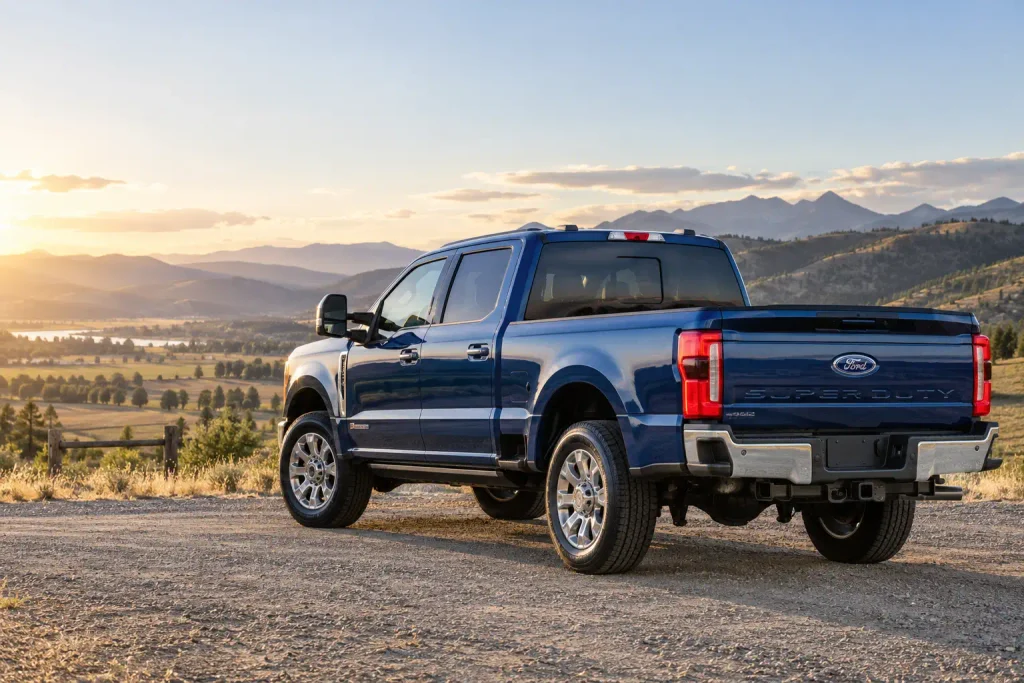
A Ford F250 gear ratio chart helps you identify the rear axle gearing installed in your F-250 Super Duty. Check the model year, engine, and axle code on the driver’s door label. A 3.73:1 axle ratio, for example, means the driveshaft makes approximately 3.73 rotations for each revolution of the axle shafts.
Ford has reused axle codes, so a decoder without the model year can be wrong. Start with the year-and-engine examples below.


F-250 Gear Ratios and Axle Codes
Match the engine first. Then decode the AXLE field on the driver’s door certification label.
Gas-engine towing-table configurations
Diesel-engine towing-table configurations
| Ratio | Non-limited-slip | Limited-slip | Electronic locking |
|---|---|---|---|
| 3.31 | 31 | Not listed | 3H |
| 3.55 | 35 | 3K | 3J |
| 3.73 | 37 | 3L | 3E |
| 4.10 | Not listed | 4N | Not listed |
| 4.30 | Not listed | 4L | 4M |
Important: The code table covers the 2026 Super Duty pickup family. A listed code does not guarantee that ratio is offered with every F-250 engine, trim, or package.
Ford F250 Gear Ratio Chart by Year 1999 to 2026
This chart shows factory-documented F-250 pickup examples from 1999–2026. It is not an exhaustive option list; each row applies only to the year shown.
| Model year | F-250 engine | Rear axle ratios documented | Notes |
|---|---|---|---|
| 1999 | 5.4L gasoline V8 | 3.73, 4.10 | Listed in 1999 F-250 towing tables |
| 1999 | 6.8L gasoline V10 | 3.73, 4.30 | Listed in 1999 F-250 towing tables |
| 2002 | 5.4L gasoline V8 | 3.73, 4.10 | F-250 pickup towing configurations |
| 2002 | 6.8L gasoline V10 | 3.73, 4.30 | F-250 pickup towing configurations |
| 2005 | 5.4L gasoline V8 | 3.73, 4.10 | Gas-engine table in Ford owner’s guide |
| 2005 | 6.8L gasoline V10 | 4.10, 4.30 | Gas-engine table; diesel uses a separate supplement |
| 2008 | 5.4L gasoline V8 | 3.73, 4.10 | Ford F-250 pickup GCWR chart |
| 2008 | 6.8L gasoline V10 | 4.10, 4.30 | Ford F-250 pickup GCWR chart |
| 2011 | 6.2L gasoline V8 | 3.73, 4.30 | Ford gasoline towing configurations |
| 2011 | 6.7L Power Stroke V8 diesel | 3.31, 3.55 | Ford diesel owner’s supplement |
| 2016 | 6.2L gasoline V8 | 3.73, 4.30 | Ford F-250 towing chart |
| 2016 | 6.7L Power Stroke V8 diesel | 3.31, 3.55 | Ford F-250 towing chart |
| 2017 | 6.2L gasoline V8 | 3.73, 4.30 | Ford model-year towing data |
| 2017 | 6.7L Power Stroke V8 diesel | 3.31, 3.55 | Ford model-year towing data |
| 2020 | 7.3L gasoline V8 | 3.55, 4.30 | F-250 towing selector; package dependent |
| 2022 | 6.2L gasoline V8 | 3.73, 4.30 | F-250 towing selector |
| 2022 | 7.3L gasoline V8 | 3.55, 4.30 | F-250 towing selector |
| 2022 | 6.7L Power Stroke V8 diesel | 3.31, 3.55 | F-250 towing selector |
| 2025 | 6.8L / 7.3L gasoline V8 | 3.73, 4.30 | Engine- and equipment-specific configurations |
| 2025 | 6.7L Power Stroke V8 diesel | 3.31, 3.55 | Includes standard and High Output applications |
| 2026 | 6.8L / 7.3L gasoline V8 | 3.73, 4.30 | Engine- and equipment-specific configurations |
| 2026 | 6.7L Power Stroke V8 diesel | 3.31, 3.55 | Includes standard and High Output applications |
How to read the chart: Listed ratios are documented for the specified year and engine, not necessarily every cab, trim or drivetrain. Older diesel models need separate documentation.
For historical verification, Ford’s 2005 F-250 owner’s guide shows the gas-engine axle ratios and explicitly directs 6.0L diesel owners to a separate supplement. The 2016 Super Duty owner’s manual separately lists 3.31/3.55 for F-250 diesels and 3.73/4.30 for the 6.2L gas engine.
One detail matters: a 3.55 ratio was already offered in F-250 diesel applications before 2020. It is not exclusive to newer ten-speed trucks. The modern 7.3L gasoline engine also changed its documented ratio combinations between model years, so a 2022 chart cannot replace a 2026 chart.
How to Find Your Ford F250 Axle Code
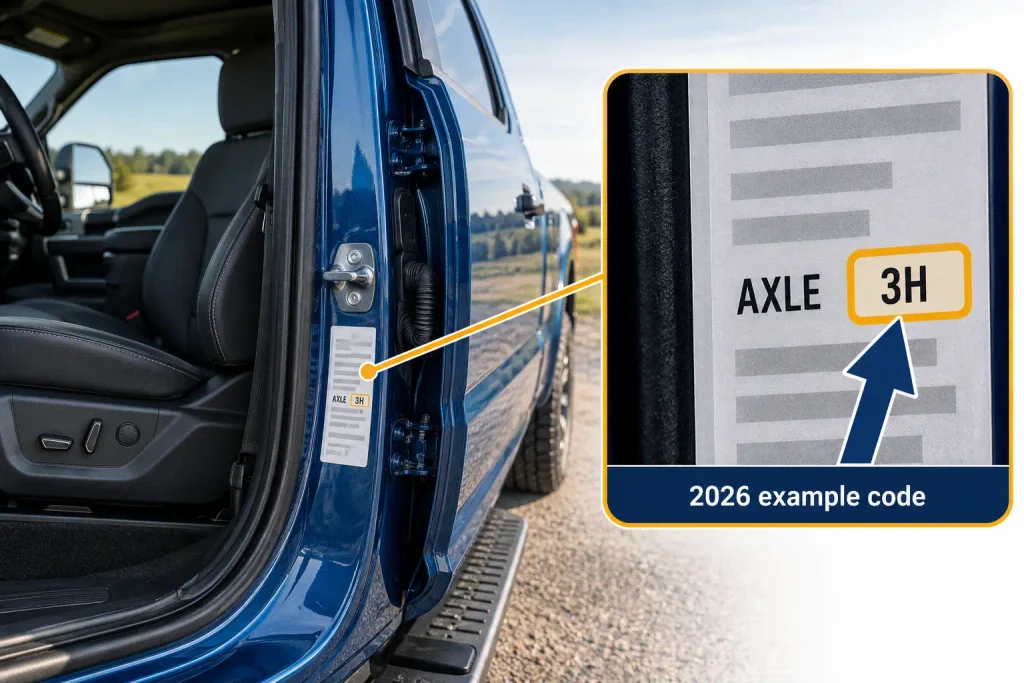
Ford puts the original axle identification on the Safety Compliance Certification Label at the driver’s side door opening. The label is generally on the door latch post or door-lock-facing area. Its position and appearance vary with model year.
- Open the driver’s door and find the factory certification label, not the tire-pressure label.
- Locate the field marked AXLE, usually near other coded fields below the barcode.
- Record the exact characters, including letters. For example,
3His different from3L. - Record the model year and engine, then consult the matching model-year decoder.
- If the code is absent or illegible, use your VIN and build records through a Ford dealer before ordering axle parts.
The code describes the truck’s factory-installed axle. It cannot confirm that a previous owner never replaced the differential or changed its ring-and-pinion gears. A used F-250 with drivetrain modifications needs an additional hardware check.


Ford F250 Axle Code Chart for 2026 Models
Ford’s 2026 Super Duty Pickup Towing Guide contains this rear axle code table. It is a Super Duty-wide decoder, so not every listed ratio is an available F-250 engine configuration.
| Axle ratio | Non-limited-slip code | Limited-slip code | Electronic-locking code |
|---|---|---|---|
| 3.31:1 | 31 | Not listed | 3H |
| 3.55:1 | 35 | 3K | 3J |
| 3.73:1 | 37 | 3L | 3E |
| 4.10:1 | Not listed | 4N | Not listed |
| 4.30:1 | Not listed | 4L | 4M |
For example, 3H identifies a 3.31:1 electronically locking axle in the 2026 chart. Code 3L means a 3.73:1 limited-slip axle, not a 3.31 axle. A limited-slip differential and an electronically locking differential are different mechanisms; the code specifies more than gearing.
Do not confuse this code chart with an F-250 order sheet. The 4.10 ratio appears in the Super Duty-wide decoder, but Ford’s 2026 F-250 pickup towing tables use the gas and diesel combinations summarized in the next section.
Why Older F250 Axle Codes Can Be Different
A code lookup becomes risky when you ignore the model year. Historical F-250 service-label references identify 31 as a 3.73:1 non-limited-slip axle in 2001-era Super Duty applications. The 2026 table identifies 31 as 3.31:1.
| Example model year | Door-sticker axle code | Ratio identified |
|---|---|---|
| 2001 F-250 | 31 | 3.73:1 |
| 2001 F-250 | C1 | 3.73:1 limited-slip |
| 2001 F-250 | 32 | 4.10:1 |
| 2001 F-250 | C2 | 4.10:1 limited-slip |
| 2026 Super Duty | 31 | 3.31:1 |
| 2026 Super Duty | 3H | 3.31:1 electronic locking |
These are specific historical and modern examples, not a universal Ford code list. Never decode an early Super Duty using the 2026 table or assume a modern code means the same thing on an older truck.
Which Ford F250 Engines Use Each Gear Ratio
For the 2026 F-250 pickup, Ford’s towing tables show two principal rear-axle choices per engine family:
| 2026 F-250 engine | Documented axle ratios |
|---|---|
| 6.8L gasoline V8 | 3.73, 4.30 |
| 7.3L gasoline V8 | 3.73, 4.30 |
| 6.7L Power Stroke V8 Turbo Diesel | 3.31, 3.55 |
| 6.7L High Output Power Stroke V8 Turbo Diesel | 3.31, 3.55 |
These are not interchangeable specifications. A gas-engine ratio cannot be assumed to be available on the diesel, and the same ratio does not establish identical towing capability across engines or cabs.
The model-year difference is especially clear with the 7.3L gas V8. Ford’s 2022 Super Duty towing selector lists 3.55 and 4.30 in its F-250 chart; the 2026 selector instead shows 3.73 and 4.30. That makes the owner’s own model year more useful than a generic “best gear ratio” list.
Older engines introduce other differences. The 1999-era 5.4L V8 and 6.8L V10 had different published combinations, while the 2011–2016 6.7L Power Stroke diesel commonly appears with 3.31 and 3.55 in Ford documents. Confirm the drivetrain before comparing two F-250s advertised with the same axle ratio.
What Ford F250 Axle Ratios Mean for Towing
The axle ratio changes torque multiplication between the driveshaft and rear wheels. At the same transmission gear, engine speed, and tire diameter, a higher numerical axle ratio gives more wheel torque but produces more driveshaft revolutions per wheel revolution.

| Ratio comparison | What changes mechanically | Practical interpretation |
|---|---|---|
| 3.31 vs. 3.55 | 3.55 has about 7.3% more final-drive multiplication | Useful when comparing otherwise similar diesel setups |
| 3.73 vs. 4.30 | 4.30 has about 15.3% more final-drive multiplication | May favor pulling at lower road speeds, depending on engine and transmission |
| 3.55 vs. 4.30 | 4.30 has about 21.1% more final-drive multiplication | Not a standalone towing-capacity comparison |
These percentages describe ratio multiplication only. They are not measured acceleration, fuel-economy, or towing gains. Tire size, transmission ratios, load, and engine calibration all affect actual performance.
Do not select or alter an axle ratio solely to claim a bigger tow rating. Ford assigns ratings by the entire factory configuration, including engine, cab, drivetrain, equipment and Gross Combined Weight Rating (GCWR). For the broader model-specific limits, use the Ford towing capacity chart. The more focused 2024 Ford F-250 towing capacity chart explains the year-specific towing configurations without duplicating the axle-code decoder here.
How F250 Transmission Ratios Differ From Axle Ratios
An axle ratio describes the final-drive gearing in the differential. A transmission gear ratio describes the gearing selected inside the transmission. Both contribute to the overall drive ratio, but they are not the same specification.
For example, a transmission gear with a 2.00:1 ratio paired with a 3.73:1 rear axle produces a theoretical 7.46:1 overall ratio, before considering other drivetrain components. This example is arithmetic, not a claim about a specific Ford transmission gear.
Earlier F-250 trucks used different automatic and manual transmissions from later Super Duty models. Modern models also have different ten-speed transmission families depending on the engine. If you are decoding the separate TR field rather than the AXLE field, use the Ford transmission identification guide instead.
How to Verify an F250 After an Axle Swap
The door sticker tells you what Ford built, not necessarily what is installed today. After a rear axle replacement, differential rebuild, or gear change, the original AXLE code may no longer match the truck.
- Check service receipts for ring-and-pinion replacement or a complete axle swap.
- Compare the axle assembly identification with Ford parts records for the truck’s VIN and model year.
- Have a qualified technician inspect the differential or confirm the actual tooth-count ratio when the documentation conflicts.
- On 4×4 trucks, verify that front and rear final-drive ratios are compatible before engaging four-wheel drive.
A larger tire may change effective road-speed gearing without changing the internal axle ratio. It may also affect indicated speed or odometer accuracy unless the relevant calibration is adjusted. Avoid relying on an unsupported wheel-rotation test if the result would determine expensive parts purchases or towing decisions.
4 Common Ford F250 Gear Ratio Chart Mistakes
- Ignoring model year. The same axle code can identify different ratios in different generations. Always decode the year first.
- Mixing truck classes. F-350 dual-rear-wheel and chassis-cab charts are not interchangeable with F-250 pickup configurations.
- Confusing differential types. Open, limited-slip, and electronic-locking codes may identify the same numerical ratio but different hardware.
- Assuming the axle is original. A previous gear swap can make factory door-sticker information outdated for the installed parts.
One more distinction matters when towing: an axle ratio is not the same as the truck’s certified tow rating. Use the model-year towing selector and the ratings on the actual truck.
How to Confirm Your F250 Gear Ratio Before Towing
The most reliable way to use a Ford F250 gear ratio chart is to combine the truck’s model year with its AXLE field and Ford’s documentation for that specific year. The factory rear axle ratio tells you how the differential is geared, while the engine and transmission determine how the truck puts that gearing to work.
For an original, unmodified F-250, the door sticker and correct model-year chart usually provide the answer. For a truck with an unknown history, confirm the installed hardware before buying drivetrain parts. If you plan to tow, check the applicable Ford towing selector and the vehicle’s actual weight ratings rather than relying on the gear ratio alone.
5 Common Ford F250 Gear Ratio Questions
What Gear Ratio Does My Ford F250 Have?
Your F-250’s ratio depends on its model year, engine, and installed rear axle. Read the AXLE field on the driver’s door certification label and match it against the correct model-year code chart. A modified truck may need physical axle verification.
Where Is the Axle Code on a Ford F250?
Look on the Safety Compliance Certification Label at the driver’s door opening, generally on the latch-side post or door-lock-facing area. Find AXLE near the other coded fields. Record every character exactly, because letters distinguish different differential types.
Is 3.31 or 3.55 Better for F250 Towing?
A 3.55 axle offers roughly 7.3% more final-drive torque multiplication than a 3.31 axle, all else equal. That does not prove a higher manufacturer tow rating. Compare Ford’s towing tables for the two actual truck configurations before choosing.
What Does Axle Code 3L Mean on an F250?
In Ford’s 2026 Super Duty decoder, 3L identifies a 3.73:1 limited-slip rear axle. Do not assume that interpretation applies to every model year. Use the decoder for your specific truck and confirm equipment availability for its engine and trim.
Can an F250 Gear Ratio Change After an Axle Swap?
Yes. Replacing the differential gears or axle assembly can change the installed ratio without changing the original certification label. Check repair records or have the installed hardware identified, especially before purchasing replacement axle parts or using four-wheel drive.