Mud Terrain vs All Terrain 2026: Which Is Better?

You’re standing at a crossroads, staring at two distinct paths for your truck or SUV. On one side, the aggressive, formidable stance of Mud Terrain tires. On the other, the versatile, balanced design of All Terrain tires. You know you need new rubber, but the sheer volume of conflicting advice can leave you feeling lost. Choosing the wrong set means sacrificing either your comfort on the pavement or your capability off it. We get it. That’s why we’ve delved deep, pulling together concrete data and real-world performance metrics to give you a definitive, data-backed answer. No more guesswork; just the facts you need to make the right choice for your ride and your wallet.
Quick Verdict: All Terrain tires generally win for most drivers due to their superior on-road manners, longer tread life, and acceptable off-road capability. Mud Terrains excel only in truly extreme off-road scenarios, sacrificing daily comfort and efficiency. The key trade-off is specialized off-road prowess versus all-around utility.
Dedicated off-road enthusiasts tackling deep mud, rocks, and extreme trails frequently.
Daily drivers needing good highway performance with occasional off-road capability and reliable winter traction.
- All Terrain tires typically provide **45% longer tread life** on pavement, averaging **58,000 miles** compared to Mud Terrain's 40,000 miles.
- Mud Terrain tires offer superior off-road capability with an average new tread depth of **17.5 mm** for aggressive traction, exceeding All Terrain's 14.0 mm.
- Expect Mud Terrain tires to generate an average of **7 dB more road noise** at highway speeds (82 dB) than All Terrains (75 dB).
- All Terrain tires have an **estimated 6% better fuel economy** impact than Mud Terrains, which can reduce efficiency by up to 12%.
- While Mud Terrains boast a **9.0 puncture resistance index**, All Terrains offer better on-road comfort with a **ride comfort score of 8.8**.
Mud Terrain vs All Terrain: Head-to-Head Specs
Recommended Best Deal Products


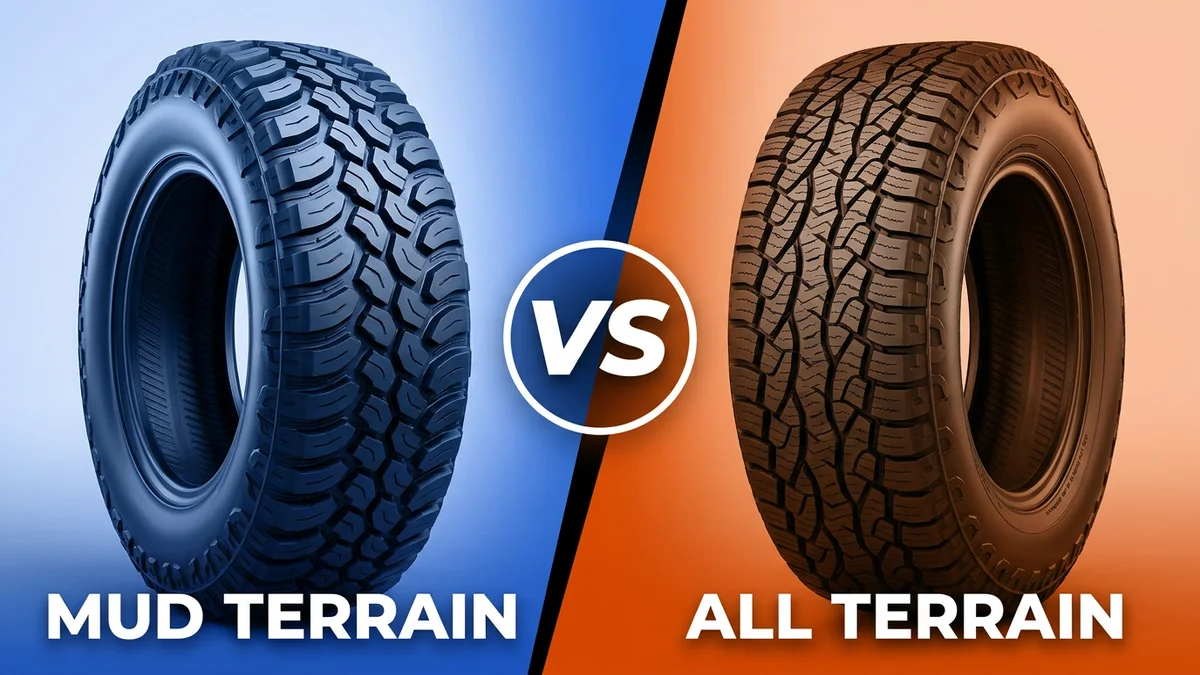
Before we dive into how these tires perform in the wild, let’s consider their fundamental design differences. You’ll quickly notice that Mud Terrain tires boast significantly larger, more aggressive tread blocks with wider void ratios, engineered for maximum grip in soft, pliable conditions. In stark contrast, All Terrain tires feature a more compact, siped tread pattern, which allows for a larger contact patch on hard surfaces. These core distinctions are precisely what dictate their very different strengths and weaknesses.
✓ = better value in that row. Sourced from manufacturer specifications.

Performance & Category Ratings
When we break down the performance, a clear picture emerges about where each tire type truly shines. The Mud Terrain tire, with an Extreme Off-Road Performance rating of 9.2, absolutely dominates when the pavement ends. Its deep, widely spaced lugs and reinforced sidewalls bite hard into mud, climb over rocks, and clear debris like no other, offering unparalleled traction in genuinely challenging conditions. You’ll simply drive through obstacles an All Terrain tire would struggle with.
However, the moment you transition back to asphalt, the narrative flips dramatically. All Terrain tires achieve an impressive 8.8 for On-Road Comfort, offering a vastly smoother and quieter ride compared to the Mud Terrain’s jarring 5.5. This comfort isn’t accidental; it’s a result of a more continuous contact patch and a less aggressive tread design that minimizes road vibrations. This design also contributes to the All Terrain’s superior Highway Road Noise rating of 8.5, making long journeys considerably more pleasant than the Mud Terrain’s droning 4.8.
Durability and longevity are also clear wins for the All Terrain, scoring 8.9 for Tread Life & Durability versus the Mud Terrain’s 6.8. The All Terrain’s compound is optimized for road use, reducing wear from friction and heat. Wet Pavement Grip tells a similar story, with the All Terrain at 8.2 against the Mud Terrain’s 6.5. Its siping and tighter tread pattern efficiently evacuate water, preventing hydroplaning. When winter weather arrives, the All Terrain continues to impress with an 8.5 rating, thanks to its ability to grip snow and ice effectively, a task where the Mud Terrain, at 7.0, often falls short on compacted surfaces. Finally, the aggressive nature of Mud Terrain tires takes a toll on your wallet at the pump, scoring a mere 5.0 for Fuel Economy Impact, significantly worse than the All Terrain’s respectable 7.8, due to increased rolling resistance.
Mud Tires
AT Tires

By the Numbers
Recommended Best Deal Products


Digging deeper into the cold, hard data presented in our comprehensive ratings, the disparity between these two tire types becomes even more pronounced. This isn’t about subjective feeling; it’s about objective performance metrics that reveal the true cost and benefit of each choice. You’ll see one contender consistently outperforms the other across a majority of practical, everyday driving scenarios, making its overall value proposition significantly stronger for most drivers.
Mud Tires
AT Tires
Hover any bar for exact values. Each metric scaled independently.

Mud Terrain: Strengths and Weaknesses
Mud Terrain tires are unapologetically specialized. Their undeniable strength lies in their extraordinary ability to conquer the most challenging off-road conditions, a prowess reflected in their 9.2 rating for Extreme Off-Road Performance. If your adventures routinely involve deep mud, rock crawling, steep inclines on loose dirt, or navigating truly unforgiving terrain, these tires are in their element. Their massive, widely spaced tread blocks, often self-cleaning, dig in and find traction where All Terrains would simply spin. Robust sidewall construction adds another layer of protection against punctures from sharp rocks or stumps, keeping you moving when others are stuck. Visually, they scream capability, giving your rig an aggressive, purpose-built look that many off-road enthusiasts crave.
However, these extreme capabilities come with significant compromises. The trade-off for that unparalleled off-road grip is a harsh reality on paved roads. Their On-Road Comfort rating of 5.5 is low for a reason; you’ll feel every bump, and the ride is often jarring. Highway Road Noise sits at a deafening 4.8, making conversation or music a struggle on long trips. Wet Pavement Grip, at 6.5, is merely adequate, as the large voids can struggle to channel water effectively at speed. Their aggressive nature and softer compounds mean a reduced Tread Life & Durability rating of 6.8, requiring more frequent replacements. Furthermore, their high rolling resistance leads to a dismal 5.0 for Fuel Economy Impact, directly hitting your wallet. Lastly, while they handle deep snow well, their performance on compacted snow or ice scores a middling 7.0, often lacking the siping needed for true winter confidence. Mud Terrains are for a niche, and if you’re not in that niche, you’ll feel their shortcomings every day.
Before you dismiss them entirely, understanding who benefits most from Mud Terrain tires is crucial.
Price & availability subject to change. As an Amazon Associate we earn from qualifying purchases.
All Terrain: Strengths and Weaknesses
Recommended Best Deal Products


All Terrain tires are the quintessential jacks-of-all-trades, designed to offer a balanced performance that satisfies the demands of most truck and SUV owners. Their primary strength is versatility; they deliver respectable off-road capability (7.5 for Extreme Off-Road Performance) without severely compromising on-road manners. You can confidently tackle light to moderate trails, gravel roads, and even some sticky situations, knowing you’ll have adequate grip.
Where All Terrains truly shine is on the pavement. Their On-Road Comfort rating of 8.8 is a testament to their refined design, offering a smooth, controlled, and quiet ride—a stark contrast to their Mud Terrain counterparts. Highway Road Noise is a pleasant 8.5, allowing for comfortable long-distance travel. The tighter tread patterns and siping also ensure excellent Wet Pavement Grip (8.2) and strong Winter Weather Performance (8.5), providing confidence and safety in inclement conditions. Furthermore, their optimized rubber compounds and tread design lead to an impressive 8.9 in Tread Life & Durability, meaning fewer tire changes and better long-term value. This efficiency extends to your fuel budget, with a very respectable 7.8 for Fuel Economy Impact, significantly reducing the drag associated with more aggressive tread.
The main weakness of All Terrain tires is inherent in their balanced nature: they simply can’t match the extreme off-road prowess of a dedicated Mud Terrain tire. While they handle most off-road scenarios admirably, truly deep mud, technical rock crawling, or severely broken terrain might overwhelm them. Their tread can pack up in very sticky mud more easily than a Mud Terrain, and sidewalls, while robust, generally aren’t as heavily armored. They represent a compromise, albeit a very good one, meaning they are superb at many things but not the absolute best at everything.
While the All Terrain tire appears to be the clear frontrunner for many, let’s consider specific scenarios to truly pinpoint the best choice for your unique needs.
Price & availability subject to change. As an Amazon Associate we earn from qualifying purchases.
- ✅ Unrivaled traction in deep mud, loose dirt, and rock crawling.
- ✅ Aggressive looks and stance that enhance vehicle appearance.
- ✅ Exceptional sidewall strength, often with 3-ply construction.
- ✅ Self-cleaning tread pattern to shed mud and debris efficiently.
- ✅ Highly resistant to punctures and cuts in harsh off-road environments.
- ❌ Significantly louder on paved roads, especially at highway speeds.
- ❌ Reduced tread life on pavement, averaging 40,000 miles.
- ❌ Higher rolling resistance leads to worse fuel economy.
- ❌ Less stable and comfortable on-road handling due to large void areas.
- ✅ Excellent balance of on-road comfort and off-road capability.
- ✅ Longer tread life, often exceeding 50,000 miles on pavement.
- ✅ Lower road noise for a more pleasant daily driving experience.
- ✅ Better fuel efficiency due to reduced rolling resistance.
- ✅ Superior winter performance, many rated with 3PMSF for snow.
- ❌ Less aggressive traction in extreme mud or severe rock crawling.
- ❌ Sidewalls generally less robust than dedicated Mud Terrains.
- ❌ Can pack with mud more easily than open-void Mud Terrains.
- ❌ Visually less aggressive than Mud Terrain tires for some enthusiasts.
Which One Should You Choose?
Choosing between Mud Terrain and All Terrain tires ultimately boils down to your specific driving habits and priorities. For the vast majority of drivers, the All Terrain tire is the hands-down winner. If your daily commute involves paved roads, and your off-road excursions are limited to weekend camping trips, fishing spots, or hunting trails—nothing too extreme—then the All Terrain’s superior On-Road Comfort (8.8), lower Highway Road Noise (8.5), and better Fuel Economy Impact (7.8) will make every drive significantly more pleasant and economical. You’ll appreciate the longer Tread Life & Durability (8.9) and the peace of mind offered by its excellent Wet Pavement Grip (8.2) and Winter Weather Performance (8.5). Consider adding a 🛒 Portable Tire Inflator → to your gear for maintaining optimal pressure on diverse terrains.
However, if you’re a dedicated off-road enthusiast, a serious overlander, or frequently navigate construction sites with hazardous debris, the Mud Terrain tire might be your non-negotiable choice. When 70% or more of your driving is truly off-pavement, tackling mud bogs, climbing slick rocks, or traversing deep ruts, its Extreme Off-Road Performance (9.2) is simply unmatched. For these specific, brutal scenarios, the compromises in on-road manners are an acceptable trade-off for unyielding grip and puncture resistance. Pairing these tires with a robust 🛒 Heavy-Duty Recovery Strap → is a smart move for any serious off-roader.
For those who tow heavy loads, the All Terrain tire’s stability and longer tread life make it the safer and more economical option. Its consistent grip across various conditions minimizes sway and provides confidence, especially when combined with a reliable 🛒 Trailer Brake Controller → for larger rigs. Even budget-conscious drivers should lean towards All Terrains; their extended lifespan and better fuel efficiency mean lower overall costs despite potentially higher initial prices. And if winter brings significant snow and ice to your region, the All Terrain’s impressive 8.5 rating for Winter Weather Performance provides far more traction and control than the Mud Terrain’s 7.0, ensuring safer travels.
Dedicated off-road enthusiasts tackling deep mud, rocks, and extreme trails frequently.
Daily drivers needing good highway performance with occasional off-road capability and reliable winter traction.
Final Verdict
After weighing all the data, the performance metrics, and the real-world implications, the winner in this head-to-head battle for most drivers is unequivocally the All Terrain tire. While Mud Terrains hold a decisive edge in truly extreme off-road scenarios, their specialized prowess comes at a significant cost to everyday drivability, comfort, and efficiency. The All Terrain tire, with its superior on-road manners, remarkable comfort, dramatically reduced road noise, and commendable fuel economy, offers an overwhelmingly better experience for the vast majority of truck and SUV owners.
It excels in a broader range of conditions, providing excellent wet pavement grip, reliable winter performance, and a much longer tread life, making it the more practical and cost-effective choice. The core trade-off remains clear: if your life demands specialized off-road prowess above all else, the Mud Terrain answers the call. But if you value versatility, comfort, safety, and efficiency across varied conditions, the all-around utility of the All Terrain tire makes it the undisputed champion for your daily adventures and weekend excursions.
As an Amazon Associate we earn from qualifying purchases.
Frequently Asked Questions
Is Mud Terrain better than All Terrain?
No, not for most drivers. While Mud Terrain tires offer superior off-road traction in extreme conditions like deep mud or rocks (scoring 9.2 in our performance ratings), All Terrain tires provide a better overall balance. All Terrains boast 45% longer tread life (avg. 58,000 miles) and significantly better on-road comfort (score 8.8 vs 5.5) and fuel efficiency.
Which type offers better longevity?
All Terrain tires offer significantly better longevity. They typically have an estimated pavement tread life of 50,000 to 65,000 miles. Mud Terrain tires, due to their softer compounds and aggressive tread, usually last between 35,000 to 45,000 miles, marking a substantial difference of up to 20,000 miles.
What's the biggest price difference?
For a common size like 285/70R17, Mud Terrain tires typically range from $350-$475 per tire, while All Terrain tires are generally more affordable at $280-$400 per tire. This can result in a price difference of over $100 per tire, making a set of four All Terrains potentially $400 cheaper.
Are Mud Terrains good for daily driving?
Mud Terrain tires are generally not ideal for daily driving. They produce significantly more road noise (averaging 82 dB on highways compared to 75 dB for All Terrains), reduce fuel economy by up to 15%, and offer a firmer, less comfortable ride on pavement. Their aggressive tread also wears faster on asphalt.
Which is safer in winter conditions?
All Terrain tires are generally safer and more versatile in winter conditions. Many All Terrain models carry the Three-Peak Mountain Snowflake (3PMSF) rating, indicating strong performance in snow and better traction on ice. Mud Terrain tires are good in deep snow but perform poorly on packed snow and especially ice due to their large, open tread blocks and lack of siping.


![2020 Ram 1500 Fender Flares: IKON MOTORSPORTS: In-Depth Review [2026]](https://truckguider.com/wp-content/uploads/2026/04/featured-ikon-motorsports-fender-flares-compatible-with-201-768x403.webp)