Ram 2500 6.4 HEMI Specs: The Complete Data-Driven (2024-2026)

The 6.4L HEMI V8 stands as the standard-bearer for gasoline power in the Ram Heavy Duty lineup, a formidable workhorse engineered to deliver uncompromising capability. Often referred to by its cubic inch displacement as the “392” or simply the “BGE” (Big Gas Engine), this powertrain is not merely a larger car engine dropped into a truck chassis. Instead, it is a purpose-built powerplant specifically tuned for the grueling demands of hauling heavy loads and providing long-term durability.
For truck owners who need more strength than a half-ton can offer but don’t require the monumental torque or higher cost of a diesel, the 6.4L HEMI presents a compelling balance of power and practicality.
This comprehensive guide delves into the core specifications, real-world capabilities, and long-term ownership considerations of the Ram 2500’s 6.4L HEMI V8. We will explore detailed technical data, break down complex towing and payload charts, analyze real-world fuel economy, and address the engine’s known reliability concerns head-on, providing a complete picture for prospective buyers and current owners.
The 6.4L HEMI V8: Core Specifications and Key Numbers
At its heart, the 6.4L HEMI is a modern interpretation of a classic American V8, blending raw power with sophisticated technology. It is a naturally aspirated engine featuring the iconic hemispherical combustion chambers that give the HEMI its name, designed to optimize airflow and combustion efficiency. For recent model years, this engine has been the cornerstone of the Ram 2500’s gasoline performance, delivering consistent and robust power figures.

The engine’s architecture includes advanced features like Variable Valve Timing (VVT), which adjusts the camshaft timing to improve performance and efficiency across the RPM range, and a Multi-Displacement System (MDS) designed to save fuel under light-load conditions by deactivating four of the eight cylinders. This power is managed by a highly regarded TorqueFlite 8HP75 eight-speed automatic transmission, known for its smooth, intelligent shifting that keeps the engine in its optimal power band.
A crucial distinction for any potential buyer is understanding that the 6.4L HEMI found in Ram Heavy Duty trucks is fundamentally different from the higher-output version used in Dodge SRT performance cars like the Challenger and Charger. While they share the same 392 cubic inch displacement, the truck engine is engineered for a different mission. It operates with a lower compression ratio—$10.0:1$ compared to the car’s $10.9:1$—a deliberate choice that enhances long-term durability under heavy, continuous loads.
This design philosophy reduces internal engine stress and allows the truck to run efficiently and safely on less expensive 87-octane regular gasoline, a significant cost consideration for commercial and fleet operators. This isn’t a “weaker” engine; it is a purpose-built work engine, optimized for low-end torque and reliability over peak horsepower.
Heart of the Workhorse
A Visual Deep Dive into the Ram 2500’s 6.4L HEMI V8
Engine Output Profile
The 6.4L HEMI, known as the “BGE” or Big Gas Engine, is engineered for a broad torque curve, ensuring powerful acceleration and confident hauling. This balance makes it a versatile standard engine for the Ram Heavy Duty lineup.
Workload Capacity
The engine’s power directly translates to impressive real-world capability. Maximum towing and payload figures are achieved with specific vehicle configurations, showcasing the platform’s robust design.
Heavy-Duty V8 Competitive Landscape
While the 6.4L HEMI is a formidable standard engine, it faces stiff competition from Ford’s and GM’s large-displacement V8s. This comparison highlights the horsepower and torque figures for the primary gasoline engines in the 3/4-ton truck segment.
Smart Fuel Technology: MDS Explained
To improve fuel economy during light-load conditions, the HEMI employs a Multi-Displacement System (MDS). This technology seamlessly deactivates four of the eight cylinders, effectively turning the V8 into a more efficient four-cylinder engine.
(e.g., Highway Cruising)
Oil pressure is altered to lifters
Valves remain closed, saving fuel
System instantly reactivates all 8 cylinders
Ram 2500 6.4L HEMI V8 Key Specifications (2024-2026 Models)
| Specification | Value |
| Engine Type | Naturally Aspirated V8 HEMI |
| Displacement (Liters) | 6.4 Liters |
| Displacement (Cubic Inches) | 392 Cubic Inches |
| Horsepower | 410 hp (2024) / 405 hp (2025-2026) |
| Torque | 429 lb-ft |
| Compression Ratio | $10.0:1$ |
| Bore x Stroke | $4.09 \text{ in} \times 3.72 \text{ in}$ |
| Recommended Fuel | 87 Octane Regular Unleaded |
| Paired Transmission | TorqueFlite 8HP75 8-Speed Automatic |
Towing and Payload Capacity: What Can the 6.4L HEMI Really Handle?
Moving beyond raw engine data, the true measure of a heavy-duty truck lies in its ability to work. The Ram 2500 equipped with the 6.4L HEMI V8 boasts impressive towing and payload ratings, but these “maximum” figures are highly dependent on the truck’s specific configuration. Factors such as the cab type, bed length, drivetrain (4×2 vs. 4×4), and, most critically, the axle ratio, all play a significant role in determining the final, real-world capacity.
For recent model years, the 6.4L HEMI is rated to tow up to approximately 17,750 pounds when properly equipped, typically in a 4×2 Regular Cab configuration with the more aggressive 4.10 axle ratio. However, one of the engine’s most significant advantages is its payload capacity. Because the gasoline V8 is considerably lighter than the available Cummins diesel engine, it allows for a higher maximum payload.
Payload is calculated by subtracting the truck’s curb weight from its Gross Vehicle Weight Rating (GVWR); the lighter gas engine leaves more of that GVWR available for cargo in the bed. This makes the 6.4L HEMI the superior choice for applications like carrying a heavy slide-in truck camper or hauling dense materials in the bed, where in-bed weight is a greater concern than trailer weight.
The following table provides a detailed breakdown of how these capacities vary across different common configurations for the 2024 model year, illustrating why it is essential to check the specifications for the exact truck build being considered.
2024 Ram 2500 6.4L HEMI Towing & Payload Chart
| Cab & Box Config | Drivetrain | Max Towing Capacity (lbs) | Max Payload Capacity (lbs) |
| Regular Cab, 8′ Box | 4×2 | 17,740 | 4,010 |
| Regular Cab, 8′ Box | 4×4 | 17,420 | 3,690 |
| Crew Cab, 6’4″ Box | 4×2 | 17,390 | 3,660 |
| Crew Cab, 6’4″ Box | 4×4 | 16,870 (Rebel) | 3,140 (Rebel) |
| Crew Cab, 8′ Box | 4×2 | 17,260 | 3,530 |
| Crew Cab, 8′ Box | 4×4 | 16,910 | 3,170 |
| Mega Cab, 6’4″ Box | 4×4 | 16,600 | 2,940 |
| Power Wagon (Crew, 6’4″) | 4×4 | 10,590 | 1,630 |
Real-World Fuel Economy: What to Expect at the Pump
Due to their classification, heavy-duty trucks like the Ram 2500 are not required to have official fuel economy ratings from the Environmental Protection Agency (EPA). This leaves prospective buyers to rely on real-world data from owner experiences and independent testing. While individual results vary widely based on driving habits, terrain, and vehicle configuration, a clear consensus has emerged regarding the 6.4L HEMI’s fuel consumption.
- Unloaded Highway Driving: When driven conservatively at speeds under 70 mph, most owners report fuel economy in the range of 15-18 MPG. Some have achieved figures as high as 20-22 MPG under ideal, flat-road conditions, but these are exceptions rather than the norm.
- City and Mixed Driving: In stop-and-go traffic and general mixed-use driving, owners can expect fuel economy to fall into the 10-14 MPG range.
- Towing: Fuel consumption while towing is heavily dependent on the trailer’s weight and aerodynamic profile. Pulling a moderately heavy travel trailer or equipment hauler (around 8,000-12,000 pounds) will typically result in 7-10 MPG.
The engine’s Multi-Displacement System (MDS) is designed to improve these figures by shutting down four cylinders during light-load cruising on the highway. While this system is effective at boosting efficiency, it introduces a complex dynamic for owners. The very technology that helps achieve better fuel economy is also linked to the engine’s most widely discussed reliability concerns, creating a paradox where efficiency and long-term durability are sometimes seen as being at odds.
Estimated Ram 2500 6.4L HEMI MPG
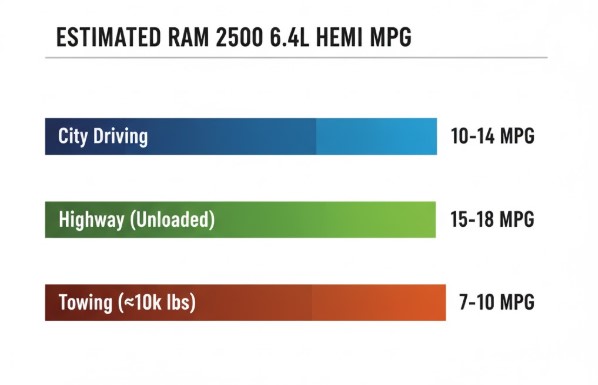
A simple bar chart would visualize these ranges effectively:
- Bar 1: City Driving: Range of 10-14 MPG.
- Bar 2: Highway (Unloaded): Range of 15-18 MPG.
- Bar 3: Towing (~10k lbs): Range of 7-10 MPG.
Long-Term Reliability and Common Problems
The 6.4L HEMI V8 is widely regarded as a durable and reliable engine, with many owners reporting well over 150,000 miles of service without major issues. However, like any modern engine, it is not without its specific, well-documented potential problems. The most prominent of these is a condition commonly known as the “Hemi Tick.”
The “Hemi Tick” and Lifter Failure
The most discussed issue affecting this engine is an audible ticking noise that can develop over time, often most noticeable at idle or during a cold start. This sound is typically not a harmless characteristic but rather a symptom of a failing valve lifter. The problem originates when the roller bearing on the lifter begins to fail, causing excessive play. This allows the lifter to impact the camshaft lobe improperly, leading to wear and, eventually, catastrophic failure of both the lifter and the camshaft.
The root cause is widely believed to be related to inadequate lubrication of the lifters. This theory is supported by the strong correlation between lifter failure and one critical factor: extended engine idle time. At idle, engine oil pressure is at its lowest, and the design of the valvetrain may not provide sufficient oil flow to properly lubricate the lifter rollers under these low-pressure conditions.
Consequently, trucks used in commercial applications, fleet service, or any role involving significant idling are at a much higher risk. For anyone considering a used Ram 2500 with this engine, checking the engine idle hours in the vehicle’s information center is as crucial as checking the odometer. A truck with low mileage but a high percentage of idle hours (over 20-30%) could be a significant liability.
The Multi-Displacement System (MDS) Controversy
The MDS adds another layer of complexity. While it’s debated whether the system directly causes lifter failure (as non-MDS lifters can also fail), its operational mechanics are intertwined with the issue. The solenoids that control oil flow to deactivate the lifters can be a failure point, and the system’s complexity is viewed with suspicion by many mechanics and owners.
Some owners choose to disable the MDS using an aftermarket tuner or by using the transmission’s gear-limiter buttons, sacrificing some fuel economy for what they perceive as increased reliability.
These valvetrain issues have become significant enough to prompt a class-action lawsuit against parent company Stellantis (formerly FCA), alleging that the manufacturer is aware of the defect but has not provided an adequate long-term solution. This legal action, covered by publications like Car Complaints, lends significant credibility to the widespread owner reports.
Exhaust Manifold Bolts
A more common but less severe issue is the tendency for the exhaust manifold bolts to break. This can cause an exhaust leak that produces a ticking sound, particularly when the engine is cold, which can sometimes be mistaken for the more serious lifter tick.
Recommended Maintenance Schedule for Longevity
Proper and timely maintenance is the single most effective way for an owner to maximize the life of their 6.4L HEMI and mitigate the risk of common problems. Adhering to a consistent service schedule, especially regarding oil changes, is paramount. Following a consistent maintenance schedule is key to vehicle longevity.
While the owner’s manual provides the definitive schedule, the following table consolidates common service recommendations for the Ram 2500 with the 6.4L HEMI engine under normal operating conditions. Trucks used for frequent heavy towing, in dusty environments, or with high idle time should follow a more aggressive “severe duty” schedule.
Ram 2500 6.4L HEMI Maintenance Schedule
| Mileage / Time Interval | Required Service(s) |
| Every 8,000 Miles / 1 Year | Change engine oil and filter. Rotate tires. Inspect brake system. |
| Every 20,000 – 30,000 Miles | Replace engine air cleaner filter. Inspect front suspension, tie rod ends, and CV/Universal joints. |
| At 60,000 Miles | Change automatic transmission fluid and filter. Inspect and service transfer case and axle fluids (more frequently for severe use). |
| At 100,000 Miles | Replace spark plugs. Inspect PCV valve and replace if necessary. |
| At 150,000 Miles / 10 Years | Flush and replace engine coolant. |
Conclusion
The Ram 2500’s 6.4L HEMI V8 is a powerful, capable, and proven engine that serves as an excellent gasoline heart for a heavy-duty truck. It shines in applications requiring high payload capacity and offers robust towing performance without the higher purchase price and maintenance complexity of a diesel engine. Its design is a thoughtful compromise, tuned for durability and the ability to run on regular-grade fuel, making it a practical choice for a wide range of users.
However, ownership requires an awareness of its primary vulnerability: the valvetrain. The “Hemi Tick” associated with lifter failure is a real and well-documented concern. The most effective defense against this issue is diligent maintenance, particularly frequent oil changes with high-quality oil, and a conscious effort to minimize engine idle time.
For prospective buyers in the used market, this makes inspecting a truck’s idle hours an essential part of the purchasing process. Ultimately, for the informed owner who understands its needs, the 6.4L HEMI is a workhorse that can provide hundreds of thousands of miles of reliable service.
Frequently Asked Questions (FAQs)
Is the Ram 2500 6.4 HEMI a reliable engine?
Yes, it is generally considered a reliable engine, with many owners reaching high mileage. However, it is known to be susceptible to a “Hemi Tick” issue caused by valvetrain lifter failure, which is often linked to extended idle times and insufficient maintenance.
How many miles will a 6.4 HEMI last?
With proper care and maintenance, a 6.4L HEMI engine can be expected to last 200,000 to 300,000 miles or more. The key factors for longevity are consistent oil changes with quality oil and, crucially, minimizing engine idle time to ensure proper lubrication of valvetrain components.
Does the 6.4 HEMI in the Ram 2500 require premium fuel?
No. Unlike the high-performance version of this engine found in SRT cars, the 6.4L HEMI in Ram Heavy Duty trucks is specifically designed with a lower compression ratio to run optimally on regular 87-octane unleaded gasoline.
What is the best axle ratio for the 6.4 HEMI?
The choice depends on the primary use. The 4.10 axle ratio provides the best acceleration and maximum towing capacity, making it ideal for those who tow heavy loads frequently. The 3.73 axle ratio offers a good balance, providing slightly better fuel economy during unloaded highway driving, and is suitable for those who tow less often or lighter loads.
How can I prevent the “Hemi Tick”?
The most effective preventative measures are to strictly follow the maintenance schedule, use high-quality engine oil of the correct viscosity (5W-40 is often recommended by specialists over the factory 0W-40), and, most importantly, avoid letting the engine idle for extended periods whenever possible. For used vehicles, checking for low idle hours is a critical step.