Ram Towing Capacity Chart by Year and Specs (Guide 2015-2025)

Understanding a truck’s true towing capacity is one of the most critical aspects of ownership, yet it’s often shrouded in confusing marketing terms and complex specifications. The maximum towing figure advertised by a manufacturer represents a best-case scenario—a specific, often sparsely equipped, configuration under ideal conditions.
Real-world towing capability is a dynamic equation influenced by engine choice, axle ratio, vehicle weight, and the specific configuration of your truck.
This comprehensive guide serves as the definitive resource for Ram truck owners and prospective buyers. It provides detailed, year-by-year towing capacity charts and decodes the technical factors that determine how much your truck can safely and legally pull.
While the primary focus is on the popular Ram 1500, this report also covers the heavy-duty Ram 2500 and 3500 models to provide a complete picture of the brand’s capabilities.
The Ram truck lineup is strategically tiered to meet different needs. The light-duty Ram 1500 is designed for daily driving, light hauling, and recreational towing, while the heavy-duty Ram 2500 and 3500 are built for commercial work, large RVs, and the heaviest gooseneck trailers
For those trying to decide between these classes, a detailed comparison is essential. For a complete analysis, see our guide on Dodge Ram 1500 vs. 2500
Ram 1500 Towing Capacity Chart by Year (2015-2025)
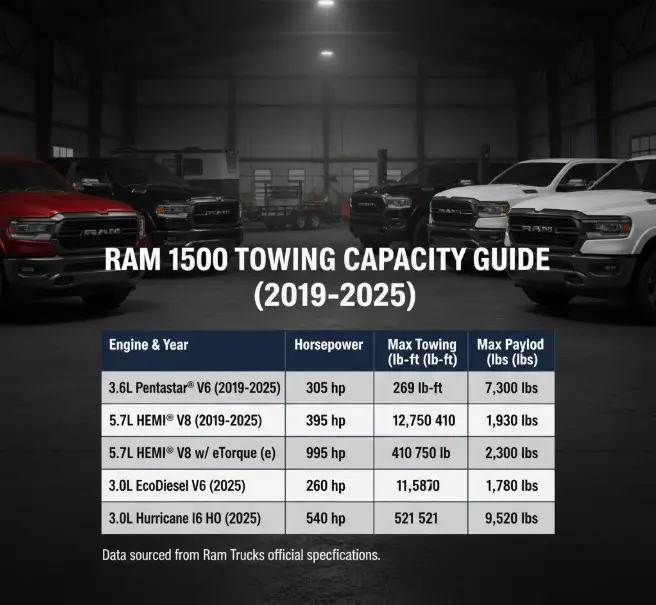
The Ram 1500 has undergone significant evolution over the past decade, with towing capacity fluctuating based on powertrain advancements and generational redesigns. The following chart outlines the maximum conventional towing capacity for a given model year when properly equipped with the specified engine.
Ram 1500 Maximum Towing Capacity by Year & Engine (lbs)
| Year | 3.6L Pentastar V6 | 5.7L HEMI® V8 | 3.0L EcoDiesel V6 | 5.7L HEMI® V8 w/ eTorque | 3.0L Hurricane I6 | 3.0L Hurricane I6 H/O |
| 2025 | 8,110 | N/A | N/A | N/A | 11,570 | 9,920 |
| 2024 | 7,760 | N/A | N/A | 12,750 | N/A | N/A |
| 2023 | 7,730 | N/A | 9,600 | 12,750 | N/A | N/A |
| 2022 | 7,730 | 11,610 | 12,560 | 12,750 | N/A | N/A |
| 2021 | 7,730 | 11,610 | 12,560 | 12,750 | N/A | N/A |
| 2020 | 7,730 | 11,610 | 12,560 | 12,750 | N/A | N/A |
| 2019 | 7,730 | 11,610 | 12,560 | 12,750 | N/A | N/A |
| 2018 | 7,600 | 10,620 | 9,210 | N/A | N/A | N/A |
| 2017 | 7,610 | 10,640 | 9,210 | N/A | N/A | N/A |
| 2016 | 7,610 | 10,640 | 9,210 | N/A | N/A | N/A |
| 2015 | 7,310 | 9,180 | N/A | N/A | N/A | N/A |
Note: Data compiled from multiple sources. Figures represent the maximum possible rating for a given year and engine combination and require specific configurations.
The 4th Generation (2015-2018)
During the latter years of its fourth generation, the Ram 1500 solidified its reputation for a superior ride quality thanks to its class-exclusive coil-spring rear suspension. Towing capability was robust, primarily led by the 5.7L HEMI® V8, which offered a maximum capacity of up to 10,640 pounds in 2016 and 2017.
This era also featured the first generation of the 3.0L EcoDiesel V6, an engine prized for its impressive torque and fuel efficiency, though its initial towing capacity was more modest at 9,210 pounds. The standard 3.6L Pentastar V6 provided a respectable baseline, capable of towing over 7,600 pounds in its final years before the redesign.
The 5th Generation Leap (2019-2024)
The 2019 model year marked the debut of the completely redesigned fifth-generation Ram 1500, a truck that MotorTrend named its Truck of the Year. This redesign brought a stronger, lighter frame and significant powertrain advancements, leading to a dramatic increase in capability. The headline achievement was a new maximum towing capacity of 12,750 pounds, a figure that would define the model for the next six years.
This peak rating was made possible by the introduction of the 5.7L HEMI® V8 with the eTorque mild-hybrid system. This system uses a 48-volt belt-starter generator to provide a momentary torque boost for smoother acceleration from a stop, while also improving the efficiency of the start/stop system.
The second generation of the 3.0L EcoDiesel V6 also saw a major capability boost, reaching a formidable 12,560-pound tow rating, making it a powerful and efficient alternative to the HEMI.
The Hurricane Era (2025 and Beyond)
For the 2025 model year, Ram made its most significant powertrain shift in over a decade, retiring the venerable 5.7L HEMI® V8 and the 3.0L EcoDiesel from the 1500 lineup. In their place is the new “Hurricane” engine family: a 3.0L twin-turbocharged inline-six (I6) available in two outputs.
The Standard-Output (SO) Hurricane engine is the new towing champion, enabling the 2025 Ram 1500 to pull a maximum of 11,570 pounds. While this is a slight reduction from the outgoing HEMI eTorque’s peak, the new engine produces significantly more power, with 420 horsepower and 469 pound-feet of torque.
This change reflects a broader engineering strategy focused on delivering a superior balance of power, efficiency, and performance across the board, rather than chasing a single, narrowly configured maximum tow rating. The High-Output (HO) Hurricane engine, with a massive 540 horsepower and 521 pound-feet of torque, is tuned for performance and has a lower max tow rating of 9,920 pounds.
A Deeper Look: Ram 1500 Towing Capacity by Engine
The engine is the heart of any tow vehicle. Over the last decade, the Ram 1500 has offered a diverse portfolio of powertrains, each with distinct characteristics tailored to different user needs.
The Workhorse: 3.6L Pentastar V6 with eTorque
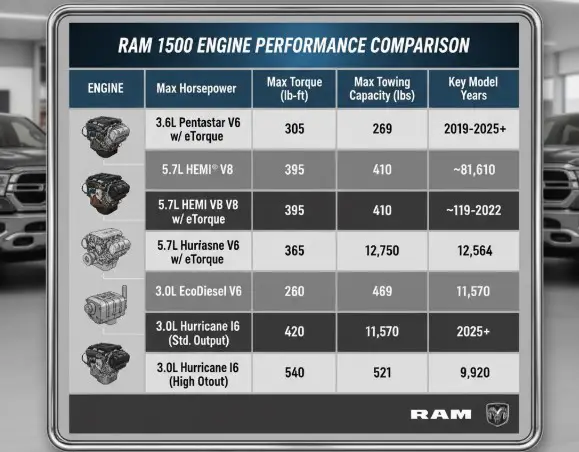
The 3.6L Pentastar V6 has served as the reliable and efficient base engine for the Ram 1500 for years. With 305 horsepower and 269 pound-feet of torque, it is perfectly suited for light-duty towing and daily driving. When properly configured, it can tow up to 8,110 pounds.
An interesting characteristic of the V6 is that trucks equipped with it often boast the highest payload capacities in the lineup, reaching up to 2,370 pounds. This is because the engine’s lighter weight reduces the truck’s overall curb weight, leaving more of the Gross Vehicle Weight Rating (GVWR) available for cargo.
The Legend: 5.7L HEMI® V8 with eTorque
The 5.7L HEMI® V8 is the engine most synonymous with Ram’s power and capability. Producing 395 horsepower and 410 pound-feet of torque, it has been the go-to choice for serious towing for over a decade. From 2019 to 2024, the version enhanced with the eTorque mild-hybrid system was the undisputed towing champion of the lineup.
While the horsepower and torque figures are identical to the non-eTorque version, the system’s ability to provide instant torque fill from a standstill improved driving dynamics and enabled Ram engineers to certify the truck for its peak 12,750-pound tow rating. The non-eTorque version still offered a very strong 11,610-pound capacity.
The Torque King (Discontinued): 3.0L EcoDiesel V6
The 3.0L EcoDiesel V6, offered in two generations, was a favorite among those who towed long distances. While its 260 horsepower was modest, its massive 480 pound-feet of torque gave it effortless pulling power, rivaling the HEMI V8.
The second-generation engine (2020-2022) achieved an impressive maximum towing capacity of 12,560 pounds, just shy of the HEMI’s peak, while delivering significantly better fuel economy. Despite its popularity, the EcoDiesel was discontinued from the Ram 1500 lineup after the 2023 model year.
The New Era: 3.0L Hurricane Twin-Turbo I6
The 3.0L Hurricane engine family represents Ram’s future. The Standard-Output (SO) version is the new mainstream towing engine, producing 420 horsepower and 469 pound-feet of torque to enable a maximum towing capacity of 11,570 pounds. The High-Output (HO) version is a performance powerhouse, churning out 540 horsepower and 521 pound-feet of torque.
Counterintuitively, the more powerful HO engine has a lower maximum tow rating of 9,920 pounds. This is not due to a lack of power but a difference in application and tuning. The HO engine is standard on performance-oriented trims like the off-road RHO and top-tier luxury models like the Tungsten.
These trims feature specialized suspension systems (either for high-speed off-roading or for ultimate ride comfort) and are not equipped with the specific axle ratios and other components needed to achieve a maximum tow rating. This indicates a clear segmentation strategy: the SO Hurricane is the new workhorse for towing, while the HO Hurricane is the engine for maximum on-road and off-road performance.
Stepping Up: Ram Heavy-Duty Towing Charts (2500 & 3500)
For loads that exceed the Ram 1500’s capabilities, Ram offers its Heavy-Duty lineup. The Ram 2500 and 3500 are built on a more robust frame with stronger axles and suspension, designed for the extreme demands of commercial work and hauling the largest trailers.
Ram Heavy-Duty (2500/3500) Max Towing by Year (lbs)
| Year | Ram 2500 Max Towing | Ram 3500 Max Towing | Key Engine |
| 2025 | 20,000 | 36,610 | 6.7L Cummins H/O |
| 2024 | 19,990 | 37,090 | 6.7L Cummins H/O |
| 2023 | 19,980 | 37,090 | 6.7L Cummins H/O |
| 2022 | 19,980 | 37,090 | 6.7L Cummins H/O |
| 2021 | 19,680 | 37,100 | 6.7L Cummins H/O |
| 2020 | 19,680 | 35,100 | 6.7L Cummins H/O |
| 2019 | 19,780 | 35,100 | 6.7L Cummins H/O |
| 2018 | 17,980 | 31,210 | 6.7L Cummins H/O |
| 2017 | 17,980 | 31,210 | 6.7L Cummins H/O |
Note: Data compiled from multiple sources. Figures represent the maximum possible rating for a given year and require specific diesel engine options and configurations.
The immense capability of the Heavy-Duty trucks comes from two primary engine options. The standard engine is a powerful 6.4L HEMI® V8, which provides excellent power and often allows for the highest payload ratings. However, to achieve maximum towing, buyers must opt for the legendary 6.7L Cummins® Turbo Diesel I6 engine.
This engine is available in both Standard-Output and High-Output versions, with the High-Output variant in the Ram 3500 producing over 1,000 pound-feet of torque to achieve its class-leading tow ratings. For a complete breakdown of these workhorses, consult(https://www.ramtrucks.com/towing/towing-capacity-guide.html).
The Ultimate Towing Equation: Factors That Define Your Truck’s Real-World Limit
The “max tow” number is just one part of a complex equation. To truly understand what your truck can handle, it is essential to grasp the key factors that contribute to its final rating.
Horsepower vs. Torque: What Matters More for Towing?
Both are crucial, but they play different roles. Torque is the rotational force that gets a heavy load moving from a standstill. It’s the grunt power you feel at low RPMs. Horsepower is the measure of work done over time, which determines how well the truck can maintain speed with that load, especially up hills or against a headwind.
Diesel engines, like the 6.7L Cummins, are prized for towing because they produce immense torque at very low engine speeds, making it feel effortless to pull a heavy trailer.
The Axle Ratio Multiplier
Perhaps the most important yet least understood option for towing is the axle ratio. This number (e.g., 3.21, 3.55, 3.92) describes the ratio of gears in the truck’s differential. A 3.92 axle ratio, for example, means the driveshaft rotates 3.92 times for every single rotation of the wheels.
- A higher numerical ratio (like 3.92) acts as a torque multiplier, making it much easier for the engine to turn the wheels and pull a heavy load. This significantly increases towing capacity but results in slightly lower fuel economy during unloaded highway cruising.
- A lower numerical ratio (like 3.21) is better for fuel efficiency and daily driving, as the engine runs at lower RPMs at highway speeds, but it limits the truck’s maximum towing ability.
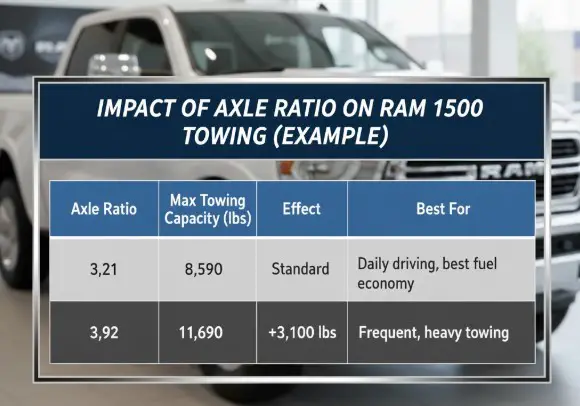
The difference is not trivial. As the example table below shows, choosing the optional 3.92 axle ratio over the standard 3.21 can add over 3,000 pounds of towing capacity to the exact same truck.
Impact of Axle Ratio on Ram 1500 Towing
Configuration is Key: Cab, Bed, and Drivetrain
Every component of your truck has weight, and that weight impacts its towing ability.
- Cab Size & Bed Length: A larger, heavier configuration, like a Crew Cab with a long bed, has a higher curb weight than a smaller Quad Cab. This extra weight is subtracted from the Gross Combined Weight Rating (GCWR), reducing the amount left over for the trailer.
- Drivetrain (4×2 vs. 4×4): Two-wheel drive (4×2) trucks are lighter than their four-wheel drive (4×4) counterparts. This lower weight means they often have slightly higher maximum towing ratings. However, a 4×4 system provides significantly better traction, which can be invaluable when pulling a boat up a slippery ramp or navigating a muddy job site.
Decoding the Door Sticker: GVWR, GCWR, and Payload
The most accurate information for your specific vehicle is on the stickers located on the driver’s side door jamb. Here is how to decode the key terms:
- GVWR (Gross Vehicle Weight Rating): The absolute maximum weight of your truck, including fuel, passengers, and any cargo in the cab and bed.
- GCWR (Gross Combined Weight Rating): The absolute maximum weight of your fully-loaded truck and your fully-loaded trailer combined. This is the ultimate limit for your entire setup.
- Payload: The maximum weight of cargo and passengers you can carry in your truck. It is calculated by subtracting your truck’s curb weight from its GVWR.
- Tongue Weight: The downward force that the trailer tongue exerts on the truck’s hitch. This weight is carried by the truck and must be counted against your payload capacity. It is typically 10-15% of the total trailer weight.
The relationship between tongue weight and payload is the most critical concept for safe towing. A truck can be well within its maximum tow rating but dangerously overloaded if the trailer’s tongue weight, combined with passengers and gear, exceeds the truck’s payload capacity.
For example, a truck with a 1,500-pound payload rating pulling a 10,000-pound trailer (with a 1,200-pound tongue weight) only has 300 pounds of payload capacity left for the driver, passengers, and any gear in the truck. For this reason, payload is often the true limiting factor in real-world towing scenarios.
What Can Your Ram Truck Actually Tow?
Translating pounds into real-world objects helps put these numbers into perspective. Here are some general examples of what different towing capacities can handle:
- Under 8,000 lbs (Most V6 and base V8 configurations): This range is perfect for recreational use. It can comfortably handle small travel trailers, pop-up campers, utility trailers with ATVs or landscaping equipment, and most aluminum fishing or ski boats.
- 8,000 – 12,750 lbs (Well-equipped HEMI, EcoDiesel, and Hurricane models): This is the sweet spot for the Ram 1500. It can manage larger travel trailers up to about 32 feet, medium-sized sailboats on a trailer, or a flatbed trailer with a car or light tractor.
- 12,750 – 20,000 lbs (Ram 2500): This is heavy-duty territory. The Ram 2500 is ideal for large fifth-wheel RVs, multi-horse trailers with living quarters, and heavy equipment trailers carrying skid steers or mini-excavators.
- 20,000+ lbs (Ram 3500): This is the domain of the Ram 3500, especially dually models. These trucks are designed to pull the largest luxury fifth-wheel campers, gooseneck trailers with heavy construction machinery, and other substantial commercial loads.
For more on towing, see the expert tests and reviews from publications like(https://www.caranddriver.com/ram/1500).
Frequently Asked Questions (FAQs)
Which Ram 1500 year is best for towing?
The model years from 2019 to 2024 offer the highest maximum towing capacity for the Ram 1500, peaking at 12,750 pounds. This rating requires a specific configuration: a truck equipped with the 5.7L HEMI® V8 engine with the eTorque mild-hybrid system.
How much can a Ram 1500 with a HEMI tow?
The capacity depends on the specific year and configuration. For model years 2019-2024, the 5.7L HEMI® V8 with eTorque can tow up to 12,750 pounds. The version without eTorque, available through 2022, typically maxes out around 11,610 pounds.5 The HEMI V8 was discontinued for the 2025 model year.
Does the Ram 1500 EcoDiesel have a good towing capacity?
Yes, the second-generation 3.0L EcoDiesel V6 (offered from 2020-2023) was an excellent towing engine. It achieved a maximum towing capacity of 12,560 pounds, nearly matching the HEMI V8 while offering superior fuel efficiency, making it a favorite for long-haul towing.
Why is the new 2025 Ram 1500 towing capacity lower?
While the new 3.0L Hurricane Standard-Output engine is more powerful (420 hp, 469 lb-ft) than the outgoing 5.7L HEMI, the truck’s maximum tow rating was certified at a slightly lower 11,570 pounds. This reflects a modern engineering philosophy that prioritizes a balance of overall performance, power density, and efficiency rather than focusing solely on achieving the highest possible peak towing number in a single, specific configuration.
How do I find my specific truck’s towing capacity?
The most accurate sources are your vehicle’s owner’s manual and the manufacturer’s VIN lookup tool on the official Ram Trucks website. Additionally, a sticker on your driver’s side door jamb lists critical weight ratings like GVWR and payload, which are essential for calculating your safe towing limit for any given load.
Can I increase my truck’s towing capacity?
Officially, the towing capacity certified by the manufacturer is the legal and safe limit and cannot be increased. While aftermarket upgrades such as heavy-duty brakes, an upgraded suspension, or a larger radiator can improve the stability and durability of your truck while towing, they do not change the legally rated GVWR or GCWR. Always ensure you are using the correct class of hitch and a trailer brake controller for heavy loads.