
Steering Wheel Squeaking What It Means and How To Fix It [2026]

If your steering wheel squeaking has you second-guessing every turn, you’re not alone. It’s one of the most common truck complaints — and one of the most misdiagnosed. The reason it’s so hard to pin down is that four completely different components can produce an identical squeak sound.
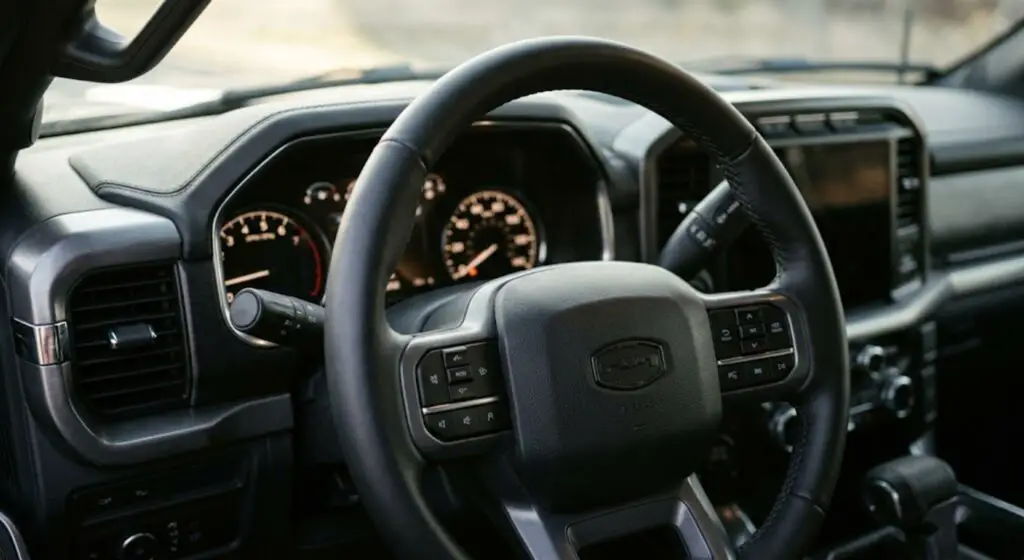
The fix depends entirely on when and how your squeak happens. Answer the right questions about your specific squeak, and you’ll know exactly what to check before touching a wrench or calling a shop.
Why Steering Wheel Squeaking Has No Single Answer
The squeak you hear can come from four completely different places — and the sound alone won’t tell you which one.
One truck might squeak because its power steering fluid is degraded. Another makes the same noise because a tie rod end is wearing out. A third squeaks only on cold mornings because the serpentine belt stiffens up. The fourth has a dry steering column bushing that nobody has touched in 80,000 miles.
Each cause sounds nearly identical from the driver’s seat. But the conditions under which each squeak happens are completely different. Temperature, speed, steering angle, and when the noise started all point to different branches.
That’s what this guide does. Before jumping to fixes, these four conditions narrow it down fast.
4 Conditions That Identify Which Part Is Causing the Squeak
Answer these four questions about your squeak — each one eliminates causes and points to the right branch.
1. When does it squeak?
- Only when turning (left, right, or both) → points toward suspension joints, tie rods, or low power steering fluid
- Only on startup, then disappears → points toward belt or cold fluid
- Constantly, including straight-line driving → points toward a failing power steering pump
- Only at near-full steering lock → points toward CV joint
If the squeak only happens when turning and disappears on a straight road, that points away from the belt and toward a suspension or fluid issue.
2. What temperature triggers it?
- Only when cold (below 32°F), disappears after 5 minutes of driving → almost always fluid viscosity or belt stiffness — usually not a component failure
- Any temperature, warm or cold → points toward a mechanical issue (worn joint, failing pump, or low fluid)
3. What does it feel like alongside the squeak?
- Squeak only, no resistance → steering column bushing or mild fluid issue
- Squeak plus stiffness → power steering pump under pressure, or low fluid
- Squeak plus grinding sensation through the wheel → upper strut bearing or CV joint
- Squeak plus play or looseness in the wheel → tie rod ends — treat as urgent
4. When did it start?
- Gradual over months → normal wear on a joint or pump
- Sudden appearance after a repair → likely a disturbed fitting, wrong lubricant, or a loose component
- After hitting a curb or pothole → stop driving and inspect — structural damage is possible
The Most Common Cause: Dry or Worn Power Steering Components
In most trucks, the first place to check is the power steering system. It’s responsible for the majority of steering squeaks — and it’s also the easiest to fix when caught early.
Low or Degraded Power Steering Fluid
Symptoms: Squeak when turning, worse at low speeds or full steering lock, often disappears at highway speed.
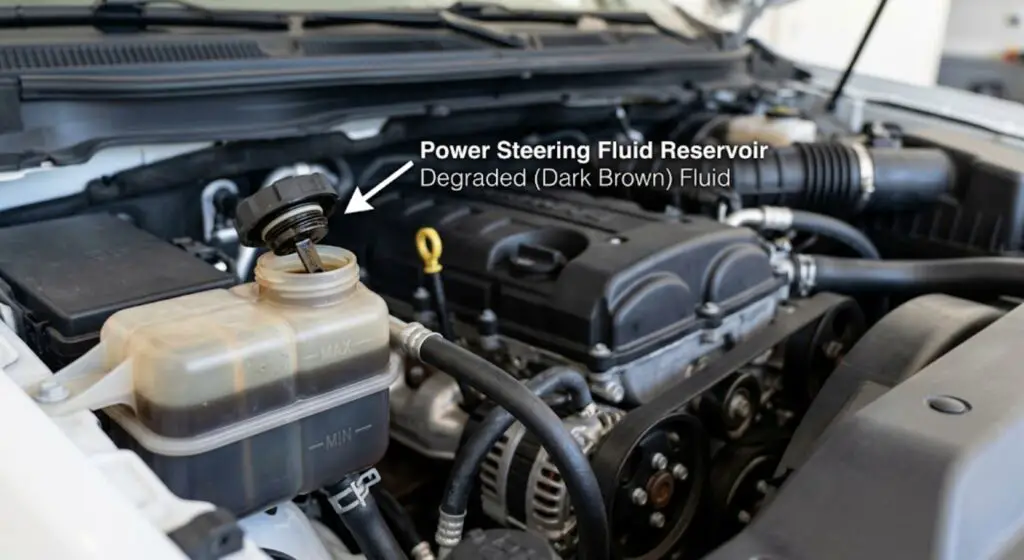
Why it happens: Power steering fluid loses its lubricating properties over time. Most manufacturers recommend flushing it every 50,000 miles or every two years — whichever comes first. If your fluid is dark brown, cloudy, or has a burnt smell, it’s no longer doing its job.
If the squeak occurs at slow turns and your fluid reservoir is low or dark brown, this is your cause. Check the reservoir first. If it’s low — top it up with the correct spec fluid for your truck (check your owner’s manual — using the wrong fluid can damage the system). If the fluid is dark — a full flush is the right move, not just a top-up.
A power steering fluid flush costs $70–$150 at a shop, or $10–$50 in fluid cost if you do it yourself. It’s the cheapest steering repair on this entire list.
Power Steering Pump Wear
Symptoms: Constant squeak or groan, worse under load when parking, often accompanied by resistance at the wheel.
Why it happens: Power steering pumps generally last 80,000–150,000 miles. Past that threshold — especially if the truck has run low on fluid at some point — internal bearing wear begins.
If the squeak is constant and accompanied by resistance or a groaning sound at low speed, the pump itself may be failing. A worn pump can’t maintain hydraulic pressure quietly. The groan gets louder when you load it (tight parking turns, slow-speed maneuvering).
Pump replacement runs $699–$925 at a shop. Don’t delay a constant squeak with stiffness — a pump running dry can send metal through the rack, turning a $900 repair into a $2,000+ one.
DIY difficulty: Advanced — shop job for most truck owners.
If your squeak is isolated strictly to turning and is not present when driving straight, the cause shifts to a different set of components.
When the Squeak Only Happens While Turning
If your squeak only appears mid-turn and disappears on a straight road, the power steering pump is less likely. These three components move to the front of the list.
Steering Squeak Diagnosis at a Glance
Match your symptom pattern to find the most likely cause and urgency level
| When It Squeaks | Temperature | Other Symptoms | Most Likely Cause | Repair | Urgency |
|---|---|---|---|---|---|
| Slow turns | Any | No stiffness; possible steering play | Tie rod ends or column bushings | DIY Possible | Fix Soon |
| Any turn or constant | Any | Stiffness or groaning sound | Failing power steering pump | Shop Job | Urgent |
| Turning; fluid low or dark | Any | No stiffness | Degraded power steering fluid | DIY | Fix Soon |
| Cold start only | Below 32°F | Disappears within 5 min | Fluid viscosity or serpentine belt | DIY | Monitor |
| Near-full lock turns only | Any | Clicking under acceleration through turn | CV joint wear | Shop Job | Fix Soon |
| Any turning input | Any | Grinding felt through steering wheel | Upper strut bearing | Shop Job | Fix Soon |
| Stationary wheel rotation | Any | Truck not moving; squeak during wheel spin | Steering column bushing (dry) | DIY | Monitor |
Tie Rod Ends
Symptoms: Squeak or creak at slow turns, especially in parking lots. May produce a click at full lock. Sometimes accompanied by slight looseness in the steering.
Why it happens: Tie rod ends connect the steering rack to the wheel hub. The ball-and-socket joint inside them dries out with age and begins to squeak under load. Worn tie rods often show up first as uneven front tire wear.
If the squeak is heard at low-speed turns and you notice any play in the steering response or uneven wear on the front tires, tie rod ends are the likely cause. However, if you notice looseness in the steering wheel itself alongside the squeak, treat this as urgent — a failing tie rod is a safety issue, not a monitoring situation.
Outer tie rod end replacement (one side, including alignment) costs $250–$450 at an independent shop in 2025. Trucks run slightly higher due to parts complexity.
DIY difficulty: Experienced DIY possible. Requires an alignment after replacement.
Upper Strut Bearing (Strut Mount)
Symptoms: Squeak or grinding sensation when turning, often felt through the wheel as well as heard. More common on trucks past 80,000–100,000 miles.
Why it happens: The upper strut bearing sits at the top of the front strut assembly. It allows the strut to rotate as the wheel turns. When the bearing wears, it grinds and squeaks during steering input.
If the squeak is accompanied by a slight grinding sensation at the top of the wheel travel when turning — not just a sound but a physical sensation through the steering wheel — the upper strut bearing is the likely source.
Strut bearing replacement costs $382–$530 on average, though trucks at dealerships can run higher.
DIY difficulty: Shop job. Requires coil spring compressors and specialized tools — risk of injury if done without proper equipment.
CV Joint
Symptoms: Clicking or squeaking specifically at near-full steering lock turns (tight U-turns, parking lot maneuvers). Worsens when accelerating through the turn.
Why it happens: CV joints flex at extreme angles during full-lock turns. When the grease inside dries out or the rubber boot tears, the joint starts clicking or squeaking under load.
If the noise only happens at near-full lock — like a tight parking lot turn — and worsens when you apply throttle through the turn, a worn CV joint is the cause. The noise is position-dependent: it appears at one specific angle and disappears when you straighten the wheel.
CV axle replacement costs $250–$650 per axle at an independent shop.
DIY difficulty: Shop job. Involves drivetrain disassembly.
Temperature changes the diagnosis entirely. If your squeak only appears on cold mornings and disappears after the truck warms up, the cause is different again.
When the Squeak Only Happens in Cold Weather
A squeak that only shows up on cold mornings and vanishes after a few minutes of driving is almost always a fluid or belt issue — not a failing joint or pump.
Cold power steering fluid: Below freezing (32°F and below), power steering fluid thickens and moves sluggishly through the system. This creates a brief squeak on startup as the pump works against thicker-than-normal fluid.
If the squeak appears only on cold mornings below 32°F and disappears completely within 2–5 minutes of driving, the fluid viscosity is the cause, not a failing component. The fix is to check that your fluid spec matches your manufacturer’s recommendation. If the fluid is more than 50,000 miles or two years old, a flush solves this.
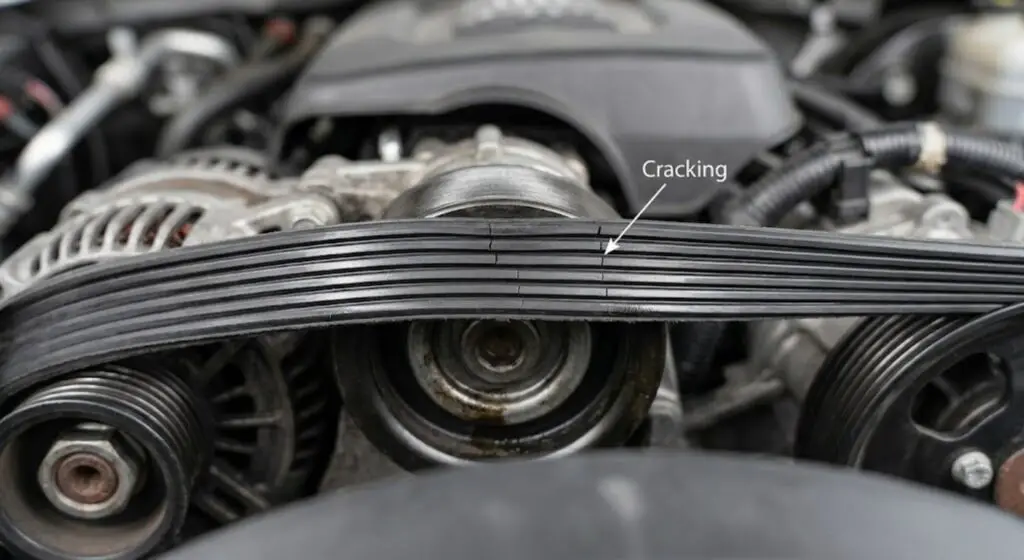
Belt stiffness: If the squeak sounds more like a high-pitched squeal than a squeak, and it seems to come from under the hood rather than from the steering wheel itself, the serpentine belt is the source — not the steering column. Cold rubber stiffens, and a belt that’s glazed, cracked, or slightly misaligned will squeal briefly on cold starts.
Inspect the serpentine belt for cracks, glazing, or missing ribs. Serpentine belt replacement costs $109–$203 at a shop — one of the lowest-cost fixes on this list.
A cold-only squeak that fully resolves after warmup is rarely a safety issue. But don’t ignore it permanently — if it gets louder over time or starts happening in warmer weather, it’s progressing.
Some squeaks don’t fit these main branches cleanly. These less common causes are worth checking if none of the above matched your symptoms.
Less Obvious Causes That Mimic a Steering Squeak
If none of the main branches matched your squeak exactly, these less common sources are worth a quick check before spending money on parts.
Dry steering column bushings: If the squeak happens when you rotate the wheel while parked and stationary — not just when you’re turning the truck — the steering column bushings are the source. This is a distinct diagnostic clue: the squeak is about wheel rotation, not vehicle movement.
Fix: Spray silicone spray or apply white lithium grease to the steering column bushings (never use WD-40 on rubber — it strips lubrication and dries the bushing out faster). This is a DIY-accessible fix that costs under $10 in product and takes about 10 minutes.
Brake dust on rotors: Occasionally mimics a steering squeak at slow turns. Test by gently applying the brakes mid-turn. If the squeak stops or changes character when braking, brake dust or rotor glazing is the source — not the steering system.
Post-repair squeak: If the squeak appeared directly after a recent shop visit involving steering or suspension work, a disturbed component is the likely cause. Wrong lubricant, a dry fitting, or an improperly torqued joint can all produce a squeak that wasn’t there before. Return to the shop — this is their repair to resolve.
Steering Squeak Diagnosis at a Glance
Use this table to confirm your diagnosis before buying parts or booking a shop visit.
Squeak only when turning? Compare the three most likely causes
Slow turns, parking lot speed
Squeak or creak; may click at full lock. Possible steering play or uneven tire wear
DIY Possible
$250 – $450 per side
Any turning input, especially 80k+ miles
Grinding sensation felt through the wheel — not just heard
Shop Job
$382 – $530
Near-full lock turns only (tight U-turns, parking)
Clicking or squeak at full lock; worsens when accelerating through the turn
Shop Job
$250 – $650 per axle
| When It Squeaks | Temperature | Other Symptoms | Most Likely Cause | DIY or Shop | Urgency |
|---|---|---|---|---|---|
| Slow turns, any temp | Any | No stiffness | Tie rod ends or column bushings | DIY possible | Monitor / Fix soon |
| Any turn or constant | Any | Stiffness or groan | Power steering pump | Shop | Urgent |
| Turning, fluid low/dark | Any | No stiffness | Degraded power steering fluid | DIY | Fix soon |
| Cold start only | Below 32°F | Disappears in 5 min | Fluid viscosity or belt | DIY | Monitor |
| Full lock turns only | Any | Clicking under acceleration | CV joint | Shop | Fix soon |
| Turning + grinding sensation | Any | Felt through wheel | Upper strut bearing | Shop | Fix soon |
| Stationary wheel rotation | Any | No vehicle movement | Steering column bushing | DIY | Monitor |
When To Stop Driving and See a Mechanic Immediately
Most steering squeaks are a maintenance issue, not a safety emergency — but these four symptoms change that immediately.
- Squeak plus sudden increased steering effort — If the wheel becomes noticeably harder to turn alongside the squeak, power steering assist is failing. Pull over safely and do not continue driving.
- Squeak plus steering pulling hard to one side — This combination can indicate a tie rod on the verge of failure. A failed tie rod means loss of steering control. Do not drive.
- Squeak plus clunking or banging — A loose component in the steering linkage is moving when it shouldn’t. The clunk is the component shifting under load. Stop immediately.
- Squeak that appeared after a collision or curb strike — Even a minor curb hit can bend steering components. Have the truck inspected before driving further — what looks like a squeak can be structural damage.
A squeak alone — with no other symptoms — is almost never an emergency. Squeak plus any of the above is a different situation entirely.
If your squeak is paired with any of these — do not continue driving
Frequently Asked Questions
Why does my steering wheel squeak only when turning slowly?
Slow-speed turns load the steering system hardest — the pump, joints, and fluid all work under maximum pressure at low speeds. If the squeak only occurs when turning slowly, check the power steering fluid level and condition first, then inspect tie rod ends for wear.
Is a squeaking steering wheel dangerous to drive with?
A squeak alone with no other symptoms is usually safe to drive on short-term while diagnosing the cause. If the squeak is accompanied by stiffness, pulling to one side, or clunking, stop driving and have it inspected immediately — those combinations indicate a component that may be approaching failure.
Can low power steering fluid cause a squeaking noise?
Yes. Low or degraded power steering fluid is one of the most common causes of steering squeak. As the fluid drops or loses viscosity, the pump draws air and components begin to rub. Check the reservoir — if the fluid is low or dark brown, a top-up or flush will often resolve the squeak.
Why does my steering wheel squeak in cold weather but not when warm?
Cold temperatures thicken power steering fluid and stiffen rubber belts, both of which can produce a brief squeak on startup. If the noise disappears completely within 5 minutes of driving, it’s almost always a cold-fluid or belt issue — not a failing component. Check fluid age and belt condition.
How much does it cost to fix a squeaking steering wheel?
It depends entirely on the cause. A power steering fluid flush runs $70–$150. A serpentine belt is $109–$203. Steering column bushing lubrication is under $10 DIY. Tie rod end replacement runs $250–$450 per side including alignment. Upper strut bearings are $382–$530. A power steering pump replacement is the most expensive at $699–$925. Diagnose the cause first — the condition map in this guide tells you which branch to check before spending anything.
Conclusion
Steering wheel squeaking almost always has a specific, fixable cause — and the condition of your squeak points directly to it. A cold-only squeak that disappears in minutes is almost never the same problem as a constant squeak with steering resistance. The diagnostic map in this guide separates them.
Start with the four condition questions in Section 3. Confirm your branch. Check the summary table before buying any parts. If you’re dealing with stiffness, pulling, or clunking alongside the squeak, skip the DIY path and get the truck inspected right away.
Most truck owners who walk through this process find the answer before they spend a dollar.