2017 Toyota Tundra Towing Capacity Chart and Trim Guide

The 2017 Toyota Tundra towing capacity chart runs from 6,400 lbs to 10,500 lbs, and the exact number for your truck depends on its engine, cab, bed and drivetrain. The highest rating belongs to a Regular Cab 4×2 with the 5.7L V8. This guide gives you the full chart for every trim and configuration, plus the payload, GCWR and tongue weight limits that decide what you can tow in real life.


Every figure below comes from Toyota’s own 2017 Tundra material and the 2017 eBrochure data it publishes, cross-checked against dealer and valuation sources. Your door jamb sticker still has the final word for your specific truck, since options and accessories change the rating.
What Is the 2017 Toyota Tundra Towing Capacity


The 2017 Toyota Tundra tows up to 10,500 lbs when properly equipped. That rating applies to a Regular Cab 4×2 with the 5.7L i-FORCE V8 and the 4.30 rear axle ratio.
Toyota rates the truck under the SAE J2807 towing standard, which sets one test method for every maker. Toyota announced the 10,500 lb maximum for the 2017 Tundra and notes that the truck was the first pickup to adopt the SAE J2807 standard back in 2011. The standard tow hitch receiver became standard equipment for 2017, and the Tow Package was available on all grades.
Which 2017 Tundra Engine Tows More
The 2017 Tundra came with two V8 engines, and the choice between them is the single biggest factor in your tow rating. Both engines pair with a 6-speed automatic transmission.
| Engine | Horsepower | Torque | Max Towing | Max Payload | GCWR |
|---|---|---|---|---|---|
| 4.6L i-FORCE V8 | 310 hp at 5,600 rpm | 327 lb-ft at 3,400 rpm | 6,800 lbs | 1,600 lbs | 14,000 lbs |
| 5.7L i-FORCE V8 | 381 hp at 5,600 rpm | 401 lb-ft at 3,600 rpm | 10,500 lbs | 2,080 lbs | 16,000 lbs |
The 5.7L i-FORCE V8 is the clear towing choice. It makes 71 more horsepower and 74 more lb-ft of torque than the 4.6L, and it adds 3,700 lbs of tow rating.
The 4.6L V8 was offered only on SR and SR5 Double Cab and CrewMax trucks. Every 5.7L truck came standard with the tow package hardware, including the integrated hitch receiver, trailer brake controller prewire, 4.30 axle ratio, TOW/HAUL mode switch, engine oil cooler, transmission cooler, heavy-duty battery and 170-amp alternator. Edmunds lists the 5.7L as standard on the Regular Cab and all Limited, Platinum, 1794 Edition and TRD Pro trucks, with the 4.6L as the base SR and SR5 engine.
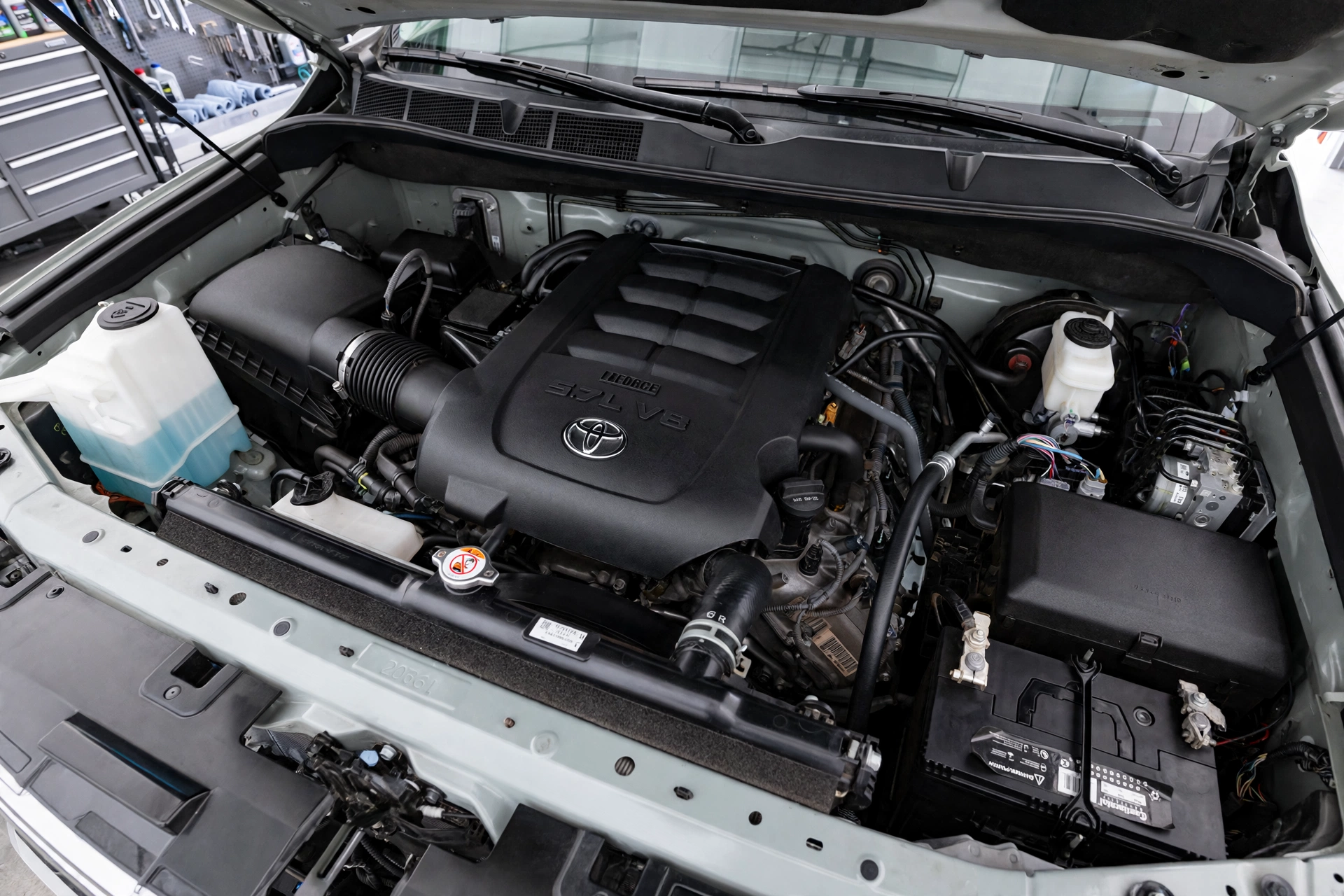
The engine cover in the photo above shows the 5.7L i-FORCE V8 that earns the top rating. If your truck has the 4.6L, your ceiling is 6,800 lbs no matter which cab or bed you have.
2017 Tundra Towing Capacity Chart in 28 Configurations
Use this chart to find your truck. Match your trim, engine, cab, bed and drivetrain, then read across to the tow rating and the gross combined weight rating. All weights are in pounds.
2017 Tundra Towing at a Glance
- Max towing: 10,500 lbs with the 5.7L V8 in a Regular Cab 4×2
- Max payload: 2,080 lbs on that same Regular Cab 4×2 truck
- 5.7L i-FORCE V8: 381 hp and 401 lb-ft of torque
- 4.6L V8: 310 hp and 327 lb-ft, with max towing of 6,800 lbs
- GCWR: 16,000 lbs with the 5.7L V8 and 14,000 lbs with the 4.6L V8
| Trim | Engine | Cab | Bed | Drive | Max Tow (lbs) | GCWR (lbs) |
|---|---|---|---|---|---|---|
| SR | 5.7L V8 | Regular | Long 8.1 ft | 4×2 | 10,500 | 16,000 |
| SR | 5.7L V8 | Regular | Long 8.1 ft | 4×4 | 10,300 | 16,000 |
| SR | 4.6L V8 | Double | Standard 6.5 ft | 4×2 | 6,800 | 14,000 |
| SR | 4.6L V8 | Double | Standard 6.5 ft | 4×4 | 6,500 | 14,000 |
| SR | 5.7L V8 | Double | Standard 6.5 ft | 4×2 | 10,300 | 16,000 |
| SR | 5.7L V8 | Double | Standard 6.5 ft | 4×4 | 9,900 | 16,000 |
| SR | 5.7L V8 | Double | Long 8.1 ft | 4×2 | 10,100 | 16,000 |
| SR | 5.7L V8 | Double | Long 8.1 ft | 4×4 | 9,800 | 16,000 |
| SR5 | 4.6L V8 | Double | Standard 6.5 ft | 4×2 | 6,800 | 14,000 |
| SR5 | 4.6L V8 | Double | Standard 6.5 ft | 4×4 | 6,500 | 14,000 |
| SR5 | 5.7L V8 | Double | Standard 6.5 ft | 4×2 | 10,300 | 16,000 |
| SR5 | 5.7L V8 | Double | Standard 6.5 ft | 4×4 | 9,900 | 16,000 |
| SR5 | 5.7L V8 | Double | Long 8.1 ft | 4×2 | 10,100 | 16,000 |
| SR5 | 5.7L V8 | Double | Long 8.1 ft | 4×4 | 9,800 | 16,000 |
| SR5 | 4.6L V8 | CrewMax | Short 5.5 ft | 4×2 | 6,700 | 14,000 |
| SR5 | 4.6L V8 | CrewMax | Short 5.5 ft | 4×4 | 6,400 | 14,000 |
| SR5 | 5.7L V8 | CrewMax | Short 5.5 ft | 4×2 | 10,100 | 16,000 |
| SR5 | 5.7L V8 | CrewMax | Short 5.5 ft | 4×4 | 9,800 | 16,000 |
| Limited | 5.7L V8 | Double | Standard 6.5 ft | 4×2 | 10,100 | 16,000 |
| Limited | 5.7L V8 | Double | Standard 6.5 ft | 4×4 | 9,100 | 16,000 |
| Limited | 5.7L V8 | CrewMax | Short 5.5 ft | 4×2 | 9,500 | 16,000 |
| Limited | 5.7L V8 | CrewMax | Short 5.5 ft | 4×4 | 8,900 | 16,000 |
| Platinum | 5.7L V8 | CrewMax | Short 5.5 ft | 4×2 | 9,500 | 16,000 |
| Platinum | 5.7L V8 | CrewMax | Short 5.5 ft | 4×4 | 8,800 | 16,000 |
| 1794 Edition | 5.7L V8 | CrewMax | Short 5.5 ft | 4×2 | 9,500 | 16,000 |
| 1794 Edition | 5.7L V8 | CrewMax | Short 5.5 ft | 4×4 | 8,800 | 16,000 |
| TRD Pro | 5.7L V8 | Double | Standard 6.5 ft | 4×4 | 9,700 | 16,000 |
| TRD Pro | 5.7L V8 | CrewMax | Short 5.5 ft | 4×4 | 9,200 | 16,000 |
Three patterns run through the chart. First, 4×2 trucks rate 200 to 1,000 lbs higher than the same truck in 4×4, because the four-wheel-drive hardware adds weight.
Second, heavier cabs tow less, so a CrewMax rates below a Double Cab with the same engine and drivetrain. Third, the top trims tow the least, since Platinum and 1794 Edition trucks carry more equipment.
The SR Regular Cab 4×2 sits at the top with 10,500 lbs. The SR5 Double Cab 4×2 with the 5.7L follows at 10,300 lbs, and the Limited Double Cab 4×2 rates 10,100 lbs.
At the bottom, the SR5 CrewMax 4×4 with the 4.6L rates just 6,400 lbs. KBB specs list the same 10,500 lb maximum across its 12 listed 2017 Tundra configurations, with its lowest listed rating at 6,500 lbs.
How Much Payload Can a 2017 Tundra Carry
Payload is the weight your truck can carry in its cab and bed, and it caps many real trailers before the tow rating does. The 2017 Tundra carries up to 2,080 lbs of payload, again on the lightest truck in the lineup.
| Trim | Payload Range (lbs) | Highest Payload Setup |
|---|---|---|
| SR | 1,490 to 2,080 | Regular Cab 4×2, 5.7L V8, 2,080 lbs |
| SR5 | 1,400 to 1,700 | Double Cab Standard Bed 4×2, 5.7L V8, 1,700 lbs |
| Limited | 1,530 to 1,670 | Double Cab Standard Bed 4×2, 5.7L V8, 1,670 lbs |
| Platinum | 1,530 to 1,630 | CrewMax Short Bed 4×2, 5.7L V8, 1,630 lbs |
| 1794 Edition | 1,530 to 1,630 | CrewMax Short Bed 4×2, 5.7L V8, 1,630 lbs |
| TRD Pro | 1,560 to 1,630 | Double Cab Standard Bed 4×4, 5.7L V8, 1,630 lbs |
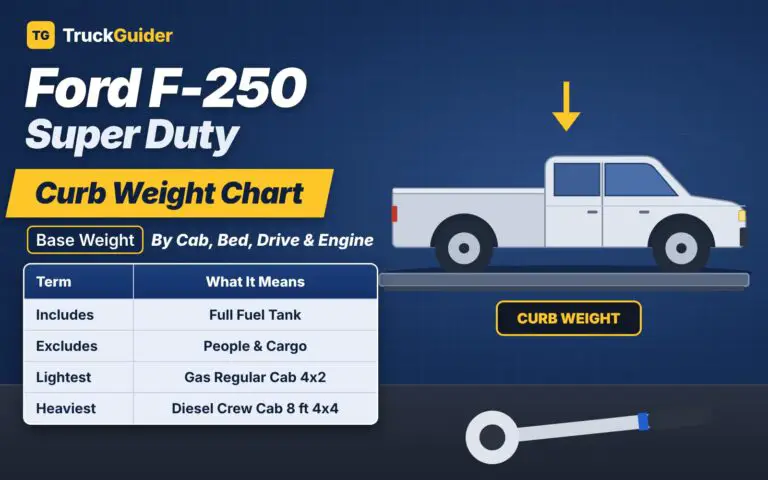
Payload equals GVWR minus curb weight, so the lightest truck carries the most. The SR Regular Cab 4×2 weighs 4,920 lbs with a 7,000 lb GVWR, which leaves 2,080 lbs of payload.
Tongue weight counts against payload, and that is where most owners run out of room. A 9,000 lb trailer at 11 percent tongue weight puts about 990 lbs on the hitch. On a CrewMax 4×4 with 1,560 lbs of payload, that leaves only 570 lbs for the driver, passengers and cargo in the truck.
How to Find Your Exact 2017 Tundra Tow Rating
The chart gives you the rating for your configuration. These four steps pin it down for your exact truck.
- Read the certification label on the driver side door jamb. It lists your GVWR and your payload figure for your truck as built.
- Confirm your engine, cab, bed and drivetrain from the window sticker or build sheet. The 4.6L and 5.7L have very different ratings.
- Match that combination to a row in the chart above. If your truck has extra options, treat the chart number as a ceiling.
- Check your GCWR. The loaded truck plus the loaded trailer must stay under 16,000 lbs with the 5.7L or 14,000 lbs with the 4.6L.
Here is the math on a common setup. A 5.7L Double Cab 4×4 with the standard bed rates 9,900 lbs, and its GCWR is 16,000 lbs. If the truck weighs 5,470 lbs empty, the trailer plus cargo and passengers must fit inside the remaining 10,530 lbs, so the 9,900 lb tow rating is the limit that binds first.
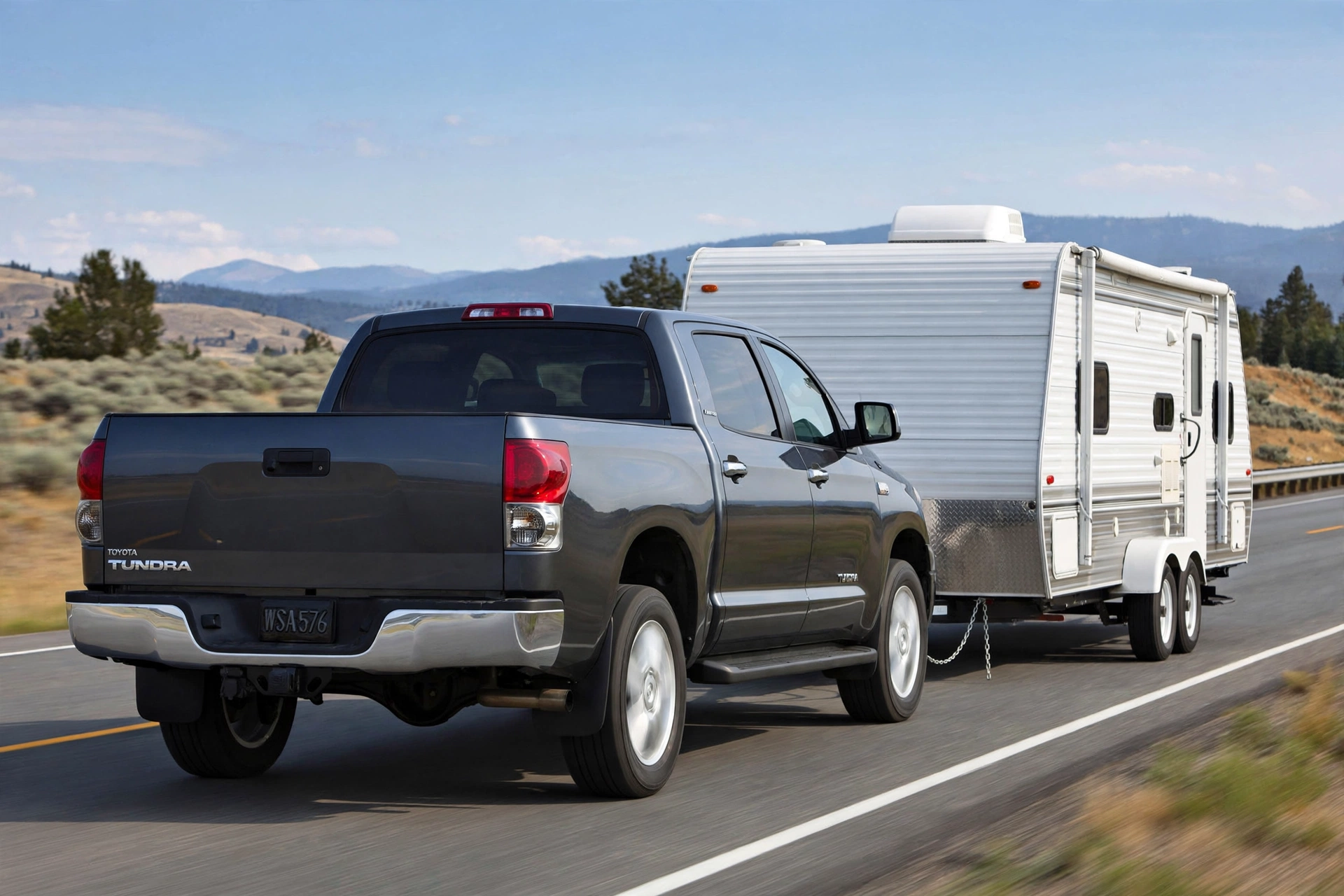
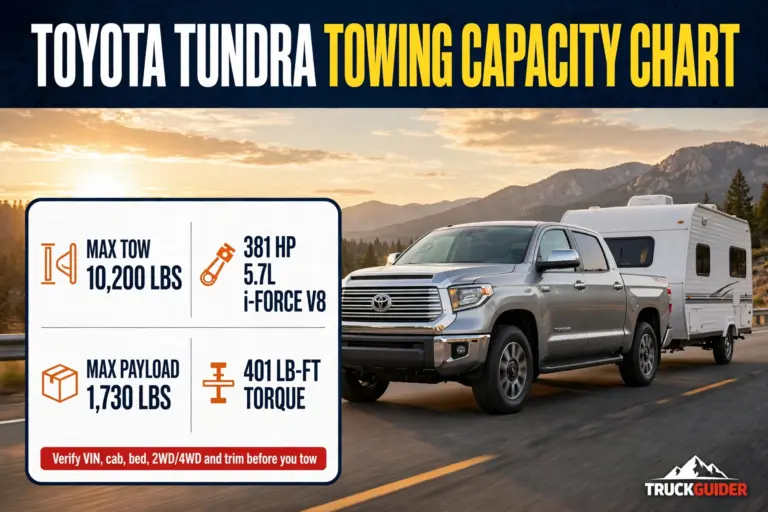
The photo above shows a second-generation Tundra pulling a travel trailer on the highway. A setup like this needs the trailer brakes and the weight-distributing hitch covered in the next section.
5 Towing Rules for a Safe 2017 Tundra Setup
Toyota sets five limits that apply to every 2017 Tundra, no matter the trim. They come from the 2017 owner manual data behind the chart above.
- Tongue weight stays under 11 percent. Toyota caps tongue weight at 11 percent of the loaded trailer weight. At the 10,500 lb maximum, that means no more than 1,155 lbs on the hitch.
- Trailers over 1,000 lbs need their own brakes. Do not tow a trailer above 1,000 lbs without a working trailer brake system.
- Trailers over 5,000 lbs need a weight-distributing hitch. A standard ball mount is not enough once the trailer passes 5,000 lbs.
- Payload runs out first. Tongue weight, passengers and cargo all share the same payload number. Check payload before you check the tow rating.
- GCWR is a hard ceiling. The truck and the loaded trailer together must never pass 16,000 lbs with the 5.7L or 14,000 lbs with the 4.6L.
Standard safety equipment helps, but it does not raise any rating. Every 2017 Tundra came with trailer sway control, which applies brake pressure at individual wheels to steady a swaying trailer, plus a standard tow hitch receiver for the model year.
2017 Tundra vs Ram 1500 and Ford F-150 Towing
The 2017 Tundra sits below its half-ton rivals on headline towing, and the gap is worth knowing before you shop. A 2017 Ram 1500 with the 5.7L Hemi was rated up to 10,620 lbs, just above the Tundra’s 10,500 lb ceiling, according to our Ram towing capacity chart by year.
The newer Rams moved further ahead. Our Ram 1500 towing capacity guide shows the current truck reaching 11,610 lbs with the Hurricane engine. Ford’s half-ton trucks also top the Tundra, as our Ford towing capacity chart shows, with the F-150 reaching 13,500 lbs with the 3.5L EcoBoost.
The Tundra still earns its place on reliability and on its standard tow equipment. The 5.7L V8, the 4.30 axle ratio and the integrated hitch receiver came standard on every 5.7L truck, so most used 2017 Tundras on the market already carry the hardware for their full rating.
3 Numbers That Define Your 2017 Tundra Tow Rating
Your 2017 Toyota Tundra towing capacity chart number is only the start. The three numbers that decide a safe tow are your tow rating from the chart, your payload from the door sticker, and your GCWR of 16,000 or 14,000 lbs.
Match your exact engine, cab, bed and drivetrain to a row in the chart. Then subtract your tongue weight from your payload and confirm the loaded truck and trailer stay under GCWR. When those three numbers all check out, your Tundra is ready to tow.
5 Questions About the 2017 Tundra Towing Capacity
How Much Can a 2017 Toyota Tundra Tow


A 2017 Toyota Tundra tows up to 10,500 lbs when properly equipped. That rating needs the 5.7L V8 in a Regular Cab 4×2, and the range across all configurations is 6,400 to 10,500 lbs.
Which 2017 Tundra Engine Tows the Most
The 5.7L i-FORCE V8 tows the most, at up to 10,500 lbs. It makes 381 hp and 401 lb-ft of torque, against 310 hp and 327 lb-ft for the 4.6L V8, which tops out at 6,800 lbs.
What Is the Payload Capacity of a 2017 Tundra
The 2017 Tundra carries up to 2,080 lbs of payload on the SR Regular Cab 4×2 with the 5.7L V8. Most CrewMax 4×4 trucks carry between 1,440 and 1,560 lbs, so check your door sticker.
What Is the GCWR of a 2017 Toyota Tundra
The GCWR is 16,000 lbs with the 5.7L V8 and 14,000 lbs with the 4.6L V8. The loaded truck plus the loaded trailer must stay under that combined limit.
Does a 2017 Tundra Need a Weight Distributing Hitch


Yes, for trailers over 5,000 lbs Toyota requires a weight-distributing hitch. Trailers over 1,000 lbs also need their own brake system, and tongue weight must stay under 11 percent of the trailer weight.