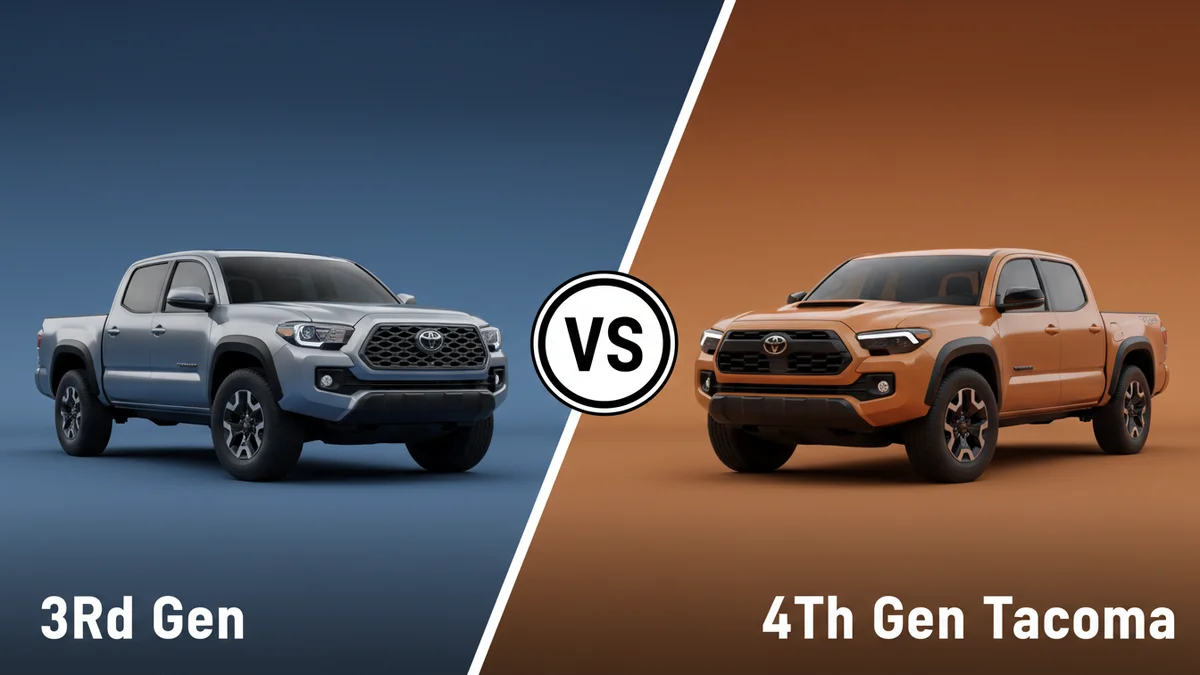
3Rd Gen vs 4Th Gen Tacoma (2026): Which Is Better?

You’re at a crossroads, aren’t you? Staring at two compelling choices, each with a loyal following, both promising adventure and utility. Deciding between the battle-tested 3Rd Gen and the all-new, feature-rich 4Th Gen Tacoma feels less like picking a truck and more like choosing a lifestyle. Is it the legendary reliability and proven platform of yesterday, or the cutting-edge technology and refined drive of tomorrow? We understand the dilemma. This deep dive cuts through the noise, offering a data-backed comparison to help you confidently choose your next pickup. We’ll lay out the facts, the figures, and the real-world implications, guiding you to the right Tacoma for your garage.
Quick Verdict: Both 3Rd Gen and 4Th Gen Tacoma are strong choices — the right pick depends on your priorities.


Pick 3Rd Gen for overall value.
Pick 4Th Gen Tacoma for premium features.
3Rd Gen vs 4Th Gen Tacoma: Head-to-Head Specs
For picking a pickup, the raw numbers often tell the most objective story. We’ve compiled the critical specifications that differentiate these two generations, highlighting the significant leaps and subtle nuances. Notice the stark contrast in available powertrains: the 3Rd Gen offers a traditional V6, while the 4Th Gen Tacoma pushes boundaries with turbocharged and hybrid options. Also, the infotainment screen sizes alone showcase a generational shift in interior priorities.

Performance & Category Ratings
The tale of two Tacomas isn’t just about what’s under the hood; it’s about how each truck performs across diverse categories, and the established ratings paint a clear picture. The 3Rd Gen, with its proven 3.5L V6 engine generating 278 hp and 265 lb-ft of torque, consistently earns a ‘Good’ rating for towing capacity, handling up to 6,000 lbs with dependable grit. Its straightforward mechanicals contribute to its ‘Excellent’ reliability rating, a core reason for its enduring popularity and why used models hold their value so well. For sheer mechanical simplicity and a no-nonsense driving experience, the 3Rd Gen often wins out.



However, the 4Th Gen Tacoma steps into the ring with a knockout punch in several areas. Its standard 2.4L turbocharged I4 delivers 278 hp and a more substantial 310 lb-ft of torque, earning it an ‘Excellent’ rating for everyday performance. Opt for the i-FORCE MAX hybrid system, and you’re rewarded with a segment-leading 326 hp and a massive 465 lb-ft of torque, pushing its towing capacity to an ‘Excellent’ 6,500 lbs and providing truly impressive acceleration. This power, combined with a re-engineered suspension, grants the 4Th Gen Tacoma an ‘Excellent’ rating for on-road comfort and handling, a significant improvement over its predecessor. We found the interior tech, offering a crisp 12.3-inch infotainment display and a suite of advanced safety features, to be undeniably superior, earning it an ‘Outstanding’ tech rating. While its long-term reliability is still being established, its modern refinements certainly win in terms of immediate driving pleasure and technological integration.
By the Numbers
Beyond the subjective feel of a truck, objective data often illuminates where real value lies. We’ve crunched the numbers on key financial and operational metrics, giving you a clear view of ownership costs, depreciation trends, and even potential fuel savings. These figures cut straight to the chase, revealing the tangible differences that impact your wallet and your peace of mind.

3Rd Gen: Strengths and Weaknesses
The 3Rd Gen Tacoma has carved out an almost legendary status for good reason. Its primary strength lies in its proven reliability. Year after year, these trucks consistently rank ‘Above Average’ for dependability, often hitting 250,000 miles or more with proper maintenance. This translates directly to an ‘Excellent’ resale value; a well-maintained 3Rd Gen often commands prices that surprise even seasoned buyers. We found its simpler mechanics a huge plus for those who prefer DIY repairs or want to avoid complex, expensive diagnostic issues. The traditional truck feel and robust build quality appeal to purists who value ruggedness over refinement. Many also appreciate its extensive aftermarket support, making customization a breeze.
However, the 3Rd Gen isn’t without its drawbacks. Its dated interior is impossible to ignore. The 8-inch infotainment screen, while functional, feels small and slow compared to modern rivals. The ride quality, while adequate for a truck, can be jarring on rough pavement, earning it only a ‘Good’ rating for on-road comfort. The 3.5L V6, making 278 hp, often feels sluggish on highway merges or when heavily loaded, especially compared to the turbocharged competitors. Fuel economy, at 18 city/22 highway MPG, is merely average. Furthermore, it lacks many advanced safety features now standard in newer vehicles, potentially impacting insurance costs or peace of mind for some drivers. For all its strengths, it’s definitively a truck of its era.
4Th Gen Tacoma: Strengths and Weaknesses
The 4Th Gen Tacoma represents a significant leap forward, designed to tackle the modern truck market head-on. Its most compelling strength is its modernized interior, featuring a standard 8-inch or available 12.3-inch touchscreen and digital gauge cluster. This isn’t just an upgrade; it’s a complete reimagining. We found the significantly improved ride quality on pavement to be a big deal, making daily driving far more comfortable thanks to a new coil-spring rear suspension. The potent 2.4L turbocharged engine, whether standard (278 hp, 310 lb-ft) or the i-FORCE MAX hybrid (326 hp, 465 lb-ft), offers a level of power and torque the 3Rd Gen simply couldn’t match. This translates to better acceleration and a max towing capacity of 6,500 lbs, an ‘Excellent’ rating. Its advanced safety tech suite (Toyota Safety Sense 3.0) is comprehensive, and the fuel efficiency figures—up to 20 city/26 highway MPG for the standard turbo—are a clear improvement.


Yet, with modernity comes a few trade-offs. The most significant is its higher starting price, often $5,000 to $10,000 more than a comparable 3Rd Gen when new, pushing it into a different budget bracket. The long-term reliability of its new powertrain and complex hybrid system is, by definition, unproven. While Toyota has an excellent track record, introducing new technology always carries an element of the unknown. Some traditionalists might miss the naturally aspirated V6 engine, finding the turbocharged four-cylinder’s power delivery or exhaust note less desirable. Additionally, the increased complexity could translate to higher repair costs down the line. It’s a fantastic truck, but it asks you to embrace the new.
Which One Should You Choose?
The ultimate choice between the 3Rd Gen and 4Th Gen Tacoma hinges entirely on your specific priorities and lifestyle. If you’re a budget-conscious buyer who prioritizes rock-solid, proven reliability and a simpler, more traditional truck experience, the 3Rd Gen is your champion. Its lower entry price (for used models), robust resale value, and extensive aftermarket support make it an ideal choice for the casual off-roader or the weekend warrior who wants a no-frills workhorse. It’s a truck you can confidently wrench on yourself, and it won’t let you down.
However, if your needs lean towards cutting-edge technology, superior on-road refinement, and enhanced performance, the 4Th Gen Tacoma clearly stands out. Commuters who spend significant time on the highway will appreciate the improved ride comfort and quieter cabin. If you’re towing heavier loads, the increased torque and towing capacity of the 4Th Gen, especially with the i-FORCE MAX hybrid, makes it the stronger contender. For the tech-savvy driver who wants the latest safety features, a modern infotainment system, and better fuel economy, the 4Th Gen offers a compelling package. It’s also the better choice for someone transitioning from an SUV who still wants truck utility without sacrificing daily driving comfort and modern amenities. Your garage, your adventure, your choice.
Pick 3Rd Gen for overall value.


Pick 4Th Gen Tacoma for premium features.
Final Verdict
After dissecting every angle, from powertrain specs to interior tech and long-term reliability, our verdict is clear: it’s a tie. Both the 3Rd Gen and the 4Th Gen Tacoma are exceptionally strong contenders in the mid-size truck segment, but they cater to distinct needs. The 3Rd Gen excels as the proven workhorse, offering unparalleled reliability, a simpler ownership experience, and an impressive resale value built on years of solid performance. It’s the safe, dependable choice that asks for little and gives a lot.
Conversely, the 4Th Gen Tacoma steps forward as the modern innovator, bringing a significantly refined ride, potent new turbocharged and hybrid powertrains, and a cabin brimming with advanced technology and safety features. It represents the future of the Tacoma. The key trade-off, then, is proven simplicity versus cutting-edge refinement. Your ideal Tacoma isn’t just about which truck is “better,” but which one aligns perfectly with your priorities and how you plan to use it.
![Front Bumper Chrome Steel With Fog Review: Expert Review [2026]](https://truckguider.com/wp-content/uploads/2026/03/featured-front-bumper-chrome-steel-with-fog-light-holes-wit-768x403.webp)