5.3L Vortec Oil Type and Capacity: All Generations 1999-2026

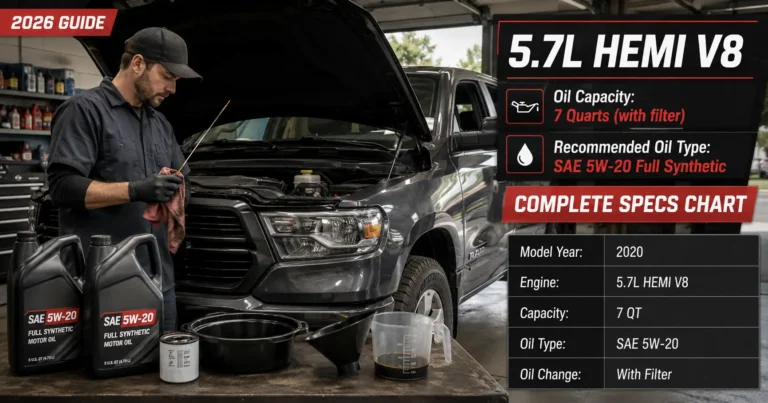
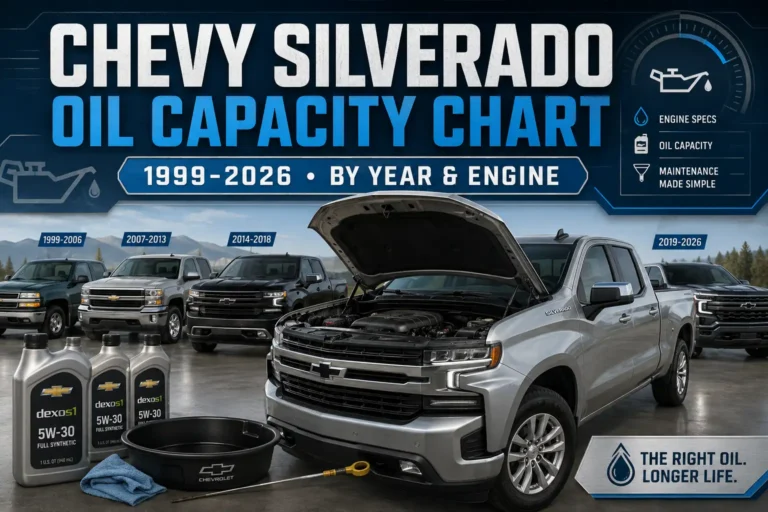
The 5.3L Vortec’s oil capacity depends entirely on which generation you have. Trucks built from 1999 through 2013 take 6.0 quarts of SAE 5W-30 with a filter change. Trucks built from 2014 onward take 8.0 quarts of SAE 0W-20 full synthetic.
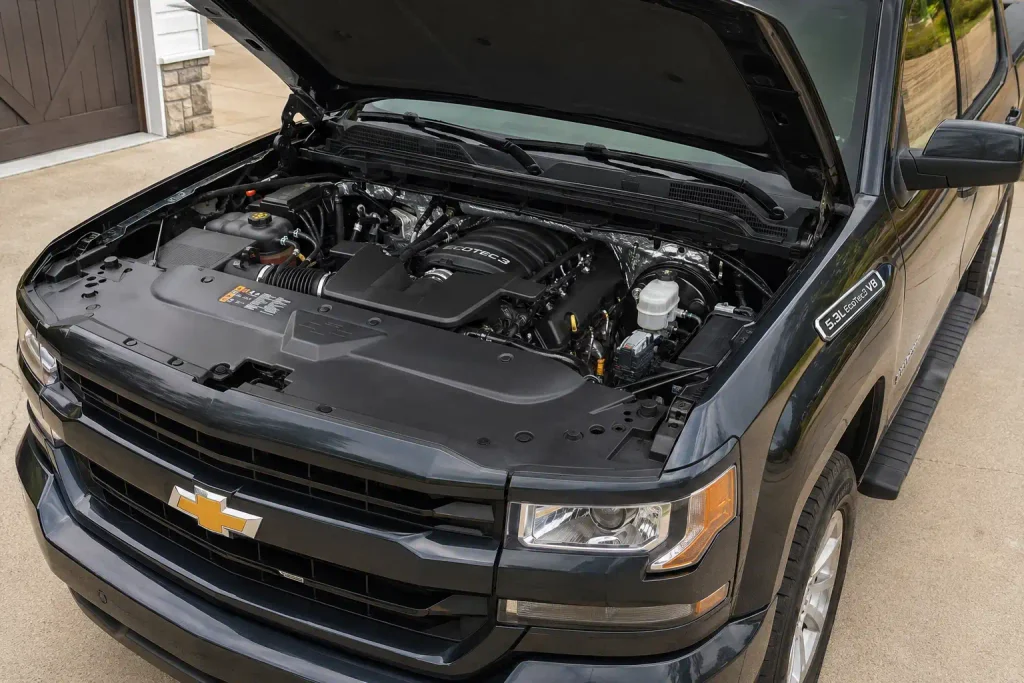
Mixing these numbers up is the single most common source of confusion online, and it traces back to a real General Motors correction that most guides never mention.

Prime for Young Adults — 6 Months Free
Students and 18–24s get six months of Prime free, then half price.
Start 6 Months FreeGM’s own paperwork added to the confusion. When the redesigned EcoTec3 5.3L launched for 2014, the published capacity was 8.5 quarts. Owners who followed that number ended up with dipsticks reading overfull,
and GM issued a technical service bulletin months later correcting the spec down to 8.0 quarts. If you’ve seen three different numbers across three different forum threads, that TSB is why.
Below is the exact type, capacity, and filter for both generations, the vehicles each one shipped in, and the GM service bulletins that explain the numbers you’ll find scattered across owner forums.
5.3L Vortec Oil Capacity at a Glance
Two generations, two different fill specs. Confirm yours before your next oil change.
Gen III / Gen IV Vortec 5300
- Oil typeSAE 5W-30
- RPO codesLM7, L59, LY5, LC9 +3
- FilterACDelco PF48
- TrucksSilverado, Sierra, Tahoe, Suburban
Gen V EcoTec3
- Oil type0W-20 dexos1
- RPO codesL83, L82, L84, L8B
- FilterACDelco PF63
- TrucksSilverado, Sierra, Tahoe, Yukon
Gen III and Gen IV Vortec 5300 Oil Capacity 1999 to 2013
Recommended Best Deal Products


The original 5.3L Vortec, badged internally as the Vortec 5300, takes 6.0 quarts of oil with a filter change. GM specifies SAE 5W-30 for this generation across nearly all climates, with SAE 10W-30 listed as an acceptable alternate in warmer regions. This figure is consistent across GM’s owner’s manuals and dealership service documentation for the full 1999-2013 run.
This spec covers two distinct sub-generations that share the same oil capacity:
- Gen III (1999-2007): RPO codes LM7, L59 (flex-fuel), LM4, and L33. Iron-block LM7 and L59 were the volume engines; the aluminum-block L33 was the high-output version starting in 2005.
- Gen IV (2007-2013): RPO codes LY5, LMG (flex-fuel), LH6, LC9 (flex-fuel), LH8, LH9, and LMF. This generation introduced Active Fuel Management (cylinder deactivation), and variable valve timing was added starting in the 2010 model year.
Vehicles equipped with this generation include the 1999-2013 Chevrolet Silverado 1500, GMC Sierra 1500, Suburban, Tahoe, Avalanche, and the GMC Yukon and Yukon XL, along with the Cadillac Escalade in select years.

Audible — Listen Free for 30 Days
One free credit a month and thousands of titles included.
Listen Free for 30 DaysThe 5.3L also appeared outside the full-size truck lineup during this window, including the Chevrolet SSR and Impala SS, though the maintenance schedule and oil spec stayed the same regardless of which body the engine sat in.
The 2005 model year is a useful line to remember within this generation. That’s when the aluminum-block L33 arrived as the high-output option, and it’s also close to when AFM-equipped Gen IV engines started phasing in for 2007.
If you’re shopping a used truck from this era and the seller isn’t sure which engine code they have, the oil capacity and type won’t change your answer either way, but the RPO code still matters for parts compatibility on anything beyond an oil change.
Use an ACDelco PF48 oil filter for this generation. Regardless of which specific RPO code your truck carries, the 6.0-quart, 5W-30 spec holds across the entire 1999-2013 range.
For related maintenance specs on this same engine family, see our 2007 Chevy 5.3 torque specs guide.
Gen V EcoTec3 5.3L Oil Capacity 2014 to 2026
The redesigned 5.3L introduced for the 2014 model year takes 8.0 quarts of oil with a filter change, using SAE 0W-20 full synthetic that meets the dexos1 Gen 2 or Gen 3 specification. This is a hard requirement, not a recommendation.
GM’s dexos1 standard has tighter detergent and shear-stability requirements than a generic API-SN oil, and using an oil that doesn’t meet dexos1 can affect warranty coverage on emissions-related components.
RPO codes for this generation are L83 (2014-2019, with Active Fuel Management), L82 and L84 (2019-present, with Dynamic Fuel Management), and L8B (the mild-hybrid eAssist version). All four share the same 8.0-quart, 0W-20 spec. Use an ACDelco PF63 oil filter.
Audible Premium Plus — Annual Membership
12 audiobook credits up front, plus the full Audible catalogue.
See Annual PlansHere’s the source of the capacity confusion: GM originally published 8.5 quarts as the fill spec for 2014-2015 Silverado 1500, Sierra 1500, Suburban, Tahoe, Yukon, and Escalade models equipped with the L83 or L86 engine.
Owners and technicians who filled to that number found the dipstick reading overfull immediately after an oil change. GM investigated and issued Technical Service Bulletin PIP5231A in October 2014,
which corrected the published fill spec to 8.0 quarts and confirmed the overfull indication was a paperwork error, not an engine problem. If you’re still seeing 8.5 quarts referenced anywhere, that’s the pre-correction figure.
This matters beyond just getting the pour right. GM’s bulletin specifically notes there’s no need to drain oil if your dipstick shows a half-quart overfill after a service visit, since the discrepancy comes from the outdated spec sheet rather than an actual overfill condition.
A shop still working from an old parts catalog or an outdated printed manual can easily hand you the wrong number, so if your paperwork says 8.5 quarts, ask them to confirm against the corrected 8.0-quart figure before your next service.
For companion maintenance specs on the current-generation Silverado, see our lug nut torque specs for the Chevy Silverado 1500.
Why Oil Consumption Complaints Are Common on 2014 to 2017 5.3L Trucks
Recommended Best Deal Products


If you’re topping off oil between changes on a 2014-2017 Silverado, Sierra, Suburban, Tahoe, Yukon, or Escalade with the L83 engine, you’re not necessarily dealing with a leak.
GM documented a known oil consumption issue on Active Fuel Management-equipped 5.3L and 6.2L trucks from this window, tracked internally under bulletin PIP5382 and its later supersessions, most recently reissued as bulletin 19-NA-036 in March 2019.
The GM diagnostic threshold defines excessive consumption as 1 quart burned per 2,000 miles of driving, or 1.5 quarts per 100 hours for fleet vehicles. Trucks that meet this threshold under GM’s testing procedure qualify for a piston and ring replacement under the applicable bulletin, performed at a dealership.
The repair itself is labor-intensive, running over 20 hours of shop time on the 5.3L and 6.2L applications, which is one reason GM built a formal measured-consumption test into the diagnostic step rather than approving the repair on complaint alone.
Coverage under these bulletins runs through GM’s applicable warranty terms for the model year in question, so a truck well outside its original powertrain warranty may not qualify for a covered repair even if it shows the documented consumption pattern.
Independent shops familiar with this issue can still perform the same ring and piston service outside of warranty, though it’s worth getting a second opinion before committing to a repair of that scope.
This doesn’t mean every 5.3L from this era burns oil, and it doesn’t mean a truck using oil between changes is broken. It means the pattern is well-documented enough that GM built a formal repair procedure around it, so checking your dipstick between scheduled oil changes on a 2014-2017 truck is worth the two minutes it takes.
If you’re researching this generation’s reliability more broadly, our coverage of the 2015 Chevy Silverado 1500 transmission recall covers another documented issue from the same model years.
5.3L Vortec Oil Capacity Quick Reference Chart
The table below summarizes both generations side by side. Confirm your exact RPO code against your engine or door-jamb sticker before your next oil change, since capacity and oil type are not interchangeable between generations.
| Years | Generation | RPO Codes | Capacity (with filter) | Oil Type | Filter |
|---|---|---|---|---|---|
| 1999-2007 | Gen III | LM7, L59, LM4, L33 | 6.0 qt | SAE 5W-30 | ACDelco PF48 |
| 2007-2013 | Gen IV | LY5, LMG, LH6, LC9, LH8, LH9, LMF | 6.0 qt | SAE 5W-30 | ACDelco PF48 |
| 2014-2019 | Gen V (AFM) | L83 | 8.0 qt | SAE 0W-20 dexos1 | ACDelco PF63 |
| 2019-present | Gen V (DFM) | L82, L84, L8B | 8.0 qt | SAE 0W-20 dexos1 | ACDelco PF63 |
How to Check Your 5.3L Vortec’s Exact Spec
Recommended Best Deal Products


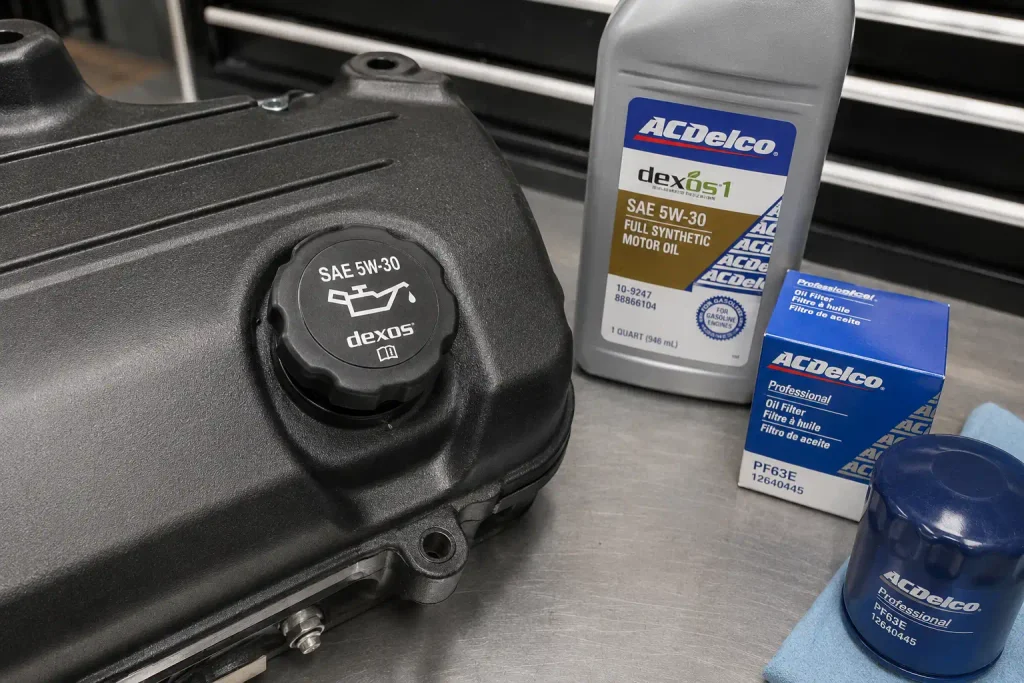
Start with the oil fill cap on the valve cover. GM stamps the required viscosity directly on the cap on most Gen IV and Gen V trucks, which is the fastest way to confirm 5W-30 versus 0W-20 without pulling any paperwork.
To identify your exact RPO code, check the RPO code sticker inside the glovebox, or in the trunk or spare tire area on some model years, which lists every option code including the engine designation. You can also decode it from the eighth digit of your VIN, cross-referenced against your model year, since GM reused some digit codes across different engine families over the years.
If your dipstick reading and the published capacity spec ever disagree by a small margin, especially on a 2014-2015 truck, that’s consistent with the PIP5231A overfill correction covered above rather than a sign of a mechanical problem. For a broader look at which model years in this platform hold up best long-term, see our guide to the best years for the Chevrolet Silverado 1500.