How Much Oil Does A Tanker Hold Oil Capacity & Type Chart By Year: All Engines (2026 Full Reference)

Quick Answer
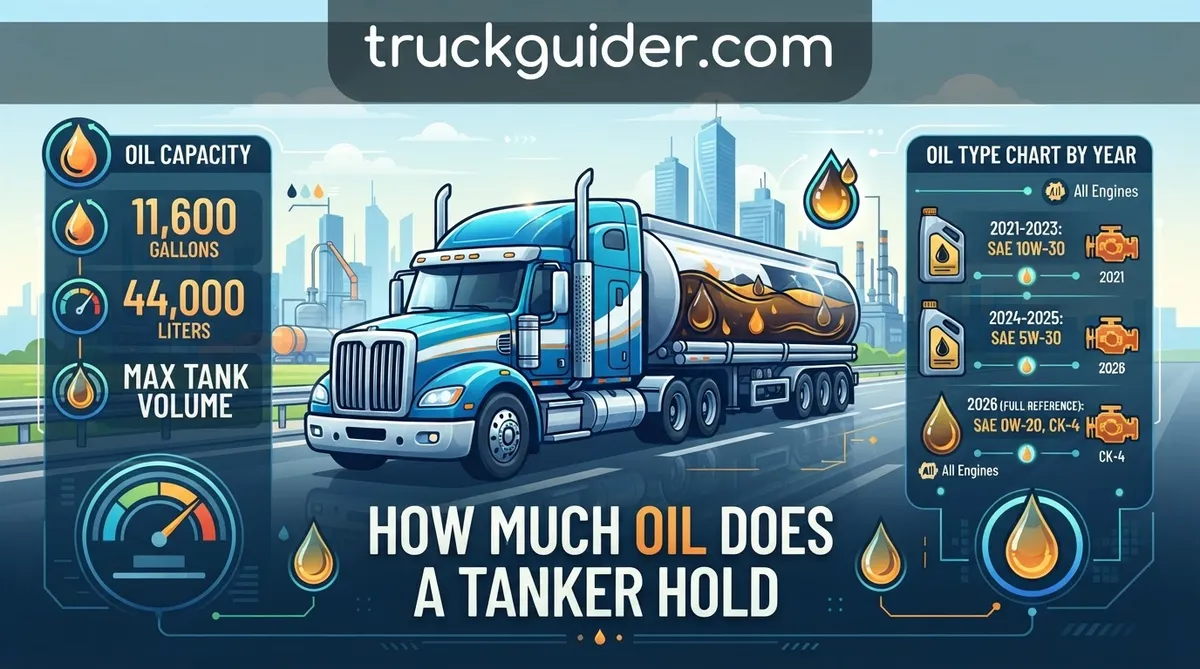
A standard crude oil tanker holds between 500,000 and 2,000,000 barrels (21 to 84 million gallons), depending on vessel class from Aframax to VLCC. In addition, its primary marine diesel propulsion engine requires 5,000 to 12,000 gallons (19,000 to 45,000 liters) of system lubrication oil. Cargo capacity depends on deadweight tonnage (DWT), seasonal draft lines, and crude API gravity.
An ocean-going crude oil supertanker is the largest mobile structure constructed by humanity, capable of moving vast volumes of liquid energy across oceans in a single voyage. A standard global supertanker—specifically a Very Large Crude Carrier (VLCC)—holds approximately 2 million barrels of crude oil, which converts to 84 million US gallons (or roughly 318 million liters). Across the entire commercial maritime spectrum, a tanker’s cargo capacity ranges from 300,000 barrels (12.6 million gallons) on regional coastal vessels to over 3 million barrels (126 million gallons) on Ultra Large Crude Carriers (ULCCs). The absolute maximum rating of oil a vessel can intake depends strictly on crude API gravity, cargo temperature, fuel bunker volume, and seasonal load line draft limits established by the ship’s stability booklet and classification society rules.
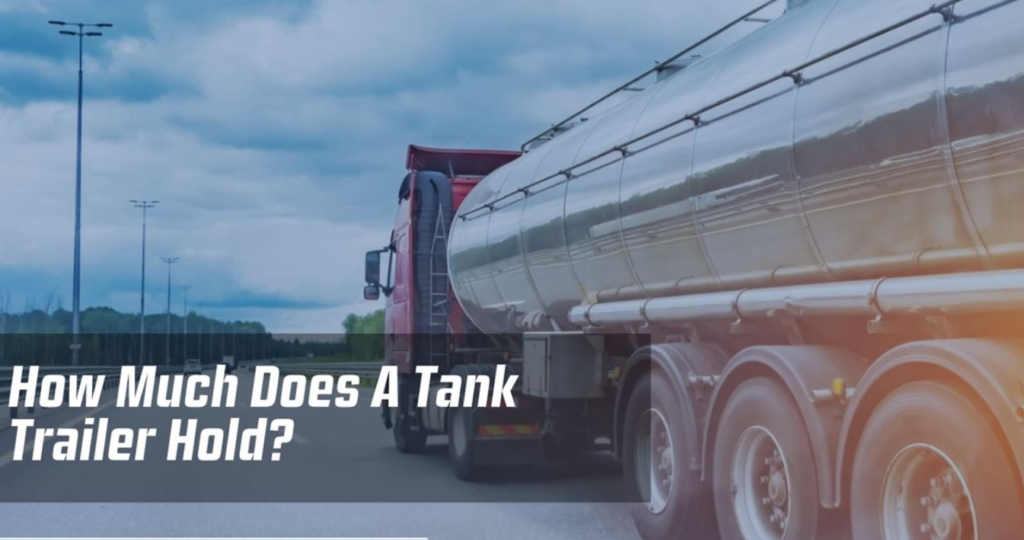
How Much Oil Does a Tanker Hold: Capacity Chart by Vessel Class
Recommended Best Deal Products


📤 Share Image
Data Scope and Capacity Measurement Standards
Marine oil tankers are classified primarily by Deadweight Tonnage (DWT) and physical hull dimensions that dictate transit clearance through strategic maritime choke points, including the Panama and Suez Canals, the Strait of Malacca, and the Bosporus. One international oil barrel (bbl) is legally defined as exactly 42 US gallons (158.987 liters). In maritime shipping, crude cargo is calculated in metric tons and converted to liquid volumetric barrels based on standard American Petroleum Institute (API) gravity references measured at 60°F (15.6°C).
This reference guide covers ocean-going petroleum crude and product carriers built between 1970 and 2026, categorized by standard International Maritime Organization (IMO) vessel classifications and propulsion configurations. Data reflects maximum volumetric capacities under 98% filling limits (governed by MARPOL Annex I thermal expansion regulations) and standard light-to-medium crude specifications (31° to 38° API). Real-world load volumes vary based on seawater density, cargo heating requirements, fuel bunker weight, and port draft restrictions. Last reviewed: October 2026.
How to read this chart: The table below cross-references vessel build eras, standard propulsion engines, cargo capacity ratings, and fuel viscosity grades. Capacity is presented in both standard petroleum barrels (bbl) and US liquid gallons, assuming standard 98% maximum tank filling limits to account for thermal expansion during transit.
Master Marine Tanker Oil Capacity and Specification Chart
| Year | Engine | Oil Capacity | Recommended Oil Type | Notes |
|---|---|---|---|---|
| 1970–1979 | Steam Turbine (Stal-Laval / GE 32,000–45,000 shp) | 3,000,000–3,770,000 bbl (126.0M–158.3M gal) | Heavy Fuel Oil (HFO) 380 cSt / Crude Cargo: Heavy & Light Crudes | Single hull ULCC era (e.g., Seawise Giant / Batillus class). 500,000+ DWT. Phased out by modern environmental mandates. |
| 1980–1992 | Low-Speed 2-Stroke Diesel (Sulzer RTA84 / MAN B&W L90MC) | 1,800,000–2,100,000 bbl (75.6M–88.2M gal) | HFO 380 / IFO 180 / ISO 8217 DMA / Cargo: Unrefined Petroleum | Single hull VLCC configuration (240,000–280,000 DWT). Higher cargo volume ratio than post-OPA 90 double-hull rebuilds. |
| 1993–2005 | Low-Speed 2-Stroke Diesel (MAN B&W 6S70MC / 7S80MC) | 1,900,000–2,150,000 bbl (79.8M–90.3M gal) | HFO 380 cSt / Low-Sulfur MGO / Cargo: Sour, Sweet, & Heavy Blends | First-generation double hull VLCC standard (290,000–310,000 DWT). Dedicated water ballast tanks reduced internal cargo block volume. |
| 2006–2014 | Electronic Common-Rail Diesel (MAN B&W 7S80ME-C / WinGD RT-flex) | 950,000–1,050,000 bbl (39.9M–44.1M gal) | ISO 8217 RMG 380 / Low-Sulfur Gas Oil (LSGO) / Cargo: Dirty Crude | Suezmax configuration (150,000–165,000 DWT). Designed specifically for full transit draft through dredged Suez Canal channels. |
| 2015–2019 | Derated Ultra-Long Stroke Diesel (MAN B&W 6G70ME-C9 / WinGD X72) | 650,000–750,000 bbl (27.3M–31.5M gal) | VLSFO 0.50% Sulfur / ULSFO / Cargo: Crude & High-Flash Feedstocks | Aframax configuration (105,000–115,000 DWT). Optimized for regional trades, shallow coastal lightering, and short-haul logistics. |
| 2020–2023 | Dual-Fuel Tier III Diesel (MAN B&W 7G80ME-C9.5-GI / WinGD X82DF) | 2,000,000–2,200,000 bbl (84.0M–92.4M gal) | Cryogenic LNG + VLSFO Pilot / SAE 40 Marine System Lubricant | Modern Eco-VLCC (300,000–320,000 DWT). LNG fuel tanks placed on deck to preserve primary 340,000 m³ internal cargo block volume. |
| 2024–2026 | Dual-Fuel Methanol/Ammonia-Ready (MAN B&W G95ME-C10.5-LGIM) | 2,050,000–2,180,000 bbl (86.1M–91.5M gal) | Green Methanol / Biodiesel B100 / Low BN Cylinder Oils | Next-generation 300,000 DWT crude carriers. Smart ullage radar monitoring and high-efficiency submerged cargo pumping systems. |
*Footnote: Barrel calculations assume standard 42 US gallons per bbl. Volumetric loading capacities utilize standard 98% filling limits according to international cargo tank thermal expansion criteria. Main engine power outputs represent typical modern ratings (22,000–32,000 kW) for ships of specified DWT class.
700,000 bbl
29.4 Million Gallons
1,000,000 bbl
42.0 Million Gallons
2,000,000 bbl
84.0 Million Gallons
3,500,000 bbl
147.0 Million Gallons
Year-by-Year Tanker Design Changes and Capacity Rating Rules
Pre-1990 Single Hull Supertankers vs. Post-OPA 90 Double Hulls
The history of marine tanker design reveals a dramatic evolution in how internal volumetric space is engineered. During the 1970s, shipyard design focused almost exclusively on scale economies, leading to the construction of gigantic single-hull Ultra Large Crude Carriers (ULCCs). The peak of this movement was the Seawise Giant (later Knock Nevis), constructed in 1979 with an astonishing 564,763 DWT and an internal cargo capacity of 4,240,865 barrels (178 million US gallons). On single-hull hulls, cargo tanks directly met the outer side shells and bottom plating of the vessel, maximizing internal volume at the cost of catastrophic environmental risk in grounding or collision scenarios.
The structural paradigm shifted permanently following the 1989 Exxon Valdez grounding in Alaska. The United States Congress passed the Oil Pollution Act of 1990 (OPA 90), swiftly followed by International Maritime Organization amendments to MARPOL Annex I (Regulation 13F/19). These statutes made double hulls mandatory for all crude carriers entering US waters and global international ports, enforcing a complete phase-out of single-hull crude carriers by 2010.
Double hull regulations mandate a protective 2-to-3 meter void separation between outer hull plating and internal cargo tank boundaries. Consequently, a modern double-hull VLCC of 300,000 DWT requires an overall vessel length of ~330 meters and a beam of 60 meters to maintain a 2-million-barrel cargo intake. A pre-1990 single-hull vessel achieved that identical cargo capacity within a significantly smaller hull footprint, because its outer hull plating formed the direct boundary of the liquid cargo hold.
Canal Expansion Milestones: Panamax to Neopanamax and Suezmax Limits
Tanker carrying capacities are strictly disciplined by global navigation waterways and canal locks:
- Panamax (Historical): Limited to a beam of 32.3 meters and draft of 12.04 meters, capping oil payload at 300,000 to 500,000 barrels (50,000–80,000 DWT).
- Neopanamax (Post-2016 Locks): The opening of expanded Panama locks increased allowable beam to 51.25 meters and draft to 15.2 meters, allowing modern Aframax and shallow-loaded Suezmax tankers to carry up to 750,000 to 800,000 barrels through the Isthmus.
- Suezmax: Tailored specifically to transit the Suez Canal fully laden at up to 20.1 meters (66 feet) of draft. Standard Suezmax capacity ranges precisely between 950,000 and 1,050,000 barrels (150,000–165,000 DWT). Vessels exceeding this capacity (VLCCs) must discharge part of their cargo at the SUMED pipeline terminal before transiting, or route entirely around the Cape of Good Hope.
2020–2026 Eco-Design and Dual-Fuel Structural Trends
Between 2020 and 2026, maritime environmental regulations transformed supertanker engine spaces and hull forms. The introduction of the IMO 2020 0.50% global sulfur cap, alongside IMO Tier III NOx rules, mandated high-efficiency electronic engines, exhaust scrubbers, and dual-fuel infrastructure. On modern 2024–2026 eco-VLCC designs, internal machinery rooms must accommodate massive fuel tanks for LNG (Liquefied Natural Gas) or methanol, requiring naval architects to optimize hold geometries. By raising deck heights and modifying longitudinal cofferdams, modern shipyard designs maintain the industry benchmark 340,000 to 350,000 cubic meter liquid capacity without compromising double-hull crash zones.
Tanker Hold Configuration: Cargo Tanks and Double Hull Architecture
Recommended Best Deal Products



Mitigating the Free-Surface Effect Through Bulkhead Segregation
A common misconception is that a supertanker is a single cavernous hollow ship floating across the sea. In reality, filling a ship’s hull as an undivided, giant open pool would cause catastrophic structural failure or capsize within hours due to the free-surface effect. When a vessel rolls in open ocean swells, thousands of tons of unimpeded liquid sloshing across an undivided compartment shift the vessel’s center of gravity rapidly outward, inducing dynamic transverse instability and hull shearing.
Divide the vessel into 4 to 6 main cargo blocks along the length of the hull to resist longitudinal bending moments.
Split cargo blocks into port, centerline, and starboard compartments to eliminate dynamic transverse liquid sloshing.
Internal corrugated baffle plates dissipate kinetic surge pressures inside tanks during rough sea passages.
Two isolated aft holding tanks manage dirty tank-wash residues, oily water separation, and interface decanting.
To preserve stability, a standard modern 300,000 DWT VLCC divides its hold volume into 12 to 15 independent cargo tanks plus two aft slop tanks. A standard arrangement uses 5 longitudinal tank rows divided into sets of three (Port Wing Tank, Centerline Tank, and Starboard Wing Tank), or two rows separated by a centerline oil-tight longitudinal bulkhead.
Protective Double Hull and Segregated Ballast Tank Layout
Surrounding the cargo core is the double hull structure, engineered with dedicated Segregated Ballast Tanks (SBT). Ballast tanks run along the outer bottom (double bottom) and wing spaces (double sides) of the entire cargo block. Under MARPOL Annex I, these spaces must remain strictly isolated from oil cargo piping. When the tanker discharges its crude oil cargo, these tanks take on 60,000 to 100,000 metric tons of seawater ballast to sink the hull down to a stable propeller submersion draft and trim, ensuring seaworthiness on ballast return voyages without requiring oil-contaminated ballast.
Vapor Safety: Inert Gas Blanketing and Ullage Monitoring Systems
The empty headspace above crude oil inside a closed cargo hold is known as the ullage space. Liquid petroleum emits volatile hydrocarbons that become violently explosive when mixed with atmospheric oxygen (above 11% oxygen concentration). To eliminate fire and explosion hazards, oil tankers utilize an Inert Gas System (IGS).
Treated boiler flue gas or dedicated nitrogen gas generators pump inert gas into the ullage spaces, driving oxygen levels below 5% by volume while maintaining a positive deck pressure. Cargo volume is continuously tracked without exposing crew to lethal vapors using sophisticated radar ullage transmitters installed on the dome of each tank, feeding real-time millimeter measurements to the vessel’s cargo control room (CCR) loading computer.
Under international maritime safety rules (SOLAS and classification society regulations), no crude oil cargo tank may be loaded past 98% of its total geometric capacity. The remaining 2% empty ullage cushion allows thermal expansion as cargo travels across climatic zones (e.g., from the Persian Gulf at 35°C to Northern European terminals at 5°C). Exceeding 98% risks liquid cargo breaching high-velocity pressure relief valves or entering inert gas lines, triggering environmental blowouts or structural overpressure.
How Much Oil Tankers Hold Across Engine and Class Configurations
Crude Oil Carriers vs. Clean Product Tankers
Marine liquid transport diverges into two core disciplines: Crude Oil Carriers hauling unrefined black petroleum from offshore wells to coastal refineries, and Clean Product Tankers distributing refined fuels (aviation jet fuel, premium gasoline, diesel, and chemical feedstocks) from refineries to end markets. Product carriers are significantly smaller, ranging between 25,000 and 55,000 DWT (Medium Range / MR class), holding between 200,000 and 380,000 barrels (8.4 to 16 million gallons).
Product tanker compartments feature specialized internal coatings (such as pure epoxy, phenolic epoxy, or zinc silicate) and dedicated independent submerged Framo cargo pumps per tank to prevent cross-contamination between multi-grade fuel shipments. Crude carriers carry unlined raw steel tanks equipped with steam or thermal oil heating coils to prevent heavy asphalt and paraffin wax solidification.
Ocean Tanker Capacities Compared to Railcars and Tanker Trucks
To grasp the vast scale of an ocean-going crude tanker, compare its intake against conventional overland supply chains:
Propulsion Powerplant Demands and Machinery Room Tradeoffs
Propelling a fully loaded 300,000-ton steel vessel at 13 to 15 knots requires substantial propulsion architecture. Standard modern VLCCs rely on massive low-speed, two-stroke marine crosshead diesel engines (such as the MAN B&W 7G80ME-C or WinGD X82-B). Standing 45 feet tall and weighing over 1,000 metric tons, these engines generate 25,000 to 32,000 kW (33,500 to 43,000 hp) directly coupled to a single fixed-pitch propeller rotating at an ultra-slow 55 to 70 RPM.
A continuous design tradeoff exists between engine machinery space, fuel storage, and revenue cargo hold capacity. Operating over a 20,000-nautical-mile round trip (e.g., Arabian Gulf to US Gulf Coast via Cape of Good Hope) requires a supertanker to store 4,000 to 6,000 metric tons of bunker fuel (VLSFO or LNG) alongside hundreds of tons of engine system lubricating oils. Every metric ton of heavy bunker fuel burned reduces deadweight draft, causing the ship to ride higher in the water as the voyage progresses.
What Affects How Much Oil a Tanker Can Hold and Discharge
Recommended Best Deal Products


Deadweight Tonnage vs. Gross Tonnage Explained
In maritime operations, confusion frequently arises between Gross Tonnage (GT) and Deadweight Tonnage (DWT). Gross Tonnage is not a measurement of weight; it is a non-linear geometric index of the vessel’s total internal enclosed volume (where 100 cubic feet historically equated to one register ton). GT dictates port fees, canal transit tolls, pilotage charges, and safety manning scales.
Deadweight Tonnage (DWT) is the actual physical lifting capacity of the ship measured in metric tonnes (1,000 kg). DWT represents the maximum permitted weight the vessel can safely intake before submerging its Plimsoll line (summer load line mark) in seawater. DWT encompasses cargo weight, bunker fuel, ballast, freshwater, lubricating oil, provisions, and crew.
By The Numbers: VLCC Discharge Dynamics
Full Terminal Discharge Time
Combined Pumping Flow Rate
Full Scantling Draft
Standard Manifold Backpressure
Crude API Gravity, Thermal Expansion, and Draft Marks
The specific weight of liquid crude varies drastically by geological basin, directly altering the volumetric payload an oil tanker can legally carry:
- Light Sweet Crudes (38° to 45° API / e.g., Brent, WTI): Possess a low specific gravity (~0.80 to 0.835 kg/L). When loading light crude, an oil tanker typically cubes out—meaning its internal cargo tanks hit the 98% volumetric ceiling before the vessel sinks to its legal maximum summer draft marks.
- Heavy Crudes (20° to 24° API / e.g., Maya, Basrah Heavy): Much denser, with specific gravities exceeding 0.91 to 0.93 kg/L. A 300,000 DWT VLCC loading heavy Venezuelan or Iraqi crude will weigh out—hitting maximum permissible hull draft and load line marks while 5% to 8% of the vessel’s internal tank volume remains unfilled.
Crude oil expands and contracts substantially based on ambient and sea temperatures. Ship cargo officers calculate volumetric deliveries using international ASTM Table 54A (Volume Correction Factor), which normalizes observed liquid cargo volume down to standard base volume at 15°C (60°F). A temperature swing of just 10°C on a 2-million-barrel cargo can change measured volume by more than 16,000 barrels (672,000 US gallons).
Discharge Pump Rates, Manifolds, and Offshore Lightering
Unloading 84 million gallons of crude oil requires immense mechanical pumping power. Conventional crude supertankers feature a dedicated cargo pump room located forward of the engine room bulkhead. Inside, three or four massive steam-turbine-driven centrifugal pumps (COP), powered by auxiliary auxiliary water-tube marine boilers, connect to a central pipe manifold header system.
Each pump delivers flow rates between 3,500 and 5,500 cubic meters per hour, giving a combined maximum discharge rate of up to 15,000 m³/hr (94,000 bbl/hr). Under standard terminal conditions, offloading a full VLCC cargo requires between 24 and 36 continuous hours of pumping at manifold backpressures of 100 to 135 psi.
Because fully laden VLCCs draw up to 21.5 meters (70.5 feet) of water, they cannot enter most shallow commercial ports in the United States or Western Europe. To circumvent this, the industry utilizes Ship-to-Ship (STS) lightering. The arriving VLCC anchors in deep-water offshore lightering zones (such as the Gulf of Mexico lightering areas off Galveston), mooring alongside smaller Aframax shuttle tankers. High-capacity flexible rubber hoses transfer 500,000-barrel increments until the supertanker’s draft is sufficiently reduced to enter port docks, or until its cargo is entirely disbursed.
How Much Oil Does a Tanker Hold: Frequently Asked Questions
How many gallons of oil are inside a standard VLCC tanker?
A standard Very Large Crude Carrier (VLCC) holds approximately 84 million US gallons of petroleum. This calculation is derived from its rated 2,000,000-barrel cargo capacity multiplied by the international statutory standard of 42 US gallons per oil barrel (42 × 2,000,000 = 84,000,000 gallons).
What was the largest crude oil tanker ever built in history?
The largest oil tanker in maritime history was the Seawise Giant (later renamed Happy Giant, Jahre Viking, and Knock Nevis). Built by Sumitomo Heavy Industries in Japan in 1979, the ship possessed an overall length of 458.45 meters (1,504 feet), a deadweight of 564,763 DWT, and a maximum carrying capacity of 4,240,865 barrels (178.1 million US gallons) of crude oil. The vessel was intentionally beached and scrapped in Alang, India, in 2010.
Why are crude oil cargo tanks never loaded to 100% full?
Under international maritime safety conventions (MARPOL and SOLAS), tankers are legally restricted to loading a maximum of 98% of their gross internal tank capacity. Crude oil expands noticeably when heated by warmer sea surface waters or internal heating coils. The 2% empty headspace (ullage) provides a necessary thermal expansion buffer, preventing hydraulic rupture of tank decks and high-pressure blowouts through venting masts.
How much does it cost to completely fill a supertanker with oil?
Filling a standard 2-million-barrel VLCC supertanker represents an immense capital trade. At an oil benchmark price of $75 per barrel, purchasing a full cargo requires $150,000,000 USD. If benchmark prices spike to $100 per barrel, a single full cargo payload reaches a commercial value of $200,000,000 USD, excluding charter hire, canal tolls, insurance, and marine bunker costs.
Determining exactly how much oil an ocean tanker holds depends on its designated structural class and deadweight configuration. Standard VLCC supertankers operate as the backbone of international crude commerce, moving roughly 2 million barrels (84 million US gallons) safely secured within 12 to 15 segregated, double-hulled compartments protected by positive-pressure inert gas. Regional Aframax and Suezmax classes transport between 650,000 and 1,050,000 barrels to meet canal drafts and port clearances, while specialized clean product carriers manage refined retail-ready volumes.
Use our master marine tanker capacity chart above for commercial fleet modeling, charter logistics planning, and precise vessel class volume evaluations.