Chevy Silverado Generations Chart: Years, Specs & Engines

Tracking the evolution of the Chevrolet Silverado is essential for truck buyers, mechanics, and automotive enthusiasts alike. Knowing exactly which generation of Silverado you are looking at determines its towing capability, engine reliability, and aftermarket parts compatibility. It also drives drivetrain specs like the Silverado gear ratio chart and wheel fitment in the Silverado bolt pattern chart.
Since its official debut in the late 1990s, the Silverado 1500 has evolved from a simple utilitarian workhorse into a highly advanced, luxury-capable machine. Over the decades, General Motors has continually refined the platform to battle its fierce domestic rivals in the highly lucrative full-size pickup market.
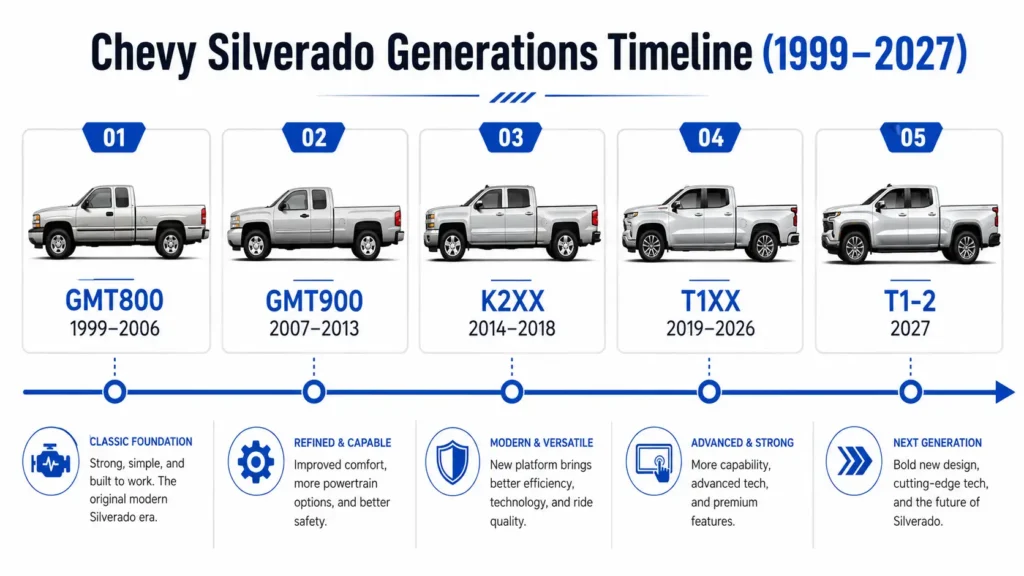
This comprehensive guide serves as your definitive Chevy Silverado generations chart. We will dissect every major platform change, engine upgrade, and technological leap from the original GMT800 era to the highly anticipated 2027 fifth-generation models.
By understanding the distinct eras of Chevrolet’s flagship pickup, buyers can pinpoint the most reliable years and avoid costly maintenance traps. We will also dive deep into the heavy-duty variants and historical towing capacities.
Whether you are restoring a classic first-generation truck or pre-ordering a brand-new ZR2, this exhaustive research report provides the data-driven insights you need.
chevy silverado generations chart
Recommended Best Deal Products


A comprehensive data guide to 25 years of Chevrolet performance, from the reliable GMT800 to the high-tech 2027 V8 Renaissance.
Historical Towing Growth
Watch the massive leap in half-ton capability. Modern Silverados now tow weights that previously required a Heavy Duty 2500 chassis.
*Based on max configuration per model year.
Gen 3 Engine Torque
Recommended Best Deal Products


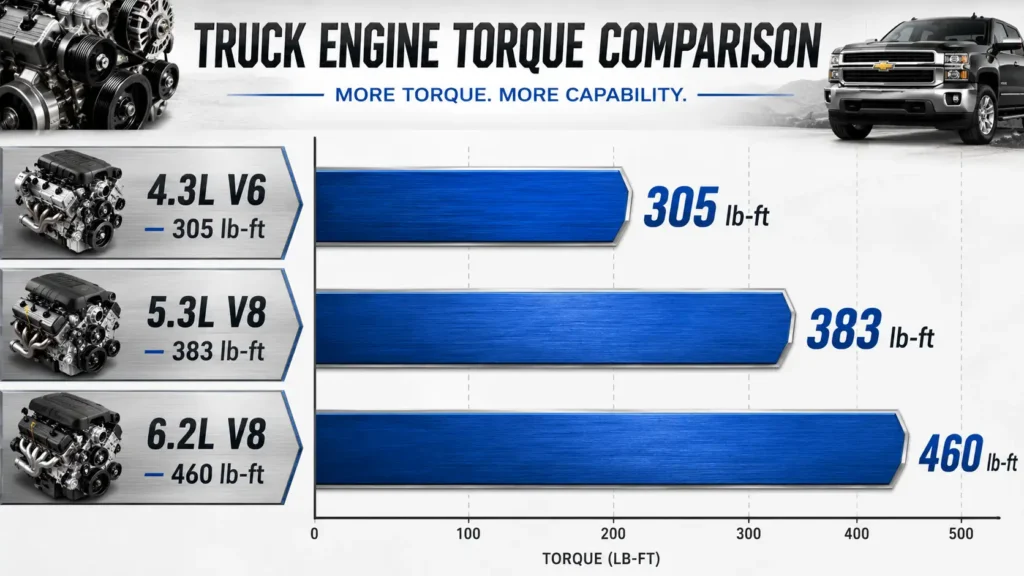
The K2XX era (2014-2018) solidified the performance gap between the entry-level V6 and the premium 6.2L V8 powerhouses.
GEN 1: THE GMT800
Launched in 1999, the GMT800 was the first “true” Silverado. It replaced the C/K series and introduced the world to the reliable LS-based Vortec V8 family.
Reliability Heatmap (1999-2027)
A visual guide to the most dependable years. Note the dip during early AFM introduction (2007) and the recovery in later generations.
Technical Engineering: AFM vs DFM
General Motors evolved from static cylinder deactivation (AFM) to a complex, dynamic system (DFM) that calculates torque requirements 80 times per second.
2027: The V8 Renaissance
Recommended Best Deal Products



While others downsize, Chevy returns to displacement. The Gen VI V8 family introduces a 5.7L standard and a massive 6.6L performance V8 for the half-ton market.
- 01 16.3-Inch Curved OLED Display
- 02 Next-Gen 10-Speed Transmission
- 03 Standard 35-Inch Tires on ZR2
Trim Streamlining
2027 Model Year Architecture
The Origins: Before the Silverado Nameplate
The name “Silverado” did not start as a standalone truck model on dealership lots. For decades, it was simply a trim level used to denote the highest luxury package available on Chevrolet pickup trucks.
Following World War II, Chevy introduced the Advance Design series, running from 1947 to 1955. This era set the stage for modern truck utility by moving the cab forward and prioritizing driver visibility.
This was followed by the Task Force series, which introduced dual headlamps and fiberglass-bed options. Eventually, GM launched the legendary C/K series in 1960.
The C/K series reigned supreme for nearly 40 years across multiple generations. The “C” denoted two-wheel-drive models, while the “K” indicated four-wheel-drive variants.
By 1975, General Motors began applying the “Silverado” badge to its top-tier C/K trucks. This trim offered buyers plush interiors, woodgrain accents, and superior sound insulation.
As the 1990s came to a close, GM realized the full-size pickup market was rapidly fracturing. Buyers no longer just wanted farm implements; they wanted daily drivers with luxury-car comfort and advanced safety features.
To signal a massive leap forward in engineering, GM officially retired the venerable C/K nomenclature. For the 1999 model year, the Silverado was born as a standalone model, built on an entirely new architecture.
First Generation (1999–2006): The GMT800 Era
The first-generation Chevy Silverado hit dealership lots in August 1998 for the 1999 model year. Built on the highly successful GMT800 platform, it represented a monumental shift in pickup truck design.
GM replaced the boxy, square-body aesthetics of the older trucks with wind-tunnel-tested curves. This aerodynamic styling improved highway fuel economy and significantly reduced wind noise in the cabin.
The GMT800 trucks were the first in their segment to feature four-wheel disc brakes as standard equipment. This vastly improved stopping power when towing heavy trailers and forced competitors to adapt.
Chevy also introduced the AutoTrac four-wheel-drive system during this generation. This high-tech transfer case could automatically detect tire slip and engage the front axle without driver intervention.
During its initial launch, the Silverado was available in regular cab and extended cab configurations. It was not until the 2004 model year that a true four-door crew cab was offered on the half-ton 1500 platform.
The first-generation trucks are highly regarded for their robust build quality. Because GM continued producing the classic GMT400 platform alongside the new GMT800 for a short overlap period, the early Silverado models had to prove their superiority immediately.
The Legendary GMT800 Engine Lineup
Under the hood, the first-generation Silverado offered a highly reliable, modern multi-engine lineup that still commands immense respect today.
The base model featured a 4.3-liter Vortec V6 producing 200 horsepower and 260 lb-ft of torque. This engine was favored by fleet operators for its simplicity and low maintenance costs.
However, the true stars of the GMT800 platform were the all-new LS-based Vortec V8 engines. These powerplants revolutionized truck performance and longevity.
Buyers could choose between a 4.8-liter V8, which pushed between 255 and 285 horsepower, and the legendary 5.3-liter V8, which generated up to 310 horsepower in its later iterations.
For heavy hauling, the 1500HD and 2500 models offered a 6.0-liter V8 pushing 300 horsepower and 360 lb-ft of torque.
These engines utilized a simple, pushrod overhead-valve design that proved to be incredibly durable. Many units easily surpassed 300,000 miles with basic fluid maintenance, making them highly sought after on the used market.
Innovation and Oddities: SS Models and Hybrids
The first-generation Silverado served as a testing ground for several ambitious automotive technologies. GM was eager to push the boundaries of what a pickup truck could be.
In 2003, Chevy released the Silverado SS, an aggressive street truck designed to combat the Ford SVT Lightning. It featured a high-output 6.0L V8 making 345 horsepower.
The SS model utilized an all-wheel-drive system and unique suspension tuning to put that power to the pavement. In 2006, GM released a special Intimidator SS edition honoring racing legend Dale Earnhardt.
GM also released a Silverado Hybrid in 2004, the industry’s first true full-size mild-hybrid pickup. It used an electric assist to shut the engine down at stops and restart it quickly, though fuel economy gains were marginal.
The Quadrasteer Phenomenon
Perhaps the most fascinating technological marvel of the GMT800 era was the introduction of Delphi’s Quadrasteer system in 2002.
This four-wheel-steering technology was available on select GM trucks and SUVs, including the Silverado 1500 and the 1500HD. It was designed to solve the maneuverability issues inherent in long-wheelbase vehicles.
Quadrasteer allowed the rear wheels to turn up to 12 degrees in the opposite direction of the front wheels at low speeds. This reduced the turning radius of a massive crew cab to just 37.4 feet, comparable to a compact car.
At highway speeds, the rear wheels turned slightly in the same direction as the fronts. This provided unparalleled stability when changing lanes or towing heavy trailers by virtually eliminating trailer sway.
The system utilized a specialized Dana 60 rear axle with a rack-and-pinion assembly, an electric motor, and a complex array of sensors to determine steering angle based on vehicle speed.
Despite its mechanical brilliance, Quadrasteer was a massive commercial failure. Initially priced as a $7,000 option package, the exorbitant cost scared away traditional truck buyers.
By 2004, GM slashed the price of the option to just $1,995, but the damage to its reputation was already done. The system added roughly 350 pounds to the truck, and parts availability became a major concern.
By the end of the 2005 model year, GM discontinued the option entirely. Today, surviving Quadrasteer trucks are considered rare collector items, though repairing the rear steering rack can be prohibitively expensive.
| First Generation (GMT800) Quick Specs | Details |
| Production Years | 1999–2006 (Sold as ‘Classic’ in 2007) |
| V8 Engine Options | 4.8L, 5.3L, 6.0L, 8.1L |
| Max 1500 Towing | Up to 10,400 lbs (2006 2WD) |
| Notable Tech | Quadrasteer, Mild Hybrid, AutoTrac 4WD |
| Performance Model | Silverado SS (345 hp AWD) |
Second Generation (2007–2013): The GMT900 Era
For the 2007 model year, General Motors unveiled the second-generation Silverado on the newly developed GMT900 platform. The truck was critically acclaimed upon release.
It immediately captured the 2007 North American Truck of the Year award, signaling a genuine leap forward in structural engineering and overall refinement.
The redesign brought a massive improvement in chassis rigidity. GM utilized a fully boxed high-strength steel frame that improved ride quality and increased the truck’s torsional stiffness.
Aerodynamics were further refined, with a steeply raked windshield, tighter panel gaps, and a smoothed front fascia contributing to a quieter cabin and slightly better fuel efficiency.
The interior was completely overhauled, moving away from the cheap plastics of the 1990s. A redesigned dashboard with a column shifter freed up valuable floor space for passengers in the front row.
The Introduction of Active Fuel Management (AFM)
The second generation saw the widespread implementation of Active Fuel Management (AFM) on the popular 5.3L V8 engines. This was a direct response to tightening federal fuel economy standards.
AFM was designed to shut down four of the eight cylinders under light load conditions, such as steady-state highway cruising. It effectively turned the V8 into a V4 to sip fuel.
The system operated using pressurized oil-controlled locking pins inside specialized valve lifters. When activated by the engine control module, these pins disengaged, preventing the valves from opening on cylinders 1, 4, 6, and 7.
When the driver demanded acceleration, the oil pressure engaged the locking pins within milliseconds, seamlessly reactivating the deactivated cylinders and restoring full V8 power.
While the engineering concept was brilliant, AFM became a notorious pain point for second-generation Silverado owners. The specialized AFM lifters were highly prone to collapsing or sticking.
If oil change intervals were neglected, the oil control solenoids would foul. Failed lifters often resulted in a loud ticking noise, severe engine misfires, heavy oil consumption, and costly camshaft damage.
Because of these documented failures, the 2007-2010 model years are often viewed with caution on the used market. Many owners today use aftermarket AFM disabler devices plugged into the OBD-II port to keep the truck in V8 mode permanently.
Expanding Power: The 6.2L V8 Upgrade
In 2009, Chevy introduced a massive powertrain upgrade for the Silverado 1500 to combat the rising horsepower figures from Ford and Dodge.
Chevrolet dropped a 6.2-liter V8 engine into the half-ton chassis. Previously reserved for luxury SUVs like the Cadillac Escalade, this Generation IV small-block was a true powerhouse.
It produced an exhilarating 403 horsepower and 417 lb-ft of torque. This engine transformed the Silverado from a capable hauler into a bona fide muscle truck.
The 6.2L V8 drastically improved towing performance on steep inclines and provided highway merging confidence that the smaller 5.3L V8 simply could not match.
During this generation, the maximum towing capacity of the Silverado 1500 plateaued at around 10,700 pounds, a figure that remained consistent from 2009 through 2013.
Third Generation (2014–2018): The K2XX Era
Launched for the 2014 model year on the GMT K2XX platform, the third-generation Silverado showcased a return to a more muscular, boxy design aesthetic.
Chevrolet pushed hard for weight reduction in this generation to improve fuel economy. Engineers utilized high-strength steel for the frame and roll-formed steel for the bed.
Aluminum components were integrated into the hood and control arms to shave hundreds of pounds off the curb weight without sacrificing structural integrity.
This era also marked a massive upgrade in cabin technology. The MyLink infotainment system introduced vibrant touchscreens, Bluetooth streaming, and eventually Apple CarPlay integration.
Chevy addressed the rapidly growing luxury truck market by introducing the High Country trim level in 2014. It featured saddle-brown leather, unique chrome grilles, and premium sound systems to challenge the Ford King Ranch.
In 2016, GM gave the Silverado a mid-cycle refresh. This dropped the stacked headlight design in favor of a streamlined front fascia with modernized LED lighting and updated grille inserts.
The EcoTec3 Engine Family Revolution
The third generation introduced the EcoTec3 engine family. While these engines retained the classic pushrod V8 architecture, they added highly modern combustion technologies.
The completely revamped lineup included a 4.3L V6 generating 285 horsepower, a 5.3L V8 generating 355 horsepower, and a mighty 6.2L V8 pushing 420 horsepower.
All three EcoTec3 engines featured Direct Injection, variable valve timing (VVT), and an evolved, slightly more reliable version of Active Fuel Management.
The direct injection system sprayed fuel directly into the combustion chamber rather than the intake port. This provided cooler cylinder temperatures, allowing engineers to run higher compression ratios.
The result was a significant power bump across the board, alongside meaningful improvements in highway fuel economy.
When paired with the new 8-speed automatic transmission that was introduced in 2015, the 6.2L V8 allowed the Silverado 1500 to achieve a massive towing capacity leap, maxing out at 12,500 pounds.
| Third Generation (K2XX) Engine Specs | Horsepower | Torque (lb-ft) | Max Towing Capacity |
| 4.3L EcoTec3 V6 | 285 hp | 305 lb-ft | 7,600 lbs |
| 5.3L EcoTec3 V8 | 355 hp | 383 lb-ft | 11,500 lbs |
| 6.2L EcoTec3 V8 | 420 hp | 460 lb-ft | 12,500 lbs |
Fourth Generation (2019–2026): The T1XX Era
To coincide with the 100th anniversary of Chevy trucks, the fourth-generation Silverado debuted for the 2019 model year on the brand-new GMT T1XX platform.
General Motors dramatically altered the exterior styling, moving away from traditional blocky shapes. They added aggressive air curtains, a massive front grille, and narrowed, stylized headlights.
The truck was physically larger and boasted a longer wheelbase. This engineering change yielded best-in-class rear legroom for crew cab passengers.
Technology took center stage during this generation. The fourth-gen trucks featured up to 15 unique camera views to assist with trailering, including a transparent trailer view.
In 2022, a major mid-cycle refresh drastically improved the interior, which had been criticized for feeling dated compared to Ram’s offerings.
Chevy installed a massive 13.4-inch touchscreen powered by Google Built-In, accompanied by a 12.3-inch digital instrument cluster on the LT trims and above.
This generation also saw the introduction of Super Cruise, GM’s cutting-edge hands-free driver assistance technology. It uniquely allows for hands-free driving on mapped highways even while towing a trailer.
Powertrain Revolution: Turbo-Fours and Diesels
The fourth generation shattered traditional truck norms by offering a turbocharged four-cylinder engine as a base option. The 2.7-liter TurboMax engine generated 310 horsepower and an astonishing 430 lb-ft of torque.
This small-displacement turbo matched the low-end grunt of older V8s, providing excellent city fuel economy while maintaining a 9,500-pound towing capacity.
Chevy also introduced the highly anticipated 3.0-liter Duramax inline-six turbodiesel to the half-ton market. This engine provided exceptional fuel economy, frequently returning over 24 mpg on the highway.
In later updates, the 3.0L Duramax was tuned to deliver 305 horsepower and 495 lb-ft of torque. This torque monster enabled the Silverado 1500 to hit a 13,300-pound maximum towing capacity.
For V8 purists, the 5.3L and 6.2L options remained in the lineup. However, they were now governed by a vastly more complex cylinder deactivation system called Dynamic Fuel Management (DFM).
AFM vs. DFM: The Cylinder Deactivation Deep Dive
The shift from Active Fuel Management (AFM) to Dynamic Fuel Management (DFM) in the fourth generation represents a massive leap in computing power and mechanical complexity.
While the older AFM system could only shut down four specific cylinders (turning a V8 into a V4), DFM can deactivate any combination of cylinders on the fly.
DFM features 17 different firing patterns. These patterns are calculated by the engine control module 80 times per second based on instantaneous throttle input and load demands.
This means a 5.3L DFM engine can operate on two, three, five, or seven cylinders in real-time. In GM testing, this allowed the truck to run with fewer than eight cylinders over 60% of the time during typical driving.
Mechanically, DFM requires all 16 lifters to be specialized deactivating lifters, accompanied by complex oil control valve manifolds built directly into the engine block.
While DFM results in noticeably smoother transitions and better city fuel economy, the increased complexity has led some owners to seek aftermarket DFM disabler devices for long-term peace of mind.
The Rise of the Off-Road Trims
The fourth generation heavily capitalized on the booming off-road lifestyle trend. Chevy expanded the lineup to include dedicated off-road trims rather than just offering a basic Z71 suspension package.
The Custom Trail Boss and LT Trail Boss trims arrived with a factory 2-inch lift, Rancho shocks, underbody skid plates, and aggressive Goodyear Wrangler mud-terrain tires.
In 2022, Chevrolet introduced the ultimate off-road halo truck: the Silverado ZR2. Designed to combat the Ford F-150 Raptor, the ZR2 featured elite Multimatic DSSV spool-valve dampers.
These sophisticated dampers provided incredible suspension travel and heat dissipation for high-speed desert running. The ZR2 also included front and rear electronic locking differentials.
For extreme rock crawling, Chevy partnered with American Expedition Vehicles (AEV) to create the ZR2 Bison edition. This upfitted truck featured boron steel skid plates and heavy-duty steel bumpers.
Fifth Generation (2027–Present): A V8 Renaissance
In a massive industry twist, General Motors revealed the all-new fifth-generation 2027 Chevrolet Silverado in mid-2026. While competitors were downsizing to turbocharged V6s, Chevy aggressively doubled down on traditional V8 power.
The 2027 Silverado marks one of the most significant architectural updates in a decade. Built on an evolution of the T1 architecture (T1-2), the truck sports a blockier, more upright front fascia inspired by the Silverado EV.
Chevy completely revamped the trim hierarchy, trimming the fat to offer seven highly focused models. The LT, LTZ, and RST trims were officially discontinued.
The new streamlined trim ladder consists of: Work Truck, Custom, Silverado (replacing the LT), Custom Trail Boss, Trail Boss, ZR2, and High Country.
The 2027 Engine Revolution: 5.7L and 6.6L V8s
For the first time since 1999, the iconic 5.3-liter V8 has been retired from the half-ton lineup. In its place, Chevy introduced two brand-new, naturally aspirated small-block V8s assembled in the United States.
The new mainstream engine is a 5.7-liter Gen VI V8. Engineered with advanced combustion technology and lightweight materials, it targets approximately 400 horsepower and 430 lb-ft of torque.
Replacing the venerable 6.2L V8 is a massive 6.6-liter V8. Drawing inspiration from Chevy’s heavy-duty truck engines, this powerplant crowns the 2027 Silverado with the most powerful naturally aspirated V8 in its class.
Both V8 engines are paired exclusively with a recalibrated 10-speed automatic transmission. Chevy engineers achieved a 6% improvement in fuel economy and a 10% reduction in greenhouse gases despite the massive engine displacements.
The 2.7-liter TurboMax four-cylinder and the highly efficient 3.0-liter Duramax diesel carry over to round out the four-engine lineup.
The Digital Cockpit Expansion
The interior of the fifth-generation 2027 Silverado borrows heavily from Cadillac’s luxury SUVs, offering a jaw-dropping amount of digital real estate.
Every 2027 Silverado comes standard with an expansive 16.3-inch center infotainment display and a 12.2-inch digital driver information center.
On the High Country and ZR2 trims, Chevy integrated a class-leading 11.5-inch front passenger screen. This allows the co-pilot to manage audio and navigation without obstructing the driver’s primary map display.
Combined with an available head-up display and rear camera mirror, the cabin boasts over 60 inches of active digital displays.
To increase interior functionality, Chevy introduced a reconfigurable Multi-Flex center console. This unit can slide backward and forward, converting into a flat workstation for contractors on job sites.
Upgraded 2027 Off-Road Dominance
Chevrolet noted extreme consumer demand for factory-lifted trucks, making the off-road trims central to the 2027 lineup.
The heavy-duty Z71 suspension package is now standard on all four-wheel-drive models, ensuring exceptional durability over rough terrain regardless of the trim level chosen.
The 2027 ZR2 returns as a desert-running monster. It is now equipped with 35-inch mud-terrain tires standard direct from the factory, drastically increasing ground clearance to properly challenge the Ford Raptor.
The ZR2 retains its elite Multimatic DSSV dampers and front/rear electronic lockers. It also adds unique interior touches like forged carbon-fiber trim and Torch Red-edged seatbelts.
The Electric Future: The Silverado EV (2024–Present)
While traditional V8s dominate the standard lineup, Chevrolet reimagined its best-selling pickup for the electric era with the 2024 Silverado EV.
Built from the ground up on GM’s Ultium platform, the Silverado EV is a dedicated electric vehicle featuring a unibody-type architecture rather than a traditional body-on-frame setup.
The flagship RST model relies on a dual-motor e4WD drivetrain that produces a staggering 754 horsepower and over 780 lb-ft of torque in Wide Open Watts mode. This allows the massive truck to sprint from 0 to 60 mph in under 4.5 seconds.
The Silverado EV brings back the beloved Midgate system, previously seen on the Chevy Avalanche. This allows the rear cabin wall to fold down, expanding the bed length to an impressive 130 inches.
Additionally, the lack of a traditional combustion engine allows for a massive front trunk (frunk), providing secure, weatherproof storage for tools and groceries.
Chevy Silverado HD Generations: The Heavy Duty Lineup
While the half-ton 1500 captures the mainstream retail market, the heavy-duty variants (2500HD and 3500HD) form the vital backbone of commercial towing operations. Its fiercest rival in this class is the Ram 3500.
The heavy-duty generations typically lag one or two model years behind the 1500 series. This ensures the new platforms are thoroughly stress-tested before being subjected to immense payload demands.
First Generation HD (2001–2006)
Introduced for the 2001 model year, the first-gen HD trucks were built on a heavily reinforced version of the GMT800 architecture. These trucks featured a massive hydroformed front frame section and heavy-duty torsion bars.
The monumental achievement of this era was the debut of the 6.6-liter Duramax diesel V8 (LB7). Engineered alongside Isuzu, the original Duramax utilized high-pressure common-rail injection.
It produced a class-leading 300 horsepower and 520 lb-ft of torque, fundamentally changing consumer expectations for heavy-duty diesel performance.
Paired with the incredibly robust 5-speed (and later 6-speed) Allison 1000 automatic transmission, this powertrain cemented Chevy’s absolute dominance in the diesel towing wars.
Second Generation HD (2007–2014)
Launching on the GMT900 platform, the second-generation HD trucks brought refined interiors and vastly improved highway ride quality.
However, early Duramax engines in this era (2007-2008) suffered from reliability issues related to the newly mandated diesel particulate filters (DPF), which were prone to clogging.
By 2011, GM executed a comprehensive heavy-duty upgrade. The frame was fully boxed with high-strength steel, completely abandoning the older C-channel rear sections.
The 2011-2014 HD models, specifically those equipped with the bulletproof 6.0L Vortec gas engine or the refined LML Duramax, are widely considered some of the most durable heavy-duty trucks on the used market.
Third Generation HD (2015–2019)
Arriving a year after the K2XX 1500s, the third-generation HD trucks integrated advanced driver-assistance features like Adaptive Cruise Control and Lane Departure Warnings for the first time.
The defining mechanical moment of this generation occurred in 2017 with the introduction of the L5P Duramax engine. Utilizing a functional hood scoop for cold air induction, the L5P was an engineering marvel.
This diesel powerhouse pushed an astonishing 445 horsepower and 910 lb-ft of torque, ensuring the Silverado HD could pull massive fifth-wheel trailers up steep mountain grades without overheating.
Fourth Generation HD (2020–Present)
The current generation of Silverado HD trucks features a massive, polarizing front grille designed explicitly to maximize airflow cooling for extreme towing loads. See how these HD trucks rate in the Silverado 3500 payload capacity chart.
Chevy introduced a new 6.6-liter gas V8 as the standard base engine, mated to a robust Allison 10-speed transmission.
By 2024, a mid-cycle refresh bumped the Duramax diesel output to 470 horsepower and 975 lb-ft of torque. The cabin was also upgraded with the large 13.4-inch infotainment displays seen in the 1500 series.
When properly equipped in a 3500HD dually configuration with a gooseneck hitch, the modern Silverado HD can tow an incredible 36,000 pounds.
Silverado Towing Capacity Chart by Year (1500 Series)
To truly understand how far automotive engineering has progressed, one must look at the historical towing data over the last three decades.
A first-generation 1999 Silverado 1500 maxed out at just 8,200 pounds of towing capacity. See every year in our Silverado 1500 towing capacity chart. By 2026, a properly configured half-ton Silverado with a 3.0L Duramax could pull an incredible 13,300 pounds.
This means a modern half-ton truck is safely pulling weight that used to require a dedicated 3/4-ton heavy-duty chassis.
Below is an exhaustive Chevy Silverado towing capacity chart detailing the maximum trailer ratings by year for the 1500 series.
| Model Year | Generation | Max Towing Capacity | Required Engine for Max Towing | Required Drivetrain |
| 2027 | Fifth | 13,300+ lbs (Est.) | 6.6L V8 / 3.0L Duramax | TBA |
| 2024–2026 | Fourth | 13,300 lbs | 3.0L Duramax | 2WD |
| 2021–2023 | Fourth | 13,300 lbs | 6.2L V8 | 4WD |
| 2020 | Fourth | 13,400 lbs | 6.2L V8 | 4WD |
| 2019 | Fourth | 12,200 lbs | 6.2L V8 | 4WD |
| 2014–2018 | Third | 12,000 – 12,500 lbs | 6.2L V8 | 2WD |
| 2009–2013 | Second | 10,700 lbs | 6.2L V8 | 2WD |
| 2007–2008 | Second | 10,500 lbs | 6.0L V8 | 4WD |
| 2006 | First | 10,400 lbs | 6.0L V8 / 4.8L V8 | 2WD |
| 2001–2005 | First | 9,000 – 10,200 lbs | 5.3L V8 / 6.0L V8 | 4WD |
| 1999–2000 | First | 8,200 – 9,500 lbs | 5.3L V8 / 4.8L V8 | 4WD |
Note: Maximum towing capacities require specific cabin configurations, bed lengths, axle ratios (usually 3.73 or 4.10), and the factory Max Trailering Package. Always consult the owner’s manual before towing.
Silverado Trim Levels Explained: From WT to High Country
Navigating the Chevy Silverado trim levels can be daunting for new buyers. Over the generations, GM has expanded the lineup to cater to fleet operators, off-road enthusiasts, and luxury buyers.
Here is a breakdown of the core trim philosophy that defines the modern Silverado lineup and what sets them apart.
Work Truck (WT) and Custom
The WT trim is a no-frills, highly durable fleet vehicle. It features easy-to-clean vinyl seats, rubber flooring, and steel wheels, making it perfect for muddy job sites and rough commercial use.
The Custom trim builds on the WT by adding necessary visual flair. It includes body-colored bumpers, 20-inch aluminum wheels, deep-tinted glass, and essential creature comforts like remote start.
The Mid-Tier: LT (Silverado) and RST
For decades, the LT trim has been the volume seller. It introduces chrome grilles, upgraded 13.4-inch infotainment screens, dual-zone climate control, and optional leather seating. (Note: For 2027, the LT trim is rebranded simply as the “Silverado” trim). Owners who want to protect that upholstery can see our best seat covers for Chevy Silverado 1500.
The RST (Rally Sport Truck) is the aggressive street-performance variant. It strips away the chrome in favor of body-color grilles, dark-finish wheels, and LED lighting accents for a sportier aesthetic.
The Off-Roaders: Trail Boss and ZR2
The Custom Trail Boss and LT Trail Boss trims are factory-lifted overlanders. They feature a 2-inch suspension lift, Z71 off-road shocks, heavy-duty skid plates, and Goodyear Wrangler mud-terrain tires straight from the factory.
The ZR2 is the absolute pinnacle of high-speed off-road performance. It boasts electronic locking differentials on both axles and elite Multimatic DSSV spool-valve dampers designed to absorb massive impacts.
The Luxury Tier: LTZ and High Country
The LTZ trim focuses on premium utility and comfort. It includes perforated leather seating, ventilated front seats, advanced trailering camera systems, and standard power tailgates. (Note: The LTZ is being discontinued for the 2027 generation).
The High Country is the ultimate luxury flagship of the Chevy lineup. It rivals European luxury SUVs with open-pore wood trim, two-tone premium leather with custom stitching, a panoramic sunroof, and standard Super Cruise hands-free driving tech.
FAQs
What are the best years for a used Chevy Silverado 1500?
If you prioritize extreme long-term reliability and low maintenance costs, the late first-generation (2004-2006) and late second-generation (2011-2013) models are exceptional choices.
The 2011-2013 models feature refined build quality and less complex electronics, making them highly sought after by independent mechanics.
For modern tech without the earliest AFM glitches, 2017 and 2018 models in the third generation are heavily praised. They offer stout 6.2L V8 performance and a highly refined high-strength steel chassis.
Which Chevy Silverado years should I avoid?
Mechanics generally advise caution with the 2007-2010 models equipped with early Active Fuel Management (AFM) systems. The lifters in these engines are prone to premature failure, leading to costly valvetrain repairs and camshaft replacements.
Similarly, the 2014-2015 models faced early adoption issues with the direct-injection EcoTec3 engines. They also suffered from structural vibrations commonly known on forums as the “Chevy shake”.
The 2020-2021 models equipped with early Dynamic Fuel Management (DFM) also experienced higher-than-average lifter failure reports, exacerbated by pandemic-era supply chain constraints.
What is the difference between AFM and DFM?
Active Fuel Management (AFM) is a rudimentary cylinder deactivation system that shuts down four specific cylinders (1, 7, 4, and 6) under light loads, effectively turning the V8 into a V4.
Dynamic Fuel Management (DFM) is vastly superior, featuring 17 distinct firing patterns. It can deactivate any combination of cylinders on the fly, calculating torque demand 80 times per second.
DFM allows the engine to run on just two or three cylinders to maximize efficiency. However, it requires all 16 lifters to be complex deactivating units, which increases the potential for mechanical failure.
Will the 2027 Silverado still have a V8?
Yes, and it is a massive upgrade. Defying industry trends that favor downsized twin-turbo V6s, the 2027 fifth-generation Silverado introduces two completely new V8 engines.
A 5.7-liter V8 replaces the classic 5.3-liter, while a massive 6.6-liter V8 replaces the outgoing 6.2-liter.
These engines utilize advanced combustion techniques to lower emissions by 10% while delivering segment-leading naturally aspirated horsepower and torque.
Why did GM discontinue Quadrasteer?
Quadrasteer was a revolutionary four-wheel steering system introduced in 2002 that reduced the Silverado’s turning radius to just 37.4 feet.
However, it was priced exorbitantly as a $7,000 option package, which alienated traditional truck buyers. Despite eventually lowering the price to $1,995, the system added 350 pounds of weight and complex electronics.
Due to abysmally low adoption rates (only 5,502 units sold in 2004), GM discontinued the technology entirely by the end of the 2005 model year to save on production costs.