Chevy Silverado 1500 Towing Capacity Chart by Year – Deep-Dive Guide 2026

Understanding the exact towing capabilities of a half-ton pickup truck requires far more than simply glancing at a glossy dealership brochure.
For dedicated truck owners, accurately matching a vehicle to a heavy travel camper, marine vessel, or industrial work trailer is a matter of paramount safety.
The Chevrolet Silverado 1500 has evolved significantly over the last decade, transitioning through multiple generations and complex powertrain overhauls.
Today, a properly equipped modern Silverado 1500 can confidently tow up to 13,300 pounds, placing it firmly at the absolute top tier of light-duty pickups.
However, achieving that impressive headline number requires a highly specific combination of engine, cab style, bed length, and specialized trailering packages.
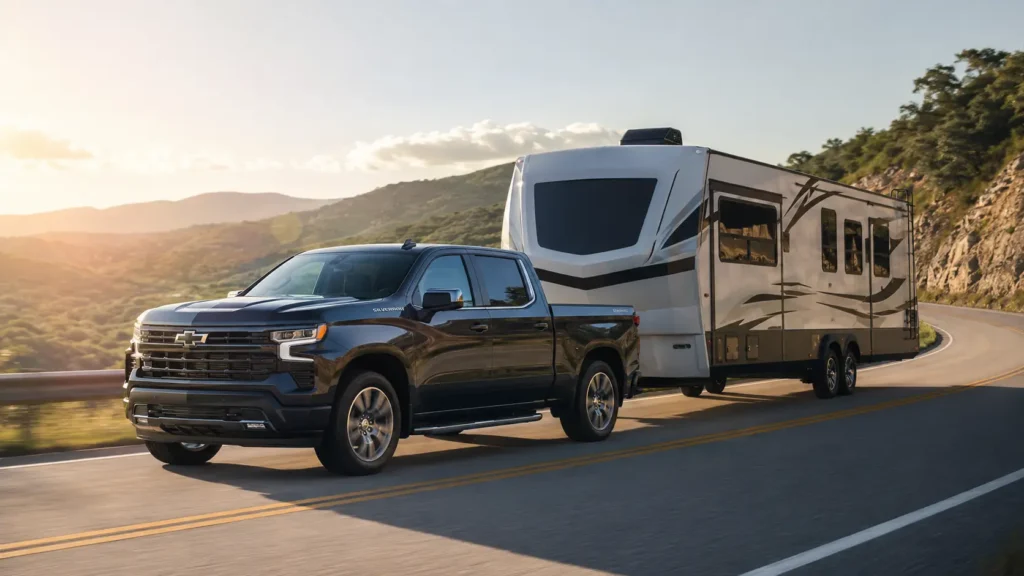
This comprehensive automotive research report meticulously breaks down every engine, configuration, and structural package that dictates how much weight a Silverado can safely handle.
We will explore the underlying mechanical engineering principles, the evolution of the chassis, and the strict mathematical formulas that govern heavy hauling.
Chevy Silverado 1500 Towing Capacity Chart
Recommended Best Deal Products


Master your hauling capabilities with our complete, data-driven breakdown of the Silverado 1500’s towing limits, engine specs, and optimal setups.
What Is the Chevy Silverado 1500 Towing Capacity?
The Chevy Silverado 1500 is a powerhouse in the half-ton truck segment, known for its exceptional versatility. Knowing your exact towing capacity is absolutely crucial for both highway safety and long-term vehicle performance.
With the optimal configuration, this truck can handle massive loads effortlessly. The absolute maximum towing capacity reaches an impressive 13,300 pounds for properly equipped models.
However, achieving this maximum number requires specific hardware. You must select either the 6.2L V8 or the 3.0L Duramax engine, paired strictly with the Max Trailering Package.
Engine Towing Capacity Comparison
Recommended Best Deal Products


Your engine choice is the primary deciding factor for how much weight you can safely pull behind your Silverado. Review the baseline and maximum capacities below.
⚙ 2.7L TurboMax
This standard 4-cylinder engine surprises many with its robust low-end torque. It provides a highly capable 9,500 lbs max towing limit.
It is perfect for small boats, ATVs, and single-axle utility trailers.
⚙ 5.3L EcoTec3 V8
The classic workhorse V8 engine offers a beautiful balance of daily drivability and hauling power. Expect up to 11,300 lbs of towing capability.
This is the sweet spot for medium-sized travel trailers and equipment hauling.
⚙ 6.2L EcoTec3 V8
If you prefer gas power with maximum grunt, the 6.2L V8 is your best option. It ties for the highest capacity at 13,300 lbs.
Requires the Max Trailering Package and specific axle ratios to hit this number safely.
⚙ 3.0L Duramax Diesel
Offering incredible fuel efficiency and massive low-end torque, the diesel option matches the 6.2L V8. It pulls up to 13,300 lbs with ease.
Highly recommended for drivers who tow heavy loads frequently over long distances.
The Complete Silverado Towing Matrix
Different cab sizes and bed lengths alter the curb weight, which directly impacts towing limits. Reference this data table to match your exact build specifications.
| Cab / Bed Style | Drive Type | Engine Required | Max Capacity (lbs) |
|---|---|---|---|
| Regular Cab / Long Bed | 2WD | 2.7L TurboMax | 9,500 |
| Double Cab / Standard Bed | 2WD | 5.3L V8 | 11,300 |
| Crew Cab / Short Bed | 4WD | 6.2L V8 | 13,300 |
| Crew Cab / Standard Bed | 4WD | 3.0L Duramax | 13,000 |
Note: Capacities reflect vehicles equipped with the Max Trailering Package and 20-inch wheels. Always verify via the door jamb sticker.
Payload vs. Towing: The Hidden Limits
Recommended Best Deal Products


Many drivers forget that towing capacity is heavily reliant on available payload. The tongue weight of your trailer pushes down directly on the truck bed.
Typically, tongue weight accounts for 10% to 15% of your total trailer weight. If you max out your payload with passengers and cargo, your towing capacity drops drastically.
Understanding the SAE J2807 towing standard is vital to calculating these interconnected weight limits accurately.
Crucial Towing Metrics Explained
GCWR
Gross Combined Weight Rating. The absolute maximum allowable weight of the loaded truck and the loaded trailer combined.
GVWR
Gross Vehicle Weight Rating. The maximum allowable weight of the fully loaded truck itself, including passengers, cargo, and tongue weight.
Axle Ratio
A higher ratio (like 3.42 or 3.73) increases towing power at the expense of slight fuel economy drops. Crucial for heavy hauling.
For legal safety guidelines, always consult the NHTSA Trailer Safety Guide before hitting the highway.
The Master Chevy Silverado 1500 Towing Capacity Chart by Year
The mechanical evolution of the Silverado’s pulling power demonstrates a clear, intentional upward trajectory as high-strength steel frames and advanced powertrains were sequentially introduced.
To understand where the current capabilities originate, we must look at the historical data spanning the third and fourth generations of this iconic pickup.
The comprehensive data table below illustrates the maximum published conventional trailering capacity for every single model year from 2014 to 2026.
| Model Year | Truck Generation | Max Towing Capacity (lbs) | Notable Engineering Milestone |
| 2026 | Fourth (T1XX) | 13,300 lbs | Duramax LZ0 refinement continues |
| 2025 | Fourth (T1XX) | 13,300 lbs | TurboMax standard on lower trims |
| 2024 | Fourth (T1XX) | 13,300 lbs | High-output 2.7L rebranded as TurboMax |
| 2023 | Fourth (T1XX) | 13,300 lbs | Introduction of Duramax LZ0 engine |
| 2022 | Fourth (T1XX) | 13,300 lbs | Major interior and technology refresh |
| 2021 | Fourth (T1XX) | 13,300 lbs | Complete stability in tow ratings |
| 2020 | Fourth (T1XX) | 13,400 lbs | Absolute highest rating in Silverado history |
| 2019 | Fourth (T1XX) | 12,200 lbs | Launch of the all-new T1XX platform |
| 2018 | Third (K2XX) | 12,500 lbs | Final year of the third generation |
| 2017 | Third (K2XX) | 12,500 lbs | Peak capability for K2XX platform |
| 2016 | Third (K2XX) | 12,000 lbs | 8-speed transmissions expanded |
| 2015 | Third (K2XX) | 12,000 lbs | SAE J2807 compliance universally adopted |
| 2014 | Third (K2XX) | 12,000 lbs | Launch of EcoTec3 engine family |
- Chart Type: Line Graph showing upward historical towing trends.
- X-Axis: Model Years (spanning strictly from 2014 to 2026).
- Y-Axis: Towing Capacity in Pounds (scaled from a 10,000 to 14,000 range).
- Data Point Highlights: Observe the plateau at 12,000 lbs (2014-2016), the sudden jump to 12,500 lbs (2017), a slight dip during the massive platform redesign (2019 at 12,200 lbs), the historical spike to 13,400 lbs (2020), and the final stabilized plateau at 13,300 lbs (2021-2026).
Analyzing Towing Trends Across Distinct Generations
To truly comprehend the significance of these numbers, automotive professionals must examine the underlying engineering shifts that allowed Chevrolet to increase capacities by over a ton in a single decade.
Truck capability does not increase by accident; it requires massive investments in metallurgical science, thermal management, and transmission logic.
By breaking down the generation gaps, we can see exactly how the modern Silverado became a heavy-hauling titan.
The Fourth Generation (2019-2026): Breaching the 13,000-Pound Barrier
The 2019 complete redesign marked the monumental shift to the T1XX platform, which utilized advanced mixed-materials to shave up to 450 pounds off the truck’s overall curb weight.
Initially, the 2019 model year maxed out at a conservative 12,200 pounds as engineers worked to dial in the suspension dynamics of the completely new chassis.
However, by the 2020 model year, Chevrolet heavily optimized the 6.2L V8 engine and the Max Trailering Package hardware to achieve a historic, record-breaking 13,400-pound rating.
From 2021 through 2026, Chevrolet’s engineering teams settled the mainstream lineup at a highly consistent and reliable 13,300-pound maximum.
This fourth generation also prominently introduced the 3.0L Duramax inline-six, which eventually matched the mighty 6.2L V8 in sheer pulling power while drastically improving fuel economy while under heavy load.
The integration of 10-speed automatic transmissions across the upper powertrain lineup allowed the trucks to keep their engines in the absolute perfect power band during steep climbs.
The Third Generation (2014-2018): The EcoTec3 Era
The 2014 model year fundamentally revolutionized General Motors trucks with the introduction of the EcoTec3 engine family, featuring direct fuel injection, variable valve timing, and active fuel management.
From 2014 to 2016, a properly equipped Silverado 1500 featuring the 6.2L V8 topped out at a highly respectable, class-competitive 12,000 pounds.
Chevrolet engineers pushed the structural envelope for the 2017 and 2018 model years, tweaking the suspension geometry and transmission tuning to hit an impressive 12,500 pounds.
These late third-generation trucks remain incredibly popular on the used vehicle market because they offer serious capability without the premium price tag of a newer, highly computerized body style.
The adoption of the SAE J2807 trailering standard during this era meant these towing numbers were no longer marketing fluff, but mathematically verified engineering truths.
Deep Dive: Towing Capacity by Powertrain Option
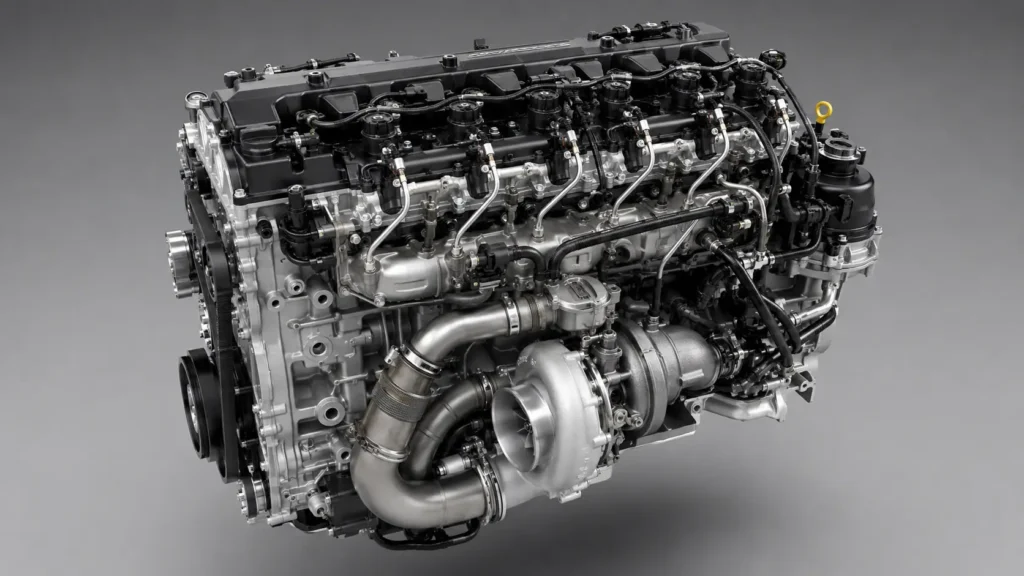
The single largest determining factor in any pickup truck’s heavy hauling capability is the specific powerplant resting under the hood.
Chevrolet currently offers four distinct, highly specialized powertrain paths, with each engine catering to a very different type of automotive consumer.
The data below represents the highest possible capabilities for the current (2024-2026) models, demonstrating how each engine handles specific loads.
The 2.7L TurboMax (High-Output Four-Cylinder)
It is incredibly easy for traditional truck buyers to dismiss a four-cylinder engine in a full-size pickup, but the TurboMax was engineered specifically for massive low-end grunt.
Generating an impressive 310 horsepower and a massive 430 lb-ft of torque, this turbocharged powerplant actually acts much more like a diesel engine off the line.
By forcing dense, pressurized air into the cylinders, the TurboMax completely eliminates the sluggish feeling often associated with base V6 engines of the past.
| TurboMax Towing Specification | Maximum Rating |
| Maximum Conventional Towing | 9,500 lbs |
| Maximum Payload Capacity | 2,260 lbs |
| Engine Horsepower | 310 hp |
| Engine Torque | 430 lb-ft |
The absolute best use case for the TurboMax engine involves daily driving, pulling mid-size utility trailers, hauling small marine craft, and carrying heavy bed loads.
Because the four-cylinder engine block is physically much lighter than a cast-iron V8, trucks equipped with the TurboMax actually boast the highest payload capacities in the entire Silverado family.
This unique trait makes it an undeniably excellent choice for drivers who carry heavy cargo directly in the bed rather than pulling massive trailers behind them.
The 5.3L EcoTec3 V8 (The Traditional Workhorse)
The 5.3L V8 is the historical, unshakeable backbone of the Chevrolet Silverado lineup, offering a perfectly balanced mix of traditional V8 acoustics, proven reliability, and solid capability.
It consistently produces 355 horsepower and 383 lb-ft of naturally aspirated torque, seamlessly paired with advanced dynamic fuel management software systems.
This engine utilizes sophisticated cylinder deactivation technology to cruise efficiently on the highway, seamlessly awaking all eight cylinders when towing demands increase.
| 5.3L EcoTec3 V8 Towing Specification | Maximum Rating |
| Maximum Conventional Towing | 11,300 lbs |
| Maximum 5th-Wheel/Gooseneck | 10,300 lbs |
| Engine Horsepower | 355 hp |
| Engine Torque | 383 lb-ft |
The ideal use case for the 5.3L V8 involves general utility towing, pulling mid-size travel trailers, and hauling enclosed cargo trailers across state lines.
While it does not quite reach the elite 13,000-pound tier, the 5.3L V8 is the versatile engine most likely to be found readily available on dealer lots.
Fascinatingly, it is also the engine that currently claims the absolute highest 5th-wheel/gooseneck rating for the Silverado 1500, topping out at 10,300 pounds in specific Double Cab configurations.
The 6.2L EcoTec3 V8 (Maximum Gas-Powered Brawn)
For uncompromising buyers who demand aggressive gas-powered acceleration and the absolute maximum trailering limits, the 6.2L V8 serves as the apex predator of the lineup.
It forcefully generates 420 horsepower and 460 lb-ft of torque, utilizing immense displacement to push the T1XX truck chassis to its very structural limits.
When this engine roars to life under a heavy load, it provides a linear, predictable surge of power that turbocharged engines sometimes struggle to replicate smoothly.
| 6.2L EcoTec3 V8 Towing Specification | Maximum Rating |
| Maximum Conventional Towing | 13,300 lbs |
| Maximum Payload Capacity | 1,980 lbs |
| Engine Horsepower | 420 hp |
| Engine Torque | 460 lb-ft |
The primary use case for this massive V8 involves pulling heavy toy haulers, transporting heavy construction equipment, and conquering steep mountain grades with ease.
To achieve these peak numbers, the 6.2L V8 must be explicitly paired with the Max Trailering Package and highly specific 20-inch factory wheel setups.
Without the vital NHT package, a standard 6.2L V8 configuration generally tops out around 9,500 to 11,100 pounds, perfectly highlighting how critical the upgraded axle ratios and cooling systems truly are.
The 3.0L Duramax Turbo-Diesel I-6 (Where Efficiency Meets Capability)
The bold introduction of the inline-six diesel completely transformed the half-ton towing landscape, offering HD-like torque curves seamlessly wrapped in a light-duty package.
The original LM2 generation engine paved the way, but the vastly updated LZ0 generation pushes 305 horsepower and a staggering 495 lb-ft of torque.
The inherent balance of an inline-six cylinder arrangement ensures that the engine runs incredibly smooth, virtually eliminating the harsh vibrations associated with older diesel designs.
| 3.0L Duramax LZ0 Towing Specification | Maximum Rating |
| Maximum Conventional Towing | 13,300 lbs |
| Maximum Payload Capacity | 1,970 lbs |
| Engine Horsepower | 305 hp |
| Engine Torque | 495 lb-ft |
The best use case for the Duramax is undoubtedly long-distance highway towing, cross-country RV travel, and pulling heavy aerodynamic horse trailers.
The Duramax delivers its peak torque at an incredibly low 1,500 RPM, meaning the truck rarely has to downshift to maintain highway cruising speeds on inclines.
Furthermore, inherent diesel thermal efficiency means drivers will experience significantly less fuel economy degradation while towing compared to the thirsty 6.2L V8.
The Secret to Maximum Towing: The Max Trailering Package (RPO NHT)
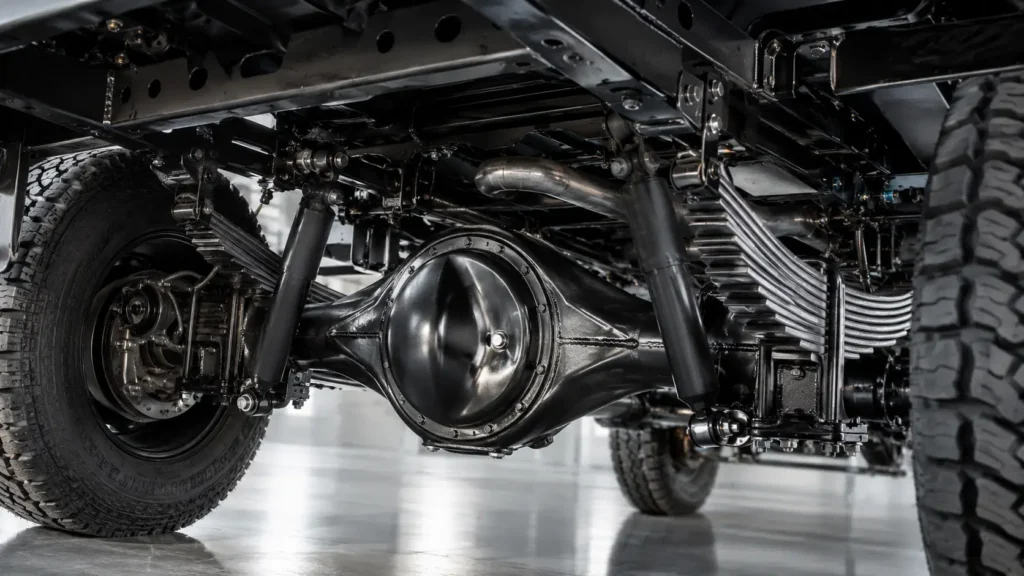
It is a highly common, yet dangerous misconception that simply buying the biggest engine guarantees the absolute highest tow rating on the dealership lot.
In stark reality, an improperly configured 6.2L V8 truck will tow thousands of pounds less than a smaller 5.3L V8 truck that is equipped with the correct hardware.
The definitive key to safely unlocking the Silverado’s 13,300-pound capability is the Max Trailering Package, known internally by its production RPO code: NHT.
If you are researching a vehicle purchase, reviewing resources like the(https://www.machaikchevy.com/manufacturer-research/2026-silverado-1500-towing-capacity/) can help identify this package on the window sticker.
Exhaustive Breakdown of NHT Package Components
The official Chevrolet Trailering Guide explicitly outlines that the NHT package upgrades the base truck from a standard daily commuter to a dedicated heavy-duty hauler.
The package is an available premium option on mid-to-high trims like the LT, RST, LTZ, and High Country, and it includes the following vital, heavy-duty components :
| NHT Component | Engineering Purpose |
| 9.76-Inch Rear Axle | Upgraded from the standard 9.5-inch ring gear to handle massive torque loads without internal shearing. |
| Revised Axle Ratios | Gas engines receive a 3.42 ratio, while diesels receive a 3.73 ratio for drastically increased mechanical pulling advantage. |
| Heavier-Duty Rear Springs | Thicker leaf spring packs designed to manage heavy tongue weights and prevent dangerous rear-end suspension sag. |
| Enhanced Cooling Radiator | Upgraded thermal management systems to prevent engine and transmission overheating on long, steep grades. |
| Revised Shock Tuning | Dampers calibrated specifically for heavily loaded conditions to physically eliminate trailer sway and porpoising. |
| G80 Automatic Locking Differential | Ensures maximum traction is distributed evenly across the rear axle when pulling off slick, algae-covered boat ramps. |
| Integrated Trailer Brake Controller | Allows the truck’s computer to modulate the trailer’s electric brakes smoothly in sync with the vehicle’s pedal. |
| 220-Amp Alternator | Provides the necessary electrical current to power heavy trailer accessories and charge auxiliary batteries. |
Without these comprehensive upgrades, the Gross Combined Weight Rating (GCWR) of the truck is artificially capped by the strict thermal limits of the standard radiator.
Furthermore, standard suspension components simply lack the physical spring rate required to manage the massive downward force of a 1,300-pound trailer tongue.
For anyone actively planning to tow over the 10,000-pound threshold, verifying the presence of the NHT package is an absolute necessity for safety and legality.
Cab Configurations, Bed Lengths, and the Strict Math of Towing
The physical dimensions and structural blueprint of a truck drastically alter its ability to pull dead weight down the highway.
Because maximum towing capacity is strictly calculated by subtracting the truck’s curb weight from its fixed Gross Combined Weight Rating (GCWR), a heavier truck inherently tows less.
This simple mathematical reality often surprises buyers who assume the largest, most expensive truck will naturally pull the heaviest trailers.
Regular Cab vs. Double Cab vs. Crew Cab Dynamics
A Regular Cab paired with a Long Bed is structurally the lightest configuration available in the Silverado lineup.
Consequently, this minimalist setup consistently yields the highest payload capacity (2,260 lbs) and leaves the absolute most weight available for the trailer.
However, consumer market demand overwhelmingly favors the massive Crew Cab Short Bed configuration, which adds hundreds of pounds in extra steel, safety glass, and interior seating.
As a direct result, a fully loaded Crew Cab truck will always have a slightly lower tow rating than an identically equipped Double or Regular Cab truck.
The 2WD vs. 4WD Towing Deficit Explained
Four-wheel drive is undeniably excellent for pulling a heavy boat out of a slippery marina, but it introduces a severe weight penalty to the chassis.
The physical addition of a heavy transfer case, front driveshaft, front differential, and reinforced half-shafts adds significant mass to the front end.
Therefore, a 2WD Silverado will typically tow between 200 and 400 pounds more than its exact 4WD counterpart, simply because the 2WD chassis is lighter.
If you live in a warm climate and strictly tow on paved roads, avoiding 4WD is an easy way to artificially boost your payload and towing margins.
The Off-Road Penalty: The Silverado ZR2 Limitations
Off-road articulation capability and heavy towing stability are fundamentally opposed engineering goals that cannot coexist on the same suspension.
The Silverado ZR2 is brilliantly built for high-speed desert running and rock crawling, utilizing highly compliant Multimatic DSSV spool-valve dampers and softer leaf springs.
While these components provide incredible off-road shock absorption, they cannot support the massive static tongue weights required for heavy trailering.
As a result, the 6.2L V8 ZR2 is strictly limited to just 8,700 pounds of conventional towing, and the Duramax ZR2 cautiously tops out at 9,100 pounds.
Decoding Towing Lexicon: GCWR, GVWR, and Payload Limits
Understanding the technical towing jargon is the only way to safely load a vehicle without inadvertently voiding warranties or risking catastrophic mechanical failure.
According to authoritative dealership data featured on the(https://www.turanfoley.com/blogs/7280/chevy-silverado-1500-towing-capacity-research/) hub, overloading is the primary mechanical cause of trailering accidents.
Here is exactly how the crucial weight metrics interact with one another on a half-ton pickup.
Gross Combined Weight Rating (GCWR)
The GCWR is the absolute maximum allowable weight of the truck, the trailer, all cargo, all fluids, and all passengers combined into one moving mass.
If a properly equipped truck has a GCWR of 19,000 pounds (the maximum for a Duramax NHT setup), the math is entirely zero-sum.
Every single pound of gear, tools, or passenger weight put inside the truck cab directly subtracts a pound from what can be pulled behind it.
Gross Vehicle Weight Rating (GVWR)
The GVWR is the maximum allowable weight of the truck itself, fully loaded with passengers and cargo, but without a trailer attached.
However, when a trailer is attached, the physical tongue weight of the trailer pushes down heavily on the truck’s rear axle receiver hitch.
This dynamic tongue weight must be added to the truck’s curb weight, passenger weight, and cargo weight to ensure it does not illegally exceed the GVWR.
Payload Capacity and Tongue Weight Dynamics
Payload is mathematically defined simply as the GVWR minus the empty, fluid-filled curb weight of the truck.
When pulling a conventional bumper-pull trailer, safety standards require that 10% to 15% of the trailer’s total weight rests directly on the hitch ball to prevent sway.
If you are towing a massive 10,000-pound travel trailer, it will place roughly 1,000 to 1,500 pounds of heavy tongue weight onto the rear of the Silverado.
If your specific luxury-trim Silverado has a payload limit of 1,600 pounds, adding a 1,200-pound tongue weight leaves you with only 400 pounds for the driver, passengers, and gear inside the cab.
This is precisely why half-ton trucks usually run out of payload capacity long before they ever run out of actual engine pulling power.
Gooseneck and 5th-Wheel Towing with a Half-Ton Silverado
While 3/4-ton and 1-ton Heavy Duty trucks are the traditional, sensible choice for 5th-wheel trailers, the modern Silverado 1500 chassis is technically rated for it.
Chevrolet officially supports gooseneck and 5th-wheel hitch installations directly in the bed, but the payload math becomes extremely tight very quickly.
The Kingpin Weight Challenge
A 5th-wheel trailer places its heavy pin weight directly over or slightly ahead of the truck’s rear axle, drastically improving stability and eliminating trailer sway.
However, 5th-wheel kingpin weight is much heavier than conventional tongue weight, typically requiring 15% to 25% of the total trailer weight to safely rest in the bed.
If a half-ton truck attempts to pull a 9,000-pound 5th-wheel camper, the physical kingpin could easily weigh upwards of 1,800 to 2,000 pounds.
Since most heavily optioned Crew Cab Silverado 1500s possess payload ratings between 1,600 and 1,900 pounds, hooking up that trailer instantly overloads the truck’s GVWR before the driver even opens the door.
Maximum 5th-Wheel Ratings and Safety
To successfully combat this mathematical payload deficit, the absolute highest 5th-wheel ratings are strictly restricted to Double Cab and Regular Cab models, which feature higher base payload capacities.
The absolute maximum 5th-wheel rating published by Chevrolet for the current generation is firmly set at 10,300 pounds, requiring the 5.3L V8 and the Max Trailering Package.
For most buyers looking to tow large, high-profile 5th-wheels across the country, stepping up to a dedicated Silverado 2500HD is always the safer, more legally compliant choice.
Advanced Trailering Technologies and Smart Camera Systems
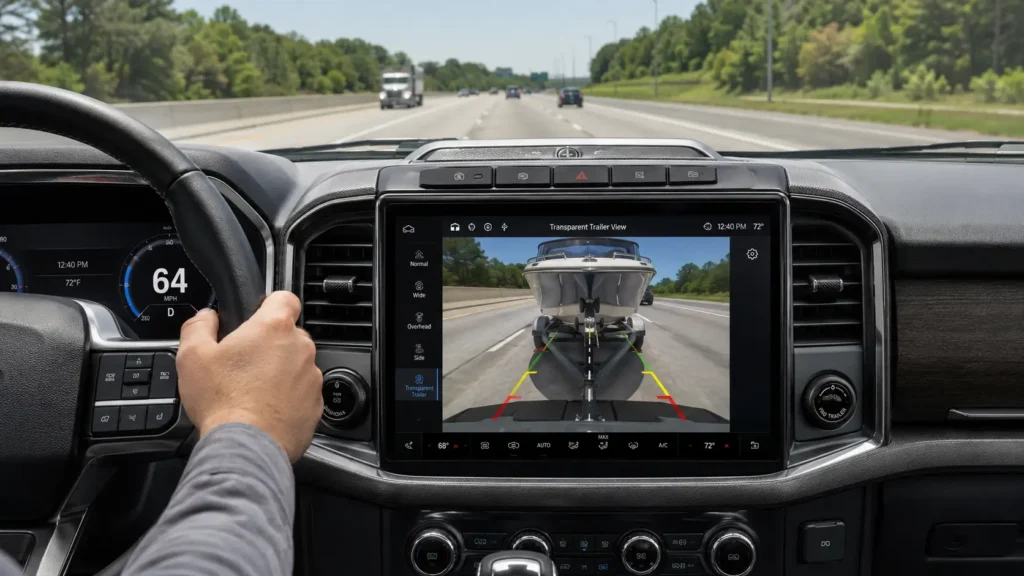
Raw mechanical brawn is only half of the modern towing safety equation.
Chevrolet has integrated an incredibly impressive suite of software algorithms and high-definition camera technologies to make hitching and hauling safer than ever before.
The current Silverado 1500 offers up to 8 available external cameras providing an astonishing 14 unique viewing angles.
Hitch Guidance and Hitch View Alignment
Standard on many trailering-equipped Silverado models, the Hitch Guidance system overlays dynamic, steering-linked tracking lines on the high-definition rear camera feed.
This software flawlessly guides the driver perfectly to the trailer tongue without requiring a second person to spot the alignment.
The upgraded Hitch View function allows the driver to zoom in directly over the hitch ball, making precision, solo hookups incredibly simple and frustration-free.
Once actively driving, the system even allows for a quick camera check on the hitch connection while cruising at highway speeds.
Jack-Knife Alert and Trailer Length Indicator
When explicitly equipped with a compatible, digitally linked trailer, the Silverado uses advanced sensors to continuously monitor the articulation angle between the truck and the trailer.
If the angle becomes dangerously sharp during a difficult backing maneuver, the Jack-Knife Alert sounds a cabin warning to prevent expensive collision damage.
Similarly, the highly intuitive Trailer Length Indicator creates a red overlay on the infotainment screen during highway lane changes.
This overlay shows exactly where the physical back of the trailer is relative to surrounding traffic, taking the guesswork out of merging.
Trailer Side Blind Zone Alert
Changing lanes on a crowded interstate with a 30-foot travel trailer is notoriously stressful and dangerous.
The Trailer Side Blind Zone Alert seamlessly extends the truck’s standard blind-spot monitoring radar to account for the entire, extended length of the trailer.
If a vehicle is aggressively lurking in the trailer’s massive blind spot, a visual alert flashes brightly in the side mirror, preventing catastrophic sideswipes.
The Transparent Trailer View Illusion
Perhaps the most innovative feature in the entire automotive trailering sector is Chevrolet’s Transparent Trailer View.
By mounting a specialized accessory camera on the absolute back of the trailer and combining its feed with the truck’s tailgate camera, the software stitches together a seamless video feed.
The stunning result is an optical illusion that renders the physical trailer “invisible” on the center infotainment screen.
This allows the driver to see traffic directly behind the trailer in real-time, exactly as if the massive box were simply not there.
Real-World Safe Towing Practices and Physical Dynamics
Even with 13,300 pounds of verified capacity and 14 distinct camera views, the brutal laws of physics still apply to every moving vehicle.
Safe towing at maximum capacity requires meticulous preparation, precise cargo loading, and constant driver situational awareness.
Following the guidelines explicitly laid out in the(https://www.chevrolet.com/trucks/trailering-and-towing-guide) ensures that the vehicle operates within its thermal and mechanical design limits.
The Necessity of a Weight-Distributing Hitch
For any conventional bumper-pull trailer weighing over 5,000 pounds, a mechanical weight-distributing hitch is highly recommended, and often explicitly required by the manufacturer.
This specialized hitch setup uses heavy tension spring bars to leverage the massive tongue weight completely off the truck’s rear axle.
It then actively distributes that force evenly back to the truck’s front steering axle and the trailer’s own axles.
This prevents the front tires of the truck from dangerously lifting, ensuring proper steering geometry, tire contact patches, and braking performance.
Managing High Elevation and Extreme Heat
When aggressively towing up steep mountain grades, atmospheric pressure drops significantly, causing both turbochargers and naturally aspirated engines to work much harder and generate immense heat.
Furthermore, as elevation increases, the physical boiling point of the engine coolant drops, bringing the vehicle closer to a dangerous overheating scenario.
If you have just conquered a massive, multi-mile hill climb, you should never shut the incredibly hot engine off immediately.
Instead, allow the truck to idle in Park for at least five full minutes; this keeps the mechanical water pump and electric cooling fans running to dissipate the trapped thermal load safely.
Highway Speed and Kinetic Braking Distances
It is a vital rule of thumb to physically double your standard following distance when towing a trailer at or near maximum capacity.
A heavily loaded Silverado 1500 pulling a 13,000-pound load effectively weighs nearly 19,000 pounds in total combined mass.
Even with the highly advanced integrated trailer brake controller fully engaged, the kinetic energy required to stop that rolling mass grows exponentially with vehicle speed.
Experts universally recommend keeping highway trailering speeds strictly at or below 65 MPH for optimal safety, tire preservation, and maximum fuel economy.
Frequently Asked Questions
What is the maximum towing capacity of a new Chevy Silverado 1500?
A modern Chevrolet Silverado 1500, specifically encompassing model years 2021 through 2026, offers a maximum conventional towing capacity of exactly 13,300 pounds.
To achieve this absolute peak rating, the truck must be equipped with either the Duramax 3.0L Turbo-Diesel inline-six or the 6.2L EcoTec3 V8 engine.
Additionally, this rating strictly requires the factory-installed Max Trailering Package (RPO code NHT) and specific 20-inch wheel configurations to manage the immense thermal and structural loads.
Can a Chevy Silverado 1500 tow a 5th-wheel or gooseneck trailer?
Yes, the modern Silverado 1500 chassis is structurally capable of supporting 5th-wheel and gooseneck towing applications, though it is heavily constrained by payload capacity limits.
Current manufacturer trailering guides indicate that the 1500 series tops out at 10,300 pounds for 5th-wheel towing on select 5.3L V8 Double Cab configurations.
Because heavy 5th-wheel kingpin weights can consume between 15% and 25% of the trailer’s total mass, the truck’s rear axle payload rating almost always maxes out before the theoretical pulling limit is reached.
What exactly is the Max Trailering Package?
The Max Trailering Package, internally designated by General Motors as RPO code NHT, is a factory-installed suite of mechanical structural upgrades necessary to reach the Silverado’s highest tow ratings.
This package significantly upgrades the truck with a heavier-duty 9.76-inch rear axle, enhanced cooling radiators, revised shock absorber tuning, and much heavier rear leaf springs.
It also alters the rear axle ratio to a mathematically advantageous 3.42 for gas engines or 3.73 for diesel engines, drastically multiplying torque delivery to the rear wheels.
Does opting for four-wheel drive (4WD) lower my towing capacity?
Yes, selecting a four-wheel drive (4WD or 4×4) drivetrain generally reduces the maximum towing capacity compared to a two-wheel drive (2WD) model within the exact same configuration.
The addition of a transfer case, front driveshaft, front differential, and reinforced half-shafts adds significant parasitic curb weight to the truck’s chassis.
Because the Gross Combined Weight Rating (GCWR) is a fixed structural limit, every single extra pound of truck hardware directly subtracts a pound from the allowable trailer weight.
What is the difference between the LM2 and LZ0 Duramax engines?
The LM2 was the first iteration of the 3.0L Duramax inline-six introduced in the fourth-generation Silverado, revolutionizing light-duty diesel towing with incredible fuel efficiency.
The LZ0 is the heavily revised second generation of this engine, introduced for the 2023 model year, featuring upgraded steel pistons, a retuned turbo compressor, and new fuel injectors.
These LZ0 upgrades increased horsepower to 305 and pushed torque to an immense 495 lb-ft, allowing the diesel powertrain to finally match the 6.2L V8’s 13,300-pound maximum towing capacity.
Why is the Silverado ZR2 towing capacity so much lower?
Off-road capability and heavy-duty towing stability are fundamentally opposed engineering goals that require completely different suspension philosophies.
The Silverado ZR2 is purpose-built for high-speed desert running and technical rock crawling, utilizing highly compliant, long-travel Multimatic DSSV spool-valve dampers and much softer spring rates.
While these components provide incredible off-road articulation, they simply cannot support the massive tongue weights required for heavy towing, limiting the ZR2 to just 8,700 to 9,100 pounds of conventional trailering.
Final Synthesis: Choosing the Perfect Silverado Towing Setup
The modern Chevrolet Silverado 1500 firmly proves that the historical line between light-duty commuters and heavy-duty work trucks has blurred significantly over the past decade.
For the vast majority of mainstream consumers, a 5.3L V8 or a 2.7L TurboMax will easily provide more than enough pulling power for weekend boating trips and light utility hauling.
However, for those dedicated owners who intend to pull massive travel trailers, car haulers, or heavy skid-steers, the path forward is absolutely clear.
To safely harness the maximum 13,300-pound tow rating without risking mechanical failure, buyers must meticulously and intentionally spec their trucks from the factory.
It explicitly requires selecting the high-output 6.2L V8 or the torque-rich 3.0L Duramax LZ0, mandating the Max Trailering Package (NHT), and opting for a lighter cab and bed configuration whenever structurally possible.
By fundamentally understanding the strict mathematics behind GCWR, GVWR, payload, and tongue weight, owners can utilize the Silverado’s immense, world-class capability with total confidence and uncompromised safety.
Related Guides
- Nissan Frontier Towing Capacity Chart
- Toyota Tundra Towing Capacity Chart
- Ford F-150 Towing Capacity Chart
- 2013 Ram 1500 Towing Capacity
- 2014 Ram 3500 Towing Capacity
- Dodge Ram 2500 Payload Capacity Chart
- Dodge Ram Tire Size Chart by Year
![What Size Winch for Car Trailer? Sizing Formula & Chart [2026]](https://truckguider.com/wp-content/uploads/2026/03/what-size-winch-for-car-trailer-featured.webp)
![How to Use a Trailer Brake Controller: Gain & Override Guide [2026]](https://truckguider.com/wp-content/uploads/2026/03/how-to-use-trailer-brake-controller-featured.webp)