Dodge Dakota Towing Capacity Guide: 1987-2011 Ratings [2026]

The Dodge Dakota towing capacity ranges from 2,000 to 7,200 pounds depending on the specific engine, cab configuration, and axle ratio. To reach the maximum 7,200-lb limit, vehicles generally require the 4.7L V8 engine and the factory-installed Heavy-Duty Service Group package.
🎯 Key Takeaways
- Maximum towing capacity peaks at 7,200 lbs for third-generation V8 models.
- Axle ratios like the 3.92 significantly increase total tow ratings over 3.55.
- The 4.7L and 5.9L V8 engines provide the highest mid-size towing performance.
- Factory cooling upgrades are essential for safely reaching maximum weight limits.
- Always subtract passenger and cargo weight from the Gross Combined Weight Rating.
The Dakota specifications and generations”>Dodge Dakota occupies a unique space in truck history, offering more muscle than a compact pickup without the bulk of a full-size rig. Depending on your specific year and engine, a Dodge Dakota’s towing capacity ranges from a modest 2,000 pounds to a stout 7,200 pounds. To find your number, you must look past the badge and identify your engine displacement, axle ratio, and whether you have the factory-installed heavy-duty cooling system.
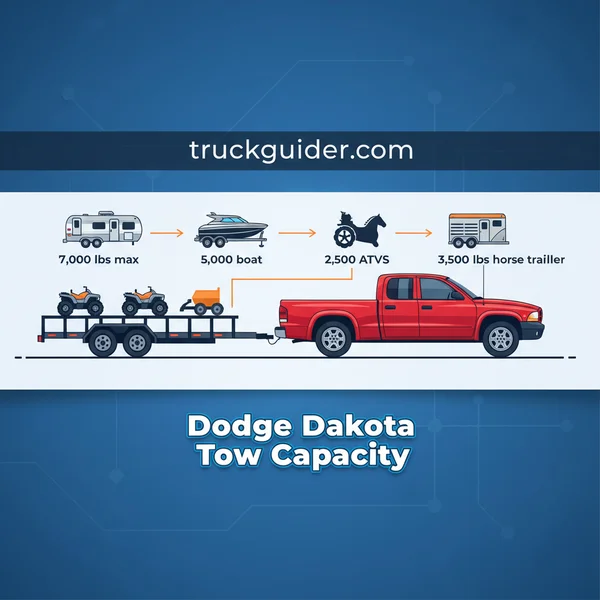
Practicality is the main reason you need these exact figures. Exceeding your Dakota’s limit doesn’t just strain the engine; it puts extreme stress on the transmission and the rear differential. Using the charts below, you can verify your truck’s mechanical limits to ensure your trailer remains stable at highway speeds and your transmission stays cool during long climbs.
Dodge Dakota Towing Capacity by Generation (1987–2011)
The Dakota’s towing capability evolved significantly across its three generations. Early models focused on light utility, while the final generation aimed to compete with full-size trucks in sheer pulling power. To find your rating, first identify which generation your truck belongs to based on the manufacture year.

First Generation (1987–1996)
First-gen Dakotas were the pioneers of the “mid-size” segment. Early 4-cylinder models are strictly for light utility trailers, while the later 5.2L V8 models began to push the truck into serious towing territory.
- 2.2L & 2.5L I4 Engines: 2,000 to 2,500 lbs. These are best suited for small utility trailers or jet skis.
- 3.9L V6 Engine: 3,500 to 4,500 lbs. This rating varies based on whether you have the 3.55 or 3.92 axle ratio.
- 5.2L V8 Engine (1991-1996): 5,500 to 6,400 lbs. This was the powerhouse of the era, though reaching the 6,000+ mark requires the 3.92 rear axle and an automatic transmission.
Second Generation (1997–2004)
The second generation is often considered the sweet spot for the Dakota. It introduced more sophisticated suspension and the legendary 4.7L Magnum V8. This generation offers a wide variance in capacity based on cab style (Regular, Club, or Quad Cab).
- 2.5L I4 Engine: 2,500 lbs max. Avoid towing large loads as the small engine struggles with wind resistance.
- 3.9L V6 Engine: 4,000 to 4,800 lbs. A reliable choice for small campers or boats.
- 4.7L V8 Engine: 5,000 to 6,200 lbs. This engine provides the best balance of torque and cooling for consistent towing.
- 5.9L V8 Engine: 6,000 to 6,600 lbs. Found in the R/T and some SLT models, this engine provides the highest torque for heavy pulls, though it is usually paired with a lower fuel economy.
Third Generation (2005–2011)
The final generation of the Dakota saw a redesigned frame and upgraded powertrains. These trucks achieved the highest tow ratings in the nameplate’s history, specifically when equipped with the High Output (HO) V8 engines.
- 3.7L V6 Engine: 3,500 to 4,800 lbs. Sufficient for most landscape trailers or small pop-up campers.
- 4.7L V8 (Standard): 5,500 to 6,000 lbs. A versatile middle-ground for mid-sized trailers.
- 4.7L V8 (High Output/2008+ Refresh): 6,500 to 7,200 lbs. When properly equipped with the 3.92 axle ratio and the Heavy Duty Service Group, this configuration reaches the Dakota’s absolute maximum capacity.
Engine and Transmission Impact on Dakota Towing Ratings
Your engine size is the most obvious factor in towing, but the transmission and axle ratio often play a bigger role in what the truck is legally rated to pull. You might have a V8 engine, but if your truck has a manual transmission, your towing capacity could be slashed by as much as 2,000 pounds compared to an automatic version of the same truck.
The V8 Advantage vs. V6 Constraints
The V6 engines (3.9L and 3.7L) are capable of moving weight, but they lack the low-end torque required to get a heavy trailer moving from a dead stop on an incline. Torque is what starts the load; horsepower is what keeps it moving.
- V6 Models: Generally limited by cooling capacity. They are prone to hunting for gears (shifting frequently) when pulling more than 4,000 lbs.
- V8 Models: These engines, especially the 4.7L and 5.9L, have wider power bands. They allow the truck to maintain cruising speeds without the engine reaching dangerously high RPMs.
Manual vs. Automatic Transmission Limits
It is a common misconception that manual transmissions are better for heavy hauling. In the Dodge Dakota’s case, the opposite is true. Most Dakota manuals were equipped with a lighter-duty clutch that could not handle the heat generated by a 6,000-pound load.
For example, in many 2002 models, a 4.7L V8 with an automatic transmission is rated for 6,000 lbs. The exact same truck with a manual transmission is often rated for only 3,500 to 4,000 lbs. The automatic transmissions used in the Dakota (like the 42RLE or 545RFE) were paired with external fluid coolers that allowed for significantly higher sustained loads.
The Role of the Axle Ratio
If you are looking at two identical Dakotas and one has a higher tow rating, the difference is likely the axle ratio. The axle ratio determines how many times the driveshaft turns for every one rotation of the rear tires.
- 3.21 or 3.55 Ratio: Optimized for fuel economy. These ratios make it harder for the engine to turn the wheels under a heavy load, resulting in lower tow ratings.
- 3.92 Ratio: Optimized for towing. This “shorter” gear gives the engine more mechanical advantage, allowing for the maximum 7,000+ lb ratings found in the third generation.
Critical Weight Factors: GCWR, Axle Ratios, and Payload
Understanding your Dodge Dakota’s maximum towing capacity is only the first step. To tow safely, you must look at the “hidden” numbers that dictate how much stress your truck can actually handle. The most important of these is the Gross Combined Weight Rating (GCWR). This is the maximum allowable weight of the entire setup: the truck, the passengers, the fuel, the cargo in the bed, and the trailer itself.
The Impact of Axle Ratios
One of the biggest variables in Dakota towing is the rear axle ratio. Two seemingly identical Dakotas with the same V8 engine can have vastly different tow ratings based on this single gear set. For instance, a third-generation Dakota with a 3.55 axle ratio might be rated for significantly less than one equipped with the 3.92 ratio. The 3.92 gears provide more mechanical advantage, allowing the engine to stay in its power band more effectively when pulling heavy loads up a grade.
- 3.55 Ratio: Better for highway fuel economy, but limits max towing capacity.
- 3.92 Ratio: The “sweet spot” for heavy hauling, often required to reach that 7,000+ lb ceiling.
- 4.56 Ratio: Often found in aftermarket setups for off-roading or extreme pulling power.
Payload and Tongue Weight Balance
It is a common mistake to focus solely on the trailer’s weight while ignoring the payload capacity. Every pound of “tongue weight” (the downward force the trailer exerts on the hitch) counts toward your truck’s payload. If you have four adults in the cab and a bed full of camping gear, you may hit your payload limit long before you reach your max towing capacity. Always aim for a tongue weight that is 10% to 15% of the total trailer weight to ensure the truck remains stable and doesn’t “squat” excessively.
Essential Factory Towing Packages and Cooling Requirements
If you plan on pushing your Dakota to its limits, having the factory Heavy Duty Service Group or Trailer Tow Group is non-negotiable. Dodge designed these packages to address the primary killer of mid-sized trucks: heat. When you are hauling 5,000 lbs behind a Dakota, the engine and transmission generate massive amounts of thermal energy that the standard cooling system simply isn’t built to dissipate.
The Transmission Oil Cooler Advantage
Transmission failure is the most common result of over-towing. Factory tow packages usually include an auxiliary transmission oil cooler. This small radiator sits in front of the main engine radiator and drops the temperature of the transmission fluid before it cycles back into the gearbox. If your Dakota didn’t come with this from the factory, adding a high-quality aftermarket plate-and-fin cooler is a smart move for any owner pulling more than a small utility trailer.
Heavy-Duty Cooling and Electrical
Beyond the transmission, towing packages typically include several mechanical upgrades that improve longevity and safety:
- High-Output Alternator: Ensures the truck can power the trailer’s lights and charge its battery without draining the truck’s electrical system.
- Heavy-Duty Engine Cooling: Usually involves a larger radiator or a more aggressive fan clutch to keep engine temps stable under load.
- 7-Pin Wiring Harness: Essential for trailers with electric brakes, allowing the truck to communicate with the trailer’s braking system.
Pro Tip: Always check your VIN or the equipment sticker inside the glove box. This will confirm if your truck has the “Heavy Duty Service Group,” which often increases the “official” capacity versus a base model.
Wrapping Up Your Dakota Towing Journey
The Dodge Dakota remains a legendary mid-sized pickup because it punches well above its weight class. Whether you are driving a classic first-gen or a late-model 4.7L V8 High Output, knowing your specific ratings is the key to a successful haul. Remember that towing is about more than just the engine; your axle ratio, cooling system, and payload balance all play a vital role in keeping you safe on the road.
Before you hitch up, take five minutes to check your door jamb sticker for the GVWR and verify your axle ratio. If you’re planning a long trip, consider a quick transmission fluid check to ensure everything is in peak condition. Now that you have the numbers, you’re ready to get out there and put that Dakota to work!
❓ Frequently Asked Questions
How do axle ratios affect the Dodge Dakota’s towing capacity?
The rear axle ratio determines the mechanical advantage the engine has; a 3.92 ratio allows for significantly higher towing capacities (often 1,000+ lbs more) than the standard 3.55 ratio by improving low-end torque delivery.
What is included in the Dodge Dakota factory tow package?
The factory ‘Heavy-Duty Service Group’ typically includes a Class IV hitch receiver, a 7-pin wiring harness, a heavy-duty engine cooling system, an auxiliary transmission oil cooler, and a higher-output alternator.
Can a Dodge Dakota tow a travel trailer?
Yes, many Dakota models can tow small to mid-sized travel trailers ranging from 18 to 24 feet, provided the total weight stays within the 5,000 to 7,000-lb range of the V8 models.
What is the GCWR and why does it matter for my Dakota?
The Gross Combined Weight Rating (GCWR) is the maximum allowable weight of the truck, passengers, cargo, and the trailer combined; exceeding this limit can cause transmission failure or braking issues.
How much can the 3.7L V6 Dodge Dakota tow?
The 3.7L V6 engine, found in later generations, generally maxes out at approximately 4,500 to 4,800 lbs when properly equipped with an automatic transmission and towing package.
Does the cab size (Club Cab vs Quad Cab) change the tow rating?
Yes, because the Quad Cab is heavier than the Club Cab or Regular Cab, it reduces the available towing capacity because more of the truck’s GCWR is used by the vehicle’s own weight.


![Does a Cold Air Intake Void Warranty? Legal Rights Explained [2026]](https://truckguider.com/wp-content/uploads/2026/03/does-cold-air-intake-void-warranty-featured.webp)