Dodge 5.9L V8 Firing Order & Distributor Wiring Guide [2026]

The official firing order for the Dodge 5.9L V8 (360 Magnum) engine is 1-8-4-3-6-5-7-2 with a clockwise distributor rotation. To ensure peak performance, it is vital to map cylinder #1 to the front-left (driver side) and follow specific wire routing to avoid inductive cross-fire.
🎯 Key Takeaways
- The standard firing order sequence is 1-8-4-3-6-5-7-2.
- Cylinder #1 is located at the front of the driver-side bank.
- The distributor rotor rotates in a clockwise direction.
- Cross-firing is prevented by separating wires for cylinders 5 and 7.
- Passenger side cylinders are even (2-4-6-8); driver side are odd (1-3-5-7).
The firing order for the Dodge 5.9L V8 engine is 1-8-4-3-6-5-7-2. This specific sequence is the heartbeat of your engine, ensuring that combustion occurs in a balanced pattern to minimize vibration and maximize torque. Whether you are replacing a cracked distributor cap or installing a fresh set of high-performance spark plug wires, getting this sequence right is the difference between a smooth-running machine and an engine that backfires, stumbles, or refuses to start.


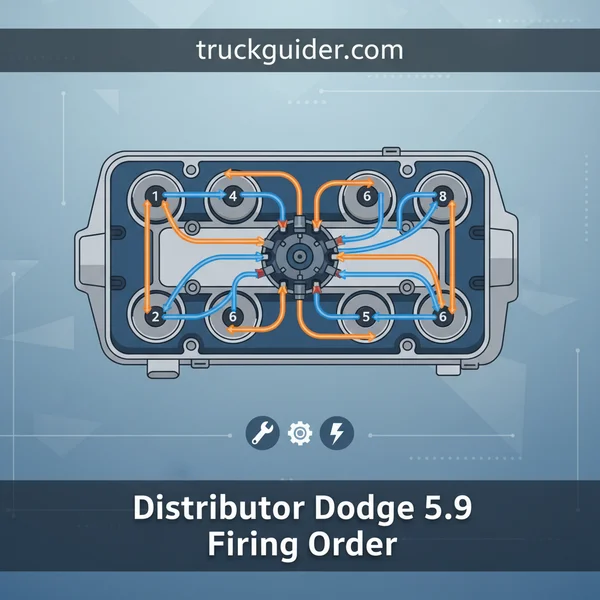
Practical application of this firing order is critical because the 5.9L Magnum engine is sensitive to “cross-fire” or electromagnetic induction between wires. If the wires are routed incorrectly—even if they are on the right terminals—induction can cause a spark to jump in the wrong cylinder at the wrong time. This guide will walk you through the physical layout of the engine and the distributor cap so you can confidently wire your V8 without second-guessing your work.
Understanding the Dodge 5.9L V8 Cylinder Numbering and Layout
Before you touch the distributor cap, you must understand how Dodge numbers the cylinders on the 5.9L (360 cubic inch) V8 block. Unlike some manufacturers that number cylinders sequentially down one bank, Dodge uses a staggered approach. To identify your cylinders, stand at the front of the vehicle looking at the engine bay.

Identifying the Cylinder Banks
The 5.9L V8 is divided into two banks: the left bank (driver side) and the right bank (passenger side). The cylinders are numbered from the front of the engine (near the radiator) toward the back (near the firewall). Identifying the #1 cylinder is the most important step, as it serves as your anchor point for both the firing order and ignition timing.
- Left Side (Driver Side): This bank contains the odd-numbered cylinders. From front to back, they are 1, 3, 5, and 7.
- Right Side (Passenger Side): This bank contains the even-numbered cylinders. From front to back, they are 2, 4, 6, and 8.
- The Front-Most Cylinder: Cylinder #1 is the forward-most cylinder on the driver’s side. It sits slightly further forward toward the radiator than cylinder #2 on the opposite side.
When you are preparing to route your wires, it is helpful to visualize this “zigzag” numbering. If you are standing at the grill, the cylinder closest to you on your right (the truck’s left) is #1. The cylinder closest to you on your left (the truck’s right) is #2. Keeping this mental map clear prevents you from accidentally crossing wires between the banks later in the process.
Mapping the 5.9 Magnum Distributor Cap Terminal Positions
The distributor on the Dodge 5.9L V8 is located at the very rear of the engine, tucked near the firewall behind the intake manifold. Because of its location, it can be difficult to see the markings on the cap while you are leaning over the fenders. You must know the rotation direction and the starting point (the #1 tower) to ensure the wires follow the 1-8-4-3-6-5-7-2 sequence correctly.
Locating the Number One Tower
The distributor rotor on a 5.9L Magnum rotates in a clockwise direction. To wire the cap correctly, you must first find the terminal designated for the #1 cylinder. On most OEM and high-quality aftermarket distributor caps, there will be a small “1” embossed into the plastic next to the correct tower. However, if the mark is obscured by dirt or grease, you can identify it by its position relative to the engine block.
Typically, when the engine is at Top Dead Center (TDC) for cylinder #1, the rotor points toward the front of the engine and slightly toward the driver’s side. On the cap, this translates to a terminal usually located at roughly the 7 o’clock or 8 o’clock position when viewed from above. Once you have located the #1 terminal, you will move clockwise around the cap to plug in the remaining wires in the firing order sequence.
- Terminal 1: Located at the 7-8 o’clock position (Start point).
- Terminal 2 (Next Clockwise): Route to Cylinder #8 (Passenger rear).
- Terminal 3 (Next Clockwise): Route to Cylinder #4 (Passenger middle-front).
- Terminal 4 (Next Clockwise): Route to Cylinder #3 (Driver middle-front).
- Terminal 5 (Next Clockwise): Route to Cylinder #6 (Passenger middle-rear).
- Terminal 6 (Next Clockwise): Route to Cylinder #5 (Driver middle-rear).
- Terminal 7 (Next Clockwise): Route to Cylinder #7 (Driver rear).
- Terminal 8 (Next Clockwise): Route to Cylinder #2 (Passenger front).
It is a common mistake to assume the terminals on the cap correspond directly to the physical location of the cylinders. They do not. The distributor’s job is to send electricity to the specific cylinder that is currently on its compression stroke. Always follow the 1-8-4-3-6-5-7-2 clockwise pattern regardless of where the cylinder is physically located on the block. If you lose your place, return to the #1 tower and count clockwise again to verify each connection.
Critical Factors in 5.9L Spark Plug Wire Routing and Cross-Fire Prevention
With the Dodge 5.9L Magnum engine, simply getting the wires in the right holes on the distributor cap isn’t enough. These engines are notoriously sensitive to how the spark plug wires are physically positioned relative to one another. If wires for cylinders that fire sequentially are routed too close and parallel to each other, you can experience a phenomenon known as induction cross-fire. This occurs when the magnetic field from one wire induces a high-voltage charge in the adjacent wire, causing a cylinder to fire prematurely.
The Problem with Sequential Cylinders
The biggest trouble spots on the 5.9L V8 are cylinders 5 and 7. If you look at the firing order (1-8-4-3-6-5-7-2), you will notice that cylinder 7 fires immediately after cylinder 5. Because these two cylinders are physically located next to each other on the driver’s side of the engine block, their wires often run parallel for a long distance. If they are bundled together tightly, the engine may suffer from a “ghost” misfire or engine knock that is difficult to diagnose with a scanner.
Best Practices for Wire Separation
To keep your ignition system “clean” and prevent stray voltage from jumping between leads, keep these routing tips in mind:
- Cross at Right Angles: If spark plug wires must intersect, try to have them cross at a 90-degree angle rather than running parallel.
- Use Loom Spacers: Never zip-tie your wires into a single tight bundle. Use high-quality plastic looms or separators to maintain at least a half-inch gap between wires.
- Specific Cylinder Focus: Pay extra attention to the routing of wires 5 and 7. Ensure they are kept as far apart as possible from the distributor cap all the way to the spark plugs.
- Avoid Metal Contact: Ensure wires are not resting directly on grounded metal surfaces like the valve covers or intake manifold, which can lead to “arcing” over time.
Performance Comparison: Stock vs. High-Output Ignition Components
When it comes to the 5.9L V8, the quality of your distributor components directly impacts fuel economy and throttle response. While basic parts-store replacements will get the truck running, they often lack the durability required for the high-heat environment of a Dodge engine bay. Upgrading a few key pieces can make a world of difference in how smoothly the engine idles and accelerates under load.
Choosing the Right Distributor Cap and Rotor
Most standard replacement caps use aluminum terminals. While inexpensive, aluminum is a poor conductor compared to copper or brass and tends to corrode or “crust up” quickly. This corrosion increases resistance, forcing the coil to work harder and eventually leading to a weak spark. Look for a cap with brass terminals. Brass is much more resistant to electrical pitting and provides a more consistent path for the spark to reach the wires.
When to Upgrade Your Ignition Coil and Wires
If your 5.9L is used for towing or has high mileage, a high-output ignition coil can be a worthwhile investment. These coils provide a higher voltage “punch,” which helps ensure a complete burn of the air-fuel mixture. Pair this with 8mm or 8.5mm wires. Stock wires are typically 7mm and have higher internal resistance. Thicker, high-quality wires offer better insulation against heat and lower resistance, allowing more energy to reach the spark plug.
- Stock Setup: Best for daily driving and budget-conscious maintenance; requires more frequent inspection of aluminum terminals.
- Performance Setup: Includes a brass-terminal cap, 8.5mm low-resistance wires, and an upgraded coil; offers better cold starts and improved high-RPM stability.
- Pro Tip: Always apply a small amount of dielectric grease to the inside of the spark plug wire boots to prevent moisture intrusion and make future removal much easier.
Conclusion
Mastering the 5.9L V8 ignition system is about more than just memorizing the 1-8-4-3-6-5-7-2 firing order. It requires a keen eye for wire routing to prevent cross-fire and a commitment to using high-quality components like brass-terminal caps. By keeping cylinders 5 and 7 separated and ensuring your wires are secured in proper looms, you can eliminate mysterious misfires and keep your Dodge running strong for years to come.
As a next step, take five minutes to pop your hood and inspect your current wire routing. If you see wires bundled together with zip ties or resting on hot engine parts, it’s time to pick up some wire separators and tidy things up. Your engine will thank you with smoother power and better reliability!
❓ Frequently Asked Questions
Why is wire routing so specific on the 5.9 Magnum engine?
These engines are highly susceptible to inductive cross-fire, specifically between cylinders 5 and 7, which can cause engine pinging or severe misfires if the wires run parallel for too long.
How do I identify the #1 terminal on the 5.9 distributor cap?
The #1 terminal is often marked on the cap with a small ‘1’ or a notch; it is generally positioned toward the front-right of the distributor assembly when looking from the front.
What is the cylinder bank configuration for Dodge Magnum V8s?
The driver’s side (left) contains the odd cylinders (1, 3, 5, 7) while the passenger side (right) contains the even cylinders (2, 4, 6, 8).
Does the 5.9 Magnum use the same firing order as the 5.2L?
Yes, both the 5.2L (318) and 5.9L (360) Magnum V8 engines utilize the exact same 1-8-4-3-6-5-7-2 firing sequence.
Can I use universal spark plug wires on a Dodge 5.9?
While possible, it is recommended to use custom-fit wire sets that include the correct lengths and loom clips to maintain factory-specified routing for heat protection and EMI reduction.
What happens if I mix up the firing order?
A mixed firing order will lead to backfiring through the intake or exhaust, a non-start condition, or violent engine shaking that could cause internal damage.