Ram 2500 Leveling Kit Before After – Stance Tire [2026]

The Ram 2500 sits nose-down from the factory — and a leveling kit is the most popular fix. That rake is intentional, built in so the truck settles level under a load or trailer. But when you’re running empty every day, it looks wrong and wastes tire clearance you could be using.
This article shows you exactly what a Ram 2500 looks like before and after a leveling kit at every lift size — with real measurements, tire fitment data, and a complete cost breakdown so you know what to expect before you spend a dollar.


Why the Ram 2500 Sits Nose Down from the Factory
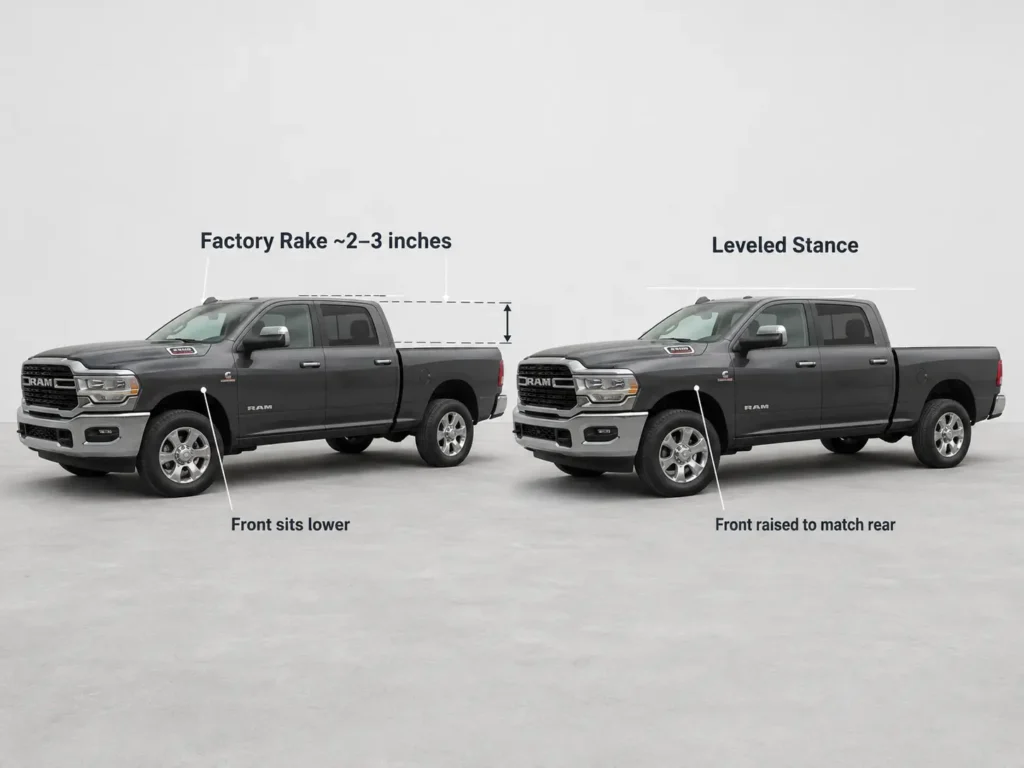
Ram engineers build roughly 2 to 3 inches of front-to-rear rake into the 2500 on purpose. Owner measurements across multiple trim levels and model years consistently show the front fender sitting 2 to 3 inches lower than the rear when measured from the ground to the bottom of the wheel well — with some 4×4 Crew Cab configurations measuring closer to 3 inches of differential.
This design decision exists for one reason: payload and tow capacity. When you load the bed or hook up a trailer, that rake compresses the rear suspension and the truck settles into a near-level stance. It also keeps your headlights aimed at the road rather than the sky when you’re towing heavy.
The problem is obvious when the truck is empty. As you can see in the annotated image above, the front sits noticeably lower than the rear even on a perfectly level surface — the roofline tilts forward and the stance looks unbalanced.
A leveling kit corrects this — but the results look different depending on which kit size you choose.
What a Ram 2500 Looks Like Before and After a Leveling Kit
This is the before and after most Ram 2500 owners are searching for. The stock truck shows a pronounced nose-down rake — the front wheel arch sits measurably lower than the rear. After a 2 to 2.5-inch leveling kit, the front end rises to match the rear, the roofline becomes parallel to the ground, and the overall stance shifts from nose-heavy to commanding.
The image above shows the key changes with annotations: the front fender gap increases by the kit’s lift height, the rake gap is eliminated, and the truck’s profile reads as level to the eye. On stock tires, the transformation is clean and understated. Pair the level with a set of 35-inch tires and the truck takes on a completely different character — taller, more proportional, and aggressive without the exaggerated look of a full lift kit.
Notice in the annotated comparison that the rear height stays essentially unchanged. A leveling kit only raises the front — the rear leaf springs remain at factory height. The parallel stance you see comes entirely from correcting the front end, not from lifting the whole truck.
How Much Lift Each Kit Size Actually Adds
Best for: Tow-focused owners
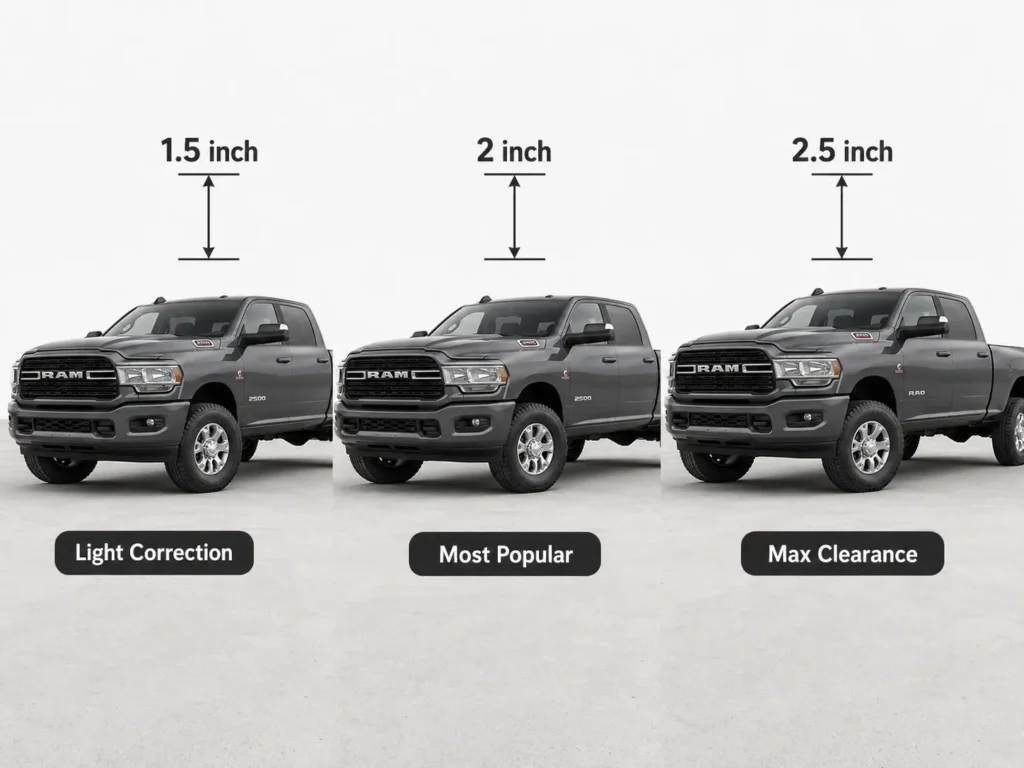
Light correction
Best for: Daily drivers



Balanced choice
Best for: Tire upgraders
Max clearance
The image above shows three Ram 2500 front ends at 1.5, 2, and 2.5 inches of lift with measurement arrows at the wheel arch. The visual difference between 1.5 and 2 inches is smaller than most people expect — but the jump from 2 to 2.5 inches is where the stance becomes noticeably more aggressive and tire options expand meaningfully.
1.5-Inch Kits
A 1.5-inch level is the conservative choice. It removes most of the factory rake on trucks with a 2-inch differential and leaves a slight rear-high stance that still reads as level to the eye. This is the right call if you tow regularly and want to preserve some rake reserve when loaded. ReadyLift’s coil spring leveling kit for the 2019–2025 Ram 2500 4WD runs in this range and is rated for up to a 35×12.50 tire on stock wheels.
2-Inch Kits
The 2-inch level is the most popular size. It fully corrects the factory rake on most Ram 2500 trucks and produces the clean, parallel stance you see in most before/after photos. At this height, you can run up to a 35×11.50 tire without rubbing on stock wheels and offset. Owners running a 2-inch level with 285/65R20 Nitto Ridge Grapplers on stock 20×9 wheels consistently report zero rubbing issues.
2.5-Inch Kits
The 2.5-inch level is the most aggressive leveling option and the most commonly chosen kit for owners who want to run 35s with confidence. Rough Country’s 2.5-inch kit for the Ram 2500 and 3500 4WD (2014–2026) includes coil spring spacers and shock extension brackets that reuse factory shocks at the correct geometry. At 2.5 inches, a few trucks will measure slightly nose-high — this is normal and visually undetectable in most cases.
What Tire Sizes Fit a Leveled Ram 2500 Without Trimming
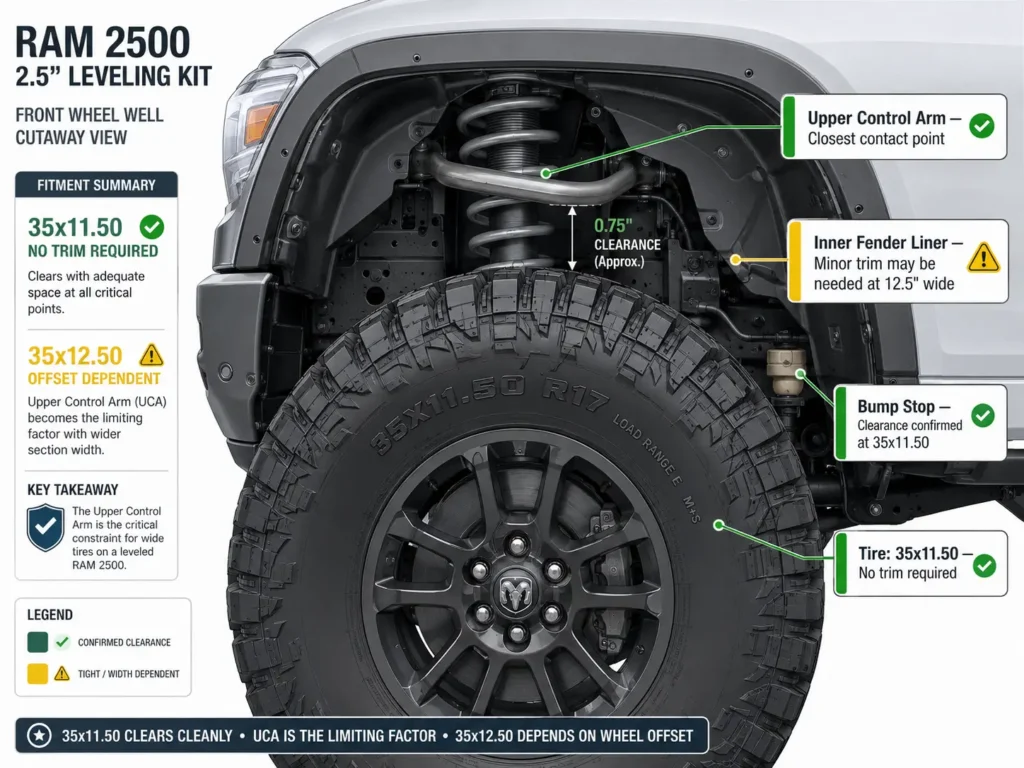
The wheel well image above shows the critical clearance points on a leveled Ram 2500: the upper control arm, the inner fender liner, and the bump stop. These three points determine whether a tire clears cleanly or requires trimming.
The table below shows confirmed fitment by lift height on the Ram 2500 4WD on stock wheels with close-to-factory offset:
| Lift Height | Max Tire (No Trim) | Notes |
|---|---|---|
| Stock | 33″ / 285/65R20 | Factory clearance only |
| 1.5″ | 35×12.50 | Confirmed by ReadyLift on stock 20×9 wheels |
| 2″ | 35×11.50 / 285/65R20 | 35×12.50 may contact UCA at full lock |
| 2.5″ | 35×11.50 confirmed / 35×12.50 possible | Width is the variable — 12.50 will be tight at UCA |
A few things to know about these numbers. First, tire width is the biggest variable — a 35×11.50 clears reliably where a 35×12.50 will be within a finger-width of the upper control arm at 2.5 inches. Second, wheel offset matters. A wheel with a +18 to +19mm offset on a 9-inch-wide rim provides more inner clearance than a zero-offset wheel. If you’re pairing a leveling kit with new wheels, factor offset into your fitment plan. Third, owners running the Ram 2500 off-road package may have slightly different factory geometry — confirm your specific suspension configuration before ordering.
What Changes After You Install a Ram 2500 Leveling Kit
The suspension geometry diagram above shows exactly why alignment is not optional after leveling. When the front end rises 2 to 2.5 inches, the caster angle changes — the front wheels tip backward relative to vertical. Without correcting this through alignment, the truck will pull, tire wear accelerates on the inner edge, and steering feel degrades within weeks.
Here is what needs to happen after install, in order:
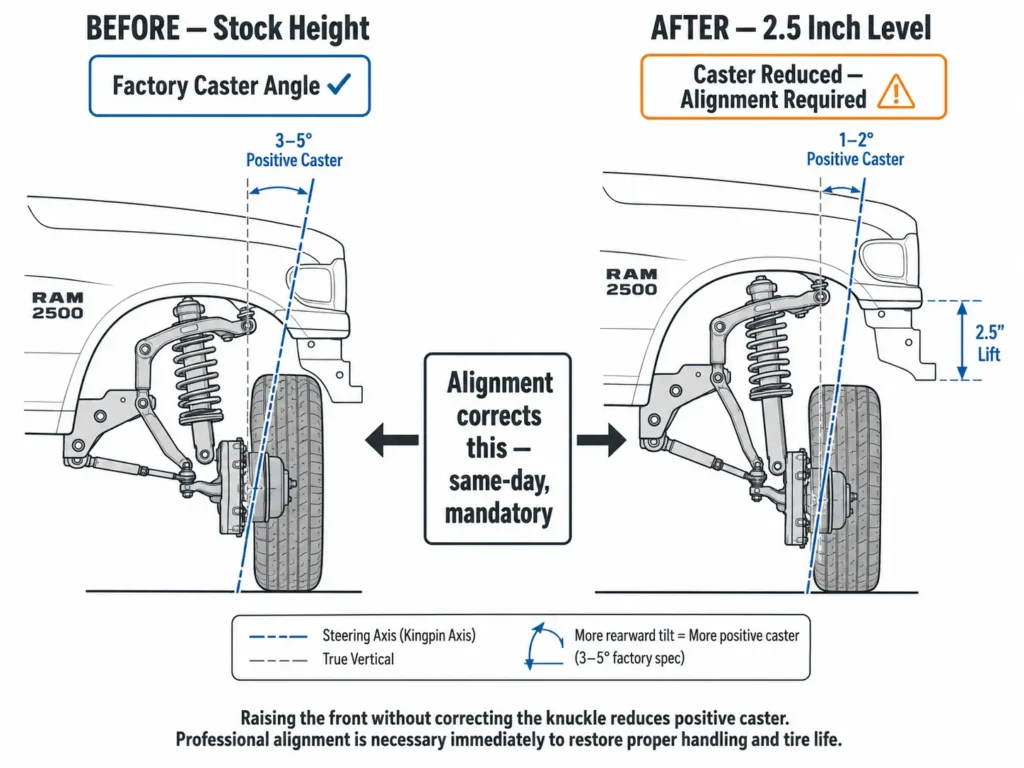
- Alignment — mandatory, same day. A professional front-end alignment corrects the caster angle change. Budget $100–$150 at a shop. Do not drive more than a few miles before getting this done.
- Shock check — important at 2.5 inches. Stock shocks work reliably at 1.5 to 2 inches. At 2.5 inches, the factory shocks are at or near the limit of their travel range. Many owners upgrade at the same time — see our guide to the best shocks for Ram 2500 for confirmed drop-in options.
- Lug nut re-torque after 50–100 miles. Any time wheels are removed and reinstalled, re-torque is required after the first drive cycle. Check the correct spec for your trim in our Ram 2500 wheel torque specs guide.
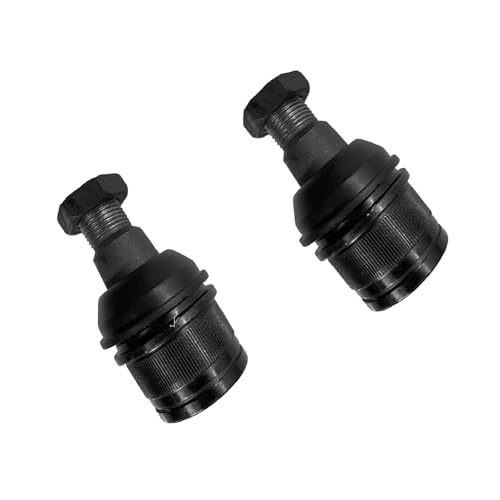
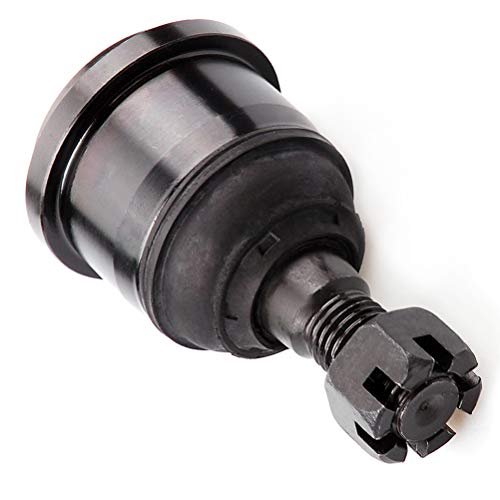
- Ball joint inspection at 6 months. Leveling changes the CV and ball joint operating angle on 4WD trucks. It’s not dangerous at leveling kit heights, but it does add stress. Check for play and wear at your first oil change after leveling. See Ram 2500 4×4 ball joint replacement cost if you find wear earlier than expected.
- ADAS recalibration if equipped. If your Ram 2500 has front-facing radar or camera-based safety systems, the height change may require recalibration at a dealer.


Mandatory / Urgent
Important
Routine Check
Ram 2500 Leveling Kit Cost Breakdown by Kit Type
Most Ram 2500 owners budget for the kit and forget the alignment — here is the actual all-in cost by kit type.
Spacer-Style Kits
Spacer kits are the most affordable entry point. They sit on top of the factory coil spring and add lift without replacing any suspension components. Rough Country’s 2.5-inch spacer kit for the Ram 2500 4WD retails around $80–$130. Readylift’s 1.75-inch powder-coated steel spacer kit runs in a similar range. These kits install in roughly 2–3 hours at a shop.
Coil Spring Replacement Kits
Coil spring replacement kits swap out the factory springs entirely. They cost more but deliver better ride quality than spacers because the spring rate is tuned for the new ride height. ReadyLift’s 1.5-inch coil spring kit with Falcon 1.1 monotube shocks for the Ram 2500 Diesel 4WD runs around $600–$700 as a complete package. BDS Suspension’s 2-inch kit with NX2 Nitro shocks retails at approximately $994. Thuren Fabrication’s Bilstein 5100 front leveling kit for the 2014–2026 Ram 2500 4×4 runs around $980.
| Cost Item | Spacer Kit | Coil Spring Kit |
|---|---|---|
| Kit (parts) | $80–$150 | $600–$1,000 |
| Shop labor | $100–$200 | $200–$350 |
| Alignment | $100–$150 | $100–$150 |
| Total estimate | $280–$500 | $900–$1,500 |
If you upgrade shocks at the same time as a 2.5-inch spacer kit — which is recommended — add $200–$400 for a quality set of front shocks, bringing the all-in total for a complete spacer + shock upgrade to roughly $500–$900.
Frequently Asked Questions
How much does it cost to level a Ram 2500?
A spacer-style leveling kit runs $280–$500 all-in including parts, shop labor, and alignment. A coil spring replacement kit with upgraded shocks runs $900–$1,500. DIY installs drop the labor cost but alignment is still required at a shop.
Will a leveling kit hurt my Ram 2500’s towing capacity?
No — a leveling kit does not reduce your Ram 2500’s rated towing capacity. What it does reduce is the rake reserve you have when the trailer pushes the rear down. If you tow heavy regularly, a 1.5-inch level is a smarter choice than 2.5 inches because it preserves more of the factory rake buffer.
Do I need new shocks after leveling my Ram 2500?
At 1.5 to 2 inches, factory shocks typically work fine. At 2.5 inches, stock shocks are at or near their travel limit — upgrading at the same time is strongly recommended. See our guide to the best shocks for Ram 2500 for specific fitment options.



What is the best leveling kit for a Ram 2500?
For budget-focused owners, Rough Country’s 2.5-inch spacer kit ($80–$130) is reliable and widely installed. For ride quality, ReadyLift’s coil spring kits and BDS’s 2-inch kit with NX2 shocks both outperform spacer options noticeably. If you want the highest-quality result and plan to run the truck hard, the Thuren Bilstein 5100 kit or Carli Spec Leveling System are the benchmark choices.
Do I need an alignment after a Ram 2500 leveling kit?
Yes, always. The caster angle changes the moment the front end rises. Skipping alignment after leveling causes premature inner tire wear and steering pull that gets worse over time — not better.
Conclusion
The Ram 2500 leveling kit before and after difference is most visible at 2 to 2.5 inches — that is the range where the factory rake is fully corrected, the stance looks intentional, and 35-inch tires become achievable without cutting. A spacer kit gets you there for $280–$500 all-in. A coil spring kit with upgraded shocks runs $900–$1,500 and delivers noticeably better ride quality in return.
Once you know which kit size fits your goal, plan the alignment on the same day as the install and check your shock travel if you’re going 2.5 inches. For the next step, our guide to the best shocks for Ram 2500 covers the confirmed drop-in upgrades that pair best with each leveling kit size.
![Ram 2500 Cab Light Bulb Guide: Sizes & LED Upgrades [2026]](https://truckguider.com/wp-content/uploads/2026/03/ram-2500-cab-lights-bulb-featured.webp)