
Dodge Ram Blend Door Recall & Failure Analysis: The Definitive Engineering Report (2002–2026)

The Dodge Ram—now simply “Ram”—stands as a paragon of American heavy-duty engineering, renowned for its Cummins turbodiesel powertrains and towing capabilities. However, beneath the rugged exterior lies a fragile component ecosystem that has plagued owners for over two decades: the Heating, Ventilation, and Air Conditioning (HVAC) distribution box.
Specifically, the failure of the “blend door”—the internal flap responsible for regulating air temperature by mixing hot and cold airstreams—has become a defining characteristic of the platform, spanning the 3rd, 4th, and 5th generations of the truck.


For the owner of a Ram 1500, 2500, or 3500, the symptoms are often sudden and confusing: a rhythmic “clicking” noise from the dashboard resembling a playing card in bicycle spokes, a sudden loss of cabin heat on the driver’s side while the passenger roasts, or a complete cessation of airflow despite the blower motor screaming at maximum revolutions.
These symptoms trigger a search for a “recall,” a term that carries specific legal weight but is often misunderstood in the context of mechanical attrition.
This report serves as a definitive technical dossier on the subject. It moves beyond the superficial advice found in forums to provide an exhaustive engineering analysis of why these components fail, the specific physics of the defect, the regulatory landscape enforced by the National Highway Traffic Safety Administration (NHTSA), and the metallurgical solutions developed by the aftermarket.
We will dissect the difference between a federally mandated safety recall and a Technical Service Bulletin (TSB), explain the chemistry of heater core clogging that mimics blend door failure, and provide a step-by-step narrative of the remediation options available to the consumer.
The Definition of the Problem Space
The term “blend door recall” is frequently searched but technically inaccurate for the vast majority of cases. While specific recalls exist for software anomalies affecting defrosting capabilities, the widespread physical breakage of plastic doors and the stripping of actuator gears are largely classified by Fiat Chrysler Automobiles (FCA), now Stellantis, as non-warranty wear items once the standard coverage expires. This classification has birthed a massive aftermarket industry dedicated to redesigning the Ram HVAC box using aerospace-grade aluminum and steel, fundamentally re-engineering the system to correct the original design limitations.
To understand the solution, one must first understand the architecture. The Ram HVAC plenum is a “clamshell” plastic housing containing the heater core (fluid dynamics), the evaporator core (thermodynamics), and a series of air distribution doors (aerodynamics). These doors are operated by DC servo motors, or actuators, which rely on plastic gear reduction systems. The catastrophic failure occurs at the intersection of these materials: the high torque of the electric motor overcomes the structural integrity of the injection-molded plastic stops, leading to a cascade of mechanical failures that render the climate control system useless.
Scope of Analysis
This report covers the following vehicle platforms:
- 3rd Generation Ram (2002–2008): Characterized by the breakage of the “clamshell” door axles and the recirculation door falling into the blower fan.
- 4th Generation Ram (2009–2018/2023 Classic): Characterized by actuator gear stripping (“The Click of Death”) and heater core sediment issues.
- 5th Generation Ram (2019–Present): Characterized by software integration issues, Over-the-Air (OTA) update glitches, and new housing designs.
Dodge Ram Blend Door Analysis
The definitive guide to the “Click of Death,” Recalls, and Repair Costs.
Is It Just You? The Context
If you own a Dodge Ram (specifically 2002-2008 or 2009-2018 models) and hear a rhythmic clicking noise behind your dashboard, or if your heater blows cold air while the engine is warm, you are experiencing the infamous Blend Door Actuator Failure.
Contrary to popular belief, while there have been software updates (Recalls) to calibrate these motors, the physical breakage of the plastic gears or the doors themselves is often considered a “wear and tear” item by the manufacturer, leading to frustration among owners. After any actuator replacement, run the relearn described in our Dodge Ram climate control reset guide.
Complaint Volume by Model Year
Analysis of NHTSA complaints and forum activity reveals specific “danger zones” for HVAC failures. The 4th Generation Ram trucks saw a spike in actuator issues.
The Failure Chain
Why does this happen? It is a cascading failure starting with software calibration and ending with physical breakage.
Calibration Error
Computer tells motor to move too far.
Over-Torque
Actuator forces plastic gears against the stop.
Physical Snap
Plastic gear strips teeth OR the door hinge snaps.
Common Symptoms
Not all blend door failures sound the same. The “Mode Door” failure differs from the “Blend Door” failure.
- Tapping: Actuator gears slipping.
- Temp Mismatch: Passenger hot / Driver cold.
Repair Cost Comparison
The “Official” repair requires removing the entire dashboard to access the HVAC box. DIY solutions involve cutting into the HVAC box behind the glove compartment (The “Hack” method) or using specialized tools.
Recall Status Reality
Users often search for a recall, but most solutions are Technical Service Bulletins (TSBs).
Part Quality Hierarchy
Not all replacement actuators are created equal. Ranking based on community longevity reports.
The Verdict
While no universal safety recall exists for the blend door hardware itself, knowing the difference between a simple actuator swap (DIY) and a broken door (Dashboard Pull) is critical for your wallet. If you hear the clicking, pull the actuator fuse immediately to save the door!
© 2026 TruckGuider Infographics
The Engineering Anatomy of the Ram HVAC System
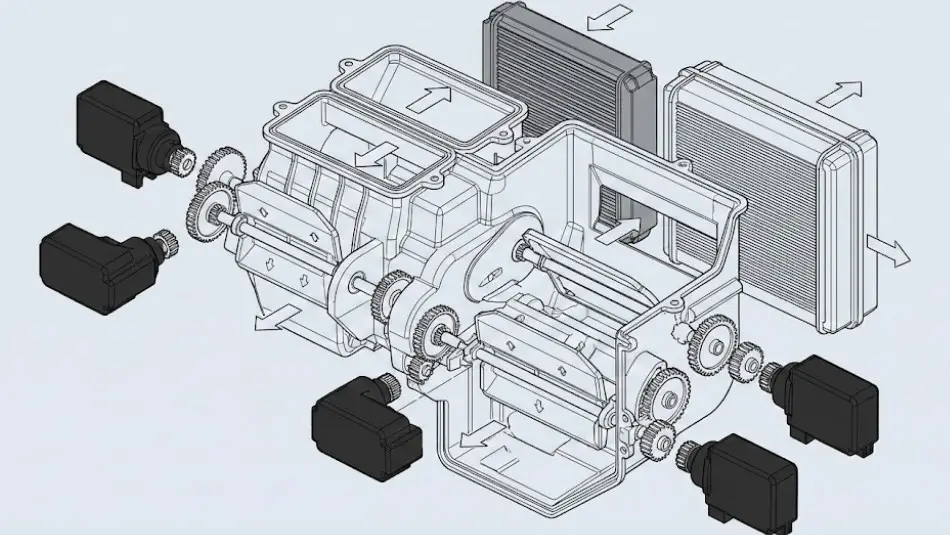
To diagnose a failure accurately, it is essential to visualize the internal mechanics of the system. The HVAC box is the “heart” of the truck’s comfort system, typically mounted behind the dashboard against the firewall. It is a complex assembly of fluid exchangers and air diverters.
The Actuation Logic: DC Motors and Feedback Loops
Unlike older vehicles that used vacuum lines to move vent doors (a binary open/closed system dependent on engine manifold pressure), modern Ram trucks utilize electromechanical actuators. These are small, black plastic boxes containing a DC electric motor, a worm gear drive, and a position sensor (potentiometer).



When a driver adjusts the temperature knob, the HVAC control module sends a voltage signal to the actuator motor. The motor spins, driving a gear reduction set that turns the output shaft. This shaft is connected to the blend door. As the door moves, the internal potentiometer changes resistance, sending a voltage feedback signal to the computer indicating the door’s exact position (e.g., 50% open).
The Calibration Flaw: The root of the systemic failure lies in the calibration logic. Upon vehicle startup or battery reconnection, the HVAC computer initiates a “calibration sweep” or “span check.” It drives the door to the full-open position until it hits a physical stop, and then to the full-closed position until it hits the opposite stop. The computer monitors the current draw of the motor. When the door hits the physical stop, the motor stalls, current spikes, and the computer records this position as the limit.
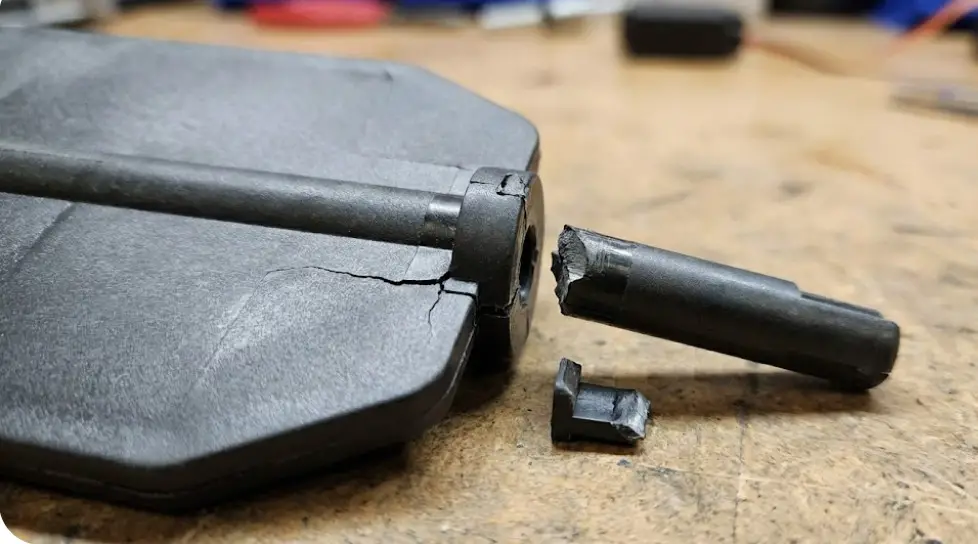
The engineering oversight in the Ram application is the disparity between the motor’s stall torque and the material strength of the stop. The stops are small plastic tabs molded into the HVAC housing or the door itself. Over thousands of cycles, the impact of the motor hitting the stop causes fatigue. Eventually, the plastic stop shears off.
Once the stop is missing, the computer does not know where the limit is. On the next calibration sweep, it drives the door past the intended stopping point. This over-rotation twists the door axle or the actuator interface until the plastic fractures. In the case of the recirculation door, this over-rotation disconnects the door from the pivot entirely, allowing gravity to pull it down into the blower fan cage.
The Door Architecture: Material Science
The doors themselves are constructed from injection-molded polymers, typically ABS (Acrylonitrile Butadiene Styrene) or a glass-filled nylon blend. While these materials are lightweight and cost-effective, they are susceptible to thermal degradation. The HVAC box is a hostile environment; the blend door sits immediately adjacent to the heater core, which circulates engine coolant at temperatures exceeding 200°F (93°C), and the evaporator, which can drop to near freezing.
This constant thermal cycling (expansion and contraction) makes the plastic brittle over time. In the 3rd Generation Ram, the specific design of the “interposer”—the connector between the motor and the door—was prone to cracking. In the 4th Generation, the weakness shifted to the internal gears of the actuator itself, which would strip their teeth when meeting resistance.
The Flow Dynamics: Single vs. Dual Zone
Ram trucks are equipped with either Single Zone (manual) or Dual Zone (automatic) climate control. This distinction is critical for diagnostics.
- Single Zone: Uses one long blend door (or two connected doors) driven by a single actuator. Failure results in a total loss of temperature control for the entire cabin.
- Dual Zone: Uses a partitioned heater box with two independent blend doors and two actuators. This allows the driver and passenger to select different temperatures. The failure of a single actuator in this system results in the classic “one side hot, one side cold” symptom, often mimicking a clogged heater core.
Table 2.1: Component Failure Modes by Generation
| Generation | Component Focus | Primary Failure Mechanism | Acoustic Symptom | Functional Symptom |
| 3rd Gen (2002-2008) | Blend Door Axle / Recirc Door | Plastic Fatigue / Stop Breakage | “Thump” or “Helicopter” noise | Loss of airflow; recirc door falls into fan. |
| 4th Gen (2009-2018) | Actuator Gears | Gear Stripping | Rhythmic “Clicking” or “Tapping” | Stuck temp; clicking lasts 20s after start. |
| 5th Gen (2019+) | Software / Module | Logic Glitch / Calibration | Silent | Unresponsive controls; defrost failure. |
Regulatory Review: Recalls vs. TSBs
A major source of confusion for consumers is the distinction between a “Safety Recall” and a “Technical Service Bulletin” (TSB). This distinction determines who pays for the repair: the manufacturer or the owner.
The Safety Recall Mandate
A safety recall is issued when a vehicle fails to conform to Federal Motor Vehicle Safety Standards (FMVSS) or poses an unreasonable risk to safety. The National Highway Traffic Safety Administration (NHTSA) enforces these recalls. In the context of HVAC systems, the primary safety concern is visibility. FMVSS No. 103, “Windshield Defrosting and Defogging Systems,” mandates that a vehicle must be able to clear a specific percentage of the windshield within a set time under test conditions.
If a blend door failure prevents the windshield from defrosting, it becomes a safety issue. However, if the failure simply prevents the cabin from getting cold (A/C failure) or getting hot (comfort issue), it is generally not considered a safety defect by NHTSA standards, regardless of the discomfort to the driver.
Case Study: Recall 21V-871 (Sales Code Y88) In 2021, FCA US LLC issued a recall for over 170,000 Ram 1500 trucks (2022 model year). The defect was identified as a software error in the HVAC control module that could prevent the defrosting system from functioning. Because this directly violated FMVSS 103, a mandatory recall was issued. The remedy was a software update to the control module. This highlights that while mechanical failures (broken doors) are often ignored by regulators, software failures that impact safety compliance are strictly policed.
Case Study: Customer Satisfaction Notification R62 For the 2014-2015 model years (specifically minivans, but utilizing shared architecture), FCA issued a “Customer Satisfaction Notification.” This is slightly different from a safety recall. The issue was that the right-side blend door actuator could bind, leading to loss of temperature control. The remedy involved reprogramming the HVAC module with new software to detect binding and “pulse” the motor differently to avoid breakage. While not a safety recall, it acknowledged the design flaw in the actuator calibration logic.
Technical Service Bulletins (TSBs)
For the vast majority of Ram blend door issues, the manufacturer communicates with dealerships via TSBs. These are instructions on how to diagnose and repair known issues, but they do not imply free repair for out-of-warranty vehicles.
TSB 24-004-03 (3rd Gen Defrost Door) This bulletin addressed the 2003 Ram Truck’s “Defrost Door Inoperative” condition. The symptom was the defrost door breaking at the pivot shaft. The repair required removing the instrument panel and replacing the lower half of the HVAC housing and the door. The existence of this TSB proves that Dodge was aware of the structural weakness of the door pivots as early as 2003, yet the design persisted through the generation.
TSB 24-001-20 (5th Gen Housing Redesign) This bulletin for 2019-2020 Ram trucks informs technicians of an “HVAC housing redesign.” It states that when servicing the housing, multiple components must be replaced together because the internal geometry was changed. This suggests that FCA engineers were actively iterating on the internal airflow dynamics and component fitment to address performance complaints, such as the left center outlet being warmer than the right center outlet.
The Consumer’s Burden
Because most blend door failures occur after the 3-year/36,000-mile bumper-to-bumper warranty expires, and because they do not always trigger a safety recall (unless defrost is lost), the cost of repair typically falls on the owner. This economic pressure is what drives the market for “cheat” fixes like the Heater Treater cut method, which avoids the $1,500+ labor cost of a dealership repair.
Chronological Analysis of Failure Modes
The “Ram Blend Door” issue is not a monolith; it has evolved over three generations of trucks. Diagnosing the problem requires knowing the specific year and generation, as the failure mechanisms differ significantly.
3rd Generation (2002–2008): The Structural Collapse
The 3rd Gen Ram 1500/2500/3500 is the most notorious for catastrophic internal damage. The HVAC box in these trucks uses a “clamshell” arrangement where the doors are large and heavy.
The Recirculation Door Failure:
This is often the first component to fail. The recirculation door is positioned horizontally above the blower motor. It pivots on a plastic axle. When the stop breaks, the actuator pushes the door too far, snapping the pivot.
- Consequence: Gravity takes over. The door falls downward, landing directly on the squirrel-cage fan of the blower motor.
- Symptoms:
- A massive reduction in airflow velocity.
- A loud, terrifying vibration or “thumping” sound as the fan blades hit the fallen door.
- In some cases, the door blocks the air intake completely, resulting in zero airflow despite the fan spinning.
The Blend Door Failure:
The blend door controls the temperature. In the 3rd Gen, the connection between the actuator and the door (the “coupler” or “interposer”) is a common failure point. The coupler is plastic. When it cracks, the motor shaft spins inside the coupler without moving the door.
- Symptoms:
- The temperature is stuck on one setting (usually whatever it was when it broke).
- The actuator motor can be heard whining or spinning, but the temperature does not change.
- In dual-zone trucks, the “common shaft” connecting the two doors can shear, causing the passenger side to lose control while the driver side works (or vice versa).
4th Generation (2009–2018): The Era of Stripped Gears
With the 2009 redesign, the HVAC box became more compact, but the actuators remained the weak link. The 4th Gen introduced the widespread phenomenon of the “Clicking Actuator.”
The Mechanism of the “Click”:


The 4th Gen actuators use a series of internal nylon gears to step down the high speed of the electric motor to the low speed required to move the door. When the door meets resistance (sticky seals or a physical obstruction), the torque shears the teeth off one of the gears.
- The Sound: The motor spins, the gear catches a few remaining teeth, moves the door slightly, then slips where the teeth are missing. This snap-back creates a loud, rhythmic click-click-click sound.
- Duration: This usually happens for 10-20 seconds after the truck is started or after the door is adjusted, as the system tries to calibrate position and fails.
Heater Core Contamination (The False Positive):
A major confounding factor in 4th Gen diagnostics is the “casting sand” issue. In early 4th Gen trucks (2009-2012), residual sand from the engine block casting process would circulate through the coolant and settle in the heater core.
- The “Pseudo-Blend Door” Symptom: The heater core in the Ram is wide. The inlet and outlet pipes are on the passenger side. As sludge fills the bottom of the core, flow is restricted to the side closest to the pipes (passenger side). The far side (driver side) gets no hot coolant.
- Result: The driver’s vents blow cold air, while the passenger’s vents blow hot air.
- Misdiagnosis: Mechanics often assume this is a broken blend door actuator (Dual Zone failure). However, if the actuators are moving correctly, this is a fluid dynamics problem, not an aerodynamics problem. The fix is flushing or replacing the heater core, not the blend door.
5th Generation (2019–Present): The Digital Disconnect
The 5th Generation introduced a massive technological leap with the 12-inch Uconnect infotainment system. The HVAC controls are now largely digital, integrated into the touchscreen.
Software-Induced Failure:
Issues in the 5th Gen are often “ghost” failures. The blend doors and actuators are mechanically sound, but the control module loses communication or calibration.
- Symptoms: The screen shows the A/C is on “LO,” but the vents blow hot air. The physical buttons on the bezel may stop responding.
- The Fix: Often requires an OTA update or a “hard reset” (battery disconnect) to reboot the BCM (Body Control Module). Mechanical failures are appearing as these trucks age, but the initial wave of complaints was largely software-centric.
Diagnostic Compendium: A Systematic Approach
Accurate diagnosis is the most critical step in resolving Ram HVAC issues. A misdiagnosis can lead to tearing out the dashboard ($1,000 labor) to replace a $40 door, only to find the problem was a $20 clogged hose.
The Sensory Diagnostic Protocol
We can categorize diagnostics by the sensory input they provide: Audio, Thermal, and Tactile.
A. Audio Diagnostics (Listen)
- Rhythmic Clicking (Fast): Indicates a stripped actuator gear (4th Gen).
- Location: Listen to where the click comes from. Glovebox area = Recirculation or Passenger Blend. Center floor = Driver Blend. Driver knee = Mode Door.
- Loud Thumping/Vibration: Indicates the Recirculation Door has fallen into the blower fan (3rd Gen). The sound changes with fan speed.
- Whining/Whirring: Indicates an actuator motor spinning freely (broken coupler) without moving the door.
B. Thermal Diagnostics (Feel)
- Driver Cold / Passenger Hot (Heat Mode):
- Test: Check the actuators. If they are moving, check the heater hoses under the hood.
- Result: If one heater hose is hot and the other is lukewarm, the heater core is clogged. This is not a blend door failure.
- Result: If both hoses are hot, it is likely a Blend Door failure (Driver side actuator or door).
- No Heat on Either Side:
- Test: Check coolant level. Low coolant prevents the heater core from filling. Check the thermostat.
- A/C Blows Warm:
- Test: Check the compressor clutch engagement. If the compressor is cycling, check the blend door. If the blend door is stuck in the “Hot” position, it will override the A/C. Clamping off the heater hoses (temporarily) can prove this—if the A/C gets cold after clamping the heater hoses, the blend door is leaking heat.
The “Calibration Reset” Procedure
Before replacing parts, attempt a calibration reset. This forces the computer to re-learn the door positions.
Method 1: The Battery Reset (Manual)
- Disconnect both negative battery terminals (if dual battery) or the single negative terminal.
- Wait 30 minutes. This drains the capacitors in the control modules.
- Reconnect the battery.
- Turn the ignition to “RUN” (do not start engine).
- Do not touch any HVAC controls. Listen. You will hear the motors whirring and clicking as they travel from stop to stop.
- Wait 2 minutes or until the noise ceases.
- Test the system. If the clicking returns immediately, the part is physically broken.
Method 2: The Scan Tool Reset (Pro)
Using a tool like AlfaOBD, wiTech, or a high-end Autel:
- Connect to the OBDII port.
- Select “HVAC” Control Module.
- Select “Actuator Calibration” or “System Test.”
- The tool will report specific fault codes (DTCs).
- B112A: Steering Wheel Heater (Ignore).
- B1081: Left Temp Door Control Circuit Open (Actuator Electrical Failure).
- B1129: Control Stalled (Mechanical Jam/Broken Door).
Table 5.1: Diagnostic Trouble Codes (DTC) for Ram HVAC
| DTC Code | Description | Probable Cause | Action |
| B1058 | Recirculation Door Control – Stalled | Broken door wedged in box | Remove/Replace Door |
| B1129 | Right Temp Door Control – Stalled | Passenger Actuator Jammed | Replace Actuator |
| B112A | Steering Wheel Heater | Common False Positive | Ignore if unrelated |
| B1081 | Left Temp Door Control – Circuit Open | Dead Motor / Unplugged | Check Wiring / Replace Actuator |
| P0128 | Thermostat Rationality | Thermostat stuck open | Replace Thermostat (affects heat) |
Remediation and Repair Engineering
Once the failure is confirmed, the owner faces a divergence in repair paths: the “Official” method (Dash Pull) or the “Bypass” method (Cut).
The “Dash Pull” Method (OEM / Blend Door USA)
This is the only way to perform a “factory-correct” repair. It involves removing the entire dashboard to access the HVAC plenum.
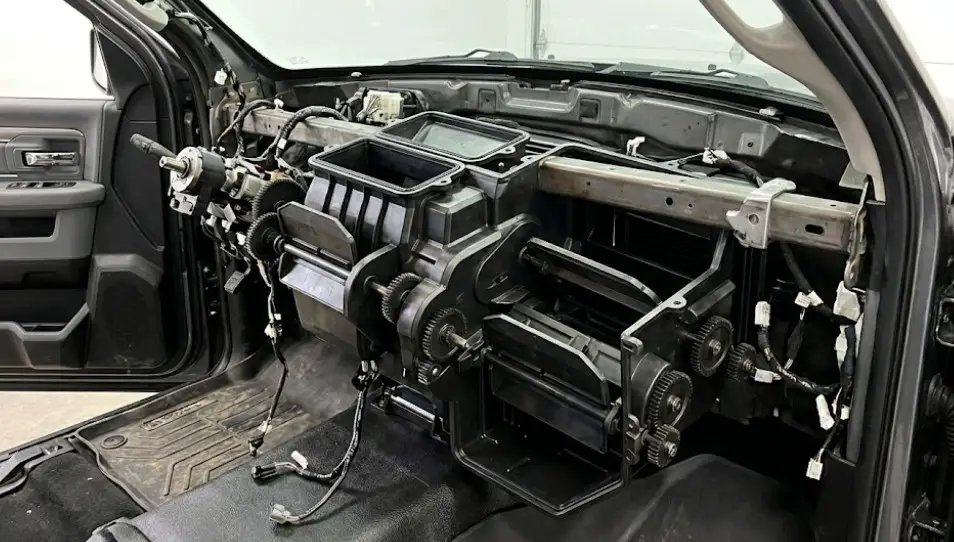
The Workflow:
- Evacuate A/C: A certified shop must remove the R134a or R1234yf refrigerant.
- Coolant Drain: Drain the engine coolant to prevent spilling when disconnecting heater hoses.
- Dash Removal:
- Remove center console (if equipped).
- Remove radio bezel and cluster bezel.
- Drop the steering column (4 bolts).
- Remove the “A” pillar grab handles.
- Remove the top dash bolts (near the windshield, under the defrost grille).
- Pivot the dash frame backward.
- Box Removal: Unbolt the HVAC box from the firewall and pull it into the cabin.
- Bench Repair: Split the box. This is the moment to upgrade.
- OEM Parts: Plastic doors. Prone to breaking again.
- Blend Door USA Parts: Solid aluminum doors. CNC machined. These use a metal splined shaft that engages the actuator positively, eliminating the plastic stress point.
- Heater Core/Evaporator: Always replace these while the box is out.
- Reassembly: Reverse the process. Crucial: Ensure all ground straps are reconnected to prevent “Ghost Electrical” issues.
Pros: Complete repair. Fixes everything (core, evap, doors). Aluminum parts are a permanent lifetime fix.
Cons: Extremely labor intensive (8-14 hours). High cost ($1,500-$2,500). Risk of squeaks/rattles if dash is not reseated perfectly.
The “Heater Treater” Cut Method
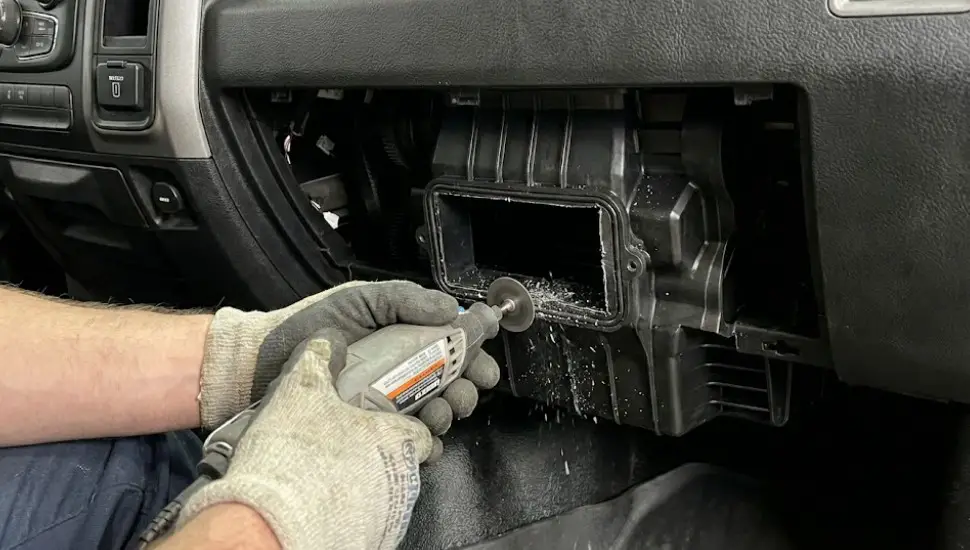
Developed as a workaround for the high labor costs, this method involves cutting into the HVAC box while it is still in the truck.
The Workflow:
- Access: Remove the glove box.
- Template: Place the provided template on the side of the plastic plenum (specific location depends on which door is broken).
- The Cut: Use a Dremel with a rotary cutting bit. Cut a window in the plastic housing.
- Warning: Careful depth control is needed to avoid cutting the evaporator core inside.
- Extraction: Pull the broken plastic door out through the window.
- Installation: Insert the new Steel door. The Heater Treater doors often use a specific “axle” design that allows them to be slipped into the pivot point from the side.
- Connection: A steel “interposer” connects the actuator to the new door, replacing the weak plastic coupler.
- Sealing: Use aluminum HVAC tape (foil tape) to seal the plastic window cut out in step 3.
Pros: Fast (1-2 hours). Cheap ($150-$250). DIY friendly. Cons: Compromises the structural integrity of the air box. If the tape fails, you have an air leak behind the dash. You cannot clean debris out of the box easily. It feels “hacky” to some owners.
Material Analysis: Aluminum vs. Steel vs. Plastic
| Material | Application | Tensile Strength | Thermal Stability | Verdict |
| OEM Plastic (ABS/Nylon) | Stock Doors | Low | Poor (Brittles with heat) | Guaranteed to fail eventually. |
| Stamped Steel (Heater Treater) | Cut Method Kits | High | High | Good for low-cost repairs. Heavy. |
| CNC Aluminum (Blend Door USA) | Dash Pull Kits | Very High | Excellent | The “Gold Standard.” Lightweight, rigid, permanent. |
The Economics of Repair: Cost-Benefit Analysis
Owners must weigh the repair cost against the vehicle’s residual value.


Dealership Repair
- Cost: $1,800 – $2,500.
- Warranty: 12 Months / 12,000 Miles.
- Parts: OEM Plastic.
- Risk: The new parts are the same design as the old ones. They will break again in 5-8 years.
Independent Shop (With Aftermarket Parts)
- Cost: $1,000 – $1,500.
- Strategy: Ask the shop to install “Blend Door USA” aluminum doors. Most shops will agree if you waive the parts warranty (since they didn’t supply them).
- Benefit: You pay the labor once, but the metal parts ensure you never pay it again.
DIY Repair
- Cost (Cut Method): $200.
- Cost (Dash Pull): $400 (Parts + Fluids).
- Value Proposition: For a 2005 Ram 1500 worth $6,000, spending $2,000 at a dealer is irrational. The Cut Method is the economically rational choice for aging work trucks. For a pristine 2016 Ram 2500 Cummins worth $40,000, the Dash Pull with aluminum parts maintains the vehicle’s value and integrity.
Critical Questions for the Consumer (FAQ)
Q1: Will Dodge cover this under a “Secret Warranty”?
Answer: Generally, no. Unless your specific VIN is covered by a limited campaign like the R62 (minivans) or the Defrost recall (2022), this is considered a wear item. Do not expect “Goodwill” repair on a 10-year-old truck.
Q2: Can I drive the truck with a broken blend door?
Answer: Yes, mechanically the engine is fine. However, safety is compromised. If you cannot defrost the windshield in winter, it is dangerous and illegal. If the recirculation door falls into the fan, use the system sparingly to avoid burning out the blower motor resistor due to stalled airflow.
Q3: Why does my A/C smell like maple syrup?
Answer: This is a leaking heater core, not a blend door. The smell is antifreeze. This requires the “Dash Pull” repair.
Q4: I replaced the actuator and it still clicks. Why?
Answer: You likely didn’t calibrate it. Or, the door itself is physically jammed/broken inside the box. If the door cannot move, the new actuator will strip its gears immediately trying to force it. Always check the door’s range of motion by hand before installing the new actuator.
Q5: Are the cheap actuators on Amazon ($20) worth it?
Answer: Use with caution. OEM actuators (Mopar/Valeo) use higher quality potentiometers. Cheap knock-offs often have “dead spots” in their resistance tracks, causing the computer to lose the door position and hunt (move back and forth constantly), leading to premature failure.
Conclusion
The “Dodge Ram Blend Door Recall” is a misnomer for a systemic engineering failure of the 3rd and 4th Generation HVAC platforms. It represents a collision between high-torque electromechanical actuation and low-durability polymer construction. While the NHTSA has intervened in specific instances where safety (defrosting) was compromised, the vast majority of failures are left to the owner to resolve.
The engineering verdict is clear: The OEM plastic design is flawed. Replacing plastic with plastic (Dealer Repair) is a temporary stay of execution. The permanent solution requires metallurgical intervention—replacing the failed polymers with aluminum or steel.
For the semantic searcher and the frustrated owner, the path forward is binary: If the truck is a long-term keeper, invest in the “Dash Pull” and aluminum doors. If the truck is a depreciating utility asset, utilizing the “Cut Method” provides a functional restoration of thermal control at a fraction of the cost. In either case, understanding the distinction between a clogged heater core and a broken blend door remains the single most valuable diagnostic insight, saving millions of dollars in unnecessary parts replacement across the Ram community.

![Truck Bed Liner Repair Guide: Complete Fix Guide [2026]](https://truckguider.com/wp-content/uploads/2026/03/truck-bed-liner-repair-featured.webp)
![Bilstein 5100 Ram 1500 [2026]](https://truckguider.com/wp-content/uploads/2026/03/bilstein-5100-ram-1500-featured.webp)