Hurricane Engine Problems: 3.0L Twin-Turbo Reliability & Failures 2026 Guide

The automotive propulsion sector is currently navigating its most volatile period in a century, a friction point perfectly encapsulated by the introduction—and subsequent market stumbling—of the Stellantis Global Medium Engine Turbo-6 (GME-T6), marketed commercially as the “Hurricane.” Designed to replace the legendary naturally aspirated HEMI V8 architecture, the Hurricane represented a multi-billion dollar bet on downsizing and forced induction.
The objective was theoretically sound: meet increasingly stringent global emissions regulations and Corporate Average Fuel Economy (CAFE) targets without sacrificing the horsepower and torque figures that truck buyers demand. On paper, the Hurricane succeeds, offering specific output figures that rival exotic sports cars while theoretically delivering improved partial-load efficiency.



However, the transition from the showroom floor to the rigors of real-world utility has revealed significant “teething pains” inherent to such a complex, clean-sheet design. From catastrophic cooling system failures and phantom electrical gremlins to assembly quality control issues at the Saltillo Engine Plant, the Hurricane has faced a trial by fire in its primary application, the Ram 1500.
These reliability concerns, compounded by a disconnect between EPA-rated efficiency and real-world towing fuel economy, have culminated in an unprecedented strategic reversal: the reintroduction of the 5.7L HEMI V8 for the 2026 model year.
This report provides a granular technical analysis of the 3.0L Hurricane platform. It synthesizes data from technical service bulletins (TSBs), oil analysis reports, engineering tear-downs, and fleet feedback to construct a definitive reliability profile. We will dissect the physics of its common failure modes, evaluate the long-term implications of its manufacturing technologies—specifically the Plasma Transfer Wire Arc (PTWA) cylinder coatings—and contextually analyze the market forces driving Stellantis to run two divergent powertrain strategies simultaneously.
The Hurricane Storm
Reliability Analysis: Stellantis 3.0L Twin-Turbo I-6 vs. The Legendary Hemi V8
Eye of the Storm: Innovation vs. Tradition
The automotive landscape is shifting. Stellantis has retired the legendary 5.7L and 6.4L HEMI V8s in favor of the new 3.0L “Hurricane” Twin-Turbo Inline-6. While the new engine promises superior efficiency and massive power gains on paper, early reports suggest a turbulent start.
Truck owners prioritize reliability over raw speed. This infographic breaks down the technical specifications, analyzes emerging failure trends, and compares the “complexity tax” of the Hurricane against its V8 predecessor and modern rivals.
The Paper Tiger: Specs Comparison
The Hurricane engines (Standard Output and High Output) objectively crush the naturally aspirated Hemi in dyno numbers. The twin-turbo setup delivers peak torque much earlier in the RPM band.
Key Takeaway
The High Output (HO) variant delivers nearly 35% more horsepower than the 5.7L Hemi, despite displacing nearly half the volume.
The Reliability Trade-off
No engine is perfect. We scored four major truck platforms on Power, Mechanical Simplicity, Reliability History, and Ease of Maintenance (DIY Friendliness).
Critical Insight
The Hurricane excels in Power but suffers in Simplicity and Maintenance Ease compared to the legacy Hemi. It mirrors the profile of Ford’s EcoBoost.
Where Things Go Wrong
Based on early service bulletins (TSBs) and owner forum analysis for the Wagoneer and early Ram 1500 builds, these are the primary problem categories.
The “Complexity Tax” Schedule
Owning a twin-turbo direct-injection engine requires a stricter regimen than a lazy V8. Ignore these steps, and you invite failure.


The Verdict
The Hurricane is a marvel of engineering, offering diesel-like torque in a gas package. However, it is not an “anvil” like the Hemi. It is a precision instrument.
Recommendation: Great for lease; Requires diligent care for long-term ownership.
Engineering Architecture: Complexity by Necessity
To understand the specific failures of the Hurricane, one must first appreciate the immense complexity of its architecture. Unlike the pushrod V8s that defined the Ram brand for decades—engines characterized by low part counts and mechanical simplicity—the GME-T6 is a high-feature powerplant designed to extract maximum energy from every drop of fuel. It achieves this through high cylinder pressures, complex thermal management, and advanced metallurgy.
The Two Faces of the Hurricane: SO vs. HO
The Hurricane is not a single engine but a platform available in two distinct output levels. The difference is not merely software calibration; it involves fundamental hardware changes to accommodate vastly different cylinder pressures.
| Feature | Standard Output (SO) | High Output (HO) |
| Displacement | 3.0L (2,993 cc) | 3.0L (2,993 cc) |
| Induction | Twin Low-Inertia Turbochargers | Twin Low-Inertia Turbochargers |
| Peak Boost Pressure | 22.4 psi | 26.0 psi |
| Compression Ratio | 10.4:1 | 9.5:1 |
| Horsepower | 420 hp @ 5,200 rpm | 540 hp @ 5,700 rpm |
| Torque | 469 lb-ft @ 3,500 rpm | 521 lb-ft @ 3,500 rpm |
| Piston Material | Cast Aluminum (Hypereutectic) | Forged Aluminum |
| Fuel Requirement | Premium Recommended (87 Accepted) | Premium Required (91+) |
| Charge Cooling | Water-to-Air (Single Inlet) | Water-to-Air (Dual Inlet) |
| Fuel Injection Pumps | Single High-Pressure Pump | Dual High-Pressure Pumps |
The engineering divergence here is critical for reliability analysis. The Standard Output (SO) engine utilizes a high compression ratio of 10.4:1. In a naturally aspirated engine, this would be aggressive; in a turbocharged engine running 22 psi of boost, it is on the jagged edge of physics, requiring sophisticated knock control strategies and direct injection to prevent pre-ignition. The High Output (HO) variant drops the compression to 9.5:1 to allow for 26 psi of boost but necessitates forged pistons to withstand the increased mechanical stress. This distinction explains why the HO is strictly a premium-fuel engine; running it on low octane would force the ECU to pull timing so aggressively that performance and efficiency would plummet, potentially leading to destructive knock events.
Plasma Transfer Wire Arc (PTWA): The Innovation and the Risk
Perhaps the most controversial engineering decision in the Hurricane platform is the abandonment of traditional iron cylinder liners in favor of Plasma Transfer Wire Arc (PTWA) technology.
The Mechanism
Stellantis engineers sought to reduce weight and improve heat transfer. Traditional cast-iron sleeves are heavy and create a thermal barrier between the combustion chamber and the water jacket. The PTWA process involves melting a steel alloy wire at roughly 23,000°F and spraying the atomized metal onto the aluminum cylinder walls using a supersonic plasma jet. This creates an ultra-thin coating—approximately 150 microns or 0.002 to 0.003 inches thick—that is mechanically bonded to the aluminum.
The Engineering Benefit
This technology, previously seen in high-performance applications like the Nissan GT-R and Ford Mustang Shelby GT350, creates a surface that is ten times harder than standard cast iron. It has significantly lower friction, which frees up horsepower and improves fuel efficiency. Furthermore, by eliminating thick iron sleeves, engineers could increase the bore diameter or reduce the bore spacing, allowing for a compact block architecture that fits within the same packaging constraints as smaller engines.
The Long-Term Maintenance Implication
While PTWA is an engineering marvel, it introduces a "fatal flaw" for long-term ownership and rebuildability. The cylinders cannot be bored. In a traditional iron-block or sleeved engine, if a piston fails, a ring breaks, or a foreign object scores the cylinder wall, a machine shop can simply bore the cylinder 0.020 inches over and install oversized pistons. With the Hurricane, the coating is too thin to machine. If the cylinder wall is damaged, the block is effectively scrap metal.


This reality fundamentally changes the repair economics of the vehicle as it ages. A catastrophic failure that might cost $4,000 to rebuild on a 5.7L HEMI could necessitate a complete short-block replacement on a Hurricane, pushing costs well past $10,000. For fleet managers who run trucks to 200,000 miles or more, this non-rebuildable nature represents a significant financial risk.
The Reliability Crisis: Documented Failure Modes
Despite the accolades and impressive spec sheets, the Hurricane has faced a difficult entry into the market. Reliability reports from early adopters, fleet operators, and dealership technicians paint a picture of an engine struggling with component quality and system integration.
The Thermostat Failure (Code P0128)
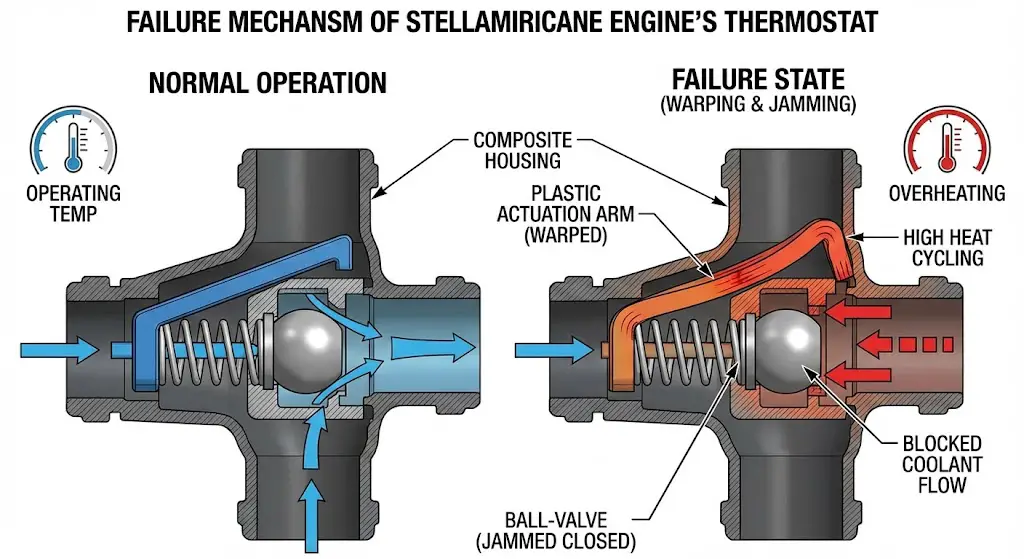
The most widespread and confirmed failure mode on the Hurricane engine involves the engine thermostat. This is not a "wear and tear" item failing at 100,000 miles; rather, these failures are occurring on brand-new trucks with as few as 800 to 3,000 miles on the odometer.
The Physics of Failure
The root cause lies in material selection. The OEM thermostat housing and the internal actuation arm are constructed from a thermoplastic composite. The Hurricane engine employs a complex split-cooling circuit with high-flow requirements to manage the thermal load of the turbos.
- Thermal Cycling: The thermostat is subjected to rapid temperature swings from ambient to over 220°F.
- Mechanical Stress: The hydraulic pressure of the coolant, combined with the thermal expansion and contraction, causes the plastic actuation arm to warp or fatigue.
- The Bind: Once warped, the ball-valve mechanism binds. It can stick open (preventing the engine from reaching operating temp) or stick closed (causing rapid overheating).
Symptoms and Impact
Owners typically experience a Check Engine Light with code P0128 (Coolant Thermostat (Coolant Temperature Below Thermostat Regulating Temperature)). If stuck closed, the vehicle will display "Engine Hot" warnings and go into limp mode.
- Safety Risk: Sudden overheating while towing or on the highway can lead to a loss of power.
- Supply Chain Crisis: The prevalence of this failure led to a massive backorder of replacement parts in late 2024 and early 2025, leaving many trucks sitting at dealerships for weeks.
The Aftermarket Solution
The failure of the OEM plastic component has spawned an aftermarket solution. Companies like Vargas Turbo Technologies (VTT) have developed thermostat upgrade kits utilizing CNC-machined billet aluminum components. Aluminum shares a thermal expansion coefficient closer to the housing and does not warp like plastic, effectively permanently solving the issue. That the aftermarket had to engineer a metal replacement for a plastic OEM part on a heavy-duty truck engine speaks to the cost-cutting pressures during the engine's development.
Random Misfires and the Carbon Problem
Another frequent complaint involves rough idling and random misfire codes (P0300 series), particularly during cold starts.
Direct Injection Carbon Buildup
The Hurricane relies exclusively on high-pressure Direct Injection (DI), operating at up to 5,075 psi. In a Port Injection engine, fuel is sprayed into the intake runners, washing over the intake valves and keeping them clean. In a DI engine, fuel is sprayed directly into the combustion chamber.
- The Mechanism: Oil vapors from the Positive Crankcase Ventilation (PCV) system recirculate into the intake. Without fuel to wash it away, this oil bakes onto the hot intake valves, forming hard carbon deposits.
- The Consequence: Over time (30,000 - 60,000 miles), these deposits disrupt the airflow into the cylinder. This turbulence causes uneven combustion, manifesting as rough idle, hesitation, and misfires.
- The Ford Lesson: Ford learned this lesson with the first-generation 3.5L EcoBoost. By Gen 2, Ford added port injectors alongside direct injectors to clean the valves. The Hurricane lacks this dual-injection strategy, leaving it vulnerable to carbon fouling.
Air Intake Sealing Issues
A specific and peculiar issue identified by technicians involves the air filter housing. Reports indicate that aftermarket air filters, or even improperly seated factory filters, can cause air turbulence that the sensitive Mass Airflow (MAF) sensors interpret as unmetered air. This can trigger a cascade of electrical gremlins, causing the engine management system to panic and shut down cylinders or stall the vehicle. This sensitivity suggests that the engine's control software has very tight tolerances for intake metrics.
The "ZF Shuffle": Transmission Integration
While the ZF 8-speed automatic transmission is widely regarded as the industry standard for reliability, its integration with the Hurricane engine has been less than seamless. Owners report a phenomenon often dubbed the "ZF Shuffle"—a distinct jerk, bump, or hesitation during low-speed maneuvers, start/stop engagement, or tip-in downshifts.
This is largely a software calibration issue rather than a mechanical transmission failure. An Inline-6 turbo engine builds torque differently than a naturally aspirated V8.
- Torque Latency: A V8 provides instant torque. A turbo engine has a momentary delay (lag) while boost builds.
- The "Handshake": The Transmission Control Module (TCM) anticipates torque arrival based on the Engine Control Unit (ECU) data. If the boost arrives 200 milliseconds later than the TCM expects, the shift feels clumsy. If the TCM waits for the boost, the truck feels sluggish.
- Corrective Action: Stellantis has issued TSB 18-19-05-SJ to reflash the TCM software, aiming to smooth out these predictions.
Oil Leaks and Assembly Quality
In a discouraging sign for a brand-new platform, there are consistent reports of oil leaks occurring within the first 5,000 miles of ownership. The primary culprits appear to be the front timing cover and the oil pan gasket.
- Labor Intensity: Repairing these leaks is not trivial. The timing cover removal requires stripping the front of the engine accessories. On 4WD models, accessing the oil pan often requires dropping the front differential or lifting the engine.
- Saltillo Quality Control: These issues point to assembly line quality control variances at the Saltillo Engine Plant in Mexico. While robotic sealant application is standard, any contamination on the mating surfaces of the aluminum block can lead to micro-leaks that expand under thermal cycling.
Performance Reality: The "Eco" vs. "Boost" Trade-off
Stellantis marketed the Hurricane as the "no compromise" solution—more power and better fuel economy. Real-world testing, however, suggests the compromise has simply shifted.
Towing and Heat Soak
Towing is the ultimate stress test for a truck engine, and it exposes the thermal limitations of the Hurricane architecture.



- The Physics of Heat: Compressing air generates heat. While the water-to-air intercooler is designed to manage this, sustained loads (like towing a 7,000 lb trailer up a mountain grade) saturate the cooling capacity.
- Ike Gauntlet Results: In independent testing such as the TFL Truck "Toaster" test, the Hurricane performs admirably in short bursts. However, under sustained high-load/high-heat conditions, the ECU protects the engine by pulling timing and reducing boost to lower internal temperatures. This is known as "heat soak".
- Comparison: A naturally aspirated V8 does not suffer from this compounding heat issue to the same degree. It loses power at altitude due to thin air, but its thermal management profile is linear. The Hurricane's performance is highly dependent on its ability to shed heat.
Real-World MPG
The "Eco" in modern turbo engines relies on the driver staying out of the boost.
- EPA Ratings: The Hurricane SO is rated around 18 MPG city / 25 MPG highway.
- The Boost Penalty: In a heavy truck, the turbos spool up even under moderate acceleration. Once under boost, the engine runs rich (more fuel) to cool the combustion chambers and prevent detonation.
- The Result: Real-world towing MPG often drops into the single digits, sometimes performing worse than the 5.7L HEMI it replaced. Furthermore, because the HO requires premium fuel (and the SO recommends it), the cost per mile is often higher for the Hurricane owner, even if the MPG number is slightly better on paper.
Visualizing the Fuel Cost Differential
| Engine | EPA Combined MPG | Fuel Type | Avg. Fuel Price* | Cost per 15k Miles |
| 5.7L HEMI V8 | 18 | 87 Octane (Regular) | $3.10 | $2,583 |
| 3.0L Hurricane SO | 21 | 91 Octane (Rec.) | $3.80 | $2,714 |
| 3.0L Hurricane HO | 17 | 91 Octane (Req.) | $3.80 | $3,352 |
Maintenance: The High Cost of Ownership
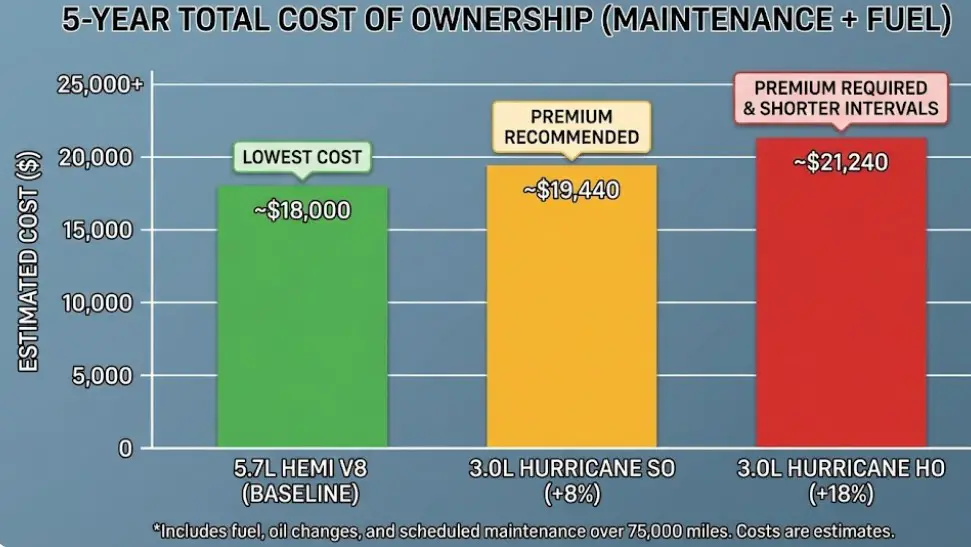
The Hurricane engine requires a stricter, more expensive maintenance regimen than its predecessor. It is not a "change the oil when you remember" engine.
The Oil Specification Criticality
- 0W-40 Synthetic Only: The engine specifies 0W-40 synthetic oil (factory fill is usually Pennzoil Ultra Platinum). This is a heavy, high-performance oil designed to withstand the extreme heat of the turbo bearings.
- Short Intervals: While the Oil Life Monitor might allow for 10,000-mile intervals, oil analysis experts strongly recommend 5,000-mile intervals. The turbochargers share the engine oil; dirty oil will coke the bearings and lead to turbo failure.
- No Dipstick: In a controversial move, Stellantis removed the physical oil dipstick, replacing it with a digital sensor. This "black box" approach prevents owners from visually inspecting the quality (color, smell) of their oil or verifying the level manually. If the sensor fails or drifts, an owner could unknowingly run the engine dry.
Spark Plugs and Ignition
High cylinder pressures blow out spark. The ignition coils and spark plugs on the Hurricane work much harder than on a V8. Owners should anticipate shorter service intervals for spark plugs to prevent misfires, which can damage the catalytic converters quickly in a turbo engine.
Strategic Context: The 2026 HEMI Revival
In early 2026, Stellantis made a shocking announcement: the 5.7L HEMI V8 would return to the Ram 1500 lineup. This decision is a tacit admission that the "Hurricane-only" strategy was flawed for the truck market.
The Fleet Factor
Fleet buyers (construction, utilities, government) prioritize reliability and low operating costs over peak horsepower. The complexity of the Hurricane—with its turbos, intercoolers, and premium fuel requirements—made it a hard sell for fleet managers accustomed to the bulletproof nature of the HEMI.
The "Symbol of Protest"
The 2026 HEMI models will reportedly feature a "Symbol of Protest" badge , a marketing spin that frames the return as listening to customer demand. In reality, it is a course correction to stabilize sales. The depreciation of Hurricane-equipped trucks in the secondary market was accelerating, and Ram needed to stop the bleeding of customers defecting to the V8 options from GM and Ford.
2026 Owner Reports: What's Actually Happening in the Field
Early 2026 model-year Hurricane trucks have generated fresh owner reports that echo the thermostat and misfire patterns documented above. One widely-circulated case involved a 2026 Ram Big Horn owner whose truck overheated at roughly 800 miles due to thermostat failure — consistent with the P0128 pattern this guide covers, and a reminder that the fix applies across model years, not just early production. Owners have also reported being placed on backorder waiting lists for replacement thermostats, suggesting the parts-supply pipeline hasn't fully caught up with demand. For the full specs, SO vs. HO comparison, and engineering background behind these failure points, see our 3.0L Hurricane SO engine specs guide.
Conclusion and Buyer's Guide
The Stellantis 3.0L Hurricane engine is a technological achievement, delivering massive power from a small displacement. However, it suffers from the classic "first-generation" syndrome. The plastic thermostat failure is a clear oversight in durability testing, and the PTWA cylinder coating presents a long-term financial risk for ownership past the warranty period.
Verdict for Prospective Buyers
- The Enthusiast: If you want the fastest gas-powered truck on the market (short of the TRX), the Hurricane HO is unmatched. It turns the Ram 1500 into a sports truck. Lease it. Do not buy it for a 10-year hold.
- The Working Owner: If you tow regularly or keep your trucks for 200,000 miles, the 2026 5.7L HEMI is the superior choice. It offers proven reliability, lower maintenance costs, and runs on regular gas.
- The Wait-and-See: If you are set on the Hurricane for its technology, wait for the 2026/2027 model years. By then, the "Thermostat Crisis" will be resolved with revised part numbers, and the transmission software will be matured.