2014 Dodge Ram 1500 HEMI: Specs, Towing & Reliability Guide 2026

The 2014 Ram 1500 represents a pivotal evolution in the light-duty pickup truck segment. Operating on the fourth-generation DS platform, the 2014 model year cemented Ram’s reputation for superior ride quality, largely achieved through its segment-exclusive rear coil-spring suspension and the available Active-Level four-corner air suspension. However, the most heavily scrutinized and commercially successful powertrain configuration for this model year remains the 5.7-liter HEMI V8 engine, especially when paired with the then-new TorqueFlite eight-speed automatic transmission.
This report synthesizes exhaustive market research, technical specifications, and owner-reported data to provide a definitive guide to the 2014 Dodge Ram 1500 5.7 HEMI, specifically tailored for automotive researchers and prospective buyers on truckguider.com.


2014 Dodge Ram 1500 HEMI
The Ultimate Data & Performance Breakdown
The 2014 Ram 1500 equipped with the legendary 5.7-liter HEMI V8 engine represents a pivotal moment in half-ton truck history. Combining traditional pushrod V8 power with a modern coil-spring rear suspension and the acclaimed TorqueFlite 8-speed automatic transmission, it offered an unprecedented mix of capability and ride quality. This infographic breaks down the essential data every buyer, owner, and enthusiast needs to know.
⚙️ Core Powertrain Metrics
The 5.7L V8 utilizes a Multi-Displacement System (MDS) to balance raw hauling power with highway cruising efficiency. Below are the peak output statistics that define the 2014 HEMI’s performance.
🛻 Max Towing by Configuration
Towing capacity in the 2014 Ram 1500 is heavily dependent on cab size, box length, and axle ratio. The data below represents maximum capacities when equipped with the 5.7L HEMI and the optimal 3.92 rear axle ratio.
⛽ Fuel Economy (MPG)
EPA estimated fuel economy for the 2WD model with the 8-speed automatic transmission. The MDS system deactivates four cylinders during steady-state cruising to improve highway figures.
⚠️ Common Maintenance Issues
While generally reliable, historical data from owners and mechanics point to three primary failure points on the high-mileage 2014 HEMI engines.
🔩 Exhaust Manifold Bolts
The most frequent issue. Thermal expansion causes the rear exhaust manifold bolts to snap, resulting in a distinct ticking sound on cold starts.
🛢️ MDS Lifter Failure
Lack of proper lubrication (often due to extended oil change intervals or excessive idling) can cause the roller lifters in the MDS system to fail, wiping out the camshaft.
⚡ TIPM Malfunctions
The Totally Integrated Power Module acts as the fuse box brain. Internal fuel pump relay failures are common, causing hard-start or no-start conditions.


📉 10-Year Value Depreciation
This chart tracks the estimated average resale value of a well-equipped 2014 Ram 1500 HEMI Crew Cab (4×4, Laramie trim) over a ten-year lifespan, assuming average mileage accumulation of 12,000 miles per year.
Powertrain Dynamics: The 5.7L HEMI V8 and Transmission Evolution
The 2014 Ram 1500’s 5.7-liter HEMI V8 is a naturally aspirated, 16-valve engine utilizing a robust cast-iron block mated to aluminum cylinder heads. It incorporates Variable Valve Timing (VVT) and a Multi-Displacement System (MDS), a cylinder-deactivation technology that disables four cylinders under light-load highway cruising to maximize fuel efficiency. When operating at full capacity, the 5.7L HEMI produces 395 horsepower at 5,600 rpm and 407 lb-ft of torque at 3,950 rpm. This output places the Ram highly competitively against its domestic rivals of the same era, slightly outperforming the base V8 offerings from both Ford and Chevrolet in raw horsepower.
A critical performance variable in the 2014 model year is the transmission. Ram offered the 5.7L HEMI with two distinct automatic transmissions: the legacy six-speed (65RFE) and the modern eight-speed (ZF 8HP70). The difference between these two gearboxes fundamentally alters the vehicle’s performance, towing capability, and long-term reliability. The six-speed 65RFE transmission relies on older architecture, which owners and mechanics widely document as feeling sluggish, limiting the HEMI’s power delivery, and suffering from premature reverse-gear failures.
Conversely, the ZF-sourced eight-speed automatic is overwhelmingly favored in the automotive community. The eight-speed transmission features tighter gear spacing, which keeps the HEMI in its optimal power band during heavy towing and aggressive acceleration. Furthermore, the 8HP70 is structurally rated for a higher torque limit (up to 560 lb-ft) than the HEMI can organically produce, ensuring a wide margin of durability and preventing internal shear stress.
Towing Capacity, Payload, and Axle Ratios
Towing capacity in the 2014 Ram 1500 is not a static figure; it is highly dependent on cab configuration, transmission choice, and most importantly, the rear axle ratio. Ram offered three distinct axle ratios for the 2014 1500: 3.21, 3.55, and 3.92.
A lower numerical axle ratio, such as the 3.21, provides lower engine revolutions per minute (rpm) at highway speeds, resulting in better fuel economy but vastly reduced towing leverage. Conversely, the 3.92 axle ratio provides maximum torque multiplication to the rear wheels, making it the strict requirement for heavy hauling. When properly equipped with the Max Tow Package and the 3.92 rear end, the 2014 Ram 1500 HEMI can tow upwards of 10,450 pounds. Buyers strictly looking to tow heavy travel trailers or equipment must actively avoid the 3.21 axle ratio, as it limits the truck to approximately 8,380 pounds and strains the transmission on steep inclines.
| Engine & Transmission | Rear Axle Ratio | Gross Vehicle Weight Rating (lbs) | Max Payload Capacity (lbs) | Max Towing Capacity (lbs) |
| 5.7L HEMI / 8-Speed | 3.21 | 6,350 | 1,390 | 8,350 – 8,380 |
| 5.7L HEMI / 6-Speed | 3.55 | 6,350 | 1,400 | 9,030 |
| 5.7L HEMI / 8-Speed | 3.92 | 6,350 | 1,390 | 10,200 – 10,450 |
Real-World Fuel Economy and Competitor Benchmarking
The integration of the eight-speed transmission and active aerodynamic grille shutters allows the 2014 Ram 1500 HEMI to achieve surprisingly competitive fuel economy for a heavy, naturally aspirated V8 truck. Official Environmental Protection Agency (EPA) estimates for the 5.7L HEMI with the eight-speed transmission dictate 15 MPG in the city and 22 MPG on the highway for rear-wheel-drive models, resulting in a combined rating of 17 MPG. Four-wheel-drive variants see a slight reduction, dropping to 21 MPG on the highway.
Real-world efficiency is heavily influenced by the chosen axle ratio. Trucks equipped with the 3.21 ratio will frequently hit or exceed the 22 MPG highway estimate. However, models equipped with the towing-focused 3.92 ratio will experience a notable drop, often averaging one to two MPG lower on the highway due to higher cruising rpm. When evaluating the 2014 domestic half-ton market, the Ram 1500 holds a unique position. The comparison matrix below illustrates how the Ram 1500’s primary V8 engine stacks up against its direct Detroit competitors.


| 2014 Half-Ton Truck Model | Primary V8 Engine | Horsepower | Torque (lb-ft) | Max Towing (lbs) | EPA Combined MPG |
| Ram 1500 | 5.7L HEMI V8 | 395 @ 5600 rpm | 407 @ 3950 rpm | 10,450 | 17 |
| Ford F-150 | 5.0L Coyote V8 | 360 @ 5500 rpm | 380 @ 4250 rpm | 10,000 | 17 |
| Chevy Silverado 1500 | 5.3L EcoTec3 V8 | 355 @ 5600 rpm | 383 @ 4100 rpm | 11,500 | 18 |
Known Reliability Issues and Maintenance Costs
While the 5.7L HEMI is generally lauded for its long-term block reliability, the 2014 model year is plagued by distinct top-end engine issues, alongside known air suspension vulnerabilities. Understanding the root causes of these failures is critical for market assessment and ownership longevity.
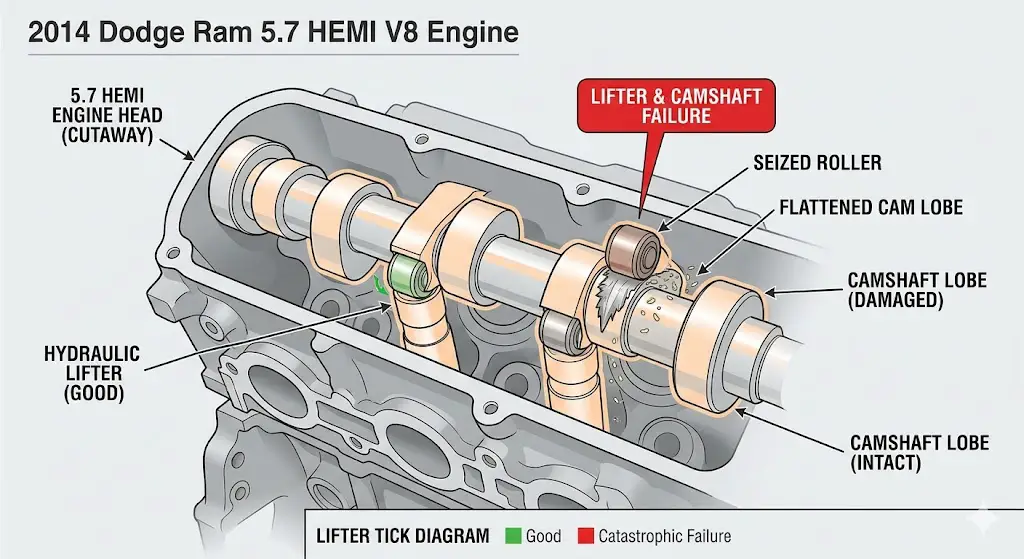
The term “HEMI tick” is a ubiquitous phrase in Ram owner communities, but it actually describes two entirely different mechanical failures with drastically different repair costs. The most prevalent cause of the ticking noise is a cracked exhaust manifold or sheared exhaust manifold bolts. The root cause of this failure is a thermal design flaw. The aluminum cylinder heads and the cast-iron exhaust manifolds expand and contract at different rates during standard engine heat cycling. Over tens of thousands of miles, this thermal stress shears the weak factory manifold bolts. The primary symptom is a pronounced ticking sound on cold starts that fades or disappears completely as the engine warms up and the metal expands to seal the gap. Resolving this involves replacing the factory hardware with aftermarket performance headers or redesigned manifolds featuring high-strength ARP bolts, a repair that typically costs under $500 for a do-it-yourself mechanic or up to $1,200 at a professional shop.
A less common but fatal cause of the tick is hydraulic lifter roller failure. The needle bearings inside the lifter roller seize due to poor lubrication, causing the roller to drag across the camshaft lobe. This eventually flattens the lobe and sends fine metal shavings into the oil supply. Symptoms of this failure manifest as a continuous, rhythmic ticking that increases with engine RPM and does not dissipate when the engine reaches operating temperature. This is usually accompanied by engine misfires, hesitation, and a permanent check engine light indicating a dead cylinder. Fixing lifter failure requires a complete top-end engine teardown to replace the camshaft and all hydraulic lifters, with repair bills frequently ranging from $3,500 to over $5,000.
Beyond the engine, the optional Active-Level air suspension system becomes a significant liability as these trucks age past 100,000 miles. The closed-loop nitrogen system suffers from cracked air springs, valve block leaks, and burnt-out compressors. In cold weather, moisture trapped inside the system can freeze, blowing electrical fuses or destroying the compressor entirely. Dealership replacement of air springs and compressors can easily exceed $3,000. As a permanent and cost-effective solution, many owners opt to remove the pneumatic system entirely and install a standard coil spring conversion kit.
Furthermore, the 2014 Ram 1500 has been subject to multiple federal safety recalls. Notable campaigns include High-Pressure Fuel Pump failures causing power loss (Recall Z46), tailgate latches opening while driving (Recall V44), and a software flaw preventing cruise control from canceling (Recall U49). Prospective buyers should always verify a vehicle’s Vehicle Identification Number against the(https://www.nhtsa.gov/recalls) to ensure compliance prior to operation.
Strict Maintenance Schedule for Longevity
Adhering to strict preventative maintenance is the only verified method to prevent the catastrophic lifter failures associated with the 5.7L HEMI. The engine’s cylinder deactivation system operates using precise oil pressure logic; therefore, using the correct oil viscosity is mandatory. The 5.7L HEMI requires exactly seven quarts of SAE 5W-20 motor oil. While conventional oil is permitted by the owner’s manual, upgrading to a high-quality full synthetic blend is heavily advised by mechanics to protect the fragile hydraulic lifter bearings from premature wear.
The factory-recommended maintenance schedule requires oil and filter changes alongside tire rotations every 8,000 miles. At 30,000 miles, owners must replace the engine and cabin air filters and inspect the constant-velocity joints. Heavy towers should replace the transmission fluid and filter at the 60,000-mile mark. Reaching 100,000 miles initiates a major service interval, requiring the replacement of all sixteen spark plugs. The 5.7L HEMI features a twin-spark cylinder head design, requiring two spark plugs per cylinder. Utilizing high-quality Iridium plugs is vital for maximizing combustion efficiency and avoiding subsequent misfires. Finally, at 120,000 miles, the transfer case fluid must be replaced, and the engine coolant system flushed.
Used Market Valuation and Trim Hierarchy
The 2014 Ram 1500 was available in an extensive array of trim levels, catering to diverse consumer profiles. The Tradesman and Express trims represent the entry-level tier, characterized by standard steel wheels, heavy-duty vinyl seating, and basic infotainment displays. The Tradesman remains highly sought after on the used market as it is the most affordable gateway to the 5.7L V8. The SLT, Big Horn, and Lone Star trims act as the volume sellers, adding chrome exterior accents, upgraded cloth seating, twenty-inch alloy wheels, dual-zone climate control, and the highly desirable 8.4-inch Uconnect touchscreen interface. The Laramie, Longhorn, and Limited trims occupy the luxury tier, featuring premium leather heated and ventilated seats, real wood interior accents, and advanced audio systems.
Core Data:


| Trim Level & Cab Configuration | Market Source | Estimated Value Range (USD) |
| Tradesman / Express (Regular Cab) | Dealer Retail Average | $9,200 – $12,300 |
| SLT / Big Horn (Quad Cab) | Private Party (Clean Condition) | $6,494 – $6,902 |
| SLT / Big Horn (Crew Cab) | Dealer Retail Average | $11,500 – $14,950 |
| Laramie / Limited (Crew Cab) | Dealer Retail Average | $14,000 – $18,440 |
Hidden Features and Owner Secrets
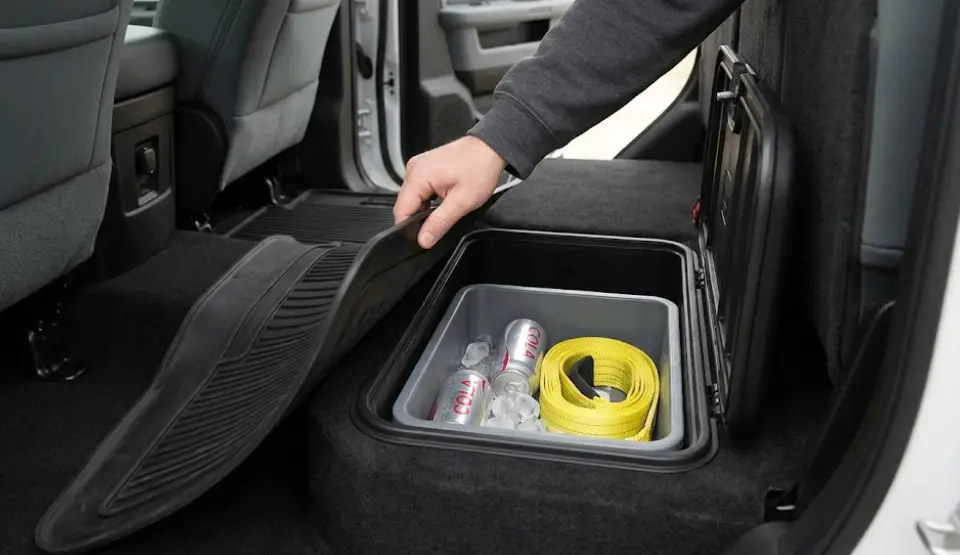
The DS-generation Ram trucks harbor several undocumented features that substantially enhance daily utility, which are frequently discovered by owners well into their tenure with the vehicle. The Tire Fill Alert System is a prime example; when inflating tires with the ignition in the active “Run” position, the truck’s computer monitors tire pressure via the internal sensors. The truck will sound a quick horn honk when the tire reaches the precise recommended PSI, eliminating the need for a manual pressure gauge. Additionally, Crew Cab models feature hidden in-floor storage compartments located beneath the rear floor mats. These bins include removable, washable plastic liners that can act as insulated coolers for ice and beverages, or as concealed security storage for tow straps and hand tools. Finally, on certain high-level trims, pressing the unlock button on the key fob once, and then holding it down on the second press, will remotely roll down the front windows to vent stagnant heat from the cabin before entry.
FAQs
Does the 2014 Ram 1500 5.7 HEMI require premium gas?
The 5.7L HEMI V8 is engineered to run efficiently on 89-octane mid-grade gasoline. However, 87-octane regular unleaded is explicitly acceptable per the manufacturer and will not cause immediate engine damage. Running 87-octane may result in a slight, largely imperceptible loss in peak horsepower and fuel economy under heavy towing conditions, as the engine’s computer retards ignition timing to prevent detonation.
How do I know if my 2014 Ram 1500 has the 6-speed or 8-speed transmission?
The most immediate visual indicator of transmission type is the gear selector design. The older six-speed automatic (65RFE) utilizes a traditional mechanical column shifter or a console-mounted T-handle shifter. The superior eight-speed automatic (ZF 8HP70) utilizes an electronic rotary dial shifter located prominently on the dashboard directly below the climate controls.
Is it safe to drive a Ram 1500 with a ticking exhaust manifold?
While aurally unpleasant, a standard exhaust manifold leak caused by sheared bolts will not immediately destroy the engine. However, if left unchecked for prolonged periods, the escaping high-temperature exhaust gasses can melt nearby electrical wiring harnesses, degrade overall fuel economy, and potentially burn the engine’s exhaust valves. It is highly recommended to repair the issue with aftermarket headers or upgraded manifolds before subjecting the truck to heavy payloads.
What is the true maximum payload capacity of the 2014 Ram 1500?
The absolute maximum payload capacity peaks at 1,703 pounds, achievable specifically on 2WD Quad Cab models equipped with the V6 engine. For the 5.7L HEMI, peak payload sits around 1,570 pounds on lighter trims. Crew Cab models, especially those equipped with 4WD or heavy luxury options like the air suspension and panoramic sunroofs, will see their payload capacities severely reduced to the 1,300-pound range, requiring careful calculation before loading the bed.